

The project inspection process is a systematic sequence of formal evaluations designed to verify that construction work meets approved plans, safety codes, and regulatory standards at each defined phase. Construction professionals and project managers rely on this process to catch deficiencies before they become costly structural failures or compliance violations. A well-executed guide to project inspection process covers everything from pre-inspection prerequisites to final corrective action verification. Agencies such as Singapore’s Building and Construction Authority (BCA), the Urban Redevelopment Authority (URA), and the Land Transport Authority (LTA) mandate specific inspection milestones that must be passed before work proceeds. Missing a single required checkpoint can halt an entire project.
What are the essential prerequisites before starting a project inspection?
Effective inspections do not begin on-site. They begin in the office, with a structured review of all documentation and site conditions before the inspector arrives.
Approved plans, building permits, and supervisor presence are non-negotiable prerequisites for any construction inspection. Without these in place, the inspection cannot proceed and the visit is wasted. The following conditions must be confirmed before scheduling any on-site evaluation:
- Approved plans on-site: The stamped and approved architectural, structural, and M&E drawings must be physically present and accessible at the work location.
- Building permit visibly posted: The permit must be displayed in a location visible from the street or site entrance, as required by most regulatory authorities.
- Work area safety and cleanliness: The inspection zone must be free of debris, temporary formwork obstructions, and hazards that would prevent a thorough walk-through.
- Phase work fully complete: The specific scope of work being inspected must be 100% complete. Partial completion is the leading cause of failed inspections.
- Responsible trade supervisor present: The site manager or lead trade supervisor must be available during the inspection to answer technical questions and receive verbal findings.
- Prior correction status reviewed: Any deficiencies noted in the previous inspection report must be resolved and documented before the next inspection is scheduled.
Pro Tip: Review the previous inspection report the day before the visit. Confirm each corrective action has been physically completed and photographed. Arriving without this verification is the fastest way to generate a repeat failure.
Reviewing the structural engineer inspection process before site visits also helps project managers align their preparation with the specific technical scope each phase demands.

Which steps make up the typical project inspection process on-site?
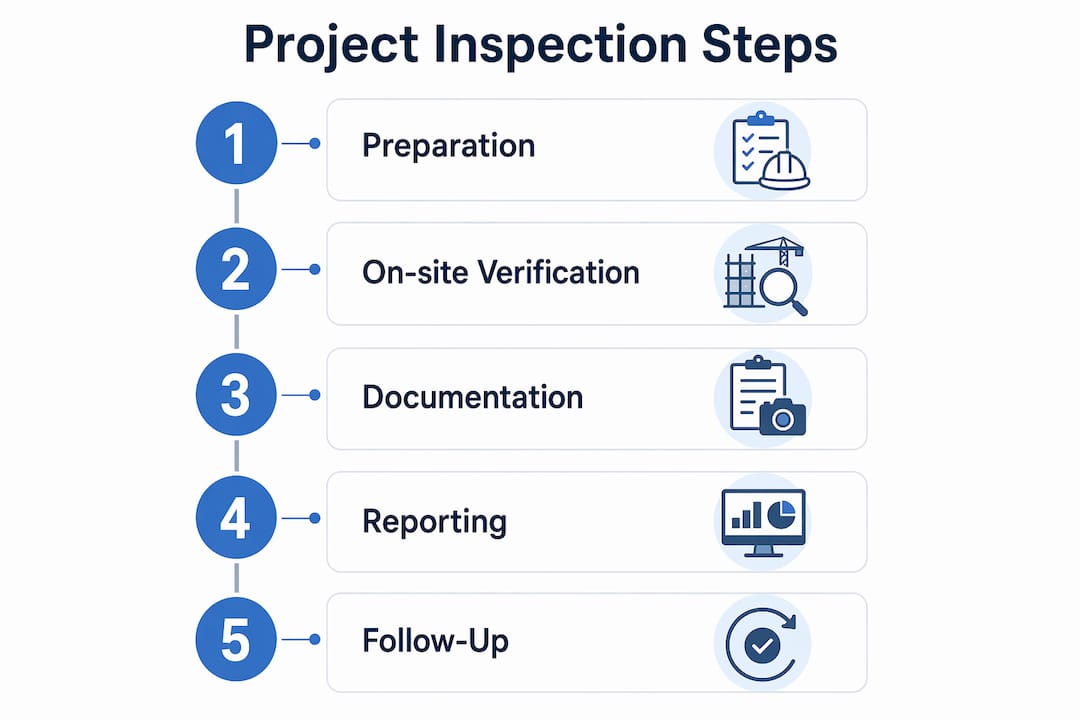
A construction site inspection follows a defined sequence: planning, site readiness check, systematic review, documentation, and follow-up. Each step builds on the previous one, and skipping any step creates gaps that compound into larger deficiencies later.
The following numbered sequence reflects standard project inspection procedures used across commercial and residential construction projects:
- Confirm site readiness. Verify that all prerequisites from the checklist above are satisfied. Check that the approved plans match the current scope of work and that no unauthorized changes have been made.
- Conduct a general site conditions review. Assess housekeeping, temporary works stability, access routes, and personal protective equipment compliance before moving to trade-specific work.
- Execute a phase-specific systematic inspection. Work through the inspection using a checklist tailored to the current phase, whether foundation, structural framing, mechanical, electrical, plumbing (MEP) rough-ins, insulation, or finishes.
- Prioritize transition points. Inspections at trade transition points such as MEP rough-ins before drywall installation are the highest-value checkpoints. Once one trade’s work is concealed by the next, deficiencies become exponentially more expensive to correct.
- Document all observations. Record findings with photographs, measurements, and direct references to the applicable plan sheet or specification clause. Vague notes produce unresolvable disputes.
- Communicate issues immediately. Notify the site manager and responsible contractor of deficiencies on-site, not days later via email. Immediate notification of issues reduces the window for additional non-compliant work to proceed.
- Issue a formal inspection report. The report must include the date, participants, observations, applicable code references, required corrective actions, and a defined resolution deadline.
- Schedule and conduct follow-up inspections. Verify that every corrective action has been completed before the next phase begins. Unverified corrections are the most common source of recurring deficiencies.
Pro Tip: Use a phase-specific checklist template rather than a generic one. A foundation inspection checklist and a framing inspection checklist share almost no items. Generic checklists produce generic results.
The table below summarizes the documentation required at each major inspection stage:
| Inspection Stage | Required Documentation |
|---|---|
| Pre-inspection | Approved plans, permits, prior inspection report |
| Site readiness check | Safety compliance log, access confirmation |
| Phase-specific inspection | Phase checklist, photographs, measurements |
| Deficiency notification | Written or digital site notice to contractor |
| Formal report issuance | Dated report with corrective actions and deadlines |
| Follow-up verification | Corrective action log, updated photographs |
How do project managers schedule inspections across project phases?
Inspection frequency is not uniform across a project’s lifecycle. It is determined by project size, construction complexity, and the risk profile of each phase.
Inspection frequency ranges from weekly to monthly depending on project profile, with higher-risk phases requiring more frequent visits. A high-rise structural frame demands weekly inspections during active concrete pours, while a fit-out phase may require only milestone-based checks. Accessory Dwelling Unit projects, as a reference point, typically require 10–15 inspections across the full construction lifecycle, with each phase required to pass before the next begins. That figure illustrates how granular inspection scheduling must be even on smaller projects.
Effective scheduling practices include:
- Milestone-based triggers: Schedule inspections at defined completion milestones rather than fixed calendar intervals. This aligns inspection activity with actual construction progress.
- Critical transition point priority: Identify in advance every point where one trade’s work will be concealed by another. These are mandatory inspection windows that cannot be deferred.
- Advance notification protocols: Provide contractors with a minimum of 24–48 hours notice before an inspection. This allows the site to be prepared and the responsible supervisor to be present.
- Integration with the project management plan: Embed the inspection schedule within the master program. Inspections treated as separate administrative tasks are consistently deprioritized and delayed.
- Spot checks between scheduled inspections: Unannounced visits during active construction phases catch workmanship issues before they are built over.
Integrating the inspection schedule with the broader engineering compliance workflow is the most reliable method for ensuring no mandatory checkpoint is missed across a multi-phase project.
What are the common challenges and best practices to avoid inspection failures?
Most inspection failures are preventable. 80% of inspection failures result from missing plans on-site, incomplete work, or unresolved prior correction notes. That figure means the majority of failed inspections are administrative failures, not technical ones.
The most frequent pitfalls and their corresponding countermeasures are:
- Missing or incorrect plans on-site: Assign a dedicated document controller responsible for maintaining the current approved plan set at the work face at all times.
- Incomplete work at time of inspection: Implement a mandatory internal pre-inspection walk-through by the site supervisor 24 hours before the scheduled inspection. This single practice eliminates the majority of avoidable failures.
- Unresolved prior corrections: Maintain a live corrective action register. Every deficiency must have an assigned owner, a resolution deadline, and a verification status.
- Poor communication between parties: Clear communication among inspectors, contractors, and project managers is the critical factor in timely deficiency resolution. Verbal findings must be followed by written records within 24 hours.
- Confusing inspections with punch lists: Inspections are proactive, ongoing quality checks conducted throughout construction. Punch lists are reactive, final-stage deficiency lists compiled before handover. Treating inspections as punch lists means deficiencies are identified too late to correct without significant rework.
“Successful inspections start with thorough planning by reviewing drawings and identifying potential problem zones ahead of the visit.” — CMiC Construction Platform
Leveraging construction project communication protocols that formalize how findings are reported and tracked reduces the risk of deficiencies being lost between site visits.
What tools and documentation are vital for a successful inspection?
The quality of an inspection is directly proportional to the quality of the tools and documentation supporting it. Inspectors working from memory or generic forms produce inconsistent results that are difficult to audit or defend.
The table below compares traditional paper-based inspection methods against digital inspection management approaches:
| Attribute | Paper-Based Methods | Digital Inspection Management |
|---|---|---|
| Plan access | Physical copies, risk of outdated versions | Cloud-synced, always current |
| Checklist customization | Manual revision, time-consuming | Template libraries, phase-specific |
| Photo documentation | Separate camera, manual filing | Integrated capture, auto-tagged |
| Report generation | Manual write-up, delayed distribution | Auto-generated, immediate distribution |
| Corrective action tracking | Spreadsheet or paper log | Live register with owner and deadline |
| Audit trail | Physical archive, difficult to search | Searchable digital record |
Approved plans, permits, and specifications remain the foundational reference documents for every inspection. No checklist or software replaces the need to verify work against the actual approved drawings. Phase-specific checklists covering foundation, structural, MEP rough-ins, insulation, and finishes provide the structured framework that prevents observations from being missed. Photographic records with embedded timestamps and location data are the most defensible form of documentation in any dispute or regulatory review.
Using inspections as strategic checkpoints reduces costs and prevents major rework during later stages. Digital tools such as mobile inspection apps and Building Information Modeling (BIM) platforms extend this capability by enabling real-time data capture, automated deficiency tracking, and integrated reporting across project teams. For Singapore-based projects, BIM modeling services provide an additional layer of coordination that directly supports inspection accuracy by maintaining a live model against which field conditions can be verified.
Key Takeaways
A structured project inspection process is the most reliable mechanism for maintaining compliance, controlling quality, and preventing costly rework across all construction phases.
| Point | Details |
|---|---|
| Prerequisites are non-negotiable | Approved plans, visible permits, and complete phase work must be confirmed before any inspection begins. |
| Transition points are highest priority | Inspect MEP rough-ins and similar concealed work before the next trade covers it to avoid expensive rework. |
| 80% of failures are preventable | Missing plans, incomplete work, and unresolved corrections cause the vast majority of failed inspections. |
| Documentation drives accountability | Phase-specific checklists, timestamped photos, and formal reports with deadlines create enforceable audit trails. |
| Frequency must match project risk | High-risk phases require weekly inspections; milestone-based scheduling keeps the process aligned with actual progress. |
Why inspections deserve more strategic attention than most teams give them
Most project teams treat inspections as a regulatory obligation to be scheduled and cleared. That framing is the source of most inspection-related delays I see on complex projects. An inspection is a structured opportunity to verify that the project is still tracking to the approved design, the contract specifications, and the regulatory requirements simultaneously. When teams approach it that way, the preparation changes, the documentation improves, and the follow-up becomes faster.
The distinction between an inspection and a punch list is one of the most consistently misunderstood concepts in construction management. I have reviewed projects where site teams deferred deficiency identification to the final punch list stage because they assumed inspections were only about regulatory sign-off. The result was a punch list with hundreds of items, a delayed handover, and a contractor dispute over responsibility. Inspections conducted at the right phase transitions, with the right documentation, make the punch list almost redundant.
Technology adoption in inspection management is accelerating, but the fundamentals have not changed. A digital checklist completed carelessly produces the same result as a paper checklist completed carelessly. The value of any inspection tool is realized only when the team using it has a clear understanding of what they are looking for and why each checkpoint matters. Invest in training the team on the purpose of each inspection phase before deploying any platform.
The importance of regulatory compliance in Singapore’s construction sector means that inspection failures carry consequences beyond project delays. They affect statutory submissions, agency approvals, and ultimately the project’s legal standing. Treat every inspection as a compliance event, not an administrative task.
— Aman
How Com supports construction professionals with inspection and compliance services
Com, operating as Aman Engineering Consultancy, provides construction professionals and project managers in Singapore with end-to-end inspection, compliance, and engineering consultancy services across structural, facade, M&E, fire safety, and digital engineering disciplines.

From statutory submissions to BCA, URA, SCDF, and LTA, through to on-site inspection support and regulatory documentation procedures, Com delivers the technical expertise and regulatory knowledge that complex projects require. Whether you need a structured inspection framework, a compliance checklist tailored to your project phase, or integrated BIM support for real-time field verification, Com’s team is equipped to support your project from approval through completion. Contact Aman Engineering Consultancy at amanengineering.com.sg to discuss your project’s inspection and compliance requirements.
FAQ
What must be on-site before a construction inspection begins?
Approved plans, a visibly posted building permit, a clean and safe work area, and the responsible trade supervisor must all be present before an inspection can proceed. Incomplete preparation is the leading cause of failed inspections.
How often should construction inspections be conducted?
Inspection frequency ranges from weekly to monthly depending on project size and complexity, with mandatory inspections at every critical phase transition. High-risk phases such as structural concrete pours require more frequent visits than lower-risk finish phases.
What is the difference between a construction inspection and a punch list?
A construction inspection is a proactive quality check conducted throughout the build to verify compliance at each phase. A punch list is a reactive, final-stage deficiency list compiled before project handover, and it should not substitute for ongoing inspections.
What causes most construction inspection failures?
80% of inspection failures are caused by missing plans on-site, incomplete work, or unresolved corrections from prior inspections. These are administrative failures, not technical ones, and are preventable with structured pre-inspection protocols.
Why are trade transition points the most critical inspection moments?
Inspections at transition points such as MEP rough-ins before drywall installation catch deficiencies before they are permanently concealed. Once subsequent trade work covers earlier installations, corrections require destructive access and significantly increase project costs.