

A construction feasibility study is a preconstruction assessment that determines whether a proposed project can achieve the owner’s intent before design and procurement commitments are made. Property developers, real estate investors, and construction companies rely on this process to make evidence-based go or no-go decisions, reducing the risk of committing capital to projects that cannot be delivered as intended. Understanding what is feasibility study in construction means understanding how uncertainty is priced and resolved before it becomes expensive. Procore defines the study’s core function as supporting go/no-go decisions while avoiding delivery risks and wasted cost escalation after assumptions harden.
What is a feasibility study in construction?
A construction feasibility study is a structured preconstruction evaluation that assesses whether a project is technically, financially, and regulatorily viable before significant resources are committed. It answers the question “should we proceed, and on what basis?” rather than “how do we build it?” This distinction separates feasibility analysis in construction from design or planning work. The study produces a formal recommendation that either authorizes the project to advance, requires conditions to be met first, or advises against proceeding altogether.
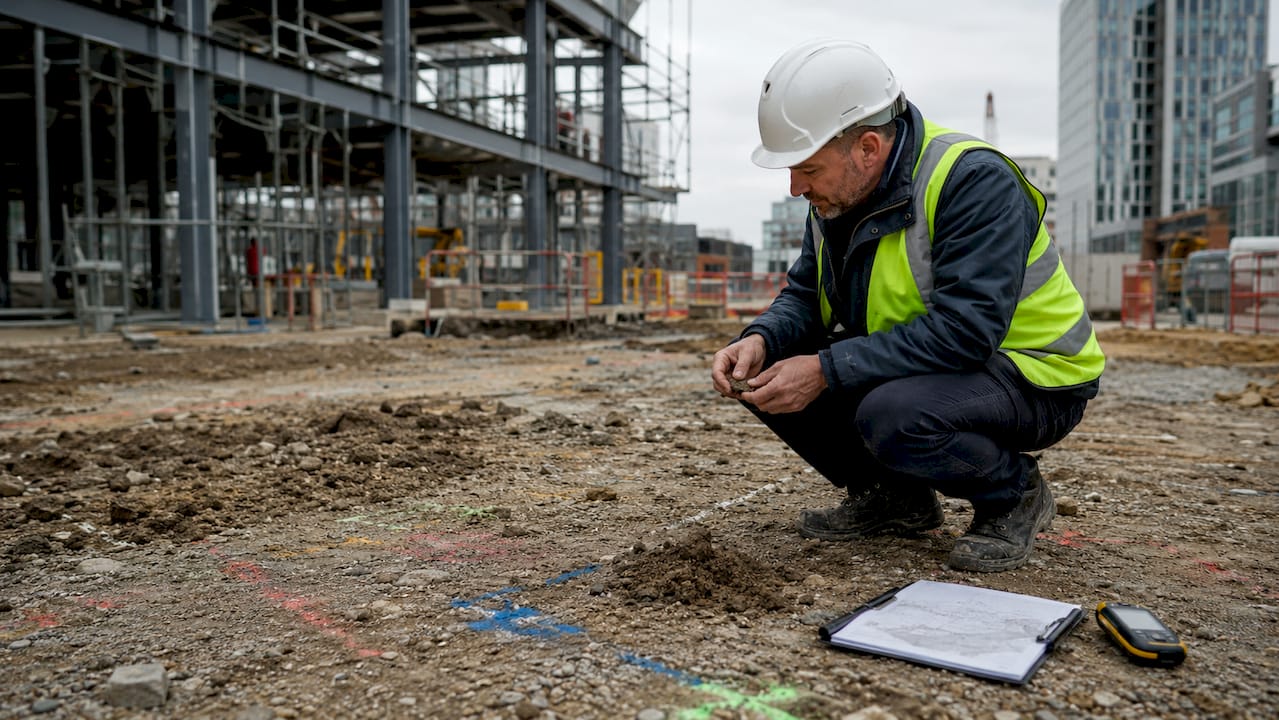
The process draws on multiple disciplines. Site engineers assess ground conditions and physical constraints. Quantity surveyors develop preliminary cost estimates. Regulatory specialists review zoning, building codes, and approval pathways through agencies such as BCA, URA, and JTC in Singapore. Market analysts evaluate demand assumptions and pricing benchmarks. Each discipline contributes a discrete investigation report, and those reports are synthesized into a final recommendation that stakeholders use to make capital allocation decisions.
The meaning of feasibility study in this context extends beyond technical assessment. For major public infrastructure, the U.S. Army Corps of Engineers (USACE) requires a formal agency and public review period of six months after draft report integration, reflecting that feasibility also encompasses governance, stakeholder alignment, and community input. Private sector projects in Singapore face equivalent complexity through multi-agency submission requirements.
What components make up a construction feasibility study?
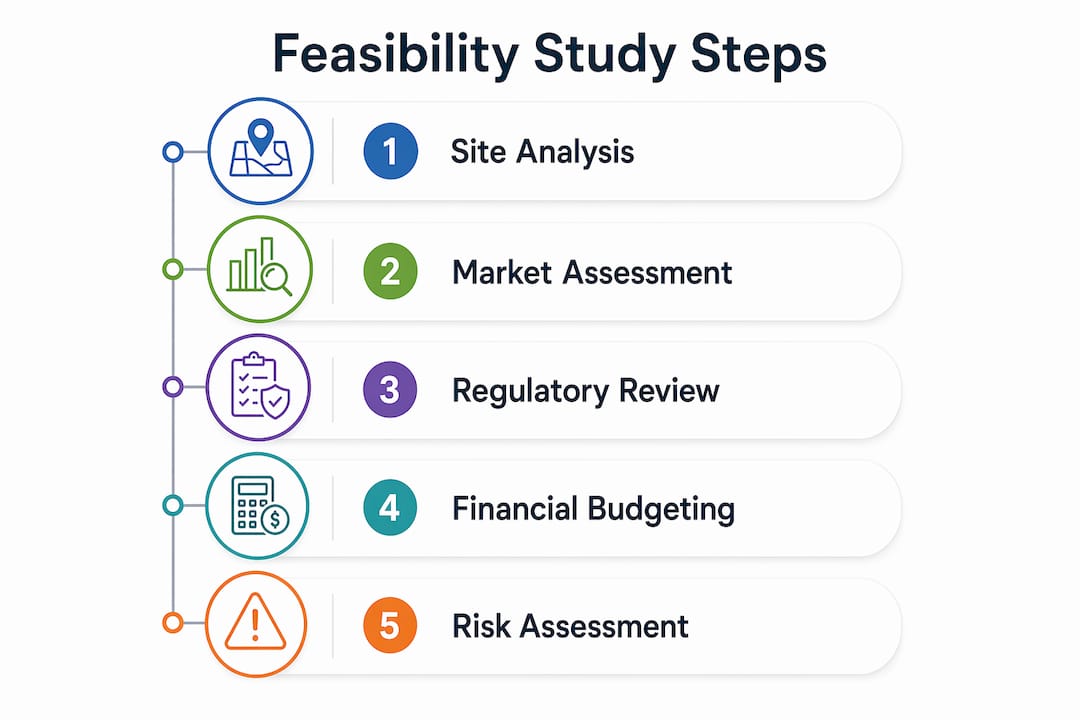
A project feasibility study guide for construction typically organizes assessment into five core components, each targeting a distinct category of risk or opportunity.
- Site analysis: Physical conditions including soil bearing capacity, drainage, topography, and existing utilities are assessed. Ground constraints such as contamination or underground services can fundamentally alter what is buildable and at what cost.
- Market assessment: Demand projections, comparable sales or rental data, and pricing assumptions are validated against current market conditions. Construction market research directly informs whether revenue assumptions are realistic and whether the project type is appropriate for the location.
- Regulatory review: Zoning classifications, plot ratio limits, height controls, and required authority approvals are mapped. In Singapore, this involves submissions to BCA, URA, HDB, or JTC depending on land tenure and project type. Regulatory constraints often define the maximum developable envelope before any design work begins.
- Financial budgeting: Preliminary cost estimates are developed covering hard costs, soft costs, land costs, and contingency allowances. Income projections are modeled against those costs to assess financial viability.
- Risk assessment and sensitivity testing: Key uncertainties such as cost escalation, demand shortfall, and approval delays are quantified. Sensitivity testing identifies the conditions under which a project remains viable and those under which it does not, reducing false feasibility conclusions.
Feasibility analysis in construction is explicitly not detailed design. Drawings produced at this stage are schematic and indicative. Their purpose is to test whether a concept can work within site, regulatory, and financial constraints, not to produce construction documents.
Pro Tip: Commission the site analysis and regulatory review before any architectural concept work begins. Site constraints and zoning limits define the maximum development envelope. Designing outside that envelope first and discovering constraints later generates rework costs that feasibility studies exist to prevent.
How and when are feasibility studies conducted in construction?
A construction feasibility study is conducted during the preconstruction phase, after the business case has been established but before design is finalized. This timing is deliberate. Modifying scope and design before detailed design and procurement is substantially less costly than resolving the same problems after commitments have been made. The study’s position in the project lifecycle is what gives it its financial value.
The process follows a staged structure:
- Define project objectives and constraints. The owner’s intent, budget parameters, program requirements, and site boundaries are documented. This establishes the evaluation criteria against which feasibility will be measured.
- Commission separate investigations. Site, regulatory, market, and cost investigations are conducted in parallel or in sequence. Separating site feasibility from design feasibility at this stage produces higher quality decision inputs and reduces the risk of invalid design assumptions entering the process.
- Develop preliminary cost estimates. Quantity surveyors produce order-of-magnitude estimates based on schematic concepts and current market benchmarks. These are refined as investigation findings narrow the range of viable options.
- Conduct risk and sensitivity analysis. Cost escalation scenarios, approval timeline risks, and demand sensitivity are modeled. This step converts qualitative risks into quantified decision inputs.
- Synthesize findings into a recommendation. All investigation outputs are compiled into a single feasibility report. The recommendation is one of three outcomes: proceed, proceed with conditions, or do not proceed.
The staged approach ensures that each decision gate is grounded in validated data rather than assumptions. This is the mechanism through which feasibility studies progressively reduce uncertainty across the preconstruction phase.
Pro Tip: Treat each stage gate as a formal decision point with documented sign-off. Projects that skip formal gate reviews tend to carry unresolved risks into design, where resolving them costs significantly more. Refer to project planning guidance for structuring these decision checkpoints effectively.
What are the typical costs and financial considerations?
Financial assessment is the component of a construction feasibility study that most directly influences the go or no-go decision. At the feasibility stage, cost estimates are order-of-magnitude figures developed from schematic concepts and current market benchmarks rather than detailed drawings. Their purpose is to establish whether the project is financially viable in principle, not to produce a procurement-ready budget.
The standard cost breakdown used in feasibility analysis covers four categories:
| Cost Category | Typical Range | What It Covers |
|---|---|---|
| Hard costs | 60% to 70% of total | Construction, structure, finishes, M&E systems |
| Soft costs | 15% to 25% of total | Professional fees, authority submissions, insurance |
| Land costs | 10% to 40% of total | Acquisition, stamp duty, holding costs |
| Contingency | 15% to 20% of total | Risk allowance for scope uncertainty and escalation |
These cost heuristics serve as benchmarks for structuring feasibility budgets. Exact percentages vary by project type, location, and market conditions, so they must be calibrated against current data from quantity surveyors and construction estimating benchmarks relevant to the specific project context.
Financial viability at feasibility stage is assessed by comparing projected total development costs against projected revenue or value. Key inputs include:
- Current construction cost rates per square meter for the relevant building type
- Comparable sales or rental evidence from the target market
- Financing costs and holding period assumptions
- Projected net operating income or gross development value
Sensitivity testing is applied to these inputs to identify break-even thresholds. For example, a feasibility model might test what happens to project returns if construction costs increase by 10% or if sales prices fall by 8%. Risk assessments that quantify cost escalation and revenue shortfalls produce more reliable go or no-go decisions than models built on single-point estimates. Projects that appear viable under optimistic assumptions but fail under moderate stress scenarios carry material financial risk.
How to interpret feasibility study results and apply them to decisions
A feasibility study delivers a formal recommendation, but the recommendation alone is not sufficient for decision-making. Stakeholders must understand the assumptions underlying it, the risk conditions attached to it, and the degree of confidence the investigation data supports.
The three standard outcomes of a construction feasibility study each carry distinct implications:
- Proceed: The project meets financial, technical, and regulatory viability thresholds under the assessed conditions. This outcome authorizes advancement to detailed design and procurement, subject to maintaining the assumptions on which viability was established.
- Proceed with conditions: The project is viable if specific issues are resolved. Conditions might include obtaining a zoning variation, redesigning to reduce hard costs, or securing pre-sales commitments before construction commences. Each condition represents a risk that must be mitigated before the project advances.
- Do not proceed: The project cannot meet the owner’s intent within the assessed constraints. This is the most valuable outcome a feasibility study can produce when the alternative is committing capital to an unviable project.
“Feasibility studies exist to make uncertainty cheaper to resolve, because modifying scope and design before detailed design and procurement is much less costly than fixing problems after commitments are made.” — Procore
When reviewing a feasibility report, examine the sensitivity analysis section with particular attention. A project that is viable under base-case assumptions but fails under a 10% cost increase scenario carries substantially more risk than one that remains viable under a 20% stress. Understanding risk evaluation in construction is critical to interpreting these findings accurately. Stakeholders should also verify that site feasibility and design feasibility were assessed separately, as combining them produces lower quality decision inputs and increases the probability of rework after design lock-in.
The regulatory review section of the feasibility report deserves equal scrutiny. Authority approval pathways, submission requirements, and compliance obligations identified at feasibility stage directly constrain what can be built and when. Engaging professional engineers who understand regulatory compliance in construction to review this section reduces the risk of proceeding on the basis of incorrect regulatory assumptions.
Key takeaways
A construction feasibility study is the most cost-effective mechanism available to investors and developers for resolving project uncertainty before capital commitments are made.
| Point | Details |
|---|---|
| Definition and purpose | A feasibility study is a preconstruction assessment that produces a go, conditional, or no-go recommendation before design begins. |
| Five core components | Site analysis, market assessment, regulatory review, financial budgeting, and risk assessment each address a distinct category of project risk. |
| Timing is critical | Studies conducted after design has advanced lose most of their value because scope changes become significantly more expensive to implement. |
| Separate site from design | Assessing site and regulatory constraints before design work begins prevents invalid assumptions from entering the design process and causing rework. |
| Sensitivity testing is non-negotiable | Financial models built on single-point estimates without stress testing produce false feasibility conclusions and expose investors to avoidable risk. |
Why feasibility studies deserve more rigor than they typically receive
From my experience working across construction and infrastructure projects in Singapore and the broader ASEAN region, the most common failure mode in feasibility assessment is not a lack of data. It is a lack of separation between what the site allows and what the developer wants to build. These are two distinct questions, and conflating them produces feasibility reports that confirm the developer’s intent rather than test it.
The second most common failure is treating sensitivity analysis as a formality. A feasibility model that tests only a 5% cost variation on a project with significant ground risk or approval uncertainty is not a risk assessment. It is a presentation document. Genuine sensitivity testing identifies the specific conditions under which a project stops being viable and forces decision-makers to confront whether those conditions are plausible.
The third issue I observe consistently is the compression of the feasibility timeline to meet development program pressures. Feasibility studies that are rushed produce recommendations based on incomplete investigation data. The cost of that compression is not visible at the feasibility stage. It appears later, in design changes, approval delays, and budget overruns that could have been identified and resolved at a fraction of the cost.
My advice to any investor or developer commissioning a feasibility study is to demand that site constraints and regulatory limits are fully documented before any concept design is produced. Demand that sensitivity testing covers realistic stress scenarios, not just minor variations. And treat a “do not proceed” recommendation as a success, not a failure. That recommendation has protected your capital.
— Aman
How Com supports your construction feasibility assessment
Com, Aman Engineering Consultancy, provides construction feasibility studies for property developers, real estate investors, and construction companies operating in Singapore and across the ASEAN region. The firm’s integrated approach covers site analysis, regulatory review through BCA, URA, JTC, HDB, and LTA, preliminary cost assessment, and risk evaluation within a single coordinated process. Com also delivers value engineering and authority approvals services that extend the feasibility process into detailed design and procurement. For investors and developers who require a rigorous, evidence-based assessment before committing capital, contact Aman Engineering Consultancy to discuss a feasibility study scoped to your specific project requirements.
FAQ
What is a feasibility study in construction?
A construction feasibility study is a preconstruction assessment that evaluates whether a proposed project is technically, financially, and regulatorily viable before design and procurement commitments are made. It produces a formal go, conditional, or no-go recommendation based on site, market, regulatory, and financial investigations.
When should a feasibility study be conducted?
A feasibility study should be conducted after the business case is established but before design is finalized. Conducting it after design has advanced significantly reduces its value because scope changes become substantially more expensive to implement at that stage.
What are the main components of a construction feasibility study?
The five core components are site analysis, market assessment, regulatory review, financial budgeting, and risk assessment with sensitivity testing. Each component addresses a distinct category of risk that could affect project viability or delivery outcomes.
How does a feasibility study differ from a business case?
A business case establishes why a project should be pursued based on strategic or financial objectives. A feasibility study tests whether the project can actually be delivered as intended within site, regulatory, and financial constraints. The business case precedes the feasibility study in the project lifecycle.
What happens if a feasibility study recommends not proceeding?
A no-go recommendation means the project cannot meet the owner’s intent within the assessed constraints. This outcome protects investors from committing capital to an unviable project and is the most financially valuable result a feasibility study can produce when the alternative is proceeding without adequate evidence of viability.