

The Singapore Civil Defence Force (SCDF) is the primary statutory authority responsible for fire safety regulation, civil defence shelter compliance, and emergency response readiness across all building types in Singapore. The role of SCDF in building safety spans two distinct but interdependent functions: formulating and enforcing the legal framework that governs fire protection systems, and maintaining 24-hour operational capacity to respond when those systems are tested. For property developers, building owners, and construction professionals, understanding how SCDF exercises these powers under the Fire Safety Act and the Civil Defence Shelter Act is not optional. It is a compliance prerequisite that affects project timelines, design decisions, and ongoing operational obligations.
What are scdf’s key regulatory responsibilities for building safety?
SCDF enforces fire safety and civil defence shelter regulations through legislative powers granted under the Fire Safety Act and the Civil Defence Shelter Act. These two statutes form the legal backbone of building safety standards in Singapore, giving SCDF authority to approve plans, conduct inspections, certify systems, and take enforcement action against non-compliant parties.
SCDF’s regulatory responsibilities cover the following areas:
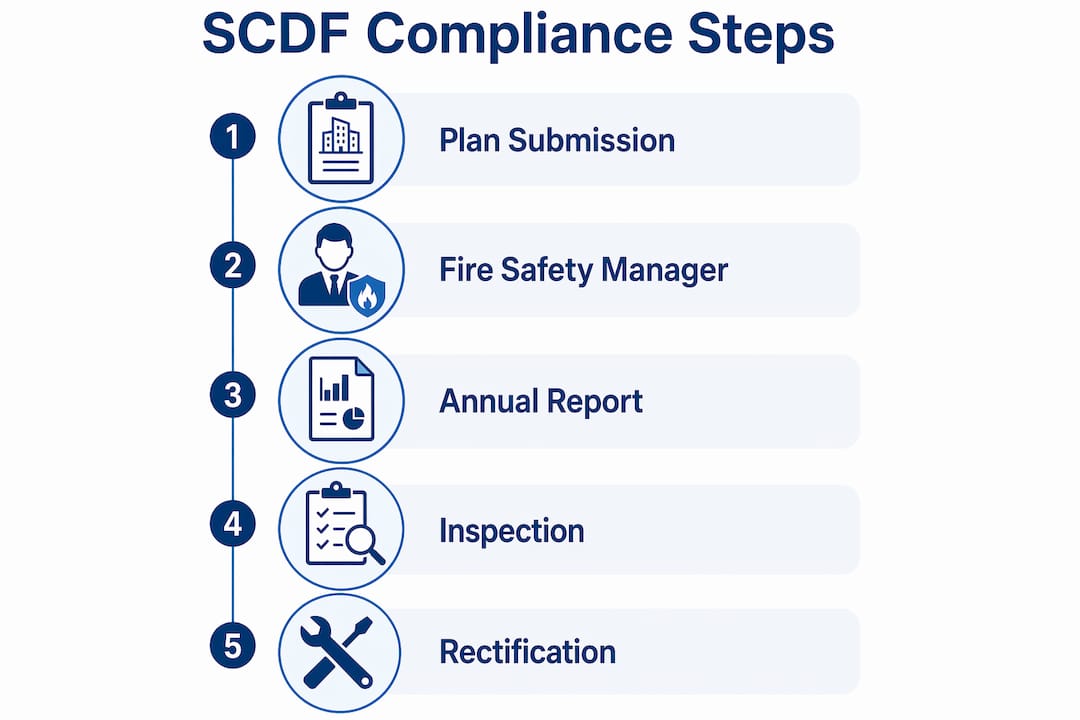
- Fire safety plan approvals: All new buildings and major additions or alterations require SCDF-approved fire safety plans before construction proceeds. Submissions are made through the CORENET system by a Qualified Person (QP), typically a registered architect or engineer.
- Fire safety system certification: Sprinkler systems, fire alarm systems, emergency lighting, and smoke control installations must be certified by SCDF-accredited inspectors before a Certificate of Statutory Completion (CSC) or Temporary Occupation Permit (TOP) is issued.
- Shelter provisions: Under the Civil Defence Shelter Act, residential and commercial developments must incorporate household or storey shelters that meet SCDF’s structural and ventilation specifications.
- Enforcement powers: SCDF holds authority to issue rectification orders, stop-work orders, and financial penalties. Compliance gaps can lead to fines and formal enforcement action, not merely advisory notices.
Pro Tip: Submit fire safety plans through CORENET at the earliest stage of design development. Late submissions frequently delay TOP issuance, which cascades into project cost overruns.
SCDF also maintains a product listing scheme for fire safety products. Only listed products may be installed in buildings subject to SCDF oversight. Using unlisted products is a direct compliance violation and a common trigger for inspection failures. Review the SCDF inspection failures that recur in fire compartmentation assessments to understand where projects most often fall short.
How does the fire safety manager scheme operationalize compliance?
The Fire Safety Manager (FSM) scheme is the mechanism through which SCDF converts regulatory requirements into active, accountable building management. Owners of designated buildings must appoint an FSM within 90 days of receiving their CSC or TOP. The scheme became mandatory under the Fire Safety Act 1993 and applies to buildings such as commercial complexes, hospitals, hotels, and industrial facilities above specified occupancy thresholds.
The FSM’s statutory duties include the following:
- Overseeing fire safety measures: The FSM is responsible for maintaining all fire protection systems in operational condition, including conducting regular inspections and coordinating maintenance contractors.
- Conducting fire drills and training: Designated buildings must carry out fire evacuation drills at prescribed intervals. The FSM plans, executes, and documents these exercises.
- Submitting the Annual Fire Safety Report: Since April 1, 2025, FSMs must submit Annual Fire Safety Reports through SCDF’s eFSM portal. This replaces previous paper-based reporting and creates a digital audit trail.
- Maintaining CPD certification: FSMs must accumulate Continuing Professional Development (CPD) points every three years to retain their certification. Lapsed certification means the building is technically without a compliant FSM, which is an enforcement risk.
- Reporting fire incidents and system activations: Any fire alarm activation or fire incident must be documented and reported through the prescribed channels.
Operationalizing fire safety through a dedicated FSM reduces the risk of compliance becoming a passive, paper-only exercise. Buildings without an active FSM consistently show higher rates of deferred maintenance, missed drills, and lapsed system certifications.
Pro Tip: Do not wait until the 90-day appointment deadline approaches. Identify and engage a certified FSM during the construction phase so the handover from contractor to building management is seamless from day one.
The eFSM portal is now the single point of truth for FSM compliance records. Non-submission of the Annual Fire Safety Report through eFSM is one of the most common audit failure points SCDF identifies during enforcement inspections.
What are scdf’s requirements for temporary building use and events?
Temporary Change of Use (TCU) is the formal term for situations where a building or space is used in a way that materially increases fire load or occupancy beyond its approved parameters. Common examples include converting a warehouse floor into an event venue, staging a trade exhibition in a covered atrium, or erecting temporary structures within an existing building footprint.
The compliance requirements for TCU scenarios are specific:
- Submission lead time: Applications must be submitted at least 3 working days before the event or change takes effect. This is a hard deadline, not a guideline.
- Qualified Person involvement: For structures or erections associated with the temporary use, a QP must submit plans through CORENET. The QP certifies that the temporary configuration meets fire safety requirements.
- Risk assessment documentation: The application must include a fire safety risk assessment that addresses egress capacity, fire load changes, and the adequacy of existing suppression and detection systems.
- Conditions of approval: SCDF may attach conditions to the TCU permit, such as limiting occupancy numbers, requiring additional fire extinguishers, or mandating a fire warden presence throughout the event.
Stakeholders consistently underestimate the time required for SCDF approval workflows. A 3-working-day window sounds manageable, but assembling the QP’s documentation, completing the risk assessment, and processing the CORENET submission realistically requires one to two weeks of preparation. Event organizers and building managers who treat the deadline as the start date, rather than the end date, of their preparation routinely miss it.
Non-compliance with TCU requirements exposes building owners and event organizers to enforcement action under the Fire Safety Act, including stop-event orders and financial penalties.
How does SCDF integrate emergency response with building safety regulations?
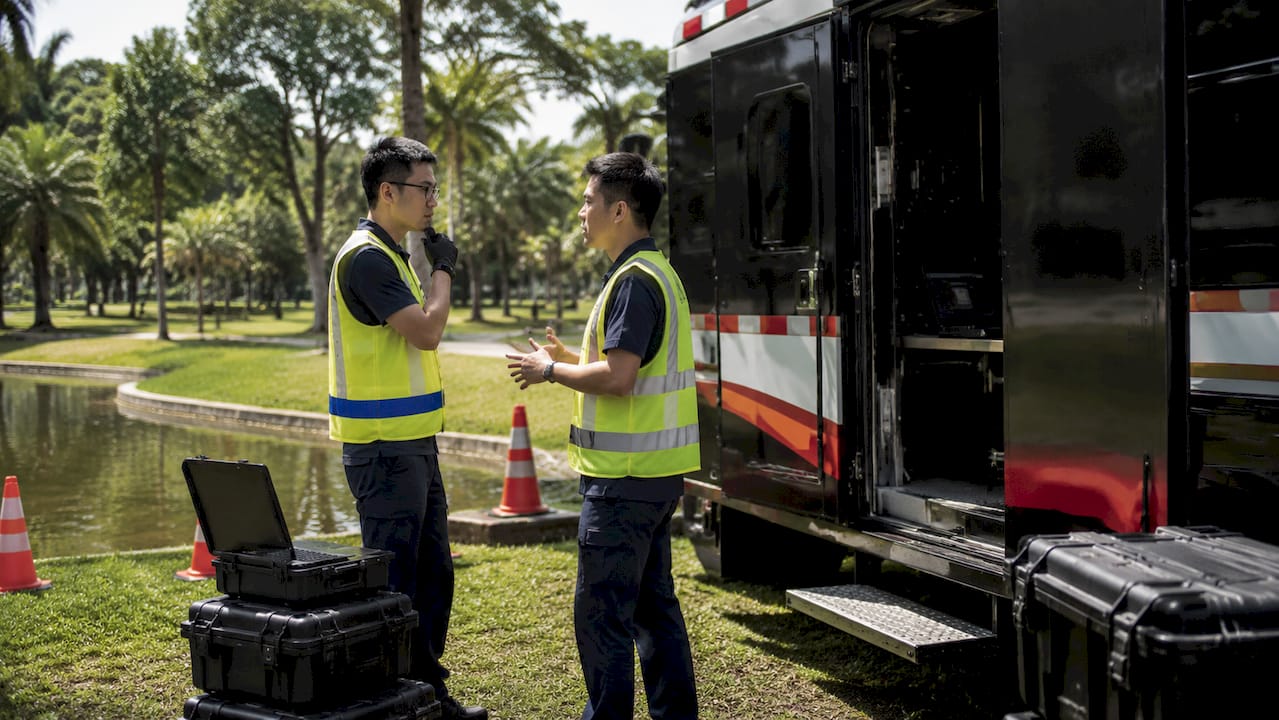
SCDF combines prevention through regulation with 24-hour operational emergency response. This dual mandate is what distinguishes SCDF from a purely administrative regulatory body. The agency deploys firefighting, rescue, and hazardous incident mitigation services while simultaneously setting the design and maintenance standards that determine how effectively those services can operate within a building.
The table below shows how SCDF’s regulatory requirements directly support emergency response effectiveness:
| Regulatory Requirement | Emergency Response Benefit |
|---|---|
| Fire compartmentation standards | Limits fire spread, giving responders time to contain incidents |
| Sprinkler system certification | Suppresses fires before SCDF units arrive on scene |
| Smoke control system approval | Maintains tenable conditions in evacuation routes |
| Emergency vehicle access provisions | Ensures fire engines can reach all building faces within required distances |
| Civil defence shelter specifications | Provides protected refuge during civil emergencies |
SCDF also runs public education programs and engages community first responders through initiatives such as the Community Emergency Response Teams (CERT) program. These programs extend SCDF’s safety reach beyond the regulatory framework into occupant behavior and preparedness. Building designs that incorporate clear signage, accessible fire hose reels, and well-lit evacuation routes directly support both occupant self-rescue and SCDF operational effectiveness.
For construction professionals, the practical implication is that SCDF safety guidelines are not simply bureaucratic requirements. They encode operational knowledge about how fires behave and how responders work. Designs that meet the letter of SCDF requirements also produce buildings that perform better in actual emergencies.
What do scdf’s standards mean for real estate and construction professionals?
The practical implications of SCDF building regulations for developers, contractors, and building owners fall into four areas: compliance calendar management, QP engagement, common pitfall avoidance, and workflow integration.
Compliance Calendar Management
Statutory deadlines under SCDF’s framework are fixed and non-negotiable. FSM appointment within 90 days of CSC or TOP, annual eFSM report submissions, CPD renewal cycles, and TCU application lead times all require forward planning. Missing any one of these triggers enforcement exposure. Maintain a dedicated compliance calendar that maps every SCDF obligation against project milestones and building operational dates.
Qualified Person Engagement
Every SCDF plan submission, whether for new construction, additions and alterations, or temporary change of use, requires a QP. The QP’s professional registration and liability underpin the submission. Engage your QP at the design development stage, not after design is complete. Late QP engagement is the single most common cause of SCDF submission delays on construction projects. Review the SCDF submission requirements checklist to confirm documentation completeness before any submission.
Common Compliance Pitfalls
| Pitfall | Consequence |
|---|---|
| Unlisted fire safety products installed | Inspection failure, rectification order |
| FSM CPD lapsed | Building non-compliant, enforcement risk |
| eFSM Annual Report not submitted | Audit failure, potential penalty |
| TCU application submitted late | Event stopped or permit denied |
| Fire compartmentation breaches | TOP withheld, costly remediation |
Workflow Integration
Integrating SCDF requirements into project workflows from the concept stage reduces rework and cost. Fire safety zoning, compartmentation design, and shelter provisions are far cheaper to incorporate during schematic design than to retrofit after structural work is complete. The authority approvals process for SCDF, BCA, and other agencies runs in parallel on most projects, so early coordination across all statutory submissions prevents bottlenecks.
Pro Tip: Build a compliance matrix at project inception that maps every SCDF requirement to a responsible party, a submission date, and a verification checkpoint. This single document prevents the majority of compliance lapses that occur on complex projects.
Key takeaways
SCDF’s role in building safety is both a regulatory mandate and an operational framework that requires active, documented compliance from every stakeholder in Singapore’s construction and property sectors.
| Point | Details |
|---|---|
| SCDF holds enforcement powers | Non-compliance triggers fines and rectification orders, not just advisory notices. |
| FSM appointment is time-bound | Designated buildings must appoint a certified FSM within 90 days of CSC or TOP. |
| eFSM reporting is now mandatory | Annual Fire Safety Reports must be submitted via the eFSM portal since April 1, 2025. |
| TCU applications require early action | Submit Temporary Change of Use permits at least 3 working days before the event, with QP documentation ready in advance. |
| QP engagement drives submission success | Engage a Qualified Person at design development stage to avoid delays in SCDF plan approvals. |
SCDF compliance requires more than paperwork
Having worked across dozens of construction and development projects in Singapore, I have observed one consistent pattern: teams that treat SCDF compliance as a documentation exercise rather than an operational discipline are the ones that face enforcement action. The Fire Safety Act gives SCDF real teeth. Rectification orders, stop-work notices, and financial penalties are not theoretical outcomes. They happen on projects where compliance is managed reactively.
The FSM scheme is the clearest example of SCDF’s intent. By requiring a named, certified individual with statutory reporting obligations, SCDF has made it structurally difficult to treat fire safety as a passive checkbox. The eFSM portal reinforces this. Digital submission creates a timestamped audit trail that SCDF can review at any time. If your FSM’s CPD has lapsed or the annual report is overdue, that gap is visible.
My recommendation to developers and building owners is to treat SCDF engagement as a continuous relationship, not a series of one-off approvals. Proactive communication with SCDF during design development, early QP appointment, and a well-maintained compliance calendar will resolve the vast majority of issues before they become enforcement matters. The fire safety approval process rewards preparation. Projects that front-load compliance work consistently reach TOP faster than those that address SCDF requirements as an afterthought.
— Aman
How aman engineering consultancy supports SCDF compliance
Aman Engineering Consultancy provides integrated fire safety and regulatory compliance services for developers, building owners, and contractors operating in Singapore’s construction sector. Com’s team manages SCDF plan submissions across new developments, additions and alterations, and temporary change of use applications, coordinating QP responsibilities and CORENET submissions to meet statutory deadlines.

Com also supports clients with FSM appointment coordination, Annual Fire Safety Report preparation through the eFSM portal, and fire safety system certification. For projects requiring multi-agency approvals across BCA, URA, SCDF, and other statutory bodies, Com’s authority approvals team manages the full submission workflow. Contact Aman Engineering Consultancy to discuss your project’s SCDF compliance requirements and establish a submission timeline that protects your project schedule.
FAQ
What is scdf’s primary role in building safety?
SCDF is Singapore’s statutory authority for fire safety regulation and civil defence shelter compliance. It formulates and enforces building safety standards under the Fire Safety Act and Civil Defence Shelter Act, while maintaining 24-hour emergency response capability.
Which buildings must appoint a fire safety manager?
Designated buildings including commercial complexes, hospitals, hotels, and large industrial facilities must appoint a certified FSM within 90 days of receiving their CSC or TOP. The FSM holds statutory reporting obligations enforced through SCDF’s eFSM portal.
How far in advance must a temporary change of use permit be submitted?
Applications for Temporary Change of Use must be submitted at least 3 working days before the event or change takes effect. Realistically, organizers should allow one to two weeks to prepare the required QP documentation and risk assessment.
What happens if a building fails an SCDF inspection?
SCDF holds legal enforcement powers to issue rectification orders, stop-work orders, and financial penalties for non-compliant buildings. Persistent non-compliance can delay TOP issuance and result in escalating enforcement action.
When must the annual fire safety report be submitted?
FSMs must submit the Annual Fire Safety Report through the eFSM portal. This digital reporting requirement has been in effect since April 1, 2025, and non-submission is one of the most frequently cited findings during SCDF enforcement inspections.