
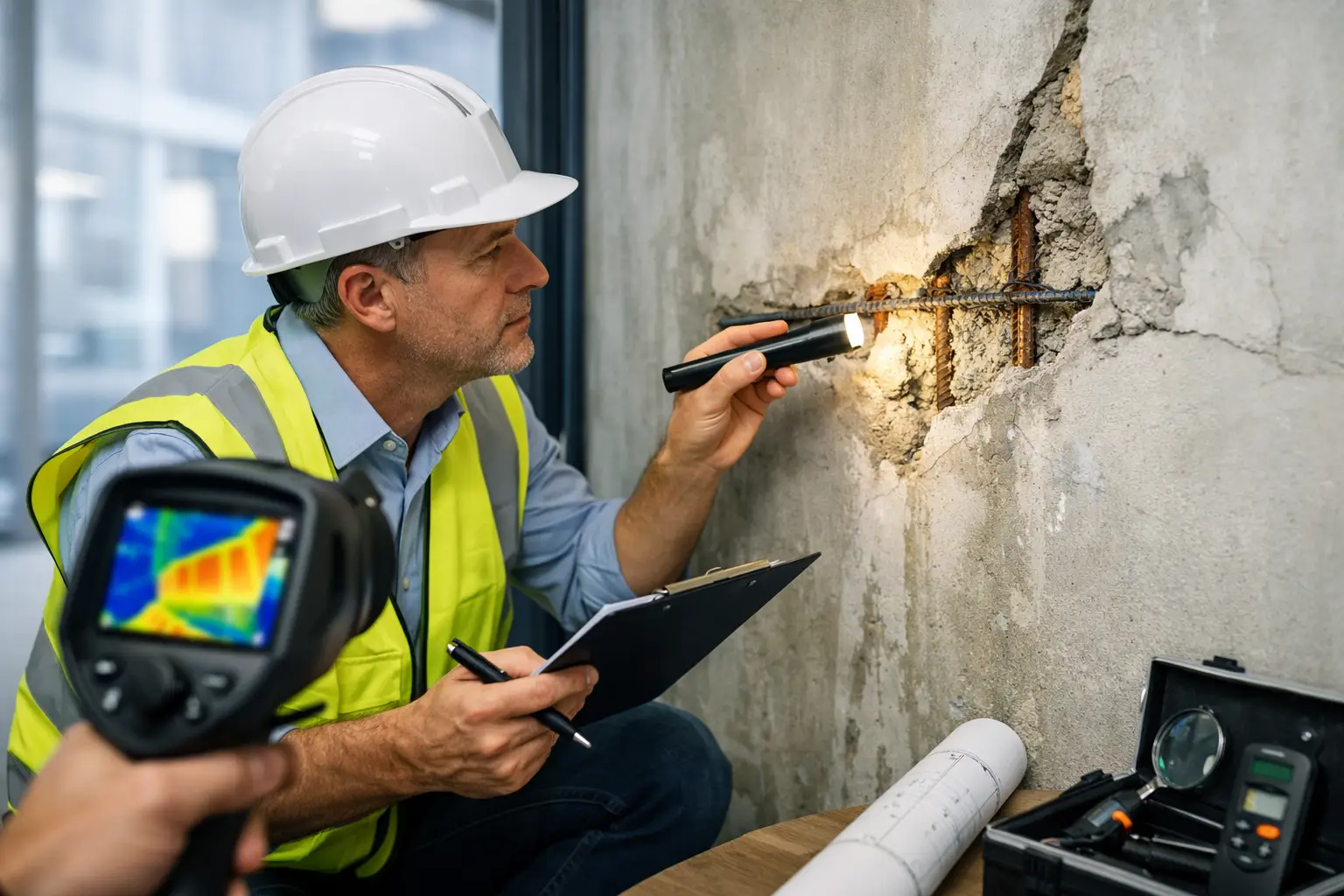
A crack above a window, water stains returning after every rainstorm, concrete spalling in a car park, or flooring that keeps lifting after handover – these are not minor maintenance annoyances when the cause is unknown. A building defect investigation consultant helps identify what is failing, why it is happening, how serious it is, and what corrective action is technically justified.
For owners, developers, facility managers, and buyers, that matters because the visible defect is often only the symptom. The actual problem may sit in the structure, facade interface, waterproofing build-up, workmanship, material selection, loading changes, detailing, or maintenance history. If the diagnosis is wrong, repair money gets spent twice, disputes escalate, and compliance risk remains in place.
What a building defect investigation consultant actually does
A building defect investigation consultant is engaged to establish evidence, not guesswork. The role usually starts with a site assessment, but competent investigations do not stop at visual observations. The consultant reviews the defect pattern, surrounding construction, design intent, available drawings, prior repair history, occupancy conditions, and any signs of progressive deterioration.
From there, the investigation may extend into crack mapping, moisture tracing, level surveys, structural assessment, facade review, material testing coordination, or limited opening-up works where hidden conditions must be verified. In some cases, the issue is straightforward, such as failed sealant joints at movement interfaces. In others, the defect has several overlapping causes, such as water ingress driven by facade detailing, poor drainage falls, and maintenance gaps all at once.
The real value is not just identifying a defect category. It is connecting symptom, mechanism, risk, and rectification pathway in a way that owners, contractors, insurers, legal teams, and regulatory stakeholders can act on.
Why defect investigation is different from a basic inspection
Many building inspections identify visible issues. A defect investigation goes further by establishing causation and consequence. That distinction is critical.
A basic inspection may note cracking to walls, corrosion staining, ponding water, or displaced finishes. A proper defect investigation asks whether the crack is cosmetic or structural, whether corrosion is superficial or linked to deeper reinforcement distress, whether ponding results from construction tolerances or substrate settlement, and whether displaced finishes indicate moisture migration, substrate failure, or installation defects.
This is where technical judgment matters. Not every defect requires intrusive testing, and not every visible issue justifies major repairs. A consultant should know when a problem can be resolved with targeted maintenance and when it points to wider failure that requires engineering review, staged monitoring, or immediate risk controls.
Common situations that justify engaging a consultant
The need for a building defect investigation consultant usually arises when the defect is recurring, technically unclear, commercially sensitive, or potentially linked to safety and compliance.
Water ingress is one of the most common triggers. Roof leaks, facade leakage, basement seepage, balcony ponding, and wet internal walls often involve multiple building elements, which makes trial-and-error repairs expensive and ineffective. Structural concerns are another major area, especially where cracks widen over time, slabs show unusual deflection, concrete begins to spall, or unauthorized alterations may have affected load paths.
Facade defects also require careful handling. Loose finishes, sealant failure, cracked cladding, and anchorage deterioration can create both asset damage and public safety exposure. In commercial and industrial properties, vibration issues, floor distress, service penetrations, and operational modifications may also need engineering investigation to determine whether building performance has been compromised.
Buyers and tenants may also seek an independent consultant before acquisition, lease commitment, or dispute escalation. In those cases, the purpose is not only technical clarity but also a documented basis for negotiation, repair obligations, or risk allocation.
How the investigation process usually works
A competent investigation follows a structured sequence. First, the consultant defines the problem statement. That sounds simple, but many projects start with assumptions that are too broad or too narrow. The issue presented as “a leak” may actually involve several leak paths. What looks like “settlement cracking” may turn out to be shrinkage, thermal movement, or differential movement at interfaces.
Next comes document review and site assessment. Available drawings, prior submissions, maintenance records, as-built information, and previous repair attempts can be highly revealing. On site, the consultant documents defect location, pattern, extent, severity, environmental exposure, adjacent systems, and possible triggers.
If visual findings are not sufficient, the consultant may recommend further investigation. That can include water tests, thermal review, crack gauges, hammer tapping, moisture readings, cover scans, rebound tests, concrete sampling, or limited opening-up. The scope depends on the building type, defect severity, access constraints, and the level of certainty required.
After evidence is gathered, the consultant develops findings on cause, urgency, and recommended rectification. The strongest reports do not simply say what is wrong. They distinguish primary causes from secondary damage, identify whether the defect is active or historic, and set out practical remedial options with enough technical detail for implementation planning.
What to look for when appointing a building defect investigation consultant
The consultant should have more than general inspection experience. Defect work often crosses structural engineering, architecture, waterproofing, facade systems, materials behavior, and regulatory obligations. If the issue affects life safety, structural integrity, building envelope performance, or statutory compliance, the investigation must be led with appropriate engineering competence.
Look for a consultant who can explain methodology before starting. That includes what will be inspected, what assumptions are being tested, whether access equipment or opening-up may be needed, and what the final deliverable will contain. Vague inspections tend to produce vague recommendations.
It also helps to appoint a firm that can continue beyond diagnosis. On many projects, the next step after identifying the defect is not simply issuing a report. The owner may need rectification specifications, contractor coordination, authority-facing documentation, structural endorsement support, or follow-up inspection after repairs. A multidisciplinary consultancy can reduce handover gaps between investigation and implementation.
For projects involving regulated works, this matters even more. In Singapore, defect situations can intersect with authority requirements, facade safety obligations, structural review, fire safety constraints, or approval pathways tied to BCA, SCDF/FSSD, PUB, URA, or other agencies. A consultant who understands both the defect itself and the approval environment is often better positioned to move the matter forward without delay.
Why cheap repairs often fail
Owners are often tempted to fix the visible damage first and investigate later. That approach can work for isolated wear-and-tear defects. It is far riskier when the cause is hidden.
Take water ingress as an example. Repainting a damaged ceiling or resealing one joint may improve appearance for a short period, but if the actual failure sits in an upper facade transition, membrane termination, or service penetration, the leak will return. The same applies to cracks. Surface patching may hide the symptom while movement continues underneath.
There is also a commercial trade-off. A detailed investigation has an upfront cost, but repeated patch repairs, tenant complaints, operational disruption, and failed contractor disputes usually cost more. The right level of investigation depends on the asset value, risk exposure, and defect severity. Not every issue needs a full forensic program, but recurring defects should rarely be handled by guesswork.
The value of clear reporting and rectification support
A useful defect report should be understandable to both technical and non-technical stakeholders. It needs clear location references, photographs, observations, analysis, risk commentary, and rectification recommendations that can be priced and executed.
Where needed, the consultant should also identify immediate precautions. That may involve restricting access, installing temporary protection, monitoring crack progression, or prioritizing urgent repair zones. For larger assets, a phased rectification plan may be more realistic than a single all-at-once repair package.
This is where execution-focused consultancy makes a difference. A firm such as Aman Engineering Consultancy can add value not only by diagnosing defects but also by aligning investigation findings with structural review, facade assessment, compliance requirements, repair coordination, and approval-related workflows where they apply.
When timing matters most
The best time to investigate a defect is usually earlier than owners expect. Fresh moisture patterns, active cracking, weather-dependent leakage, and ongoing movement are easier to diagnose before repeated patching obscures the evidence.
Delays also affect liability and cost recovery. If a defect becomes materially worse because it was left unaddressed, the technical and contractual position can become harder to prove. Early documentation helps preserve facts, especially during handover disputes, warranty claims, acquisition reviews, and tenant complaints.
A sound investigation does not promise that every defect will have a single simple cause. Buildings are layered systems, and failures can be mixed. What it should provide is technical clarity, proportionate next steps, and a path toward durable correction. When the defect has real cost, safety, or compliance implications, that clarity is not optional – it is the starting point for making the right decision.