
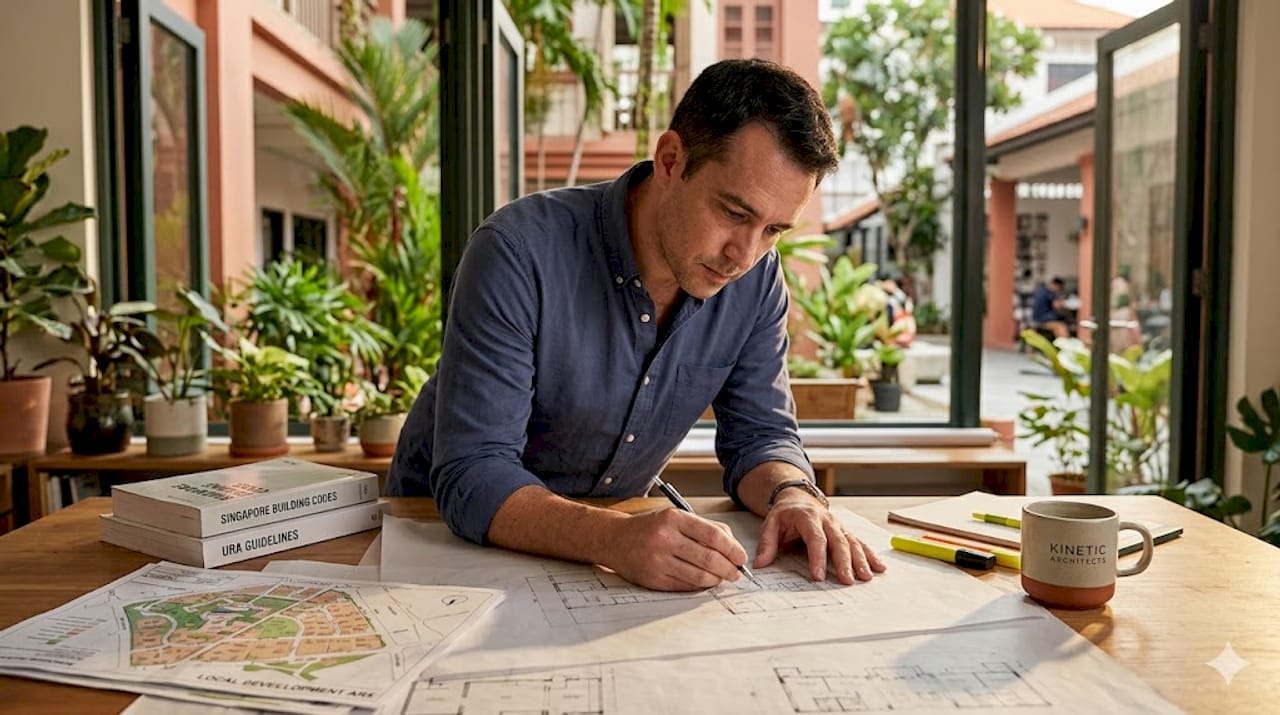
Residential development in Singapore operates within one of the most regulated construction environments in Southeast Asia, and a significant number of project delays stem not from site conditions or funding gaps but from architectural design decisions made too early or without adequate regulatory grounding. URA Envelope Control guidelines impose strict limits on building height, setbacks, site coverage, and plot ratio, meaning that even a visually compelling design concept can render a project non-compliant before the first structural column is drawn. This guide addresses the full scope of architectural design in Singapore residential projects, from regulatory frameworks and compliance processes to sustainability integration and technical coordination.
Table of Contents
- Why architectural design is crucial in Singapore’s residential sector
- Navigating compliance: Singapore residential design regulations
- Beyond compliance: Enhancing well-being and sustainability
- Design for function: User experience and technical coordination
- Our perspective: What most developers miss about architectural design
- Unlock expert-driven residential design for your next project
- Frequently asked questions
Key Takeaways
| Point | Details |
|---|---|
| Prioritize compliance | Meeting Singapore’s residential design rules is essential to avoid costly changes and delays. |
| Go beyond aesthetics | Effective architectural design must enhance both functionality and resident well-being. |
| Engage experts early | Involving regulatory-savvy architects and engineers from the start makes approval smoother. |
| Embrace stakeholder collaboration | Combining prescriptive design with stakeholder input delivers more adaptive, successful projects. |
Why architectural design is crucial in Singapore’s residential sector
Architectural design in residential development extends well beyond the visual presentation of a building. It is the foundational layer through which compliance, structural coordination, cost control, and long-term market performance are determined. A design that does not account for Singapore’s regulatory environment from the outset introduces material risk into every subsequent phase of the project.
The consequences of misaligning architectural decisions with regulatory requirements are well documented in Singapore’s development industry. Projects that proceed on the basis of aesthetic ambition without early engagement with regulatory frameworks frequently encounter costly redesigns, statutory submission rejections, or construction delays that erode developer margins. The four areas most directly shaped by architectural design at the conceptual stage are:
- Regulatory compliance, including adherence to URA Envelope Control parameters, Gross Floor Area (GFA) calculations, setback requirements, and permissible building typologies
- Structural and systems coordination, ensuring that architectural configurations are compatible with structural engineering assumptions and mechanical, electrical, and plumbing (MEP) routing
- Construction cost optimization, where design decisions directly influence material quantities, formwork complexity, and procurement efficiency
- Resale and rental value, as functional layouts, natural lighting, ventilation strategies, and unit mix all influence buyer and tenant demand
For architectural masterplanning for landed housing, these considerations must be integrated simultaneously rather than sequentially. The common developer error is to treat compliance as a downstream verification step rather than an upstream design constraint.
“Developers who treat architectural design as an aesthetic exercise rather than a compliance and coordination discipline consistently face avoidable costs and project timeline overruns in Singapore’s tightly regulated residential sector.”
Style alone is insufficient; developers should prioritize architects with regulatory expertise, technical coordination capability, and a proven compliance track record over those who offer compelling visual renderings but lack demonstrated experience navigating Singapore’s statutory submission processes.
Pro Tip: Request a compliance matrix from prospective architects before engaging them. This document should map every proposed design parameter against the applicable URA, BCA, and HDB guidelines specific to your site’s zoning classification.
Ensuring compliance with regulatory requirements in Singapore residential projects requires architects who operate as technical coordinators, not just space planners. The distinction is critical and directly affects project outcomes.

Navigating compliance: Singapore residential design regulations
Singapore’s regulatory framework for residential development involves multiple statutory bodies, each with jurisdiction over distinct aspects of design and construction. The Urban Redevelopment Authority (URA) governs land use, building form, and development intensity. The Building and Construction Authority (BCA) oversees structural safety and building standards. The Singapore Civil Defence Force (SCDF) administers fire safety requirements, while the Public Utilities Board (PUB) manages drainage and water supply compliance. Effective architectural design must satisfy all of these concurrently.
The following table summarizes the core compliance areas that residential developers must address through architectural design:
| Compliance area | Governing body | Key parameters |
|---|---|---|
| Envelope Control | URA | Height limits, setbacks, site coverage, plot ratio |
| Gross Floor Area (GFA) | URA | Permissible floor area calculations, exemptions |
| Additions and Alterations (A&A) | URA | Maximum 50% increase in GFA; no major structural changes |
| Fire Safety | SCDF | Means of escape, compartmentalization, sprinkler requirements |
| Structural adequacy | BCA | Load-bearing capacity, foundation design, structural submissions |
| Drainage and stormwater | PUB | Retention pond sizing, surface runoff management |
| Accessibility standards | BCA | Barrier-free access, lift provisions, ramp gradients |
Key compliance requirements include URA Envelope Control guidelines limiting height, setbacks, site coverage, and plot ratio, and A&A proposals cannot exceed a 50% increase in GFA or involve major structural changes. These thresholds are absolute; proposals that exceed them will not receive planning approval regardless of design quality or developer intent.
The following is a structured process developers should require their architectural teams to follow to ensure compliance throughout a residential project:
- Site analysis and zoning verification: Confirm the site’s zoning classification, applicable development control parameters, and any site-specific planning conditions before commencing schematic design.
- Regulatory pre-consultation: Engage URA through a Pre-Application Feasibility Study (PAFS) or preliminary consultation to clarify regulatory interpretation for complex or ambiguous design scenarios.
- Compliance-integrated schematic design: Develop schematic designs with all envelope, GFA, setback, and height constraints embedded as non-negotiable parameters from the first design iteration.
- Coordinated statutory submission preparation: Prepare and submit all required documentation to URA, BCA, SCDF, and PUB concurrently, with coordination managed by the lead architect.
- Design development with agency responses: Revise and refine design in response to statutory agency queries, maintaining a compliance log that documents every change and its regulatory justification.
- Construction documentation and site compliance monitoring: Issue construction drawings that carry forward all approved design parameters, with site inspections confirming adherence throughout the build.
Consulting an essential compliance guide before commencing the design process can prevent significant downstream costs. Developers who engage compliance expertise at the schematic design stage reduce statutory submission revision cycles by a measurable margin compared to those who introduce compliance review only after design development is complete.
Pro Tip: Use a structural checklist for compliance as a parallel tracking tool during architectural design. Misalignment between architectural and structural parameters is one of the most common causes of late-stage redesign in Singapore residential projects.
Beyond compliance: Enhancing well-being and sustainability
Once regulatory compliance is established as the design baseline, architectural design can deliver substantial additional value through the integration of well-being and sustainability principles. These are no longer discretionary considerations in Singapore’s residential market; buyer expectations and government green building policies have elevated them to standard practice in premium and mid-range developments alike.
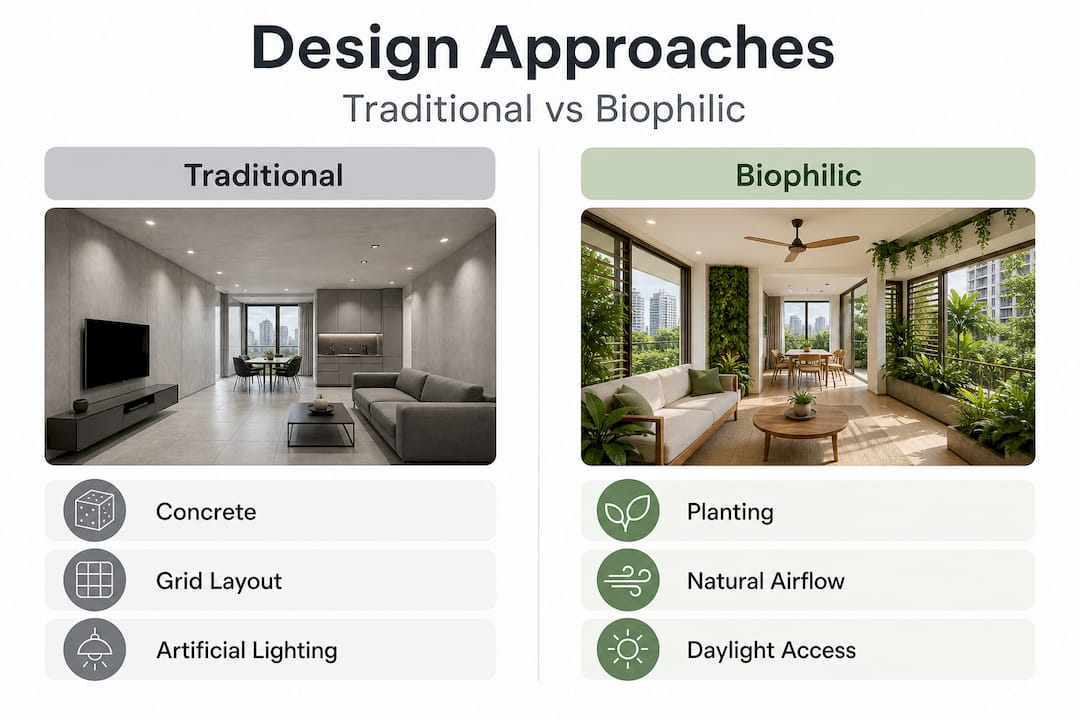
Biophilic design, which refers to the deliberate incorporation of natural elements such as planting, water features, natural light, and natural ventilation into the built environment, has measurable impacts on resident well-being. Biophilic design attributes like natural space integration score high (M=4.0) for mental well-being, and sustainable designs reduce air conditioning reliance through passive cooling strategies. These findings are directly applicable to Singapore’s residential typologies, where dense urban conditions and tropical climate conditions create specific design challenges and opportunities.
The following comparison table illustrates the distinction between traditional and biophilic or sustainable design approaches across common residential design parameters:
| Design element | Traditional approach | Biophilic/sustainable approach | Key benefit |
|---|---|---|---|
| Façade treatment | Painted concrete or glass curtain wall | Vertical greenery, sun-shading fins, textured natural materials | Reduced solar heat gain, improved thermal comfort |
| Ventilation strategy | Mechanical ventilation reliant on air conditioning | Cross-ventilation through strategic unit orientation | Reduced energy consumption, improved air quality |
| Communal areas | Hard-paved courtyards with minimal planting | Landscaped sky gardens, water features, tree canopy integration | Mental well-being, urban heat island mitigation |
| Lighting design | Artificial lighting as primary source | Daylight harvesting through clerestory windows and light wells | Energy savings, improved circadian rhythm support |
| Water management | Conventional drainage to municipal system | Rainwater harvesting, permeable paving, retention features | PUB compliance, reduced utility costs |
The most commonly requested eco-features in new Singapore residential developments, based on current market trends, include:
- Green roof and sky terrace integration for thermal insulation and recreational value
- Solar photovoltaic panels on roof structures for common area energy supply
- Energy-efficient building envelope systems including low-emissivity glazing and insulated wall assemblies
- Smart home automation for lighting, air conditioning, and water management optimization
- Bicycle parking and electric vehicle charging provisions aligned with LTA’s green mobility policies
Understanding the eco friendly design benefits is essential for developers seeking to position their projects competitively. Properties with documented sustainability credentials consistently achieve premium pricing and faster sales velocity in Singapore’s residential market.
Thoughtful landscape integration further enhances both the regulatory compliance profile of a development and its appeal to end buyers. URA’s landscape replacement policies require developers to compensate for ground-level greenery removed during construction, making landscape architectural planning a compliance obligation as well as a market differentiator.
Design for function: User experience and technical coordination
Architectural design that performs well in statutory submissions but fails to deliver functional residential environments represents an incomplete outcome for developers. The third dimension of effective architectural practice is technical coordination, which involves the precise alignment of architectural intent with structural engineering, MEP systems, fire safety provisions, and construction methodology.
In Singapore’s residential sector, this coordination is managed through an integrated project delivery model where the architect functions as the lead consultant, coordinating inputs from structural engineers, M&E engineers, fire safety engineers, and landscape architects into a single coherent design solution. The quality of this coordination directly determines construction cost certainty, site program efficiency, and the functionality of completed units.
The following numbered process outlines the key steps in effective technical coordination for residential projects:
- Appoint a full professional team at concept stage: Structural, M&E, fire safety, and landscape consultants should be engaged concurrently with the architect, not after design development is complete.
- Establish a coordinated BIM model: A Building Information Modeling (BIM) environment allows all disciplines to detect clashes and resolve coordination conflicts digitally before construction commences.
- Conduct regular design coordination meetings: Scheduled interdisciplinary reviews at schematic, design development, and construction documentation stages prevent design drift and maintain alignment with the approved regulatory submission.
- Issue coordinated construction drawings: All discipline drawings must be cross-referenced and checked against the architectural set before issue to contractors.
- Implement a site inspection and verification protocol: Regular inspections by the architect and registered inspectors confirm that construction works conform to approved drawings and specifications.
Technical coordination case studies in the landed housing typology illustrate the consequences of poor interdisciplinary alignment. Structural beam placement conflicts with architectural ceiling heights, MEP service routing that obstructs natural light paths, and fire compartmentation requirements that contradict open-plan design concepts are all resolvable through early and sustained coordination.
Contrasting viewpoints exist on how communal residential spaces should be designed: while some practitioners emphasize prescriptive simplicity that allows residents to appropriate and personalize spaces organically, others advocate for co-creation processes with future residents and stakeholders to produce environments precisely tailored to community needs. Both approaches have merit, and the choice between them should be guided by the development’s target demographic and the developer’s long-term asset management strategy.
“The most durable residential environments in Singapore are those where architects have invested in understanding how residents will actually use spaces, not merely how those spaces will photograph or present in marketing materials.”
Our perspective: What most developers miss about architectural design
The most consistently costly error in Singapore residential development is the prioritization of visual differentiation over regulatory and technical competence at the architect selection stage. Developers who select design teams on the strength of rendered imagery frequently discover, at the planning submission stage, that the selected design cannot be approved without fundamental revision. These revisions consume time, professional fees, and developer attention that could have been directed toward value-adding decisions.
The practical reality of Singapore’s regulatory environment is that design creativity operates within a tightly defined compliance corridor. The best architects working in this market are not those who push against these constraints but those who understand them precisely enough to find genuine design quality within them. Compliance is not the enemy of good design; insufficient regulatory knowledge is.
Case studies in landed house design consistently show that projects delivered on time and within budget share a common characteristic: the developer prioritized function, compliance, and cross-disciplinary coordination as the primary selection criteria, and treated aesthetic differentiation as an outcome of technical excellence rather than a starting point.
The practical sequence that produces the best residential development outcomes in Singapore follows this order: function first, compliance second, collaboration third, aesthetics as an outcome. Developers who internalize this sequence avoid the majority of costly mid-project corrections that erode returns and delay delivery.
Pro Tip: When evaluating architectural firms, request references from developers who have completed statutory submission cycles with that firm. The ability to navigate URA, BCA, and SCDF submissions efficiently is a more reliable predictor of project success than portfolio aesthetics.
Unlock expert-driven residential design for your next project
Delivering a compliant, functional, and market-competitive residential development in Singapore requires a design consultancy with demonstrated expertise across the full regulatory and technical spectrum.
Aman Engineering Consultancy offers property developers and construction firms an integrated service covering expert residential architectural design alongside structural engineering, M&E coordination, statutory submissions, and BIM implementation. Our team’s experience across URA, BCA, SCDF, PUB, and LTA submission processes ensures that your residential project moves from concept to approval with precision and minimal revision cycles. Whether you are planning a new landed house, a condominium development, or an A&A project, our consultants are equipped to deliver results that meet regulatory requirements and exceed market expectations. Explore our value engineering for developers service to understand how design optimization can reduce construction costs without compromising compliance or quality.
Frequently asked questions
What is the URA Envelope Control and why does it matter for residential projects?
URA Envelope Control sets strict limits on building height, setbacks, site coverage, and plot ratio for residential developments, and violating these parameters results in planning submission rejection or mandatory redesign that adds cost and delays project delivery.
How can architectural design improve energy efficiency in new homes?
Natural space integration and passive cooling strategies embedded in architectural design reduce dependence on mechanical air conditioning, resulting in lower energy consumption and improved thermal comfort for residents throughout Singapore’s tropical climate conditions.
What should developers prioritize when choosing an architect in Singapore?
Developers should focus on architects with proven regulatory expertise and a verifiable track record of successful statutory submissions across URA, BCA, and SCDF processes, rather than selecting based on the visual quality of portfolio renderings alone.
What is the difference between prescriptive and co-created space design?
Prescriptive design delivers ready-to-use communal spaces that residents can personalize independently, while co-created design involves structured engagement with future occupants and stakeholders to produce environments specifically configured for the target community’s actual patterns of use.