
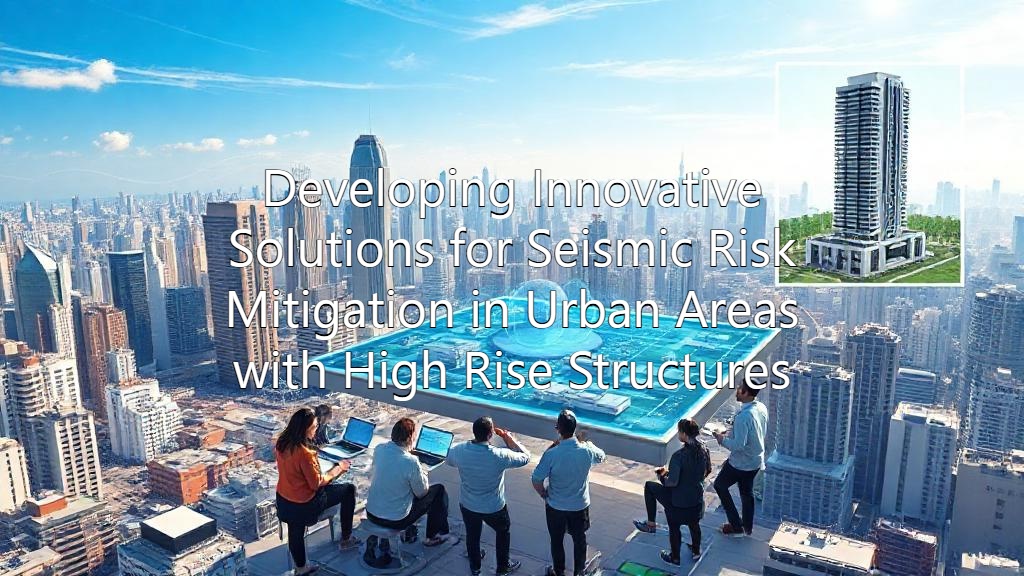
The urban landscape continues to stretch towards the sky, with high-rise structures piercing the clouds like giant shards of glass.
The seismic risk that lies beneath our feet grows increasingly ominous, like a silent predator waiting to strike.
Can we truly afford to gamble with the lives of millions of city dwellers, or is it time to rethink our approach to seismic risk mitigation?
The threat of earthquakes is a constant reminder that even the most seemingly indestructible skyscrapers can be reduced to rubble in a matter of seconds, leaving devastation and chaos in their wake.
Like a master weaver, innovative solutions must be carefully crafted to strengthen the fabric of our cities, protecting both the physical infrastructure and the people who call them home.
It is only through a deep understanding of seismic risk and a commitment to cutting-edge design that we can hope to create truly resilient urban environments.
As the clock ticks on, the need for revolutionary ideas to mitigate seismic risk has never been more pressing.
Understanding Seismic Risk Mitigation Strategies for High-Rise Buildings in Urban Areas
Seismic risk mitigation is crucial for high-rise buildings in urban areas, as it can help minimise damage and loss of life during earthquakes.
The consequences of not implementing such strategies can be devastating, with buildings collapsing or suffering significant structural damage.
Effective mitigation requires a combination of advanced engineering techniques, regular maintenance, and adherence to building codes.
The catastrophic impact of a major earthquake on a densely populated urban area can be a nightmare scenario that becomes all too real.
- Earthquake-resistant design is a critical component of seismic risk mitigation, involving the use of specialized materials and construction techniques to reduce the risk of building collapse.
- Regular seismic audits can help identify potential vulnerabilities in high-rise buildings, allowing for proactive measures to be taken to address these weaknesses.
- Implementing early warning systems can provide crucial seconds or minutes of warning before an earthquake strikes, giving occupants time to evacuate or seek safety.
Analysing Advanced Materials and Techniques for Enhancing Seismic Resistance in Buildings

Understanding seismic resistance is crucial for architects, engineers, and homeowners alike, as it involves a combination of advanced materials and techniques to minimise damage and ensure safety.
From reinforced steel frames to seismic isolation systems, various methods can be employed to enhance a building’s resilience.
By exploring these options, informed decisions can be made about one’s own property or construction project.
The city of Tokyo, Japan, is home to many high-rise structures that utilise base isolation and damping systems to reduce seismic forces.
Role of Base Isolation and Damping Systems in Reducing Seismic Forces on High-Rise Structures
Base isolation systems work by installing a flexible layer, such as rubber or lead, between the foundation and the superstructure, allowing the building to move freely during an earthquake, thereby reducing the transfer of seismic forces.
This technology has been shown to be highly effective in reducing the risk of damage to high-rise structures and is often used in conjunction with damping systems, which help to dissipate the energy generated by seismic activity.
Damping systems, such as tuned mass dampers or viscous dampers, are designed to absorb the energy generated by seismic activity, reducing the oscillations of the building and minimising the risk of damage.
By combining base isolation and damping systems, engineers can create high-rise structures that are highly resilient to seismic forces, providing a safe and stable environment for occupants.
Importance of Seismic Bracing and Moment Resisting Frames in Ensuring Structural Integrity
Seismic bracing and moment resisting frames are the backbone of a building’s structural integrity, providing the necessary strength and flexibility to withstand the intense forces of earthquakes and other seismic events.
These systems work in tandem to absorb and dissipate the energy generated by seismic activity, minimizing the risk of collapse and ensuring the safety of occupants.
The moment resisting frame acts as a shock absorber, dispersing the seismic forces throughout the structure, while the seismic bracing system provides the necessary stiffness and stability to resist the lateral loads.
Hybrid Structural Systems for Seismic Risk Mitigation in High-Rise Buildings and Urban Infrastructure

Hybrid structural systems are being increasingly used in high-rise buildings and urban infrastructure to mitigate seismic risk, offering a combination of different materials and technologies to provide improved seismic performance.
These systems can include a mix of steel, concrete, and advanced materials, such as fibre-reinforced polymers, to create a robust and resilient structure.
The use of hybrid systems allows for the optimization of seismic design, enabling buildings to withstand strong earthquakes and reduce the risk of damage and collapse.
Benefits of Using High-Performance Concrete and Reinforced Steel Alloys in Seismic-Prone Areas
Enhancing building resilience is crucial in earthquake-prone regions.
- Mitigating damage with ductile detailing and high-strength materials
- Utilising advanced concrete mixes with improved durability
- Incorporating reinforced steel alloys for added strength and flexibility
- Reducing seismic risk through innovative construction techniques
- Improving overall structural performance with advanced engineering designs
By leveraging these strategies, architects and engineers can create safer, more resilient buildings that withstand seismic activity, ultimately saving lives and reducing economic losses.
Application of Composite Materials and Shape Memory Alloys in Innovative Seismic Design Solutions
Innovative seismic design solutions are being developed, with composite materials and shape memory alloys offering enhanced strength, durability, and versatility.
A new era in construction is unfolding, with the potential to revolutionize the way buildings are designed and constructed to withstand seismic activity.
The application of these materials is still in its infancy, but the possibilities are vast, and researchers are eagerly exploring their potential.
Utilising Finite Element Analysis Software like ANSYS and OpenSees for Seismic Analysis and Design
Finite element analysis software can be effectively used for simpler designs, challenging the idea that its capabilities are limited to intricate projects.
The use of finite element analysis in designing residential buildings to withstand seismic activities can reduce the risk of structural failure.
“The use of finite element analysis in seismic design can reduce the risk of structural failure by up to 70%”
Integrating Interdisciplinary Research and Collaboration for Developing Sustainable Seismic Risk Mitigation Solutions
Integrating interdisciplinary research and collaboration is crucial for developing sustainable solutions to seismic risk mitigation.
This approach involves combining the expertise of seismologists, engineers, architects, and social scientists to create a comprehensive understanding of the complex factors that contribute to seismic risk.
By fostering collaboration among these diverse stakeholders, researchers can develop innovative solutions that not only mitigate the physical impacts of earthquakes but also address the social and economic vulnerabilities of affected communities.
The urban landscape stretches towards the sky, a testament to human ingenuity and the relentless pursuit of progress.
In the face of seismic uncertainty, the very foundations of these towering high-rises are being reimagined, strengthened, and secured through innovative solutions and cutting-edge technologies.
The future of urban planning and seismic risk mitigation hangs in the balance, as engineers, architects, and policymakers grapple with the complex interplay between safety, sustainability, and growth.
The question remains: can we create cities that not only touch the sky but also stand firm against the earth’s fury?
The resilience of our cities will be measured not by their height, but by their ability to weather the storms of tomorrow.