
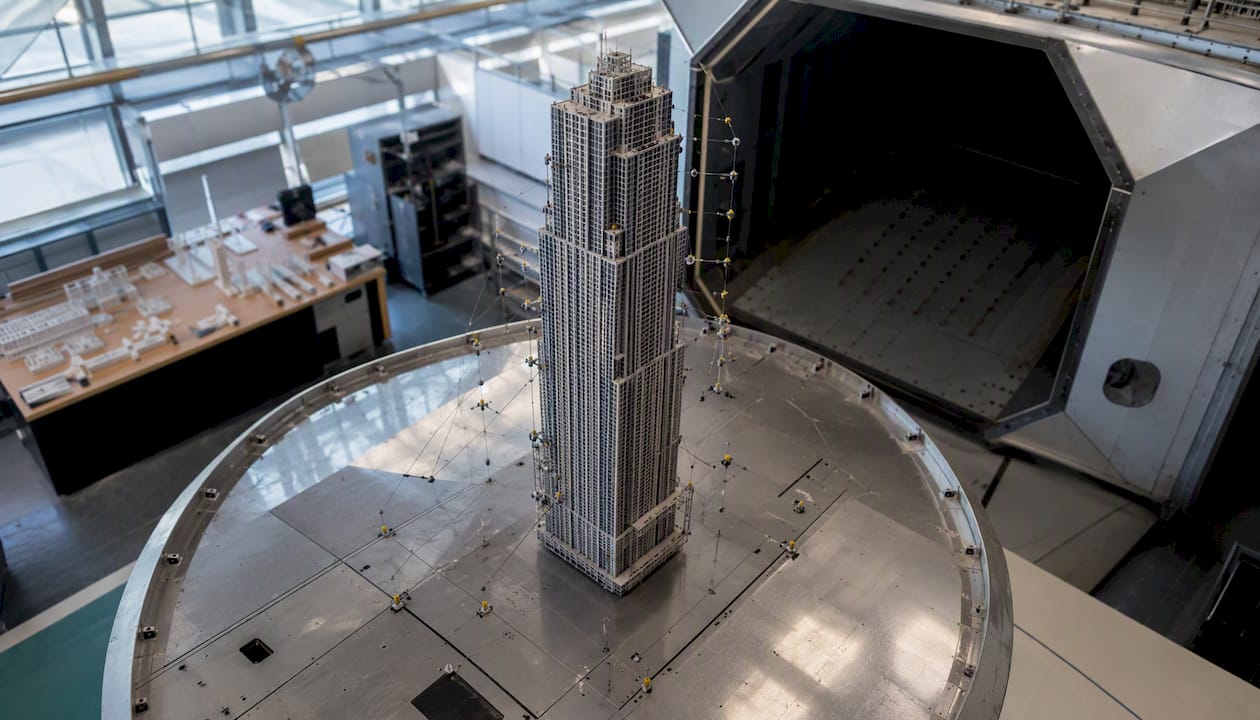
Wind engineering is the discipline that quantifies how atmospheric wind interacts with structures, machines, and the built environment, with primary goals spanning wind load analysis, aerodynamic performance, occupant comfort, and wind energy extraction. Governed by bodies such as the International Association for Wind Engineering (IAWE) and shaped by foundational researchers including Alan G. Davenport, the field draws on structural engineering, meteorology, fluid mechanics, and applied statistics. Design standards such as ASCE 7-22 translate that science into codified actions that engineers apply daily.
This guide covers:
- The field’s historical development and technical scope
- Core subfields from aeroelasticity to pedestrian wind comfort
- Primary methods: wind-tunnel testing, CFD, and field measurement
- International design codes and how they differ
- Where to publish, which societies to join, and which textbooks to read
- How consultancies package and deliver wind engineering services
- Education pathways, key facilities, and publicly available datasets
Key Takeaways
Wind engineering is a multi-method discipline requiring validated models, code-compliant load analysis, and cross-disciplinary expertise to produce defensible structural and environmental outcomes.
| Point | Details |
|---|---|
| Interdisciplinary foundation | The field combines structural engineering, meteorology, and fluid mechanics; no single discipline covers it alone. |
| Method triangulation | Combine wind-tunnel testing, CFD, and field measurements for the most defensible project outcomes. |
| Code specificity matters | ASCE 7-22, EN 1991-1-4, IS 875 Part 3, and BNBC 2020 differ in wind-speed basis and exposure framework; always verify local adoption. |
| MWFRS vs. C&C distinction | Applying MWFRS pressures to cladding design is a common error; C&C peak pressures are substantially higher. |
| Firm’s role | Aman Engineering Consultancy delivers wind-load assessments, statutory submissions, and CFD project management integrated into full structural design packages. |
Table of Contents
- What is wind engineering and why does it matter?
- Historical development and scope of the field
- Core technical subfields you need to understand
- What methods and tools do wind engineers use?
- How are wind loads codified in design standards?
- Where should you read, publish, and get involved?
- How do consultancies deliver wind engineering services?
- Education and career pathways in wind engineering
- Key experimental facilities and public datasets
- Wind engineering consultancy services from Aman Engineering
- A practitioner’s perspective on combining methods
- Sources
What is wind engineering and why does it matter?
Wind engineering is an interdisciplinary field combining structural and mechanical engineering, meteorology, and applied physics to analyze wind effects on structures, wind comfort, and wind energy applications. Its modern form traces to the United Kingdom in the 1960s, when Alan G. Davenport introduced the wind-loading chain — a systematic framework connecting atmospheric turbulence statistics to structural response. That framework remains the conceptual backbone of the discipline.
The field’s scope is broad. It encompasses the built environment (buildings, bridges, facades, towers), wind energy systems (turbines, site assessment, SCADA monitoring), aeroelastic phenomena (flutter, vortex-induced vibration), pollutant dispersion, and pedestrian-level microclimate. Practitioners include structural engineers, aerodynamicists, boundary-layer meteorologists, wind-energy engineers, and specialist consultants.
The practical stakes are high. According to the American Association for Wind Engineering (AAWE), wind is responsible for the largest component of insured losses for structures in the United States for single extreme events, and older building inventories remain especially vulnerable despite decades of wind-loading research. That vulnerability motivates both the regulatory codification of wind loads and the ongoing research into better prediction methods.
Recent drivers have intensified demand for the discipline. Taller and more slender high-rise buildings, longer bridge spans, the rapid expansion of wind energy capacity, and the growing recognition that climate change is shifting extreme wind patterns all require more rigorous analysis than empirical rules alone can provide.
Historical development and scope of the field
The timeline below traces the discipline’s major milestones and connects them to the methods and standards covered later in this guide.
- 1960s: Alan G. Davenport develops the wind-loading chain at the University of Western Ontario; boundary-layer wind tunnels emerge as the primary experimental tool.
- 1972: The Journal of Wind Engineering and Industrial Aerodynamics (JWEIA) is established, providing the field’s primary peer-reviewed publication venue.
- 1975: IAWE is formally constituted, creating an international professional body for conferences, scholarships, and best-practice dissemination.
- 1980s–1990s: Codification accelerates; ASCE 7 and Eurocode EN 1991-1-4 incorporate probabilistic wind-speed maps and exposure-category frameworks.
- 2000s–2010s: Computational fluid dynamics (CFD) matures as a complementary tool; wind energy site assessment becomes a major commercial subfield.
- 2020s: Climate change projections alter design wind-speed maps in several jurisdictions; urban microclimate studies gain prominence as dense city development intensifies.
The field’s scope today covers five broad domains: wind effects on the built environment, wind energy and turbine aerodynamics, aeroelastic stability of flexible structures, environmental wind studies including pollutant dispersion, and instrumentation and measurement science. Each domain draws on a shared methodological toolkit but applies it with different acceptance criteria and regulatory frameworks.
Core technical subfields you need to understand
The following taxonomy maps the discipline’s principal subfields, the key metric or analysis associated with each, and the cross-disciplinary connections that define modern practice.
- Aerodynamics of bluff bodies and rotors. Quantifies pressure distributions, drag, and lift on buildings, bridges, and wind-turbine blades. Key metric: pressure coefficient Cp. Cross-link: experimental aerodynamics, CFD.
- Wind climate and extreme-value statistics. Characterizes the wind resource at a site using historical records and reanalysis data. Key analysis: fitting a Gumbel or Weibull distribution to annual maxima to derive return-period wind speeds. Cross-link: boundary-layer meteorology, probability theory.
- Structural response and dynamics. Translates aerodynamic loads into structural demand, accounting for resonance and dynamic amplification. Key metric: gust effect factor G and along-wind acceleration. Cross-link: structural dynamics, finite-element analysis.
- Aeroelasticity. Studies the coupled interaction between aerodynamic forces and structural deformation. Key phenomena: flutter (divergent oscillation), vortex-induced vibration (VIV), and galloping. Key metric: flutter limit speed and VIV lock-in frequency ratio. Cross-link: structural dynamics, nonlinear mechanics.
- Pedestrian wind comfort and microclimate. Assesses ground-level wind speeds around buildings against comfort and safety thresholds. Key analysis: exceedance probability of threshold wind speed at pedestrian height. Cross-link: urban planning, landscape architecture.
- Wind energy site assessment. Evaluates the wind resource for turbine siting, energy yield estimation, and wake modeling. Key metric: capacity factor and annual energy production (AEP). Cross-link: atmospheric science, electrical engineering.
- Pollutant and particle dispersion. Models the transport of exhaust, particulates, or smoke under wind-driven flow. Key analysis: concentration contours and dilution ratios. Cross-link: environmental engineering, public health.
- Instrumentation and measurement science. Develops and deploys sensors for wind-tunnel and field campaigns. Key tools: cup anemometers, sonic anemometers, pressure scanners, PIV systems, and SCADA data loggers.
Methods, codes, facilities, and publication venues that map to each subfield are addressed in the sections that follow.
What methods and tools do wind engineers use?
Comparison of primary analysis methods
| Method | Strengths | Limitations | Typical scale | Primary applications |
|---|---|---|---|---|
| Boundary-layer wind tunnel | Captures local flow features (corner jets, through-flow); gold standard for pedestrian comfort | High cost; model scale limits Reynolds number; requires specialist facility | 1:100–1:500 model scale | Tall buildings, bridges, facades, microclimate |
| CFD (RANS, LES, DES) | Parametric flexibility; full-field data; no scale constraints | Requires validation; turbulence modeling errors; high compute cost for LES | Full scale or model scale | Preliminary design, complex terrain, dispersion |
| Field measurement | Real atmospheric conditions; full-scale Reynolds number | Long campaign duration; uncontrolled variables; instrumentation cost | Full scale | Validation, post-construction monitoring, turbine SCADA |
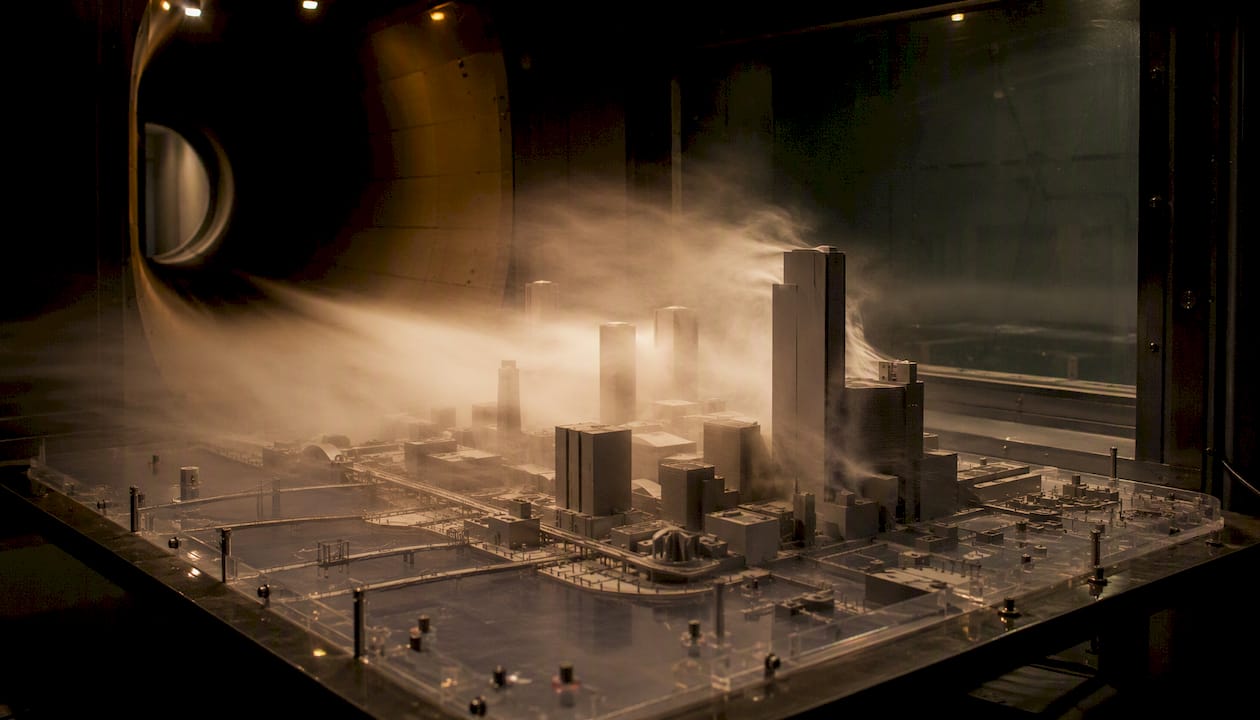
Wind-tunnel experiments remain the preferred method for detailed aerodynamic and pedestrian comfort studies because they capture local flow features — corner jets, through-flow channels, recirculation zones — that coarse field measurements or poorly validated CFD frequently miss. CFD is most productive when used alongside wind-tunnel data: the tunnel provides validation benchmarks, and CFD extends the parametric range.
Common instrumentation and typical applications
| Instrument | Typical use | Accuracy note |
|---|---|---|
| Cup anemometer | Mean wind speed at meteorological masts | ±2–3% for calibrated units; sensitive to turbulence intensity |
| Sonic anemometer (3D) | Turbulence statistics, flux measurements | High frequency response; no moving parts; preferred for research |
| Pressure tap / scanner | Surface pressure distributions on models or facades | Multi-channel scanners enable simultaneous acquisition |
| Particle Image Velocimetry (PIV) | Full-field velocity in wind-tunnel cross-sections | Requires seeding and laser sheet; high spatial resolution |
| Load cell / force balance | Integrated aerodynamic forces on wind-tunnel models | Stiff mounting required; dynamic range must match model loads |
| Strain gauge | Structural response monitoring in field campaigns | Requires temperature compensation; long-term drift management |
| SCADA data logger | Wind-turbine performance and condition monitoring | Large data volumes; preprocessing needed before analysis |
Pro Tip: *Before committing to a CFD-only study, confirm that the turbulence model and boundary conditions have been validated against a published benchmark or wind-tunnel dataset for a geometrically similar case.
Scaling and similarity are non-negotiable in wind-tunnel work. The atmospheric boundary-layer profile, turbulence intensity, and integral length scales must all be reproduced at model scale. Reynolds number similarity is generally unachievable at typical model scales, but for sharp-edged bluff bodies — the dominant geometry in structural wind engineering — flow separation is geometry-controlled, making Reynolds number effects secondary. For rounded geometries (cable cross-sections, cooling towers), Reynolds number sensitivity must be explicitly assessed.
The most defensible project outcomes combine all three method categories: wind-tunnel testing for local pressure and comfort data, CFD for parametric sensitivity and dispersion mapping, and field measurements for post-construction validation or turbine performance verification.
How are wind loads codified in design standards?
Major international standards
- ASCE 7-22 (United States): The primary reference for wind load analysis in U.S. structural design. Provides velocity-pressure equations with factors Kz (height and exposure), Kzt (topographic), Kd (directionality), and Ke (ground elevation), plus the gust effect factor G and tabulated pressure coefficients.
- Eurocode EN 1991-1-4 (European Union): Defines basic wind velocity, peak velocity pressure qp, and structural factors cs·cd for dynamic response. Exposure is handled through terrain category and orography factors.
- IS 875 Part 3 (India): Specifies basic wind speed maps, terrain categories, and design wind pressure for buildings and structures across Indian jurisdictions.
- BNBC 2020 (Bangladesh): Adopts a similar probabilistic framework, with wind-speed maps and exposure categories calibrated to local climatology.
Always verify which version of a code has been formally adopted by the local authority having jurisdiction before commencing design. Code adoption lags publication by months to years in many jurisdictions, and using a superseded version can invalidate a statutory submission.
Key distinction: MWFRS versus C&C
The separation between the Main Wind Force Resisting System (MWFRS) and Components and Cladding (C&C) is one of the most consequential distinctions in practical building wind resistance design. MWFRS provisions govern the overall lateral load path — frames, shear walls, diaphragms — using spatially averaged pressures that account for partial loading and correlation across the building envelope. C&C provisions govern individual elements — cladding panels, fasteners, rooftop signs, glazing — using peak local pressures that are substantially higher than the MWFRS values. Applying MWFRS pressures to cladding design is a common and potentially dangerous error.
Qualitative comparison of regional code approaches
| Standard | Wind-speed basis | Exposure framework | Dynamic provisions | Typical application |
|---|---|---|---|---|
| ASCE 7-22 | 3-second gust, MRI-based maps | Exposure categories A–D | Gust effect factor; flexible building procedure | U.S. buildings and structures |
| EN 1991-1-4 | 10-min mean, return period maps | Terrain categories I–IV | Structural factor cs·cd | EU buildings, bridges |
| IS 875 Part 3 | 3-second gust, regional maps | Terrain categories 1–4 | Dynamic response factor | Indian buildings |
| BNBC 2020 | 3-second gust, national maps | Exposure categories B–D | Similar to ASCE framework | Bangladeshi structures |
Multi-code calculators implementing ASCE 7-22, EN 1991-1-4, BNBC 2020, and IS 875-3 are available for rapid MWFRS and C&C checks; a multi-code wind load calculator can help practitioners cross-check results across jurisdictions during international projects.
Where should you read, publish, and get involved?
Key journals
- Journal of Wind Engineering and Industrial Aerodynamics (JWEIA): The field’s flagship peer-reviewed journal, covering experimental, numerical, and field-based studies across all subfields. Published by Elsevier; consistently high impact factor within civil and structural engineering.
- Wind Engineering (SAGE Publications): A peer-reviewed journal with a strong focus on applied wind engineering, including structural response, wind energy, and environmental wind studies. Particularly relevant for practitioners bridging research and design.
- Wind Energy (Wiley): Focused on wind-turbine aerodynamics, resource assessment, and wind energy systems; the primary venue for wind-energy-specific research.
- Journal of Fluids and Structures: Covers aeroelastic phenomena and fluid-structure interaction; relevant for bridge and slender-structure research.
Canonical textbooks
- Simiu & Scanlan, Wind Effects on Structures: The foundational reference for structural wind engineering, covering wind climate, bluff-body aerodynamics, aeroelasticity, and codification. Essential for graduate students and researchers.
- Wind Engineering: Fundamentals and Applications (Springer): A contemporary textbook linking theory to practice across wind climate, wind-tunnel testing, aerodynamics, and aeroelasticity; recommended for advanced students and researchers entering the field.
Professional societies and conferences
- IAWE: The international professional body promoting wind-engineering research and collaboration. Organizes the International Conference on Wind Engineering (ICWE) every four years, maintains a scholarship program for students, and publishes society-level best practices. Membership provides access to conference proceedings and a global network of researchers and practitioners.
- AAWE: The American national body affiliated with IAWE; organizes the Americas Conference on Wind Engineering (ACWE) and publishes technical resources on wind-related losses and mitigation.
Practical literature-search guidance
For systematic literature searches, use Scopus or Web of Science with controlled vocabulary terms (e.g., “boundary-layer wind tunnel,” “aeroelastic instability,” “pedestrian wind comfort”). Set journal alerts for JWEIA and Wind Engineering to track new publications. Follow IAWE conference proceedings for emerging research that has not yet appeared in journals. When selecting a publication venue, match the subfield emphasis: experimental aerodynamics and structural response belong in JWEIA; wind energy resource and turbine studies fit Wind Energy; applied structural dynamics with wind loading suits Engineering Structures or Wind Engineering (SAGE).
Impact factor is a useful but imperfect signal. A paper in a lower-impact specialist journal that reaches the right audience often has more career value than one buried in a high-impact general journal where wind engineering is peripheral.
How do consultancies deliver wind engineering services?
Typical project workflow
- Brief and site reconnaissance. Define the project scope, design life, risk category, applicable standards, and acceptance criteria. Collect site plans, topographic surveys, and nearby obstruction data. Confirm the exposure category and local wind-speed map value.
- Wind climate analysis. Obtain meteorological data (station records, reanalysis products) and perform extreme-value analysis to derive design wind speeds at the required return periods.
- Preliminary analysis. Apply code procedures (ASCE 7-22, EN 1991-1-4, or local equivalent) to establish baseline wind loads for structural design. Flag any features — complex geometry, flexible structure, sensitive cladding — that require physical or numerical testing.
- Wind-tunnel or CFD study. Commission boundary-layer wind-tunnel testing for detailed pressure distributions, pedestrian comfort assessment, or aeroelastic model testing. Use CFD for dispersion studies or parametric geometry variations. Validate CFD against tunnel data where both are used.
- Structural response analysis. Integrate aerodynamic loads into the structural model, accounting for dynamic amplification where required. For structural modeling and analysis, this step connects wind loads to member design and connection checks.
- Design recommendations and mitigation. Identify exceedances of acceptance criteria and recommend mitigation measures: geometry modifications, dampers, screens, canopies, or landscape features for microclimate issues.
- Statutory submission package. Compile wind-loading reports, wind-tunnel reports, CFD study summaries, and supporting calculations into a submission package compliant with the authority’s requirements.
- Construction monitoring and post-construction verification. Specify instrumentation for monitoring during construction (particularly for temporary works exposed to wind) and post-construction verification campaigns where required.
Typical consultancy deliverables
- Wind-loading report (code-based MWFRS and C&C pressures)
- Boundary-layer wind-tunnel report (pressure coefficients, comfort assessments)
- CFD study report (velocity fields, dispersion contours)
- Pedestrian wind microclimate assessment with mitigation recommendations
- SCADA data analysis report for wind-turbine projects
- Instrumentation specification for monitoring campaigns
- Statutory submission package for authority review
Questions to ask early and common project hurdles
Before engaging a wind engineering consultant, the project team should confirm: the applicable design standard and the version adopted locally; the site’s exposure category and any topographic amplification; the design life and risk category of the structure; and the required deliverable format for statutory submission.
Common project hurdles include data gaps in local meteorological records (mitigated by reanalysis products or regional correlation studies), complex terrain that invalidates simple exposure-category assumptions (addressed by site-specific wind-tunnel or CFD modeling), and code ambiguities at the boundary between MWFRS and C&C (resolved by explicit documentation of the load path and element classification). Reproducible reports with clear assumptions, validated models, and acceptance criteria tied to the applicable code or client risk tolerance are the deliverables that withstand regulatory scrutiny.
Education and career pathways in wind engineering
Recommended coursework
- Fluid mechanics and aerodynamics (incompressible and compressible flow, boundary-layer theory)
- Atmospheric boundary-layer meteorology (turbulence structure, stability, wind profiles)
- Structural dynamics (modal analysis, frequency response, random vibration theory)
- Probability and statistics (extreme-value theory, time-series analysis, reliability methods)
- Numerical methods and CFD (finite-volume methods, turbulence modeling, mesh generation)
- Experimental methods (wind-tunnel laboratory practice, instrumentation, signal processing)
Skills checklist for early-career practitioners
- CFD proficiency (OpenFOAM, ANSYS Fluent, or equivalent)
- Wind-tunnel testing experience (model fabrication, pressure scanning, force-balance operation)
- Data analysis: time-series processing, spectral analysis, extreme-value fitting (Gumbel, Weibull)
- Instrumentation and signal processing (anemometry, pressure scanners, data-acquisition systems)
- Coding: Python or MATLAB for data reduction, statistical analysis, and post-processing
- Familiarity with at least one major design standard (ASCE 7-22 or EN 1991-1-4)
Finding internships, thesis topics, and networks
Target IAWE events — particularly the ICWE and regional conferences — for networking with both academic researchers and practicing consultants. University boundary-layer wind-tunnel groups are the most direct entry point for experimental training; many accept undergraduate research assistants. NASA Glenn’s Beginner’s Guide to Wind Tunnels provides accessible grounding in wind-tunnel principles for students planning their first laboratory work.
Productive master’s and PhD topics tend to bridge method and application. Current high-value areas include wind microclimate in dense urban environments (where pedestrian comfort failures are more common than structural failures), aeroelasticity of long-span bridges under turbulent wind, machine-learning-assisted extreme-value analysis from short meteorological records, and wake interaction modeling for large offshore wind farms. Multidisciplinary projects that combine structural dynamics with atmospheric science consistently attract both academic funding and industry co-sponsorship.
Key experimental facilities and public datasets
Exemplar wind-tunnel facilities
- NASA Glenn 10×10 Supersonic Wind Tunnel: A large, versatile facility supporting high-speed propulsion and aerodynamic testing across Mach 2.0–3.5, with advanced instrumentation for steady-state and dynamic data acquisition. Primarily an aerospace wind tunnel rather than a boundary-layer facility, but exemplary for understanding large-scale facility capabilities and instrumentation standards.
- NASA Glenn 1×1 and 8×6 Wind Tunnels: Provide complementary subsonic-to-supersonic test capabilities with visualization instrumentation including Schlieren imaging and PIV, useful for fundamental and propulsion research.
- University boundary-layer wind tunnels: Facilities at institutions such as the University of Western Ontario (Davenport Wind Engineering Group), Colorado State University, and Monash University operate large boundary-layer tunnels specifically configured for civil and structural wind engineering, with turntables, roughness fetch, and spire arrays for atmospheric profile simulation.
Selected facilities and dataset sources
| Resource | Type | Contents / capabilities | Access |
|---|---|---|---|
| NASA Glenn 10×10 tunnel | Experimental facility | High-speed propulsion and aerodynamic testing, Mach 2.0–3.5 | User program; contact NASA Glenn |
| NASA Glenn 1×1 tunnel | Experimental facility | Subsonic–supersonic, Schlieren and PIV visualization | User program; contact NASA Glenn |
| ERA5 (ECMWF reanalysis) | Public dataset | Global hourly wind fields, 1940–present, 31 km resolution | Free via Copernicus Climate Data Store |
| NOAA Integrated Surface Database | Public dataset | Hourly station observations globally; wind speed and direction | Free download via NOAA NCEI |
| NREL Wind Integration National Dataset (WIND) | Public dataset | Simulated wind resource data for the continental U.S. | Free via NREL Data Catalog |
Many university facilities operate user programs or academic partnership agreements; access typically requires a formal proposal describing the test objectives and model specifications. Public datasets such as ERA5 and the NOAA Integrated Surface Database require registration but are freely available for academic use. SCADA data from commercial wind farms is generally proprietary, but some operators share anonymized datasets through research partnerships or national energy research programs.
Wind engineering consultancy services from Aman Engineering

Structural and facade wind-load assessments, pedestrian microclimate studies, CFD project management, and statutory submission packages are among the core wind-related services that Aman Engineering Consultancy delivers for developers, contractors, and building owners. The firm integrates wind-load data directly into civil and structural design workflows, ensuring that MWFRS and C&C pressures are correctly applied across the full load path from facade to foundation, and that submission packages meet authority requirements without revision cycles.
Before contacting a consultant, prepare the following: site plans and topographic surveys, the applicable design standard and local adoption version, the structure’s risk category and design life, and the required deliverable format for the relevant authority. Knowing these items in advance compresses the scoping phase significantly. For guidance on structuring the engagement itself, the firm’s resource on how to engage engineering consultants effectively outlines what to expect at each project stage.
A practitioner’s perspective on combining methods
The most persistent gap in wind engineering practice is not a shortage of methods — it is the tendency to treat any single method as sufficient. Projects that rely exclusively on code-based calculations miss the local amplification effects that wind-tunnel testing reveals. Projects that use CFD without experimental validation frequently underestimate peak pressures at building corners and re-entrant angles. Projects that collect field data without a prior analytical model often lack the structured hypotheses needed to interpret what the sensors are measuring.
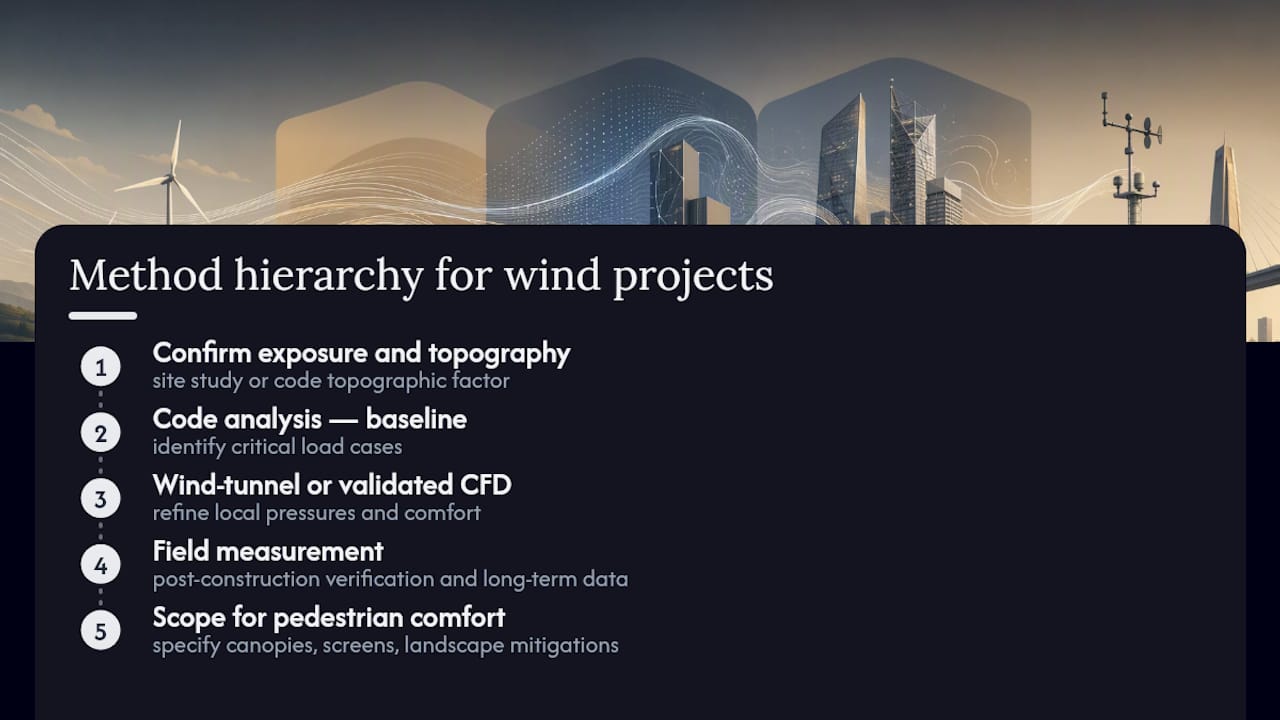
The most defensible and technically complete approach treats the three method categories as a hierarchy: code analysis establishes the baseline and identifies the critical load cases; wind-tunnel testing or validated CFD refines the local pressure distribution and comfort assessment; and field measurement provides post-construction verification or long-term performance data. On complex urban developments, the project-critical issue is frequently pedestrian-level wind comfort and microclimate rather than global structural safety, which changes how practitioners scope tests and specify mitigation measures such as canopies, screens, and landscape features.
Pro Tip: Always confirm the exposure category and the presence of nearby topographic features — escarpments, ridges, valleys — before trusting a wind-speed map value. A site that appears to fall in a standard exposure category on a regional map can experience significantly amplified speeds due to local channeling or topographic speed-up, and that amplification must be captured either through a site-specific wind study or an explicit topographic factor applied in accordance with the applicable code.
Sources
- American Association for Wind Engineering (AAWE)
- Wind engineering
- 10×10 Supersonic Wind Tunnel | NASA
- Free Wind Load Calculator (ASCE 7): Design Wind Pressures for Buildings & Structures | Simulations4All
- Home – International Association for Wind Engineering