

HDB project compliance is defined as mandatory adherence to Housing & Development Board regulations governing renovation permits, structural alterations, and construction works in Singapore’s public housing estates. Property developers and construction professionals who skip this process face stop-work orders, fines, and reinstatement costs that far exceed the original project budget. Understanding why do HDB projects need compliance is not optional knowledge. It is the foundation of every legally approved, structurally sound renovation in Singapore’s public housing sector.
Why do HDB projects need compliance?
HDB project compliance exists to protect three things simultaneously: structural integrity, resident safety, and legal standing. Singapore’s Housing & Development Board governs one of the world’s densest public housing systems, where a single unauthorized alteration in one flat can compromise the structural performance of an entire block. The regulatory framework administered through agencies including HDB, BCA, and SCDF reflects this reality directly.
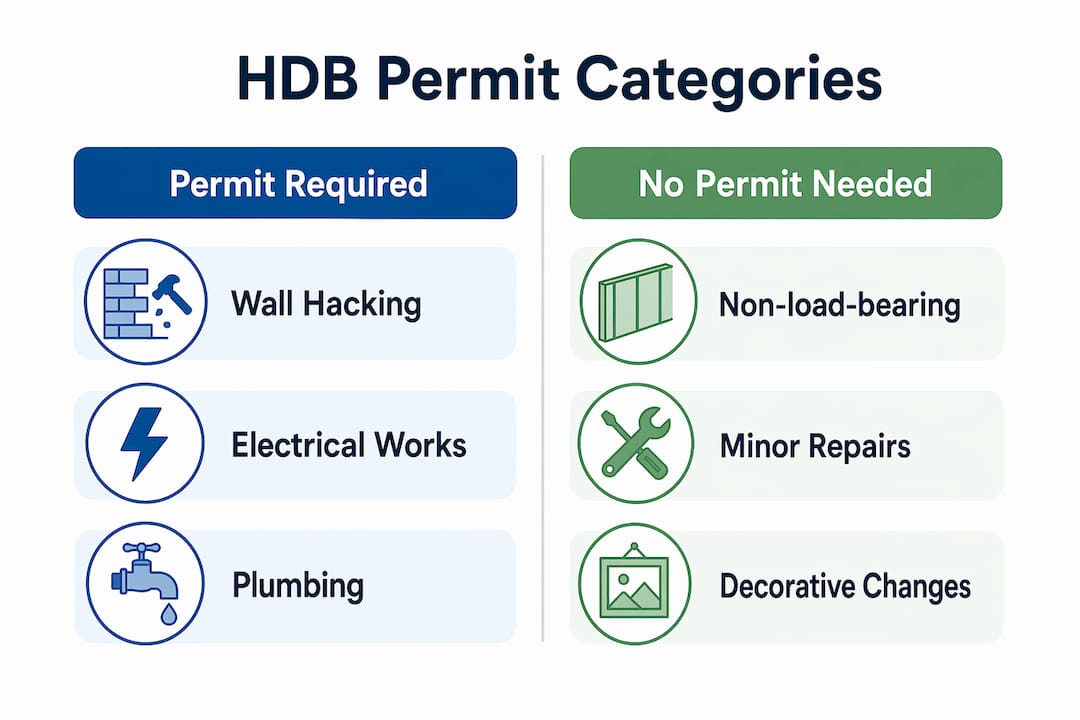
Compliance covers every phase of a renovation project, from initial permit application to final inspection. Works that require mandatory permits include wall hacking, flooring replacement, plumbing modifications, and electrical rewiring. Works that do not require permits include painting, installing curtain rods, and replacing light fixtures. The distinction matters because misclassifying a regulated activity as a minor task is one of the most common causes of enforcement action.

The APEX permit system is the primary digital platform through which registered contractors submit HDB renovation permit applications. APEX centralizes permit tracking, approval records, and contractor registration verification. Flat owners and project managers who understand the APEX workflow gain a direct advantage in managing submission timelines and avoiding resubmission cycles.
Permit categories and what they cover
The table below summarizes the main categories of HDB renovation works and their permit requirements.
| Work Category | Permit Required | Key Regulatory Concern |
|---|---|---|
| Wall hacking (non-load-bearing) | Yes | Structural and waterproofing impact |
| Flooring replacement | Yes | Waterproofing membrane protection |
| Electrical rewiring | Yes | Fire safety and load compliance |
| Plumbing modifications | Yes | Waterproofing and PUB standards |
| Painting and surface finishes | No | Cosmetic only |
| Light fixture replacement | No | No structural or safety impact |
Pro Tip: Always request a written scope breakdown from your contractor before submission. Vague descriptions like “minor works” are a leading cause of permit rejection and force costly resubmission cycles.
Why is compliance critical for safety and structural integrity?
Structural safety is the primary technical reason HDB compliance requirements exist. Unauthorized hacking of load-bearing walls or waterproofing membranes creates direct risks of structural failure and water leaks that affect neighboring units. In high-rise public housing, these failures do not stay contained to a single flat.
Waterproofing membranes beneath bathroom and kitchen floors are particularly vulnerable. Contractors who cut through these membranes without approved plans and proper reinstatement procedures create chronic water ingress problems that can affect multiple floors below. HDB regulations prohibit these alterations without explicit permit approval and, in many cases, Professional Engineer endorsement.
The safety framework extends beyond structural concerns to community impact. HDB enforces strict working hours to manage disturbance: weekdays 9am to 6pm are permitted, Saturday hours are limited, and no renovation work is allowed on Sundays or public holidays. These restrictions protect residents in adjacent units from sustained noise exposure and protect building systems from unmonitored after-hours works.
The following compliance requirements directly protect structural and community safety:
- Load-bearing wall protection: No hacking permitted without structural assessment and HDB approval.
- Waterproofing membrane preservation: Flooring works require approved methods that maintain membrane integrity.
- Professional Engineer endorsement: Structural alterations above defined thresholds require a PE-stamped submission.
- Registered contractor requirement: Only HDB-registered contractors may carry out regulated renovation works.
- Working hours compliance: Noise control guidelines protect shared living environments across the estate.
Registered contractors carry professional accountability for the works they perform. Their registration status is verifiable through HDB’s official contractor registry, and their involvement in a project creates a documented chain of responsibility. Projects that use unregistered contractors lose this accountability layer entirely.
What are the legal and financial consequences of non-compliance?
Non-compliance in HDB renovation projects produces three categories of consequences: enforcement orders, financial penalties, and mandatory reinstatement. Each category compounds the others.
“Failing to obtain required HDB renovation permits can lead to immediate stop-work orders, fines up to S$5,000, and mandatory reinstatement of the flat at the owner’s cost.”
The reinstatement obligation is the most financially damaging outcome. Flat owners ordered to reinstate must pay to hack out completed works, restore original conditions, and reapply for proper permits before restarting. In practice, this means paying twice for the same scope of work.
The legal liability structure compounds this risk. Flat owners bear full legal responsibility for permit compliance, even when a hired contractor handles all submissions. This means a contractor’s error or omission becomes the flat owner’s legal problem. Verifying contractor registration and reviewing every permit submission before it is lodged is not optional due diligence. It is a legal necessity.
The most common compliance failures that trigger enforcement action are:
- Unauthorized structural works: Hacking load-bearing walls or altering structural elements without approved plans.
- Unregistered contractor engagement: Hiring contractors not listed in HDB’s official registry.
- Vague or incomplete permit submissions: Submitting scope descriptions that do not itemize specific works.
- Works outside approved hours: Conducting renovation activities on Sundays, public holidays, or outside permitted weekday hours.
- Deviating from approved plans: Executing works that differ materially from the approved permit scope.
Developers and construction professionals managing multiple HDB projects should treat each of these failure points as a formal checklist item. A single enforcement action on one project can delay the entire portfolio through cascading stop-work orders and resubmission requirements. For a detailed breakdown of financial exposure, the cost of illegal HDB renovations analysis from Aman Engineering Consultancy provides project-specific cost modeling.
How does compliance affect project timeline and approval success?
Compliance directly controls project timeline. HDB renovation permits typically process within 3–10 working days when the application scope is complete and well-defined. That window shrinks to zero when applications are rejected and sent back for resubmission.
The most frequent cause of rejection is a vague scope description. Submissions that describe works as “minor works” or “general renovation” without itemizing specific activities are rejected at the initial review stage. Each rejection adds a minimum of one full processing cycle to the project timeline. On a project with a fixed completion date, that delay has direct cost implications for contractors and developers alike.
A compliance-first approach from project initiation prevents these delays. Detailed permit scopes and adherence to approved plans prevent costly rework and produce smoother project delivery. The practical steps that support this approach include:
- Itemize every work activity in the permit application, including dimensions, materials, and methods.
- Verify contractor registration through HDB’s official registry before engagement, not after.
- Cross-reference approved plans at every project stage to confirm works remain within permitted scope.
- Document all site inspections and maintain records accessible to both the flat owner and contractor.
- Submit amendments promptly when scope changes arise mid-project rather than proceeding without updated approval.
The HDB approval process in 2026 has become more structured, with APEX system submissions requiring greater specificity than in prior years. Developers who treat compliance as a project management discipline rather than a regulatory formality consistently achieve faster approvals and fewer enforcement encounters.
Key takeaways
HDB project compliance is non-negotiable: it protects structural integrity, prevents legal liability, and determines whether a project completes on time or stalls under enforcement action.
| Point | Details |
|---|---|
| Compliance is legally mandatory | Flat owners hold full legal liability for permit compliance, regardless of contractor involvement. |
| Permits cover specific work types | Wall hacking, flooring, plumbing, and electrical rewiring all require approved permits before works begin. |
| Non-compliance carries direct costs | Stop-work orders and fines up to S$5,000, plus mandatory reinstatement at the owner’s expense. |
| Approval timelines depend on submission quality | Complete, itemized applications process within 3–10 working days; vague submissions trigger rejection cycles. |
| A compliance-first approach reduces total project cost | Detailed scopes and registered contractors prevent rework, delays, and enforcement action. |
Compliance lessons learned from the field
The most persistent misconception I encounter among flat owners and even some developers is that engaging a registered contractor transfers all compliance responsibility. It does not. The contractor submits through APEX, but the flat owner remains the legal holder of every permit obligation. I have seen projects where a contractor submitted an incomplete scope, works proceeded, and the flat owner received the stop-work order and reinstatement bill. The contractor moved on to the next job.
The second lesson is that compliance is cheapest at the start. Every dollar spent on thorough permit preparation, contractor verification, and scope documentation saves multiples in reinstatement costs, resubmission fees, and project delays. Developers who treat the permit application as an administrative afterthought consistently face the highest enforcement costs.
The third lesson is structural. Unauthorized alterations to load-bearing walls and waterproofing membranes are not just regulatory violations. They are engineering failures waiting to materialize. I have reviewed cases where water ingress from a single improperly reinstated bathroom floor affected three units below over two years. The original renovation cost was a fraction of the eventual repair and legal liability.
The practical advice is direct: verify contractor registration before signing any contract, review every permit submission before it is lodged, and treat the approved plan as the binding project document from day one. The HDB renovation permit requirements are not obstacles. They are the framework that keeps projects legally sound and structurally safe.
— Aman
Aman Engineering Consultancy’s approach to HDB compliance
Navigating HDB regulatory requirements demands more than familiarity with permit categories. It requires systematic documentation, verified contractor coordination, and technical expertise across structural, M&E, and fire safety domains.

Aman Engineering Consultancy provides end-to-end compliance support for HDB projects, covering permit preparation, APEX submission management, statutory inspections, and coordination with BCA, HDB, SCDF, and PUB. The firm’s registered engineers and architects bring direct experience with the specific documentation standards that produce first-pass approvals. Property developers and construction professionals who require structured compliance support can review the full range of engineering and compliance services available through Aman Engineering Consultancy. For projects requiring structured compliance workflows, the Singapore construction compliance checklist provides a practical starting framework.
FAQ
What is HDB project compliance?
HDB project compliance is the mandatory adherence to Housing & Development Board regulations governing renovation permits, structural works, and construction activities in Singapore’s public housing estates. It covers permit applications, approved contractor requirements, working hour restrictions, and post-completion inspections.
What happens if you renovate an HDB flat without a permit?
Unauthorized renovation works trigger immediate stop-work orders, fines up to S$5,000, and mandatory reinstatement of the flat to its original condition at the flat owner’s cost.
Who is legally responsible for HDB permit compliance?
Flat owners bear full legal responsibility for permit compliance, even when a registered contractor handles all submissions through the APEX system. Owners must verify contractor registration and review all permit scopes before submission.
How long does HDB permit approval take?
HDB renovation permits process within 3–10 working days when the application is complete and the scope is clearly itemized. Vague or incomplete submissions are rejected and require full resubmission, adding at least one additional processing cycle.
Which renovation works require an HDB permit?
Works requiring permits include wall hacking, flooring replacement, plumbing modifications, and electrical rewiring. Cosmetic works such as painting, curtain installation, and light fixture replacement do not require permits.