

Design certification is frequently mischaracterized as procedural overhead in Singapore construction, a step that slows timelines and adds cost without proportionate benefit. This characterization is factually incorrect and professionally dangerous. For property developers and construction stakeholders operating under the oversight of agencies such as BCA, URA, JTC, HDB, SCDF, PUB, and LTA, design certification is a foundational requirement that directly determines whether a project receives statutory approval, proceeds to construction, and ultimately achieves legally valid occupancy. Understanding its full scope is not optional.
Table of Contents
- Understanding design certification in construction
- Key regulatory and compliance reasons for certification
- How certification improves project outcomes and stakeholder benefits
- Common pitfalls: consequences of skipping certification
- The deeper value of design certification: what most developers overlook
- Discover expert support for design certification and compliance
- Frequently asked questions
Key Takeaways
| Point | Details |
|---|---|
| Certification ensures compliance | Design certification is required to meet Singapore’s strict regulatory standards and avoid legal risks. |
| Proactive certification speeds approvals | Early certification simplifies the project approval process and prevents costly delays. |
| Skilled engineers are essential | Certified professional engineers play a vital role in both design integrity and regulatory success. |
| Avoidable pitfalls cause project setbacks | Skipping certification leads to rejected permits, penalties, and stakeholder distrust. |
| Certification delivers strategic value | Beyond compliance, certified designs build reputation, foster trust, and enable creative solutions. |
Understanding design certification in construction
Having set the stage for why design certification cannot be ignored, let’s clarify what it actually involves and why authorities require it.
Design certification in Singapore construction refers to the formal process by which a licensed Professional Engineer (PE) reviews, validates, and endorses construction design documents to confirm they comply with applicable codes, standards, and regulatory requirements. This endorsement is not a rubber stamp. It represents the PE’s legal accountability for the technical adequacy of the design submitted to regulatory agencies. The regulatory frameworks requiring certified designs for construction projects are extensive, spanning structural integrity, fire safety, mechanical and electrical systems, and facade performance.
In Singapore, the Building Control Act and its subsidiary legislation mandate that certified design documents accompany all major permit applications. Without valid PE certification, applications to BCA for building plan approvals, or to LTA for road reserve approvals, will be rejected at the submission stage. Certification is, therefore, a precondition for statutory processing, not an optional layer.
The certification process involves several distinct steps:
- Design development: Engineers and architects develop technical design documents that address structural loads, material specifications, construction methodology, and safety parameters.
- Internal technical review: The PE conducts a detailed technical review against relevant Singapore Standards (SS), Eurocodes adopted locally, and agency-specific guidelines.
- Document endorsement: Upon satisfying all requirements, the PE endorses drawings, calculations, and specifications under his or her professional license number and seal.
- Statutory submission: Endorsed documents are submitted to the relevant authority through approved portals such as CORENET for BCA submissions.
- Regulatory review and approval: The authority reviews the certified submission and, upon satisfaction, issues the relevant permit or approval.
The role of the PE in this process extends well beyond signing documents. The PE is responsible for the overall technical direction of the design and for ensuring that civil and structural design services are executed within the bounds of statutory compliance. This accountability creates a professional liability framework that protects the public, the developer, and the built environment.
Pro Tip: Engage your PE from the pre-design stage, not after architectural layouts are finalized. Early PE involvement significantly reduces the risk of design revisions triggered during the certification review, which can cost weeks of timeline and substantial rework fees.
Key regulatory and compliance reasons for certification
Now that we understand the basics, it’s important to see how design certification is directly tied to legal and safety regulations for construction projects.
Singapore’s regulatory framework for construction is administered by multiple authorities, each with specific jurisdictional interests and approval requirements. BCA governs structural and architectural compliance. SCDF oversees fire safety engineering. PUB regulates drainage and sewerage. LTA controls transport-related infrastructure. Each agency requires certified designs within its domain before advancing any application. Non-compliance with any single agency’s certification requirement can stall the entire project.
Design certification is not a singular event but a continuous compliance obligation spanning the design, construction, and post-completion phases of any regulated building project in Singapore.
The design compliance guide for developers outlines that design certification contributes to safety by ensuring that every technical decision made during design is reviewed against prescribed safety thresholds. This is particularly critical for high-rise structures, industrial facilities, and mixed-use developments where structural failure or fire safety non-compliance carries catastrophic consequences.
The compliance process follows a structured sequence:
- Identify applicable regulatory requirements based on development type, zoning, and use. Different development categories trigger different certification obligations.
- Appoint qualified PEs for each discipline, including structural, civil, mechanical, electrical, and fire safety, as required by the project scope.
- Develop certified design documents for each disciplinary domain, ensuring all design parameters meet the relevant codes and authority-specific guidelines.
- Conduct pre-application consultations with relevant authorities where applicable, particularly for complex or atypical structural systems.
- Submit certified documents through the approved statutory portals and maintain a documented audit trail of all PE endorsements and submission records.
- Respond to authority queries promptly and with certified amendments, since unresponsive submissions are treated as incomplete and may be voided.
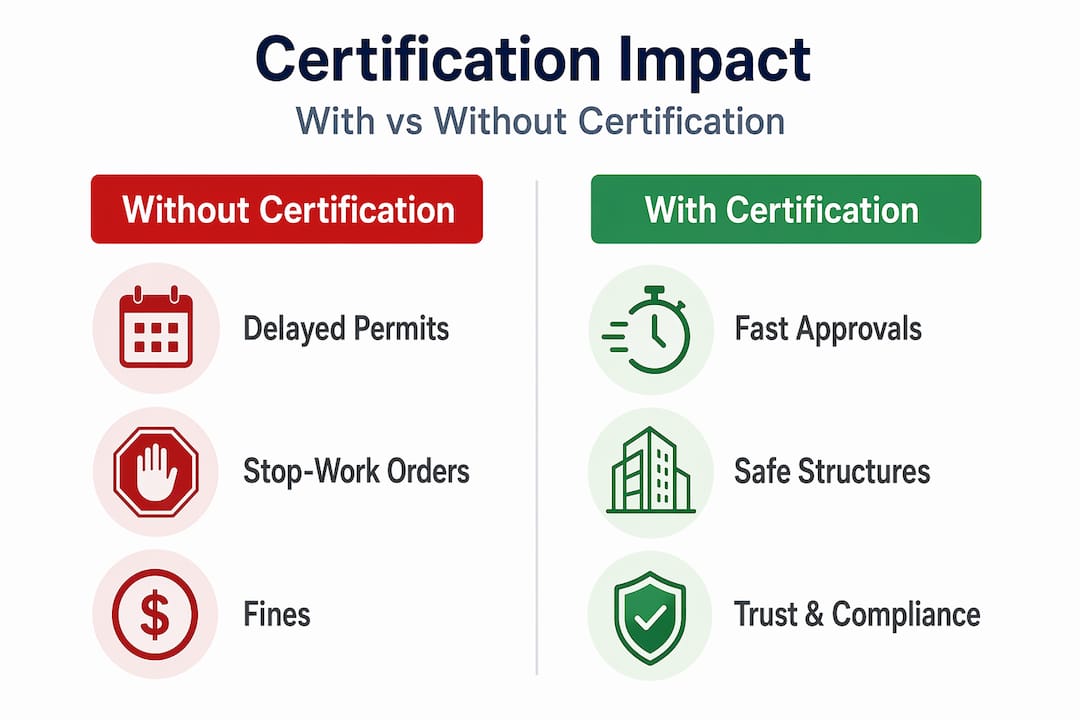
Referencing the structural engineering checklist for compliance confirms that omitting any certification element within a structural submission is sufficient grounds for rejection by BCA. A rejected submission triggers a full resubmission cycle, costing weeks and often months depending on queue volumes at the authority. Financial penalties may also apply for projects that proceed to site without valid certified approvals, with enforcement actions ranging from stop-work orders to prosecution under the Building Control Act.
How certification improves project outcomes and stakeholder benefits
Beyond compliance, design certification delivers strategic project benefits that all industry players in Singapore should understand.

The direct benefits of design certification extend well beyond simply satisfying regulatory checklists. Certified designs streamline the approval process because authorities receive documentation that has already been technically validated. This reduces the volume of authority queries, accelerates review cycles, and enables earlier commencement of construction activities. For developers managing project financing with drawdown schedules tied to construction milestones, this timeline compression has direct financial value.
The advantages of integrated design solutions in construction demonstrate that certified design documents benefit developers, contractors, and engineers by creating a single, authoritative technical reference that all parties use throughout the project lifecycle. Contractors working from certified drawings face fewer ambiguities during construction, reducing variation orders and site disputes.
| Factor | Without certification | With design certification |
|---|---|---|
| Permit approval time | Extended due to authority queries and incomplete submissions | Reduced due to pre-validated technical documentation |
| Project risk exposure | High, with liability gaps across design disciplines | Managed, with defined PE accountability per discipline |
| Contractor coordination | Frequent conflicts from unclear or non-compliant design intent | Clear construction documents with regulatory backing |
| Stakeholder confidence | Low, particularly among financiers and insurers | High, with certified compliance records available |
| Post-completion legal standing | Vulnerable to enforcement actions and occupancy permit issues | Secure, with a complete statutory approval trail |
| Dispute resolution | Complicated by lack of certified reference documentation | Simplified by certified, legally endorsed design records |
The risk reduction dimension deserves particular attention. When a PE certifies a design, that professional assumes a defined portion of the liability associated with the technical decisions. This creates a professional accountability structure that protects developers from bearing sole liability for design failures. Insurance underwriters and project financiers in Singapore increasingly require evidence of certified designs before extending coverage or approving construction loan disbursements.
Key stakeholder benefits of certified design include:
- Developers receive faster statutory approvals, stronger financing positions, and reduced post-completion liability exposure.
- Contractors benefit from technically clear construction documents that reduce ambiguity and the risk of non-compliant builds.
- Professional engineers maintain regulatory standing and professional credibility through documented certification records.
- End users and the public gain confidence that the built asset has been designed to legally mandated safety standards.
- Government agencies can efficiently process submissions and maintain public safety accountability across Singapore’s built environment.
The compounding effect of these benefits is substantial. Projects with fully certified design documentation from the outset tend to complete on schedule and within budget more consistently than those where certification is treated as a late-stage afterthought.
Common pitfalls: consequences of skipping certification
Understanding the benefits is useful, but awareness of what can go wrong without certification helps prevent costly missteps.
In practice, Singapore developers and contractors encounter a consistent set of certification-related failures that produce serious consequences. The most common is proceeding with structural works before BCA has issued the relevant building permit based on a certified structural submission. The Building Control Act is unambiguous on this point: unauthorized works constitute an offense, and enforcement responses are swift. Stop-work orders halt all site activities, and resumption requires a full compliance rectification process that may involve demolishing and rebuilding unauthorized elements.
The importance of the Certificate of Supervision system in formwork structural design illustrates why design certification is necessary even for temporary structures and construction methodology. Formwork failures are among the most serious site incidents in Singapore’s construction history. Certified formwork design and the dual Certificate of Supervision system are direct regulatory responses to these risks. Skipping certification for temporary works on the assumption that “it’s only temporary” is a well-documented pathway to both structural collapse and criminal prosecution under the Workplace Safety and Health Act.
| Pitfall scenario | Immediate consequence | Secondary impact |
|---|---|---|
| Submission without PE endorsement | Authority rejection at intake stage | Full resubmission required, weeks of delay |
| Commencing works without approved plans | BCA stop-work order issued | Financial penalties and potential prosecution |
| Incomplete disciplinary coverage in submission | Queries and clarification cycles from authority | Extended approval timeline and consultant costs |
| Non-certified formwork design | Structural risk during construction | WSH enforcement, potential prosecution, incident liability |
| Late PE appointment for certification | Retroactive design reviews required | Costly amendments and schedule compression |
The reputational consequences of certification failures are also significant and often underestimated. Developers who accumulate enforcement records with BCA or other agencies face increased scrutiny on future submissions. Some agency portals track submission histories, meaning that a pattern of incomplete or non-compliant submissions can translate into slower processing times on subsequent projects, a compounding disadvantage in Singapore’s fast-paced development market.
The financial exposure is similarly serious. Stop-work orders on large commercial or mixed-use developments can generate liquidated damages claims from tenants, contract penalties from financiers, and consultancy costs associated with rectification. A single certification oversight on a significant project can produce seven-figure financial consequences.
Pro Tip: Establish a certification tracking register at the project outset that logs each required certified submission, the responsible PE, the target submission date, and the authority review status. This simple governance tool prevents certification gaps from being discovered only when a milestone payment is blocked or a permit is rejected.
The deeper value of design certification: what most developers overlook
The industry often frames design certification purely as a compliance cost, a fee paid to a PE for a signature that authorities require. This framing fundamentally misrepresents what certification actually produces. Design certification is a structured technical quality process. The PE’s review is not a formality; it is a systematic interrogation of every significant design decision against established engineering principles and statutory requirements. This process catches errors, identifies constructability issues, and surfaces design conflicts before they manifest on site, where resolution is exponentially more expensive.
Singapore’s stringent certification standards, enforced by BCA and other agencies, are not administrative preferences. They reflect decades of institutional learning from construction incidents, structural failures, and fire safety events that occurred in less regulated environments. The standards are calibrated to the specific risks of Singapore’s dense urban construction environment, including high-rise building loads, underground infrastructure proximity, and the safety requirements of a high-density residential and commercial population.
There is a broader point that experienced practitioners recognize. Developers who engage certification not as a compliance obligation but as a technical quality mechanism consistently produce better buildings. They experience fewer construction defects, fewer post-occupancy complaints, and stronger long-term asset values. The PE’s role in reviewing civil and structural design explained documents is not a constraint on creative engineering; it is the mechanism by which creative engineering solutions are validated as structurally sound and legally executable.
The relationships built through repeated, high-quality certified submissions with regulatory agencies also generate strategic advantages. Authorities develop institutional familiarity with well-managed consultant teams, and while this does not replace rigorous review, it does create a professional trust dynamic that benefits project timelines over time. This is a competitive advantage that is difficult to quantify but consistently observable in Singapore’s construction market.
Discover expert support for design certification and compliance
Navigating Singapore’s certification requirements across multiple agencies and project types demands precise knowledge of statutory obligations, submission standards, and PE accountability frameworks.
Aman Engineering Consultancy provides specialized support for property developers, construction companies, and building owners requiring certified design documentation, statutory submissions, and multi-agency compliance management. From structural and civil engineering to fire safety, facade, and M&E certification, the consultancy delivers technically rigorous, authority-ready submissions designed to accelerate approval timelines. Explore the full range of civil and structural design services explained to understand how certified, integrated design solutions can strengthen your next project’s compliance position and reduce timeline exposure from the outset.
Frequently asked questions
What is design certification in Singapore construction?
Design certification is an official approval by a professional engineer confirming that project plans meet Singapore’s regulatory standards and safety requirements before statutory permits are issued.
Who is responsible for design certification?
Professional engineers licensed in Singapore are responsible for reviewing and certifying that construction designs comply with relevant codes and standards, carrying full professional liability for their endorsements.
What happens if a project skips design certification?
Skipping certification can result in rejected permits, stop-work orders, legal fines, and reputational risks, as certification is necessary for all authorized construction activities in Singapore.
Is design certification required for all construction types?
Yes, all major construction projects in Singapore require certified designs to ensure compliance and safety, with the developer’s essential guide confirming this obligation regardless of project scale or development category.
Recommended
- Design compliance in Singapore: The developer’s essential guide
- Formwork structural design checks and importance of 2 Certificate of Supervision System – Aman Engineering Consultancy
- Structural certification in Singapore: A compliance guide for developers
- How Professional Engineers Ensure Compliance With Regulatory Requirements In Construction Projects – Aman Engineering Consultancy