

Project valuation is the systematic process of estimating whether a proposed investment is financially worthwhile by comparing expected costs against projected cash inflows, benefits, and strategic value over the project’s lifespan. Finance professionals, property developers, and investors use this discipline to guide capital allocation decisions before committing resources. The goal is to determine whether long-term financial gain exceeds initial capital outlay and associated risks. For construction and infrastructure projects in Singapore, where regulatory compliance and capital intensity are high, rigorous project valuation is not optional. It is the foundation of every sound investment decision.
What is project valuation and why does it matter?
Project valuation is defined as the structured assessment of a proposed investment’s financial and strategic merit. The industry standard term for this discipline is “investment appraisal” or “capital project appraisal,” and both terms are used interchangeably with project valuation across finance and engineering sectors. The primary objective is determining whether the project’s long-term financial gain exceeds initial capital and risks.
The role of valuation in projects extends beyond a single calculation. It provides decision-makers with a structured basis for comparing competing investment opportunities, allocating limited capital to the highest-value options, and setting performance benchmarks before construction or development begins. Without a formal valuation, organizations risk committing capital to projects that underdeliver financially or misalign with strategic goals.

Project valuation differs fundamentally from company valuation. Company valuation assesses the total worth of a business as an enterprise. Project valuation focuses on the financial worthiness of a discrete investment, justifying individual capital expenditures on their own merits. This distinction matters when developers or investors evaluate a single building, infrastructure upgrade, or facility expansion in isolation from the broader organization.
What are the main quantitative methods for project valuation?
Four primary financial appraisal techniques form the core of quantitative project valuation. Each method measures value differently, and experienced analysts use them together rather than relying on any single metric.
Net Present Value (NPV)
NPV accounts for the time value of money and is considered the most reliable metric for long-term financial valuation of projects. It converts future earnings into present-day dollars, adjusting for inflation and opportunity costs. A positive NPV confirms that the project generates more value than it costs, after accounting for the required rate of return. A negative NPV signals the opposite. NPV is the preferred metric for long-term capital projects precisely because it captures the full financial picture across the project’s life.
Internal Rate of Return (IRR)
IRR is the discount rate at which a project’s NPV equals zero. Projects with an IRR above the organization’s required rate of return are preferable investments. IRR is most useful when comparing the efficiency of multiple projects competing for the same capital budget. It does not, however, indicate the absolute size of value created, which is why analysts use it alongside NPV rather than as a standalone measure.
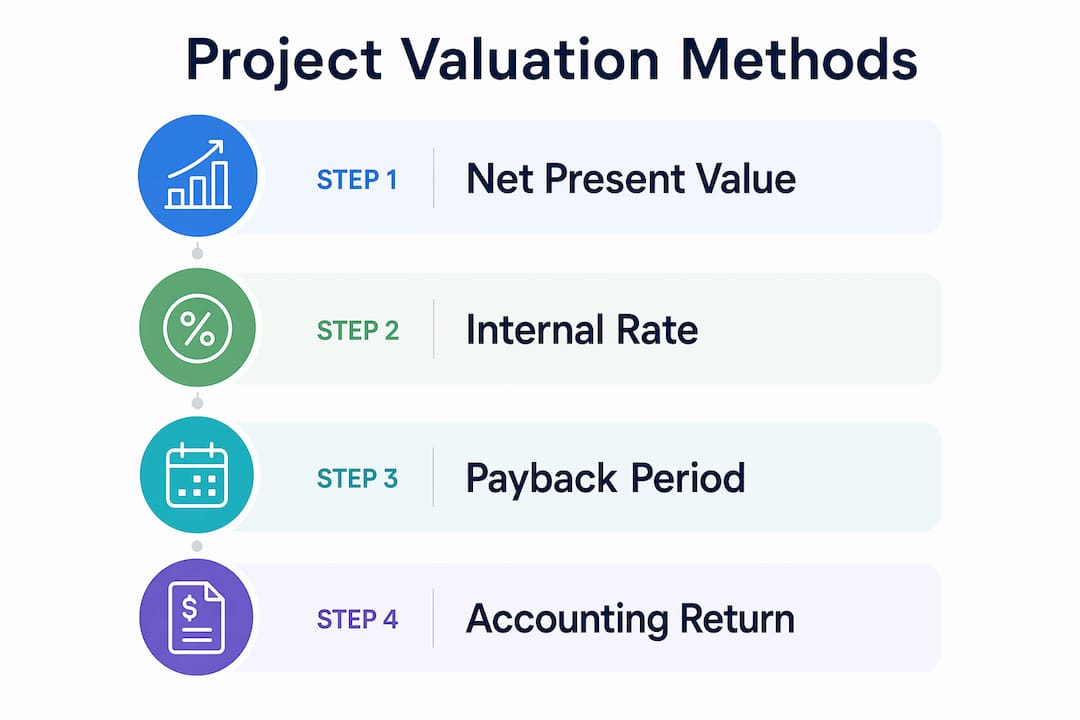
Payback period and Accounting Rate of Return
Payback period is a simple liquidity measure that calculates how quickly an investment recovers its initial cost. It is useful for quick assessments but ignores profits and the time value of money after the investment is recouped. The Accounting Rate of Return (ARR) measures average annual profit as a percentage of the initial investment. Both metrics serve as supplementary checks rather than primary decision tools.
The table below summarizes the four methods by purpose, strength, and limitation:
| Method | Primary purpose | Key strength | Key limitation |
|---|---|---|---|
| NPV | Absolute value creation | Accounts for time value of money | Sensitive to discount rate assumptions |
| IRR | Investment efficiency | Comparable across projects | Does not show absolute value size |
| Payback period | Liquidity recovery speed | Simple and fast to calculate | Ignores post-recovery cash flows |
| ARR | Average profitability | Easy to communicate | Ignores timing of cash flows |
Pro Tip: Always calculate NPV and IRR together. NPV tells you how much value a project creates; IRR tells you how efficiently it creates it. Using both gives you a complete picture before committing capital.
How do qualitative and strategic factors influence project valuation?
Financial metrics alone do not capture the full value of a project. Multi-criteria evaluation frameworks with weighted scoring models assess non-financial impacts, including risk, environmental outcomes, and social considerations, aligning projects with strategic priorities. Stakeholders rate projects on defined scales across multiple objectives, producing a composite score that supplements financial appraisal results.
Qualitative factors that commonly enter a weighted scoring model include:
- Regulatory compliance and statutory risk: Projects that face complex approval processes with BCA, URA, or LTA carry higher execution risk, which reduces effective value even when NPV appears positive.
- Environmental and sustainability impact: Projects with poor environmental profiles face increasing regulatory scrutiny and may incur future remediation costs not captured in initial cash flow projections.
- Strategic alignment: A project that supports long-term organizational goals delivers value beyond its financial return, including market positioning and capability development.
- Stakeholder acceptance: Community or government opposition can delay timelines and inflate costs, eroding projected returns.
Weighted scoring models help integrate both financial and non-financial criteria, giving objective structure to subjective decision-making. They are particularly effective for prioritizing projects when multiple options compete and no single financial metric produces a clear winner.
Relying solely on financial metrics carries real risk. A project with a strong NPV but poor regulatory compliance profile or weak strategic fit can consume resources, generate disputes, and ultimately destroy value. Decision-making should balance quantitative financial data with qualitative strategy, using the valuation as a filter to select the best overall projects rather than simply the highest-returning ones.
What are the common challenges in applying project valuation?
Applying project valuation methods in practice involves several technical and organizational challenges that analysts must address to produce reliable results.
-
Discount rate selection: The discount rate choice significantly affects valuation results and should reflect the required rate of return plus a margin for project-specific risk. An overly conservative rate inflates NPV artificially; an aggressive rate understates value. Sensitivity analysis across a range of discount rates is standard practice for credible appraisals.
-
Cash flow estimation accuracy: All financial metrics depend on projected cash flows, which are estimates at the time of project selection. Construction cost overruns, revenue shortfalls, or regulatory delays can shift actual outcomes materially from projections. Analysts should stress-test key assumptions and document the basis for each estimate.
-
Value slippage post-completion: Value slippage can occur post-project due to organizational inertia or poor governance, meaning actual value may erode if benefits realization is not actively managed after project completion. Calculated theoretical value does not automatically translate into realized value without structured tracking and accountability.
-
Confusing project valuation with company valuation: The two disciplines address different questions. Project valuation assesses a discrete investment; company valuation assesses enterprise worth. Mixing the two frameworks leads to flawed decision criteria and misallocated capital.
-
Ignoring benefits realization beyond completion: Project management now focuses on value creation beyond the construction or delivery phase, emphasizing benefits realization over the long term. A project that delivers on time and on budget but fails to generate the projected operational benefits has not succeeded by valuation standards.
Pro Tip: Build a risk assessment framework into every valuation from the start. Identifying the top three assumptions that most affect NPV lets you focus due diligence where it matters most and avoid surprises after capital is committed.
How to apply project valuation methods in practical investment decisions
Applying project valuation to a real investment decision follows a structured sequence. Skipping steps or treating the process as a single calculation produces unreliable results.
- Define the project scope and boundaries clearly. Establish what costs and benefits are attributable to the project versus the broader organization. This prevents double-counting and ensures the valuation reflects the discrete investment being assessed.
- Estimate all relevant cash flows over the project’s life. Include capital expenditure, operating costs, revenue or savings, residual value, and any regulatory compliance costs. For construction projects, factor in statutory submission fees, inspection costs, and potential remediation expenses.
- Select an appropriate discount rate. Base the rate on the organization’s cost of capital, adjusted upward for project-specific risk. Document the rationale for the rate chosen so reviewers can assess the assumption independently.
- Calculate NPV and IRR as primary decision metrics. A positive NPV above a defined threshold and an IRR above the required return both support a go decision. When the two metrics conflict, NPV takes precedence for absolute value assessment.
- Apply a weighted scoring model for qualitative factors. Rate the project against strategic alignment, regulatory risk, environmental impact, and stakeholder acceptance. Weight each criterion according to organizational priorities. Combine the financial and qualitative scores to produce a composite ranking.
- Conduct sensitivity analysis. Test how NPV changes when key assumptions shift by 10%–20%. This identifies which variables carry the most valuation risk and informs risk mitigation planning.
- Make a documented go/no-go decision. Record the valuation basis, assumptions, and decision rationale. This creates accountability and provides a baseline for post-project benefits tracking.
The table below illustrates how NPV and weighted scoring combine to support go/no-go decisions across three hypothetical project types:
| Project type | NPV result | Weighted score | Decision |
|---|---|---|---|
| Commercial development | Positive, above threshold | High strategic alignment | Go |
| Industrial facility upgrade | Marginally positive | Low regulatory compliance score | Further review required |
| Infrastructure expansion | Negative | High strategic and social value | Escalate for strategic override |
Effective project planning integrates valuation outputs directly into execution planning, ensuring that the assumptions underpinning the financial case are tracked against actual performance throughout delivery. Real-time budget tracking is one practical mechanism for maintaining this discipline. Teams that monitor expenditure against valuation assumptions in real time are better positioned to detect value slippage early. Budget tracking tools designed for construction environments support this by aligning financial monitoring with project milestones.
Key takeaways
Project valuation is the structured process of comparing a project’s expected costs against its projected financial and strategic benefits, using NPV, IRR, payback period, and weighted scoring to support defensible investment decisions.
| Point | Details |
|---|---|
| NPV is the primary metric | Net Present Value accounts for the time value of money and is the most reliable long-term valuation measure. |
| IRR complements NPV | Use IRR to assess investment efficiency across competing projects, not as a standalone decision tool. |
| Qualitative factors are mandatory | Weighted scoring models capture regulatory risk, strategic alignment, and environmental impact that financial metrics miss. |
| Value slippage is a real risk | Calculated project value can erode post-completion without active governance and benefits realization tracking. |
| Discount rate selection is critical | The chosen discount rate must reflect the organization’s cost of capital plus a project-specific risk margin. |
Valuation as a strategic instrument, not a formula
After working through project appraisals across construction, infrastructure, and property development contexts, one pattern stands out consistently. Organizations that treat project valuation as a one-time calculation before approval tend to lose value after delivery. Those that treat it as a living framework, revisiting assumptions at key milestones and tracking benefits post-completion, consistently capture more of the value they projected.
The most common misconception I encounter is that a positive NPV is sufficient justification for proceeding. It is not. A positive NPV built on optimistic cash flow assumptions and an understated discount rate is not a green light. It is a risk that has not been properly quantified. The financial metrics are only as credible as the assumptions behind them.
Qualitative factors also receive less weight than they deserve in practice. Regulatory compliance risk, in particular, is frequently underpriced in Singapore’s construction sector, where BCA, URA, and LTA approvals can materially affect project timelines and costs. A project that scores well financially but carries unresolved statutory submission risks is not a sound investment. The building valuation methods used in property and construction contexts must account for these regulatory dimensions explicitly, not as footnotes.
The shift toward value-based project management, where success is measured by benefits realized rather than outputs delivered, is the right direction. Valuation should be the beginning of a value management process, not the end of a financial exercise.
— Aman
Project valuation support from Com
Com, Aman Engineering Consultancy, provides integrated engineering and consultancy services that support every stage of project valuation and execution for property developers, construction companies, and real estate investors in Singapore and across the region.

From feasibility studies and risk assessments to statutory submissions with BCA, URA, JTC, HDB, SCDF, PUB, and LTA, Com’s team of professional engineers and architects ensures that the assumptions underpinning your project valuation are grounded in regulatory reality. Com also offers value engineering services that identify cost efficiencies without compromising design or compliance standards. For investors and developers who need a consultancy partner that connects financial appraisal with technical execution, Aman Engineering Consultancy is the firm to contact.
FAQ
What is project valuation in simple terms?
Project valuation is the process of assessing whether a proposed investment will generate sufficient financial and strategic benefits to justify its costs and risks. It uses financial metrics like NPV and IRR alongside qualitative criteria to support go/no-go decisions.
What is the most reliable method for project valuation?
Net Present Value (NPV) is the most reliable primary metric because it accounts for the time value of money and measures the absolute financial value a project creates over its full lifespan.
How does project valuation differ from company valuation?
Project valuation assesses the financial worthiness of a discrete investment, while company valuation measures the total worth of a business as an enterprise. The two disciplines use different metrics and serve different decision contexts.
What factors affect project valuation results?
Discount rate selection, cash flow estimation accuracy, regulatory compliance risk, strategic alignment, and environmental impact all affect valuation outcomes. Sensitivity to discount rate assumptions is particularly significant for long-term capital projects.
What is value slippage in project valuation?
Value slippage is the erosion of calculated project value after completion, caused by poor governance or failure to actively manage benefits realization. Ongoing monitoring and accountability structures are required to retain the value projected during the appraisal phase.