

Construction valuation is far more than a cost estimate. At its core, what is construction valuation really asking? It is asking for a professionally reasoned opinion of value, grounded in defined criteria, at a specific point in time. For real estate developers, investors, lenders, and construction companies operating in Singapore and beyond, understanding this distinction is not merely academic. It directly shapes financing decisions, payment certification, contractual obligations, and project outcomes. This guide breaks down the core methods, applications, and financial implications of construction valuation for professionals who need clarity, not generality.
Table of Contents
- Key Takeaways
- What is construction valuation and why it differs from cost
- Common construction appraisal methods
- Valuing a construction business as an entity
- Practical applications for real estate stakeholders
- My perspective on where construction valuation goes wrong
- How Aman Engineering Consultancy supports construction valuation
- FAQ
Key Takeaways
| Point | Details |
|---|---|
| Valuation is not cost | Construction valuation is a professional opinion of value, not a summation of expenditure incurred on a project. |
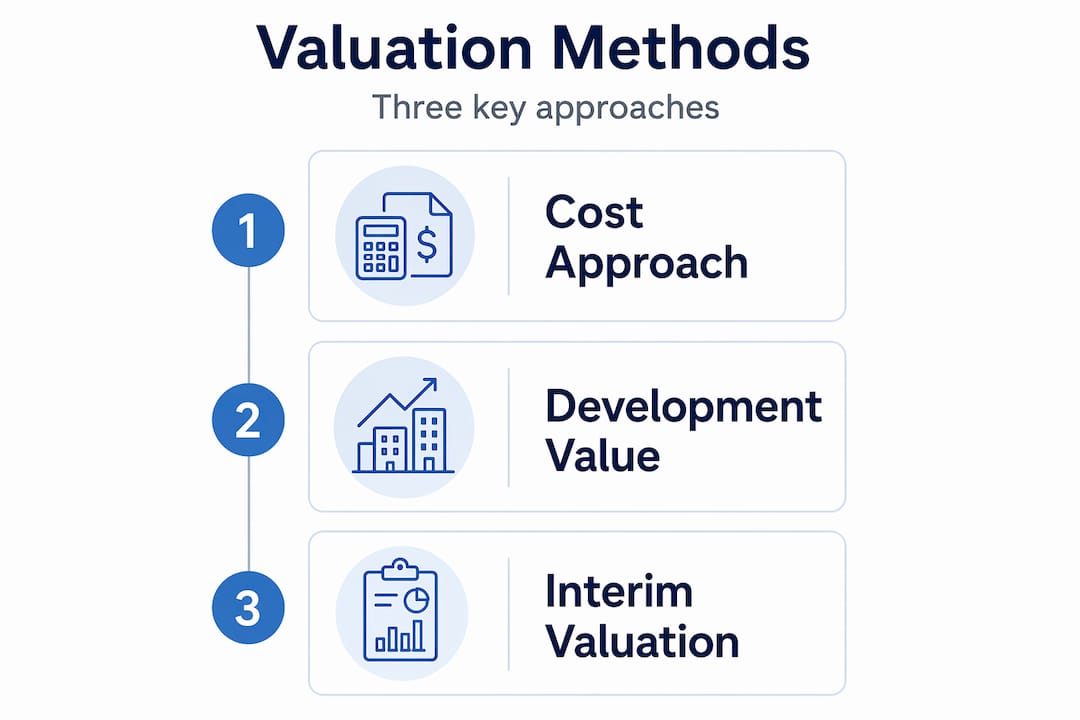
| Multiple methods apply | Cost approach, gross development value, and interim valuation serve distinct purposes across different project stages. |
| Business valuation differs | Valuing a construction firm requires income, asset, and market approaches, with WIP and backlog as critical inputs. |
| Interim valuations protect payments | Interim valuations revalue the whole works at each stage, not just costs since the last certificate. |
| Lender calculations use two figures | Development lenders assess both site value and gross development value to structure loan facilities at different risk phases. |
What is construction valuation and why it differs from cost
Construction valuation is a professional opinion of value on a stated basis, at a specified date, supported by professional inquiry and judgment. This is the definition upheld under the RICS Red Book Global Standards, the benchmark for valuation practice internationally. The distinction matters significantly in practice.
Cost is what you spend. Value is what the market, a lender, or a contract recognizes. A building may cost $8 million to construct but be valued at $6.5 million if comparable market evidence does not support a higher figure. Alternatively, a strategically located development may carry a completed value well above its construction cost. Neither outcome is unusual. Both are well-documented in development finance practice.
A valid construction valuation must satisfy three conditions:
- Defined purpose: The valuation must specify why it is being prepared, whether for lending, sale, insurance, or contractual payment certification.
- Stated basis of value: Common bases include market value, fair value, or reinstatement cost, each defined precisely under professional standards.
- Specific valuation date: Value is time-sensitive. A valuation prepared six months ago may be materially different from one prepared today, particularly in volatile markets.
Mismatches between valuation purpose, basis, and methodology are among the most frequent drivers of disputes in construction and development contexts. When a figure is produced without these parameters clearly established, it exposes all parties, including developers, lenders, and contractors, to legal and financial risk.
Pro Tip: Always confirm with your valuer the precise purpose and basis before commissioning a report. A valuation prepared for insurance purposes uses reinstatement cost and will produce a materially different figure than one prepared for development finance.
Common construction appraisal methods
Understanding how to value construction projects begins with recognizing that no single method applies universally. The method selected depends on the purpose of the valuation, the stage of the project, and the nature of the asset being assessed.
Cost approach
The cost approach estimates value by calculating the land value, adding the cost of construction or replacement, and then deducting depreciation. It is most commonly applied to new builds, specialist properties, and assets without sufficient comparable market transactions, such as industrial facilities, government buildings, or bespoke commercial structures. In Singapore, this method is frequently used in insurance valuations and for unique infrastructure assets that do not trade openly in the market.

Site value versus gross development value
Development lenders rely on two distinct valuation narratives when structuring construction finance. Site value drives initial land acquisition funding, representing the market value of the land in its current condition before any development begins. Gross development value, or GDV, represents the projected market value of the completed development and caps the total loan facility, including construction costs and rolled-up interest.
These are not interchangeable figures. Practitioners preparing development loan valuations are required to provide separate “day-one” site value narratives and “completion” GDV narratives to satisfy lender criteria and reflect the different risk profiles at each stage of the project.
| Valuation Type | Purpose | Used By |
|---|---|---|
| Site value | Supports initial land acquisition advance | Lenders, developers at project inception |
| Gross development value (GDV) | Caps total loan facility at scheme completion | Lenders, investors, development appraisers |
| Cost approach | Values property based on replacement cost less depreciation | Insurers, specialist asset valuers |
| Interim valuation | Certifies payment at defined contract stages | Quantity surveyors, contractors, employers |
Interim valuations
Interim valuation is a formal contractual revaluation process that supports interim payment certificates. Critically, it involves the revaluation of the whole of the works completed to date, not merely the costs incurred since the previous payment. This is a distinction that many stakeholders misunderstand. The quantity surveyor assesses value, which may differ from cost, and advises on the remaining contract value after each interim valuation cycle.
Pro Tip: If you are acting as an employer’s agent or contract administrator, treat each interim valuation as a complete reassessment of the project, not a reconciliation of invoices. This protects the integrity of the payment framework and reduces the risk of over-certification.
For a detailed breakdown of how building valuation in Singapore is conducted across project types, that resource outlines the specific methods applied in the local development context.
Valuing a construction business as an entity
The methods described above apply to physical construction projects or assets. When a construction firm itself is the subject of valuation, whether for acquisition, merger, or investment, a different set of approaches applies. Construction business valuation uses three primary methods: asset-based, market-based, and income-based approaches.
- Asset-based approach: Calculates the net value of all identifiable assets, including equipment, receivables, and goodwill, minus liabilities. This approach is most relevant for businesses with substantial physical assets or those in financial distress.
- Market-based approach: Derives value by comparing the subject firm to similar construction businesses that have been sold or publicly traded, adjusting for differences in size, geography, and financial performance.
- Income-based approach: Projects future earnings and discounts them back to present value using a discount rate that reflects the risk profile of the business. The discounted cash flow method is the most frequently applied technique within this category.
Each approach yields a different result, and experienced valuers typically apply more than one method before arriving at a concluded figure.
Work in progress (WIP) and backlog schedules are key valuation inputs that reveal contract totals, revenue earned, margins, and percentage completion across active projects. They directly affect cash flow forecasts and valuation accuracy. Backlog, representing expected future revenue under secured contracts, is particularly significant when assessing a construction firm’s near-term earning capacity and growth trajectory.
The challenges specific to construction business valuations include the cyclical nature of the industry, dependence on key personnel, concentration in a small number of major contracts, and the complexity of recognizing revenue under long-term contract accounting standards. A firm carrying $50 million in backlog on two contracts looks very different from one with the same backlog spread across twenty lower-risk engagements. Appraisers treat WIP and backlog as valuation drivers, not mere accounting entries, influencing discount rates and cash flow timing assumptions.
Practical applications for real estate stakeholders
The importance of construction valuation becomes most apparent when examining how it functions across specific professional contexts. Below are the primary applications real estate professionals and development stakeholders should understand.
-
Development finance drawdowns. Lenders release construction loan tranches based on milestone valuations. Each drawdown is tied to certified progress, meaning an accurate interim valuation directly affects a developer’s access to capital at each project stage. Delays or disputes in valuation can stall funding and disrupt construction programs.
-
Interim payment certification. Under standard contracts such as SIA or FIDIC conditions commonly used in Singapore, interim valuations aim to protect the payment certification framework rather than merely reconcile costs since the last certificate. The quantity surveyor’s role is to certify what the works are worth, not what was spent building them over the past month.
-
Investment and feasibility analysis. Developers use construction value assessment at the pre-acquisition stage to test whether a proposed scheme is financially viable. The GDV less construction costs, professional fees, finance costs, and land value must produce an acceptable residual profit margin. If it does not, the project does not proceed.
-
Insurance reinstatement valuations. Building owners require periodic revaluation of reinstatement costs to confirm that insurance coverage remains adequate. Construction cost inflation, changes to regulatory requirements, or building modifications can all render earlier valuations insufficient.
-
Dispute resolution and expert evidence. When contractual disputes arise over payment, defects, or delay and disruption claims, a properly documented construction valuation prepared under recognized standards provides the evidential basis for adjudication, arbitration, or litigation.
Professionals commissioning valuations should always specify the intended use at the outset, confirm the applicable standard with their valuer, and retain documentary evidence of the basis on which the valuation was prepared. Failure to do so remains one of the most common and avoidable causes of valuation disputes. Engaging qualified quantity surveying services from the outset significantly reduces that risk across all five of these application areas.
My perspective on where construction valuation goes wrong
In my experience working across construction and infrastructure projects, the most persistent source of problems is not a lack of valuation. It is a lack of clarity about what the valuation is actually for.
I have seen developers commission a single report and then use it simultaneously to satisfy their lender, support an insurance claim, and resolve a payment dispute. Those are three different bases of value. They will rarely produce the same figure, and using one for all three purposes creates legal exposure that could have been avoided entirely with proper instruction at the outset.
Interim valuations are another area where misconceptions cause real financial damage. Most people involved in construction contracts understand, at least in principle, that interim payments are made at regular intervals. What they frequently do not understand is that values during construction financing must align with contract valuation stages, and that interim valuations reissue values on the whole works, not just the work done since the last certificate. An employer who treats an interim payment as a simple cost reimbursement is operating outside the contractual framework and will eventually face a dispute.
My strongest recommendation is to treat the valuation instruction itself as a contractual document. Define the purpose. State the basis. Confirm the date. Engage a qualified valuer who operates under recognized professional standards. That process costs very little relative to the disputes it prevents.
— Aman
How Aman Engineering Consultancy supports construction valuation
For developers, investors, and construction companies seeking professional support across valuation, cost management, and compliance, Aman Engineering Consultancy delivers structured consultancy services aligned with Singapore’s regulatory environment and international standards.

Aman Engineering provides value engineering services that integrate cost-effective design decisions with construction valuation frameworks, helping project teams identify where expenditure does not translate to corresponding increases in value. The firm’s quantity surveying capability supports interim valuation preparation, payment certification, and development finance reporting across residential, commercial, and industrial projects. For real estate stakeholders requiring professionally supported valuation and engineering consultancy under one roof, Aman Engineering Consultancy offers the technical depth and regulatory knowledge to protect project outcomes from inception through completion.
FAQ
What is construction valuation in simple terms?
Construction valuation is a professional opinion of the value of a construction project or related asset, prepared on a defined basis at a specific date. It is not the same as a cost estimate, which only measures expenditure.
What are the main methods used to value construction projects?
The primary construction appraisal methods are the cost approach, gross development value analysis, and interim valuation. Each method serves a different purpose, from insurance reinstatement to development finance and contractual payment certification.
Why does development lending require both site value and GDV?
Site value and GDV reflect different risk phases of a development. Site value supports the initial advance for land acquisition, while GDV caps the total loan facility including construction costs and interest, giving lenders security across both phases.
What role does WIP play in valuing a construction business?
WIP and backlog schedules are key valuation inputs that reveal margin performance, revenue earned under active contracts, and future earning capacity. They directly influence discount rates and cash flow assumptions in income-based business valuations.
How often should construction valuations be updated?
Interim valuations are updated at contractually defined intervals throughout a construction project. Insurance reinstatement valuations and development appraisals should be reviewed whenever material changes occur to construction costs, market conditions, or regulatory requirements.