
What is a BCA PTU? Navigating Temporary Occupation For Events
Introduction To Temporary Occupation In Singapore
The BCA PTU is a highly critical regulatory document. It stands for Permit to Use. It regulates the safe temporary occupation for events in Singapore. Temporary structures introduce major safety challenges in urban planning. They alter normal pedestrian traffic patterns in public spaces. They also significantly increase local fire loads during events. Consequently, the Singapore government mitigates these risks through strict legislation.
The Building and Construction Authority oversees this rigorous framework. The BCA PTU serves as the primary safety gateway. Without it, temporary events cannot legally proceed.1 Compliance requires deep coordination across multiple technical agencies. Event organisers must navigate complex building control regulations. Therefore, understanding the BCA PTU is absolutely essential. Navigating temporary occupation for events demands meticulous planning.
Stakeholders must understand the statutory requirements thoroughly before starting. A high SEO ranking approach requires clear, authoritative industry insights. This comprehensive report details the nuances of the BCA PTU. It outlines the structural, procedural, and strict safety requirements.
Defining Temporary Buildings Under Statutory Frameworks
The definition of a temporary building is strictly regulated. The Building Control Act provides the foundational legal definitions.2 Furthermore, the Building Control Regulations 2018 refine these parameters.3 A temporary building must not exceed two storeys.2 It must be constructed entirely from short-lived materials.2 The maximum permitted usage duration is generally 36 months.2 However, extensions can increase this limit to 72 months.4
Some structures require permits regardless of their short lifespan. Examples include large gantries, massive tentages, and event stages.2 Temporary pop-up stores and large Christmas trees also qualify.2 Free-standing frames and entrance arches require strict regulatory oversight.2 Shipping containers used for events fall under this category.2
Temporary indoor LED screen supports are considered temporary structures.2 Indoor advertisement structures and their supports need a BCA PTU.2 Conversely, earth-retaining structures and bridges are explicitly excluded.2 Temporary structures exceeding two storeys face entirely different regulations. They must undergo the full permanent building submission regime.2 This applies regardless of the intended temporary occupation duration.2
Exemptions From The Permit To Use Requirement
Not all temporary structures require a BCA PTU. Specific exemptions reduce unnecessary administrative burdens for minor works. The regulations outline clear threshold limits for these exemptions. Understanding these exemptions prevents redundant regulatory submissions.
| Exemption Category | Threshold Conditions | Regulatory Source |
| Construction Site Structures | Below 4 storeys; Used as workers’ quarters or site offices. | 2 |
| Insignificant Building Works | Listed in First Schedule of Building Control Regulations 2003. | 2 |
| Event Tentages | Used < 60 days; Area < 2000 m2; Span < 18m. | 2 |
| Event Stages | Used < 7 days; For weddings, funerals, or ceremonies. | 2 |
| Free-Standing Signboards | Height < 4m from ground; Largest surface area < 10 m2. | 2 |
These exemptions do not negate overall safety responsibilities. Project parties must still ensure total structural stability.2 Protective structures near public roads still require safety compliance.2 Furthermore, stage frameworks supporting LED screens often exceed exemption limits.2 Event organisers must measure tentage spans highly accurately. Exceeding an 18-metre span triggers immediate BCA PTU requirements.2
The Permit To Use Application Architecture
The BCA PTU application process operates in two distinct stages. The owner must apply through the CORENET e-Submission system.2 Submissions must reach the authority three weeks before construction.1 This timeline ensures adequate review of all structural plans.
First Stage: Preliminary Approval
The first stage involves securing initial preliminary approval. The owner engages a Professional Engineer for this step.2 The engineer submits the structural plans and design calculations.2 Subsequently, the Commissioner of Building Control reviews these documents.5 Construction can only commence after this preliminary approval is granted.5 This stage prevents unsafe designs from reaching the event site. It forces upstream resolution of critical structural vulnerabilities.
Second Stage: Permit To Use Grant
The second stage occurs after physical construction ends. However, the owner cannot occupy the building just yet. The Professional Engineer must inspect the completed physical erection.2 The engineer then submits a formal certificate of supervision.5 This crucial document verifies compliance with the approved structural plans. A separate certificate is needed for lightning protection systems.2 The authority finally grants the BCA PTU after reviewing these.5 Only then is the temporary occupation legally permitted.5
Simplified Process For Reused Designs
Temporary structures often utilise modular or repeated designs. Event organisers frequently deploy identical container setups across locations. The authority introduced a simplified approval process for this.5 Owners using previously approved designs benefit significantly from this. The Professional Engineer simply cites the earlier approval reference number.2
This entirely eliminates the need to resubmit complex structural calculations.6 Consequently, the simplified process saves considerable time and financial resources.6 However, the physical site supervision requirement remains strictly mandatory. The engineer must still inspect the new erection onsite.2 They must submit fresh certificates of supervision before occupancy.6
Required Documents For Submission
A successful BCA PTU application requires comprehensive documentation. Missing documents lead to costly delays for event organisers. Firstly, the owner must provide written URA planning permission.2 Secondly, a formal notification of engineer engagement is required.2 This form must be signed directly by the building owner.2 Thirdly, a detailed location plan must indicate the exact site.2
Structural plans must feature the standard PE temporary building endorsement.2 Detailed design calculations are mandatory for new erections.2 Furthermore, written consent from the actual premises owner is required.2 These documents are uploaded via the CORENET e-submission portal.2
Administrative Fees And Financial Planning
Applicants must pay processing fees for BCA PTU applications. These fees are calculated based on structural dimensions. Financial planning is crucial for large-scale event setups.
| Fee Category | Cost Formula | Source |
| Structures with Floor Area | $200 per 100 square metres of statistical gross floor area. | 2 |
| Structures without Floor Area | $200 for each independent structure in the application. | 2 |
| Permit Extension Fee | $200 for each structure requiring a time extension. | 2 |
The statistical gross floor area includes all building storeys.2 It aggregates the space of all buildings per application.2 Payments are processed digitally through the CORENET payment portal.2 Accurate initial calculations prevent application delays and financial penalties.
Roles, Responsibilities, And Legal Accountability
The regulatory framework enforces strict accountability across multiple parties. This ensures no single point of failure during temporary occupation. Everyone must understand their specific legal responsibilities clearly.
The Temporary Building Owner
The owner holds the ultimate legal responsibility for public safety.5 The owner must formally appoint the Professional Engineer.2 They must ensure the structure is safely demolished upon expiry.5 The owner cannot occupy the building without the BCA PTU.5
The Professional Engineer (Civil/Structural)
The Professional Engineer anchors the entire structural safety process. They must be registered under the Professional Engineers Act.4 They design the temporary building to meet stringent codes.2 Furthermore, they supervise the erection to ensure plan adherence.2 They maintain detailed records of construction materials used.2 The engineer must ensure all necessary construction tests occur.2 They submit the supervision certificate within seven days post-completion.2 Periodic structural inspections cannot be delegated to unregistered assistants.8
The Builder And Contractor
The builder executes the physical erection of the structure. They must follow the approved plans meticulously without deviation.2 They must engage an electrical engineer for lightning protection.2 The builder submits electrical supervision certificates to the owner.2 They cannot allow occupancy before official regulatory clearance is granted.9
Structural Design And Environmental Load Considerations
Temporary structures face severe and unpredictable environmental stresses. They typically lack the deep foundations of permanent buildings. This makes them highly vulnerable to specific environmental loads. The Second Schedule dictates the precise design requirements.9
Eurocode Compliance For Wind Loads
Wind loads present the greatest risk to temporary structures. The BCA framework mandates absolute compliance with Eurocode standards.11 Specifically, SS EN 1991-1-4 governs wind action calculations.12 Imposed roof loads must follow SS EN 1991-1-1 standards.12 Crane loads are dictated by SS EN 1991-3 regulations.12 Wind forces act in all directions and cause torsion.14
Consequently, the structural factor must be calculated with high precision.13 Temporary structures often utilize very lightweight building materials. This amplifies the structural impact of sudden wind gusts. Older British Standards like BS 6399 are being phased out.15 CP3 Chapter V Part 2 assumes 33 m/s wind speeds.15 However, Eurocodes provide a more modern, comprehensive safety framework. Testing laboratories must be approved by SAC-SINGLAS.16 This ensures material testing meets strict national quality standards.
The 2016 Formwork Collapse Case Study
A critical incident in 2016 highlights these structural vulnerabilities. Strong winds impacted a construction worksite in Tampines, Singapore.18 Maximum wind speeds reached 46.5 knots early that morning.18 The average wind speed suddenly spiked to 40.1 knots.18 Normal average wind speed in August is just 2.5 m/s.18 Twenty-four large table formworks collapsed simultaneously at the site.18
These formworks were 10.2 metres tall and completely freestanding.18 A subsequent engineering analysis revealed severe structural design deficiencies. The factor of safety against overturning was below 0.7.18 The wind pressure magnified heavily against the tall, exposed surfaces.18 The structures lacked sufficient stabilising moments to resist uplift.18 One collapsed formwork triggered a massive, destructive domino effect.18
Fortunately, workers were away from the immediate collapse zone.18 This case study proves the critical necessity of stringent oversight. Temporary structures must withstand unexpected environmental extremes safely. Proper bracing and wind drag calculations are absolutely essential.18
Inter-Agency Coordination And Fire Safety Approvals
The BCA PTU does not operate in total isolation. Temporary occupation for events requires cross-agency regulatory alignment. The Singapore Civil Defence Force manages severe fire safety risks.19
The SCDF Temporary Change Of Use Permit
Events massively increase the fire load of a given space. Large crowds and temporary installations elevate public evacuation risks.19 Therefore, organisers must apply for a Temporary Change of Use permit.19 This applies to stage shows, exhibitions, and carnivals.19 The permit application costs S$60 per submitted application.19
It must be submitted three working days before the event.19 Late submissions are rejected without any further consideration.19 Each permit remains strictly valid for up to 60 days.19 Site layout plans and actual location photos are mandatory.19 Applications are processed online via the GoBusiness Dashboard portal.19
Stringent Fire Safety Conditions
The SCDF imposes strict conditions for temporary event setups. These rules ensure rapid evacuation during sudden fire emergencies. Non-compliance results in severe enforcement actions and event closures.
| Fire Safety Parameter | Regulatory Requirement | Source |
| Booth Dimensions | Maximum 15 metres long and 6 metres wide. | 20 |
| Clear Passageways | Minimum 1.2 metres width between booth rows. | 20 |
| Fire Extinguishers | One Class ‘AB’ extinguisher every 15 metres. | 20 |
| Sprinkler Clearance | Minimum 0.5 metres clearance below existing sprinklers. | 21 |
| General Clearance | Minimum 1.5 metres from hydrants and hose reels. | 20 |
| Escape Routes | Two-way escape routes of at least 1.2 metres. | 20 |
| Maximum Travel | Travel distance to nearest exit cannot exceed 45 metres. | 20 |
| Flammable Materials | No LPG, flammable liquids, or open flames permitted. | 19 |
Indoor events face additional scrutiny regarding specific ceiling heights.21 Erection of enclosed tentages within buildings is strictly prohibited.21 Completely enclosed booths that hinder visual access are entirely banned.21 If a booth has a covered roof, rules change immediately. One sprinkler-type fire extinguisher is required per 12 square metres.21
Outdoor events must never block fire engine accessways.19 Storage of materials below raised floors is strictly prohibited.22 Multi-storey car parks cannot host temporary event structures.22 Every fire safety rule serves a highly specific protective purpose. Ignoring them risks catastrophic consequences during an event emergency.
CORENET X: The Digital Transformation Of Submissions
The regulatory submission landscape is undergoing a massive transformation. The legacy CORENET system is being entirely phased out. CORENET X represents a new era of digital compliance.23 It leverages Building Information Modelling for seamless integration.24 This fundamentally alters how professionals apply for a BCA PTU.
Phased Implementation Deadlines
The transition to CORENET X follows a strict national timeline. Since October 2025, large projects deeply mandate this new platform. This applies to new projects exceeding 30,000 square metres.23 By October 2026, the mandate extends globally across Singapore.23
All new building projects must use CORENET X then.23 This includes temporary structures requiring complex structural plan submissions. Mid-project conversion from 2D to BIM is highly expensive.23 Therefore, adopting a BIM-first approach is now considered essential.23 Project sizes above 5,000 square metres require BIM models regardless.23
The Three-Gateway Approval Paradigm
CORENET X eliminates fragmented, discipline-specific agency submissions.24 It introduces a highly coordinated, multi-disciplinary review process.24 This resolves inter-agency conflicts early in the design phase.24
| Gateway Stage | Core Objective | Model Requirement |
| Design Gateway | Resolves high-impact, critical design parameters early. | Initial BIM structural massing. |
| Construction Gateway | Main submission for detailed design approval. | Coordinated IFC-SG structural model. |
| Completion Gateway | Submission of final as-built models for permits. | Final As-Built IFC-SG model. |
Agencies review a federated BIM model collectively and concurrently.24 This single source of truth prevents costly downstream abortive work.24 Simpler temporary buildings may utilize the Direct Submission Process.26 This single-stage application streamlines approvals for minor structural setups.26
Comparative Analysis: PTU vs TOP vs CSC
Navigating building occupancy requires understanding different permit hierarchies. The BCA PTU serves a highly specific, very limited purpose. It differs fundamentally from TOP and CSC legal frameworks. Many developers confuse these distinct statutory building control documents.
| Permit Type | Purpose and Scope | Regulatory Mandate |
| Permit To Use (PTU) | For temporary structures strictly under two storeys. | Mandatory for specific temporary setups.2 |
| Temporary Occupation Permit (TOP) | Allows residency before full permanent project completion. | Optional, fast-tracks residential/commercial use.28 |
| Certificate of Statutory Completion (CSC) | Certifies absolute completion of permanent developments. | Mandatory for all permanent structures.28 |
Any structure exceeding two storeys requires a full TOP/CSC.2 This rule applies regardless of how long it will exist.2 A BCA PTU is strictly temporary and legally mandates demolition.2 A TOP is merely an interim step toward a CSC.29 The CSC requires significantly more compliance than a TOP.28 Express TOPs can be obtained quickly via fast-track systems.28 Express TOP inspections cost $3,000 and occur within days.30 The BCA PTU does not offer an express fast-track option.
Signage Submissions And Structural Inspections
Outdoor advertisements and signages constitute a massive PTU category.2 Structural failure of large signages poses extreme public danger. Signages exceeding 10 square metres require a BCA PTU.2 Structures standing 4 metres above ground also need permits.2
Renewal And Maintenance Cycles
PTUs for existing signages must be renewed periodically.31 Renewals are typically granted in strict three-year intervals.31 The renewal process requires a Professional Engineer’s endorsement.31 The engineer extensively inspects the structure for wear and tear.32 They actively check for corrosion, loose bolts, and material deterioration.
Advanced inspection methods greatly streamline this highly complex process. Engineers now utilize drones for close-range visual inspections.31 Thermal imaging easily detects hidden structural defects inside the framework.31 Boom lifts and rope access provide direct manual inspection capabilities.31 Comprehensive inspection reports guarantee successful permit renewal outcomes.31 Submissions connect through the Advertisement Licensing System (ALS).34
Enforcement, Penalties, And Legal Consequences
The authorities treat temporary structure compliance with extreme seriousness. Non-compliance results in harsh financial and major legal penalties. Erecting temporary structures without permits constitutes a massive offence.35
The Building Control Act Penalties
Section 20 dictates severe penalties for unauthorised building works.37 Offenders face crippling financial fines reaching up to $200,000.37 Courts may also impose imprisonment terms up to two years.37 Operating without approved structural plans violates Section 5 outright.36 This specific contravention attracts hefty fines up to $50,000.36 Imprisonment for up to one year is also possible.36 Continuing offences generate daily fines of $1,000 post-conviction.36 Deceptive unauthorised works can trigger 25x processing fee penalties.37
Regulatory General Penalties
The 2018 Regulations outline specific temporary building offences clearly. Using a structure without a valid PTU is highly illegal.38 Failing to demolish a structure upon expiry invites immediate prosecution.9 General penalties under these specific regulations reach $20,000.39 Imprisonment terms can easily extend to 12 long months.39 Site supervisors who ignore safety directives face daily cumulative fines.35 A site supervisor faces $2,000 daily fines for continuing offences.35 This highly punitive framework strongly deters any regulatory negligence. It forces strict compliance at every stage of the project.
Real-World Application: Artbox Singapore
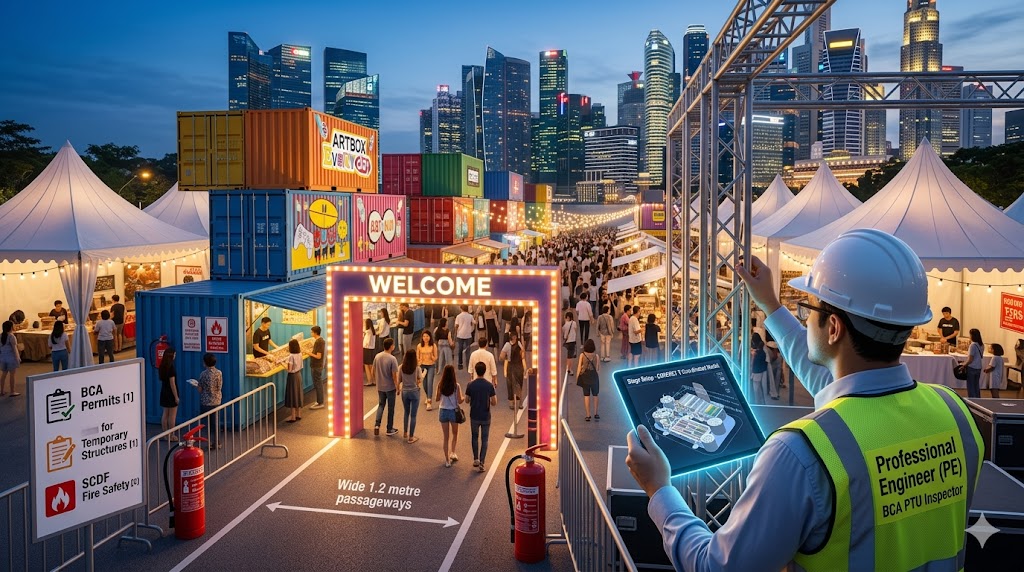
Artbox Singapore provides an excellent practical case study.41 This massive event utilises hundreds of large shipping containers.42 It creates a temporary creative marketplace at the Singapore EXPO.42 The event attracts over 50,000 visitors annually.41 Such incredibly high footfall requires absolutely flawless regulatory compliance. Every stacked container requires rigorous BCA PTU approval.2 Engineers must meticulously calculate wind loads for the stacked units.11 The sprawling layout demands an SCDF Temporary Change of Use permit.19 Fire extinguishers must be placed precisely every 15 metres.20 Passageways must handle sudden mass evacuations quickly and safely.20
The 2026 edition took place over two busy weekends.44 It ran from April 3 to 5, and April 10 to 12.44 Organisers faced massive logistical challenges coordinating multiple agency approvals.45 Food vendors required Singapore Food Agency temporary fair permits.45 Large inflatables required structural stability checks to prevent collapse.42 The event perfectly illustrates the intersection of culture and compliance. Successful execution requires months of upstream regulatory planning.
Advanced Considerations For Construction Site Temporary Buildings
Construction sites feature highly specific temporary building rules. Workers’ quarters and site offices require distinct regulatory handling.5 These structures are completely exempt from the BCA PTU process.2 However, they must remain below four storeys in total height.2 They are still governed tightly by Building Control Regulations 17 through 20.2 Even without a permit, structural integrity remains legally mandatory. Protective hoardings and catch platforms safeguard public roads.2 A Professional Engineer must still ensure their overall safety.2 Scaffolding and lattice structures require specific wind action calculations.13 Engineers must evaluate effective slenderness and force coefficients.13 A collapse here endangers both workers and the general public.
The Future of Temporary Occupation Regulations
Singapore’s regulatory landscape continues to evolve rapidly. The built environment sector increasingly prioritizes digitisation and absolute safety. The full rollout of CORENET X in October 2026 is monumental. It will standardise BIM submissions for all temporary building applications. Manual 2D drawings will become completely obsolete very soon. Furthermore, climate change may induce stronger, more unpredictable wind events. Authorities might eventually revise wind load design parameters upward. The 2016 formwork collapse remains a stark historical warning. Future regulations may require enhanced stabilising mechanisms for tall temporary structures. Event organisers must adopt a deeply proactive compliance mindset continually.
Navigating Temporary Occupation For Events Successfully
Securing a BCA PTU requires methodical, highly disciplined project management. Organisers should engage Professional Engineers early in the conceptual phase. Designing with pre-approved modular structures saves immense time and money. Organisers must map out the three-week BCA submission timeline precisely. They must concurrently manage the three-day SCDF application window. Detailed coordination between structural engineers and event planners is vital. Fire safety conditions must be integrated directly into the floorplan. Ignoring SCDF clearances inevitably leads to last-minute booth redesigns. Ultimately, safety and compliance must drive every temporary event decision.
Strategic Impact On The Creative Economy
Events like Artbox heavily drive Singapore’s local creative economy.41 They provide vital platforms for micro-businesses and emerging local brands.41 However, these events rely entirely on safe temporary infrastructure.2 Streamlined PTU processes empower the creative economy to scale safely. The simplified PTU approval process for reused designs is highly beneficial.6 It lowers massive administrative barriers for frequent event organisers. This encourages more vibrant, dynamic urban activations across the city. By balancing strict safety with administrative efficiency, Singapore thrives. The BCA PTU framework supports this delicate, highly successful balance.
Conclusions
Navigating temporary occupation for events and structures is highly complex. The BCA PTU serves as the ultimate national safety checkpoint. This rigorous regulatory framework prevents catastrophic failures and ensures safety. Wind load calculations remain the absolute most critical structural requirement.
The transition to CORENET X forces massive digital industry evolution. Multi-disciplinary BIM models will totally eliminate downstream construction conflicts. Inter-agency coordination with the SCDF prevents mass fire-related tragedies. Penalties for non-compliance are exceptionally severe and financially devastating. Owners must embrace proactive compliance for successful temporary events. The Permit to Use is not merely administrative paperwork. It is a fundamental pillar of Singapore’s urban safety.
Works cited
- Permit to Erect Temporary Building | Licence & Accreditation – GoBusiness Licensing, accessed May 25, 2026, https://licensing.gobusiness.gov.sg/licence-directory/bca/permit-to-erect-temporary-building
- FAQ on Temporary Buildings – Building and Construction Authority, accessed May 25, 2026, https://www1.bca.gov.sg/safety-and-standards/applications-and-licenses/temporary-building-application/faq-on-temporary-buildings/
- Building Control (Temporary Buildings) Regulations 2018 Table of Contents Enacting Formula Part 1 PRELIMINARY 1 Citation and com, accessed May 25, 2026, https://www.yunbaogao.cn/index/partFile/10/702/2022-03/10_152995.pdf
- Building Control (Temporary Buildings) Regulations 2018 – Singapore Statutes Online, accessed May 25, 2026, https://sso.agc.gov.sg/SL/BCA1989-S807-2018?DocDate=20181212
- Temporary Building Application | Building and Construction Authority, accessed May 25, 2026, https://www1.bca.gov.sg/safety-and-standards/applications-and-licenses/temporary-building-application/
- Circular to Industry on Simplified PTU Process, accessed May 25, 2026, https://isomer-user-content.by.gov.sg/338/ba25e337-62e9-47da-aec0-aeacf49c2154/circular-to-industry-on-simplified-ptu-process.pdf
- Supporting information on new and existing licences | Building and Construction Authority, accessed May 25, 2026, https://www1.bca.gov.sg/safety-and-standards/applications-and-licenses/outdoor-advertising-sign-signboard-licence-application/supporting-information-on-new-and-existing-licences/
- GUIDELINES FOR STRUCTURAL ENGINEERS, accessed May 25, 2026, https://isomer-user-content.by.gov.sg/338/7fefc1c0-6299-41fa-bf17-17c3a9896f1a/psi-guidelines-for-structural-engineers-(sep-2024).pdf
- Building Control (Temporary Buildings) Regulations 2018 – Singapore Statutes Online, accessed May 25, 2026, https://sso.agc.gov.sg/SL/BCA1989-S807-2018?DocDate=20181212&ValidDate=20190301&ProvIds=pr18-
- One-storey workers’ quarters or site offices, etc. – Building Control (Temporary Buildings) Regulations 2018 – Singapore Statutes Online, accessed May 25, 2026, https://sso.agc.gov.sg/SL-Supp/S807-2018/Published?DocDate=20181212&ProvIds=pr17-
- No. S 807 BUILDING CONTROL ACT (CHAPTER 29) BUILDING CONTROL (TEMPORARY BUILDINGS) REGULATIONS 2018, accessed May 25, 2026, https://sso.agc.gov.sg/SL/BCA1989-S807-2018?DocDate=20181212&ViewType=Pdf&_=20181213112854
- Building Control (Temporary Buildings) Regulations 2018 – Singapore Statutes Online, accessed May 25, 2026, https://sso.agc.gov.sg/SL/BCA1989-S807-2018?DocDate=20181212&ProvIds=Sc2-&ViewType=Advance&Any=5+Factories+Safety+Training+Courses+Order&WiAl=1
- Eurocode 1 : Actions on structures – Singapore Standards, accessed May 25, 2026, https://www.singaporestandardseshop.sg/Product/GetPdf?fileName=190102084059SS%20EN%201991-1-4-2009_Preview.pdf&pdtid=ec23c269-d576-4222-9a61-d7cb068a3288
- EN 1991: Actions on Structures; Part 1-4 – Eurocodes, accessed May 25, 2026, https://eurocodes.jrc.ec.europa.eu/sites/default/files/2023-10/1.3_N-Malakatas.pdf
- Approveddocument.pdf – Building and Construction Authority, accessed May 25, 2026, https://www.bca.gov.sg/publications/BuildingControlAct/others/Approveddocument.pdf
- Building Control (Temporary Buildings) Regulations 2018 – Singapore Statutes Online, accessed May 25, 2026, https://sso.agc.gov.sg/SL/BCA1989-S807-2018?ValidDate=20190301&ProvIds=P12-
- Building Control (Temporary Buildings) Regulations 2018 – Singapore Statutes Online, accessed May 25, 2026, https://sso.agc.gov.sg/SL-Supp/S807-2018/Published?DocDate=20181212&ProvIds=pr9-
- Case Study: Collapse of 24 Table Formworks in Singapore, accessed May 25, 2026, https://cde.nus.edu.sg/dbe/2016/12/case-study-collapse-of-24-table-formworks-in-singapore/
- Temporary Change of Use – SCDF, accessed May 25, 2026, https://www.scdf.gov.sg/fire-safety-services-listing/permits-and-certifications/temporary-change-of-use
- Updated as of 20 March 2026 OUTDOOR ENCLOSED TENTAGE – TEMPORARY CHANGE OF USE PERMIT (TCOU PERMIT) FIRE SAFETY CONDITIONS Tempo – SCDF, accessed May 25, 2026, https://www.scdf.gov.sg/docs/default-source/fire-safety-docs/permits-and-certification/Outdoor-Enclosed-Tentage-Fire-Safety-Conditions.pdf
- 1-indoor-event-fire-safety-conditions.pdf – SCDF, accessed May 25, 2026, https://www.scdf.gov.sg/docs/default-source/fire-safety-docs/permits-and-certification/1-indoor-event-fire-safety-conditions.pdf
- outdoor event – temporary change of use permit (tcou permit) fire safety conditions – SCDF, accessed May 25, 2026, https://www.scdf.gov.sg/docs/default-source/fire-safety-docs/permits-and-certification/outdoor-event-fire-safety-conditions.pdf
- CORENET-X Singapore: 2026 BIM Submission Guide – CVC Engineers, accessed May 25, 2026, https://www.cvcengineers.com/post/corenet-x-singapore-complete-guide
- BCA Structural Design Approvals in Singapore (2025 Edition), accessed May 25, 2026, https://structures.com.sg/bca-structural-design-approvals-singapore-2025/
- CORENET X, accessed May 25, 2026, https://info.corenet.gov.sg/
- By Key Gateways – CORENET X, accessed May 25, 2026, https://info.corenet.gov.sg/regulatory-process/by-key-gateways
- About the New Submission Process – CORENET X, accessed May 25, 2026, https://info.corenet.gov.sg/regulatory-process/about-the-new-submission-process
- TOP — What Does It Stand for? | by Andreea Serb | Greyloft | Medium, accessed May 25, 2026, https://medium.com/greyloft/top-what-does-it-stand-for-4cdb8cdd18f6
- Temporary Occupation Permit (TOP): Complete Guide for HDB Flats and Condos (2026), accessed May 25, 2026, https://www.propertyguru.com.sg/property-guides/top-guide-temporary-occupation-permit-12348
- BCA – Plan Approval Processes, Submission Requirements and TOP/CSC under the Building Control Act, accessed May 25, 2026, https://www.sfa.gov.sg/docs/default-source/food-farming/presentation-slide-land-based-farm-workshop/bca-presentation-slide-workshop-for-farm.pdf
- Signage Inspection | Lee Consultants, accessed May 25, 2026, https://www.leeconsultants.com.sg/services/signage-inspection/
- BCA PTU: Signage – AEC Technical Advisory Singapore Engineering Consultancy, accessed May 25, 2026, https://www.aectechnicalsg.com/bca-ptu-signage/
- BCA PTU signage submission process and renewal, accessed May 25, 2026, https://www.aectechnicalsg.com/bca-ptu-signage-submission-process-and-renewal/
- Outdoor Advertising Sign / Signboard Licence Application, accessed May 25, 2026, https://www1.bca.gov.sg/safety-and-standards/applications-and-licenses/outdoor-advertising-sign-signboard-licence-application/
- BUILDING CONTROL (AMENDMENT) ACT 2007, accessed May 25, 2026, https://www.bca.gov.sg/Publications/BuildingControlAct/BC_AmdAct2007.htm
- Building Control Act – Singapore Statutes Online, accessed May 25, 2026, https://sso.agc.gov.sg/Act-Rev/BCA1989/Published/19991230?DocDate=19991230&ProvIds=P1II-
- Revised Civil Penalty Rates for Unauthorised Works in Singapore – what you need to know, accessed May 25, 2026, https://www.adxarchitects.com/blog/revised-civil-penalty-rates-for-unauthorised-works-in-singapore-what-you-need-to-know/
- Building Control (Temporary Buildings) Regulations – Singapore Statutes Online, accessed May 25, 2026, https://sso.agc.gov.sg/SL-Rev/BCA1989-RG5/Published/20000131?DocDate=20000131
- Building Control (Temporary Buildings) Regulations 2018 – Singapore Statutes Online, accessed May 25, 2026, https://sso.agc.gov.sg/SL/BCA1989-S807-2018?ValidDate=20190301&ProvIds=P14-
- Building Control (Temporary Buildings) Regulations 2018 – Singapore Statutes Online, accessed May 25, 2026, https://sso.agc.gov.sg/SL-Supp/S807-2018/Published?DocDate=20181212&ProvIds=pr21-
- Artbox Singapore, accessed May 25, 2026, https://artbox.sg/
- First Look At ARTBOX Camp 2026 – TheSmartLocal, accessed May 25, 2026, https://thesmartlocal.com/read/artbox-camp-2026/
- Artbox Singapore 2026: Tickets, Food Lineup & Insider Tips – Trip.com, accessed May 25, 2026, https://au.trip.com/blog/artbox2026/
- Lifestyle event Artbox draws visitors with trendy wares and matcha concoctions, accessed May 25, 2026, https://www.straitstimes.com/singapore/lifestyle-event-artbox-draws-visitors-with-trendy-wares-and-matcha-concoctions
Event Licensing – Singapore – National Arts Council, accessed May 25, 2026, https://www.nac.gov.sg/resources/toolkits-and-guides/arts-self-employed-persons-(seps)-and-freelancers/event-licensing