

A valuation study is a structured, professionally prepared analysis that quantifies the economic value of a property or development project by combining financial modeling with technical inspection data, market evidence, and documented assumptions. Property developers, construction firms, building owners, and lenders commission these studies to support feasibility decisions, regulatory submissions, financing underwriting, and dispute resolution. The core deliverable is a quantified report containing a financial model, inspection-backed cost estimates, sensitivity analysis, and a transparent methodology statement prepared by credentialed professionals, typically a licensed Professional Engineer (PE) or accredited appraiser operating under standards such as those published by the Appraisal Institute.
Valuation studies provide the data needed to make informed trade-offs between project costs, benefits, and regulatory compliance obligations. They also convert polarized stakeholder debates into metrics-driven dialogues by quantifying both market and nonmarket impacts, which aids persuasion of regulators and investors alike.
Table of Contents
- What are valuation studies, and what do they contain?
- Which valuation methods apply to your project?
- How engineering inspections change your valuation outputs
- When should you commission a valuation study?
- What to expect from a professional engineering valuation consultancy
- How to evaluate and hire a valuation consultancy
- Key Takeaways
- Why engineering integration defines valuation quality
- Aman Engineering Consultancy’s valuation study services
- Further reading and authoritative sources
What are valuation studies, and what do they contain?
A complete valuation report typically includes the following sections, each serving a distinct purpose for developers, owners, and lenders.
- Scope and engagement terms: Defines the study’s purpose, the standard of value applied (fair market value, investment value, liquidation value), and the intended users.
- Site and asset description: Physical characteristics, zoning, occupancy, age, and condition summary.
- Inspection findings: Structural, façade, mechanical/electrical/plumbing (M&E), and fire safety condition data with defect logs.
- Market analysis: Comparable transactions, rental evidence, absorption rates, and supply/demand context.
- Financial model: DCF or income capitalization model with explicit inputs, growth assumptions, and exit assumptions.
- Assumptions and sensitivities: Documented discount rate, terminal growth rate, vacancy, and cost-to-cure assumptions with scenario ranges.
- Risk adjustments: Risk premiums tied to inspection findings, regulatory remediation obligations, and schedule risk.
- Recommendations: Conclusions on value, feasibility thresholds, or remediation priorities.
- Appendices: Inspection logs, photographic records, quantity takeoffs, calibration notes, and raw market data.
| Report Section | Primary User Benefit |
|---|---|
| Inspection findings | Quantifies cost-to-cure and remaining useful life for lenders and buyers |
| Financial model (DCF/Income) | Supports financing underwriting and investor return analysis |
| Assumptions and sensitivities | Demonstrates transparency; required for regulatory submissions |
| Risk adjustments | Adjusts value for engineering defects and compliance obligations |
| Recommendations | Guides feasibility decisions and scope trade-offs |
For developers, the inspection findings and risk adjustment sections are often the most consequential. A façade defect that appears minor in a visual survey can translate into a seven-figure remediation cost once a structural engineer quantifies the scope, materially shifting the residual land value calculation.

Which valuation methods apply to your project?
Valuation models fall into four broad categories: discounted cash flow (DCF), relative/comparable, cost/liquidation, and contingent-claim (real options). Selecting the right method depends on the asset type, data availability, and the study’s purpose.
Income/DCF is appropriate for income-producing assets and development projects with multi-year cash flows. It is theoretically rigorous but highly sensitive to discount rate and terminal growth assumptions. Sensitivity in discount rate assumptions significantly impacts indicated values on development models, underscoring the importance of including sensitivity tables in credible reports.
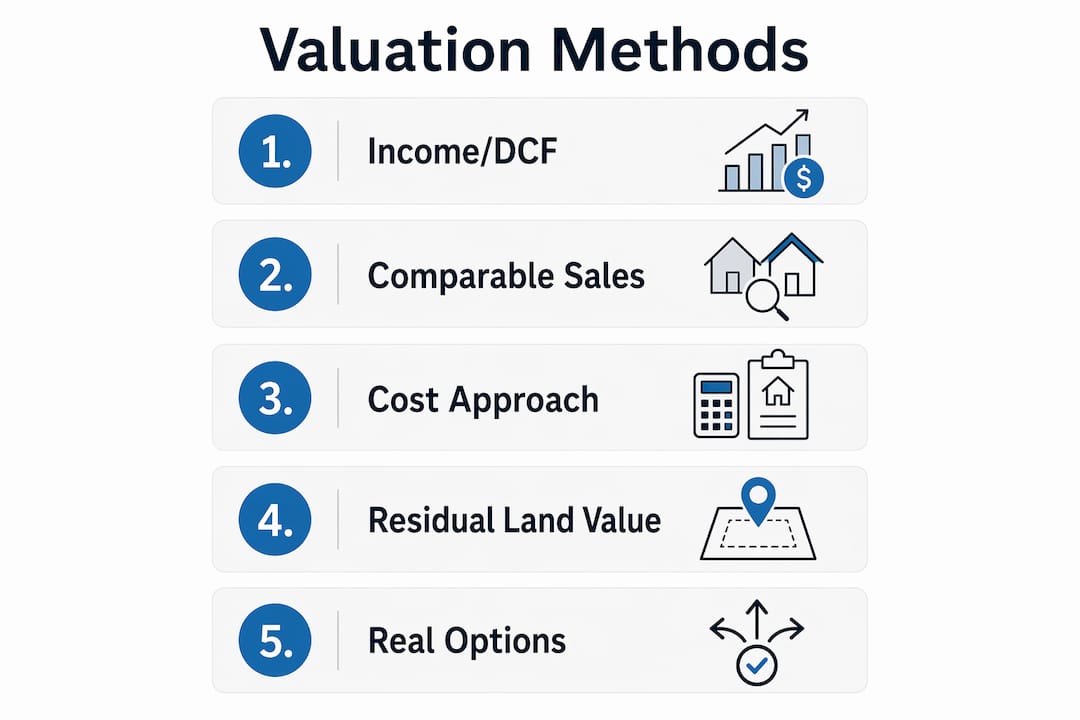
Comparable sales (market multiples) works well for standard residential or commercial assets where sufficient transaction evidence exists. Practitioners often prefer it for communication because stakeholders find price-per-square-foot metrics intuitive. Its limitation is that it cannot capture idiosyncratic engineering risks, deferred maintenance liabilities, or regulatory remediation costs that are specific to the subject property.
Cost approach values the asset at depreciated replacement cost and is most appropriate for special-use buildings, insurance purposes, or assets with no active market. It depends directly on inspection data to quantify physical depreciation and functional obsolescence.
Residual land value is the standard method for early-stage development appraisals. It deducts all development costs, finance charges, and developer profit from the gross development value to arrive at the maximum supportable land price. Errors in construction cost estimates, which engineering inspection data can significantly reduce, flow directly into the residual figure.
For complex mixed-use schemes or phased developments with embedded optionality, a contingent-claim or real-options framework may supplement the DCF. Robust valuation models balance finance-theory principles with practical project accounting and inspection inputs to produce results that are both credible and usable.
How engineering inspections change your valuation outputs
Generic appraisals rely on market evidence alone. Engineering-integrated valuation studies incorporate physical condition data that directly adjusts financial model inputs, often in ways that change the investment decision.
The inspection categories that affect valuation adjustments include:
- Structural condition: Load-bearing capacity, foundation integrity, and crack mapping translate into cost-to-cure estimates and remaining useful life adjustments.
- Façade systems: Cladding condition, sealant failure, and water ingress risk affect both remediation cost and schedule risk premiums.
- M&E systems: Age, condition, and remaining service life of HVAC, electrical, plumbing, and vertical transportation systems drive lifecycle cost projections.
- Fire safety compliance: Non-compliant suppression systems, egress deficiencies, or outdated detection equipment create regulatory remediation obligations that must be quantified and discounted into the model.
- Accessibility: ADA compliance gaps in U.S. projects carry both remediation cost and legal liability exposure that affect risk-adjusted value.
Each inspection finding maps to a specific financial model input. A failing HVAC system with five years of remaining useful life, for example, becomes a capital expenditure line in the DCF model, reducing net operating income projections and increasing the risk premium applied to the discount rate. Combining finance-theory-consistent models with practical inspection data produces results that standalone market appraisals cannot replicate.
Pro Tip: Scope the inspection to the valuation’s purpose. For a financing study, prioritize the systems with the largest capital expenditure exposure. For a regulatory submission, focus on life-safety and code-compliance items. Sampling intensity, testing type (non-destructive versus intrusive), and systems inspected should align with the financial model’s key risk drivers, not a generic checklist.
Developers working with professional engineers on compliance submissions will recognize that the same inspection data that supports authority approvals also anchors the valuation’s risk adjustments, creating efficiency when both workstreams are managed by the same consultancy.
When should you commission a valuation study?
The appropriate trigger depends on the project stage and the decision being supported.
- Initial feasibility: Before land acquisition or design commitment, a residual land value study tests whether the scheme is financially viable at current land prices and construction costs.
- Pre-acquisition due diligence: A full engineering-integrated study quantifies deferred maintenance, regulatory remediation obligations, and lifecycle costs that a vendor’s asking price may not reflect.
- Regulatory submissions: U.S. jurisdictions, including those governed by local building departments and state agencies, increasingly require documented feasibility and compliance cost analysis as part of major permit applications.
- Lender and investor underwriting: Banks and equity investors require independent valuation with transparent assumptions and sensitivity analysis before committing capital.
- Insurance and dispute support: Replacement cost studies and diminution-of-value analyses require inspection-backed cost data and a defensible methodology statement.
- Value engineering and scope trade-offs: When value engineering options are under review, a valuation study quantifies the financial impact of scope changes on residual value and project returns.
Practical triggers that indicate a study is warranted include assets over 20 years of age with no recent condition survey, planned change of use, significant façade or structural defects identified in a preliminary inspection, major tenant turnover affecting income assumptions, or complex mixed-use schemes where cost and revenue streams interact across multiple asset classes.
What to expect from a professional engineering valuation consultancy
A credible consultancy delivers a defined set of outputs on a documented timeline. The table below shows a representative milestone schedule for a mid-size commercial building study.
| Phase | Activity | Typical Duration |
|---|---|---|
| 1. Mobilization | Scope confirmation, data request, site access | Week 1 |
| 2. Site inspection | Structural, façade, M&E, fire safety surveys | Weeks 2–3 |
| 3. Draft findings | Inspection report, cost-to-cure schedule, market analysis | Weeks 4–5 |
| 4. Financial modeling | DCF/income model build, sensitivity runs | Week 6 |
| 5. Review and revision | Client review, assumption reconciliation | Week 7 |
| 6. Final report | Bound report, editable model, appendices | — |
Fee structures vary by scope and complexity. Fixed fees are standard for straightforward studies with a defined inspection scope. Time-and-materials pricing applies when the inspection scope is uncertain or when destructive testing may be required. Phased engagements, where the feasibility screen is priced separately from the full study, allow developers to control expenditure at early project stages. Cost drivers include building size and complexity, the number of systems requiring specialist inspection, required testing (non-destructive versus intrusive), and whether the study will be used in contested proceedings.
A common pitfall is conflating book value with fair market value. Credible consultancies treat maintenance capital expenditure and growth capital expenditure as distinct line items and document that distinction explicitly in the methodology statement.
How to evaluate and hire a valuation consultancy
- Ask for a sample methodology statement and confirm it documents assumptions, data sources, and the rationale for method selection.
- Verify credentials: the lead engineer should hold a PE license; the appraiser should carry accreditation from a recognized body such as the Appraisal Institute.
- Request a sample report and confirm it includes an editable financial model, sensitivity tables, and a risk register.
- Confirm the inspection scope covers all systems material to the financial model, not just a visual walkthrough.
- Ask whether the model can be re-run with revised assumptions after delivery, and whether the consultancy will support lender or regulatory review queries.
- Request references from projects of comparable type, size, and regulatory complexity.
- Require a conflict-of-interest disclosure, particularly if the consultancy has a prior relationship with the vendor or a financing party.
Red flags that indicate a consultancy should not be engaged:
- Opaque assumptions with no documented rationale or source data
- No site inspection, or inspection limited to a desktop review
- Absence of sensitivity analysis or scenario modeling
- Fixed outputs delivered as a PDF with no supporting schedules or editable model
- Unwillingness to disclose the methodology or provide a sample report before engagement
Valuation is part science, part expert judgment; its credibility depends entirely on making assumptions explicit and aligning the method with the study’s purpose. A consultancy that cannot articulate both clearly before engagement is unlikely to produce a report that survives regulatory or lender scrutiny.
For developers tracking project controls and cost risk inputs alongside valuation work, construction KPI tracking provides a useful framework for aligning schedule and cost data with the financial model’s assumptions.
Key Takeaways
A valuation study’s credibility rests on inspection-backed assumptions, transparent sensitivity analysis, and a methodology aligned to the study’s specific purpose.
| Point | Details |
|---|---|
| Commission at the right stage | Feasibility studies precede land acquisition; full studies precede financing or regulatory submission. |
| Inspection data changes outputs | Structural, façade, M&E, and fire findings directly adjust cost-to-cure, lifecycle cost, and risk premiums in the financial model. |
| Demand transparency | Require an editable financial model, documented assumptions, and sensitivity tables before accepting any report. |
| Verify credentials | The lead professional should hold a PE license or recognized appraiser accreditation relevant to the asset type. |
| Aman Engineering Consultancy | Delivers engineering-integrated valuation studies combining site inspections, financial modeling, and regulatory submission support for U.S. projects. |
Why engineering integration defines valuation quality
The most consequential gap in standard appraisal practice is the separation of physical condition assessment from financial modeling. When a market appraiser applies a generic depreciation rate to a 30-year-old commercial building without inspecting the façade, M&E systems, or fire suppression infrastructure, the resulting value may be directionally correct but is rarely precise enough to support a financing decision or a regulatory submission. The assumptions carry hidden risk that neither the developer nor the lender can quantify.
Engineering-integrated valuation closes that gap. When inspection findings feed directly into the cost-to-cure schedule, the lifecycle cost projection, and the risk premium applied in the discount rate, the financial model reflects the asset’s actual condition rather than a statistical average. That specificity matters most in contested situations, where a regulator, a lender’s technical advisor, or an opposing expert will scrutinize every assumption. A report that can trace each financial input back to a documented inspection finding, a calibrated measurement, or a sourced market transaction is substantially more defensible than one that cannot.
Aman Engineering Consultancy’s valuation study services
Aman Engineering Consultancy delivers engineering-integrated valuation and feasibility studies for property developers, construction firms, and building owners operating in the U.S. market. The firm’s scope covers structural, façade, M&E, and fire safety inspections; DCF and residual land value financial modeling; BIM-enabled quantity takeoffs through its BIM modeling services; sensitivity analysis; and regulatory submission support. Each engagement begins with a scope confirmation call, followed by a proposal that includes a methodology statement and a sample report extract so clients can evaluate the approach before committing.

To commission a valuation study or request a methodology statement for your project, contact Aman Engineering Consultancy directly through the website.
Further reading and authoritative sources
| Source | What it contributes |
|---|---|
| Valuation Approaches and Metrics: A Survey of the Theory and Evidence | Comprehensive review of DCF, comparable, and contingent-claim methods with sensitivity analysis guidance |
| An Introduction to Valuation | Foundational treatment of expert judgment, transparent assumptions, and method-purpose alignment |
| Valuation: The State of the Art | Practitioner-grade guidance on combining finance theory with inspection data and accounting standards |
| Economic Values without Prices | Establishes nonmarket valuation methods used by federal agencies for benefit-cost analysis in infrastructure projects |
| Building Valuation Methods Explained for Investors | Practical explainer on valuation techniques for complex building assets, with developer-focused examples |