

URA planning permission is the Urban Redevelopment Authority’s written approval, required under the Planning Act 1998, before any development or material change of land or building use commences in Singapore. Without this authorization, proceeding with construction, extensions, or use changes constitutes a breach of planning control, exposing developers and investors to enforcement action. The Urban Redevelopment Authority administers Singapore’s land use regulatory framework through development control, and its approval process sits at the center of every compliant property project. Understanding what triggers the requirement, how to apply, and where exemptions apply is not optional knowledge for developers, construction firms, or real estate investors operating in Singapore in 2026.
What is URA planning permission and when is it required?
URA planning permission is defined as the formal written consent issued by the Urban Redevelopment Authority authorizing a specific development or material change of use of land or buildings. The Planning Act 1998 establishes the legal basis for this requirement, and non-compliance constitutes a breach of planning control subject to enforcement. This approval attaches to the premises and the approved use, not to the operator or owner. A change in tenancy or ownership does not require a new URA planning permission, provided the use of the premises remains unchanged.
The term “development” under the Planning Act covers building operations, engineering operations, and other operations carried out on, in, over, or under land. A “material change of use” refers to a change in the purpose for which a building or land is used, where that change is significant enough to require regulatory oversight. Both categories trigger the requirement for URA planning permission before works or use changes proceed. Developers and investors should treat this distinction as foundational to any project scoping exercise.
What types of developments require URA approval?
The scope of works and use changes that require URA planning permission is broad. The following categories consistently require formal approval:
- New construction of any building or structure on land
- Extensions and additions to existing buildings that alter gross floor area or building height
- Change of use from one approved category to another, such as converting a retail shop to a food and beverage outlet or a warehouse to a light industrial facility
- Subdivision of land or amalgamation of plots
- Engineering operations that materially alter the land, including earthworks and drainage modifications
A practical example: converting a shophouse unit from retail use to a restaurant requires URA planning permission because the change from retail to food and beverage constitutes a material change of use. Similarly, adding a mezzanine floor to an industrial unit that increases gross floor area requires formal development approval.
Pro Tip: Verify the approved use of a property in URA SPACE before signing any tenancy or purchase agreement. Proceeding on the assumption that a desired use is already permitted is one of the most common and costly errors in Singapore property transactions.

Minor works and certain categories of development are exempt from the requirement. URA publishes a Planning Permission Exemption List that specifies which works do not require formal approval. Developers should consult this list directly rather than making assumptions, as incorrectly categorizing works as exempt carries significant compliance risk.
How to apply for URA planning permission: processes and submission pathways
The application process for URA planning permission differs depending on the type of development or use change being sought. Selecting the correct submission pathway is the first determinative step, and submitting through the wrong channel causes delays regardless of application quality.
The three primary submission pathways are:
- GoBusiness Singapore portal for change of use applications, with a processing fee of S$500 and a standard processing time of approximately 10 working days for complete applications
- CORENET for electronic development applications covering most building and engineering works, including new construction, additions and alterations, and subdivision
- URA’s dedicated e-services for other development applications such as minor developments, extensions of planning permission, and provisional permission renewals
The following table summarizes the key parameters for the two most commonly used pathways:
| Application Type | Submission Platform | Processing Fee | Typical Timeline |
|---|---|---|---|
| Change of use | GoBusiness Singapore | S$500 | ~10 working days |
| Development works (new build, A&A) | CORENET / EDA | Variable by project scale | Weeks to months depending on agency clearances |
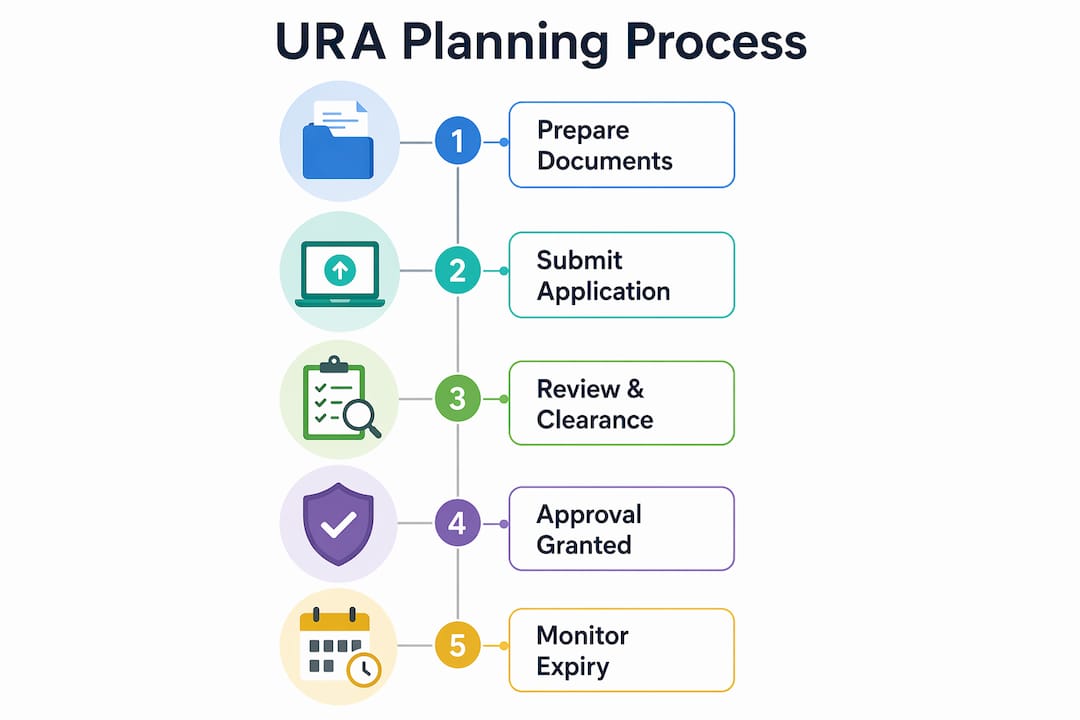
Documents typically required across both pathways include a location plan, site plan, floor plans, and relevant notices. For change of use applications, applicants must also confirm that the Land Betterment Charge with the Singapore Land Authority has been cleared before URA can grant permission. The Land Betterment Charge is a tax on the increase in land value arising from the approved development consent, and failure to address it stalls the approval process.
Pro Tip: Treat the 10-working-day timeline as a baseline, not a guarantee. Multi-agency clearances from agencies such as SCDF, PUB, or LTA can extend actual project timelines significantly beyond URA’s own processing window.
Planning permissions granted by URA carry an expiry date. Developers must track these dates and apply for extensions or renewals before expiry to maintain valid approval status. Approved permission documents are accessible through URA SPACE, which serves as the authoritative record for due diligence, lender compliance, and operational verification.
What are the common exemptions from URA planning permission?
Not all works on a property require URA planning permission. The URA Planning Permission Exemption List identifies categories of minor development and building works that fall outside the formal approval requirement. Understanding this list accurately reduces unnecessary applications and avoids compliance gaps.
Common categories of exempted works include:
- Non-structural internal renovations that do not alter the approved use, gross floor area, or building envelope
- Routine maintenance and repair works that restore existing conditions without material alteration
- Certain minor external works within defined parameters, such as small canopies or minor fencing within residential properties
- Temporary structures meeting specific criteria for duration and scale
Important: Exemption from URA planning permission does not exempt a project from other regulatory requirements. Works may still require Building and Construction Authority (BCA) approval, SCDF fire safety clearance, or other agency permits even when URA approval is not needed. Confirming exemption status with URA directly, rather than relying on inference, is the only reliable approach.
The consequences of proceeding without required approval are material. Unauthorized works constitute a breach of planning control under the Planning Act, and URA has the authority to issue enforcement notices requiring the removal or alteration of unauthorized structures at the owner’s expense. For investors acquiring properties, undisclosed unauthorized works represent a direct liability that affects asset value and financing eligibility.
How URA planning permission fits within Singapore’s broader regulatory framework
URA planning permission operates within a layered regulatory structure governed by the Planning Act 1998 and aligned with Singapore’s Master Plan. The Master Plan is the statutory land use plan that guides Singapore’s development over a 10 to 15 year horizon, designating permissible uses and development intensity for every parcel of land. URA planning permission is the mechanism through which individual development proposals are assessed against Master Plan controls.
The following comparison illustrates how URA planning permission relates to other key approval types in Singapore’s development control framework:
| Approval Type | Issuing Authority | Primary Focus |
|---|---|---|
| Planning permission | URA | Land use, development intensity, building form |
| Building plan approval | BCA | Structural safety, accessibility, building regulations |
| Fire safety approval | SCDF | Fire protection systems, means of escape |
| Sewerage/drainage clearance | PUB | Utility connections, drainage impact |
| Land Betterment Charge clearance | Singapore Land Authority | Financial obligation on land value uplift |
This multi-agency structure means that obtaining URA planning permission is necessary but not sufficient for project commencement. Developers and construction firms must coordinate clearances across all relevant agencies, and the planning approval process requires systematic management to avoid sequential delays.
Pro Tip: For investors conducting due diligence on a property acquisition, access URA SPACE to verify the existing approved use and confirm that no unauthorized works are recorded. This step is as critical as title searches and financial due diligence for any commercial or industrial asset.
The Master Plan zoning also determines whether a proposed use change is permissible in principle before an application is submitted. A proposed use that conflicts with the Master Plan zoning will not receive URA planning permission regardless of application quality. Confirming Master Plan compatibility at the project conception stage eliminates wasted application costs and delays.
What practical steps ensure compliance and avoid common pitfalls?
Late-stage project failures in Singapore frequently result not from design deficiencies but from incomplete submissions or incorrect approval categorization. The following sequence of steps reflects best practice for developers and investors managing URA planning permission requirements:
- Verify Master Plan zoning for the subject property before committing to any development concept or use change. Confirm that the proposed use is permissible under the designated land use category.
- Check the URA Planning Permission Exemption List to determine whether the proposed works require formal approval or qualify as exempt minor works. Do not assume exemption without verification.
- Confirm the correct submission pathway before assembling documentation. Change of use applications go through GoBusiness Singapore; development works go through CORENET. Submitting through the wrong channel wastes time and fees.
- Assemble complete documentation before submission. Incomplete applications are the primary cause of processing delays beyond the standard 10-working-day window.
- Clear the Land Betterment Charge with the Singapore Land Authority where applicable, as URA cannot grant change of use permission until this obligation is resolved.
- Track approval expiry dates in URA SPACE and submit extension or renewal applications proactively. Allowing planning permission to lapse requires a fresh application and resets the timeline.
For residential project planning and commercial developments alike, integrating these steps into the project workflow at the earliest stage reduces approval risk and protects project schedules. Singapore’s digital licensing ecosystem through GoBusiness reinforces the principle that use verification must precede commercial commitments such as tenancy agreements or purchase contracts.
Pro Tip: Use URA SPACE not only to retrieve approval documents but also to monitor the status of active applications. Real-time tracking reduces the risk of missed deadlines and allows teams to respond promptly to requests for additional information from URA.
Key takeaways
URA planning permission is the mandatory written approval from the Urban Redevelopment Authority required before any development or material change of use proceeds in Singapore, and non-compliance constitutes a breach of planning control under the Planning Act 1998.
| Point | Details |
|---|---|
| Mandatory before development | Any building works, extensions, or material change of use requires URA approval before commencement. |
| Correct submission pathway matters | Change of use applications use GoBusiness Singapore; development works use CORENET. Incorrect routing causes delays. |
| Exemptions require verification | Minor works may be exempt, but developers must confirm exemption status against the official URA list, not assume it. |
| Multi-agency clearances extend timelines | URA’s 10-working-day window is only one component; SCDF, PUB, and SLA clearances add to total approval time. |
| URA SPACE is the compliance record | Approval documents, expiry dates, and authorized uses are accessible through URA SPACE for due diligence and lender compliance. |
Why early planning permission checks define project outcomes
From direct experience working across Singapore’s construction and development sector, the single most consistent source of project delays is not regulatory complexity. It is the failure to verify planning permission requirements before commercial commitments are made. Developers sign tenancy agreements, investors complete acquisitions, and construction firms mobilize resources, all before confirming that the intended use or proposed works are actually permissible under URA’s framework.
The exemption question is particularly misunderstood. Many practitioners assume that internal renovation works are automatically exempt from URA planning permission. That assumption is correct for non-structural works that do not alter use or gross floor area. It is incorrect the moment a mezzanine is added, a use category changes, or a structural element is modified. The line between exempt and non-exempt is specific, and the cost of crossing it without authorization is disproportionate to the cost of checking in advance.
URA SPACE deserves more attention than it typically receives in project workflows. It is not merely a document retrieval system. It is the authoritative record of what is approved, what has expired, and what conditions attach to a property’s planning permission. Investors acquiring assets with existing approved uses should treat a URA SPACE review as a non-negotiable step in due diligence, equivalent in importance to a title search. The types of building permits that apply to any given project become clear only when the planning permission baseline is established first.
— Aman
How Aman Engineering Consultancy supports your URA planning compliance
Navigating URA planning permission requirements, multi-agency clearances, and development control submissions demands precise technical knowledge and procedural accuracy. Aman Engineering Consultancy provides integrated engineering, architectural, and statutory submission services specifically designed for property developers, construction firms, and real estate investors operating in Singapore. From URA change of use applications to full development control submissions through CORENET, the team at Aman Engineering manages the complete approval workflow, reducing the risk of delays, incomplete submissions, and non-compliance. Contact Aman Engineering Consultancy to establish a clear compliance pathway for your next development project.
FAQ
What is URA planning permission in Singapore?
URA planning permission is the written approval issued by the Urban Redevelopment Authority under the Planning Act 1998, required before commencing any development or material change of use of land or buildings in Singapore. Proceeding without this approval constitutes a breach of planning control.
How long does URA planning permission take to process?
Change of use applications submitted through GoBusiness Singapore carry a processing fee of S$500 and are typically processed in approximately 10 working days for complete applications. Development works submitted through CORENET may take longer depending on project complexity and required multi-agency clearances.
Do all renovation works require URA planning permission?
No. URA publishes a Planning Permission Exemption List covering minor works such as non-structural internal renovations and routine maintenance that do not require formal approval. Developers must verify exemption status against this list rather than assuming minor works are automatically exempt.
What happens if works proceed without URA planning permission?
Unauthorized works constitute a breach of planning control under the Planning Act 1998, and URA may issue enforcement notices requiring removal or alteration of unauthorized structures at the owner’s expense. This also affects property financing eligibility and asset value.
Where can approved URA planning permission documents be accessed?
Planning permission documents, including approved use records and expiry dates, are accessible through URA SPACE. This platform is the authoritative source for due diligence, lender compliance verification, and operational confirmation of approved uses.