

URA approval is defined as the formal authorization granted by Singapore’s Urban Redevelopment Authority before any qualifying development, structural change, or material change of use can legally proceed. The Planning Act empowers URA to regulate land use through the statutory Master Plan, which is reviewed every five years and governs zoning, plot ratio, and development intensity across the island. For property developers and investors, understanding the URA approval process is not optional. Proceeding without the correct Written Permission exposes a project to enforcement action, costly retrofitting, and potential demolition orders. This article covers what triggers the requirement, how the process works, and how to avoid the most common compliance failures.
URA planning permission explained: what it is and why it matters
URA approval is the formal permission mechanism through which Singapore controls how its limited land is used and developed. Singapore’s land area is constrained, making precise land use control a national priority. The Urban Redevelopment Authority administers this control through two primary instruments: the Concept Plan, which sets long-term strategic direction, and the Master Plan, which translates that vision into legally binding zoning and plot ratio rules at the parcel level.
The Master Plan zoning defines what activities are permitted on any given site and the maximum Gross Floor Area (GFA) that can be built. Plot ratio is the numerical multiplier applied to a site’s land area to determine maximum allowable GFA. A site zoned “Commercial” with a plot ratio of 3.0 and a land area of 1,000 square meters can support up to 3,000 square meters of GFA. Exceeding that figure without approval is a statutory violation.

Written Permission (WP) is the standard form of URA approval. Provisional Permission (PP) is an approval in principle, typically issued with conditions that must be satisfied before WP is granted. Developers must obtain PP before advancing detailed design work, and WP before commencing construction or any approved change of use. Both instruments are legally distinct and serve different stages of the development process.
What types of projects and activities require URA approval?
The Planning Act requires Written Permission for any development or material change in the use of land or buildings. The practical scope of this requirement is broader than many developers initially assume.
The following activities trigger mandatory URA approval:
-
Increasing Gross Floor Area: Any addition or extension that raises the total GFA of a building requires Written Permission, regardless of the scale of the physical works.
-
Structural alterations: Changes affecting load-bearing elements, columns, beams, or slabs require approval even when GFA remains unchanged.
-
Change of use: Changing the use of a premises from one use class to another, such as from residential to commercial, is a proposed change subject to URA review and a formal change of use application.
-
External envelope modifications: Alterations to facades, roofs, or external walls that affect the building’s appearance or envelope generally require approval.
-
Conservation properties: Shophouses, terraces, and other gazetted conservation buildings face additional restrictions. Even minor works on conservation properties may require notification or approval from URA’s Conservation Department.
Internal works that do not increase GFA or alter structural integrity generally do not require Written Permission. Developers should still assess whether such works could create amenity problems for neighbouring premises before assuming no approval is needed. Repainting, replacing finishes, or reconfiguring non-structural partitions within the same use class typically fall outside the approval threshold. However, this exemption does not apply automatically to conservation properties, where zoning specifics may impose notification requirements even for minor works.
The Change of Use Lodgment Scheme provides a faster pathway for certain low-impact use changes on shophouses and selected property types. Applications under this scheme can be submitted by a business owner, property owners, landlord, consultant, or Qualified Person through GoBusiness Singapore, and approval may be instantaneous upon proper submission.
**Pro Tip:**Before committing to a lease or purchase for a specific business use, verify the existing approved use class for the property via URA SPACE. Assuming a use is permitted without checking is one of the most expensive mistakes in Singapore commercial real estate.
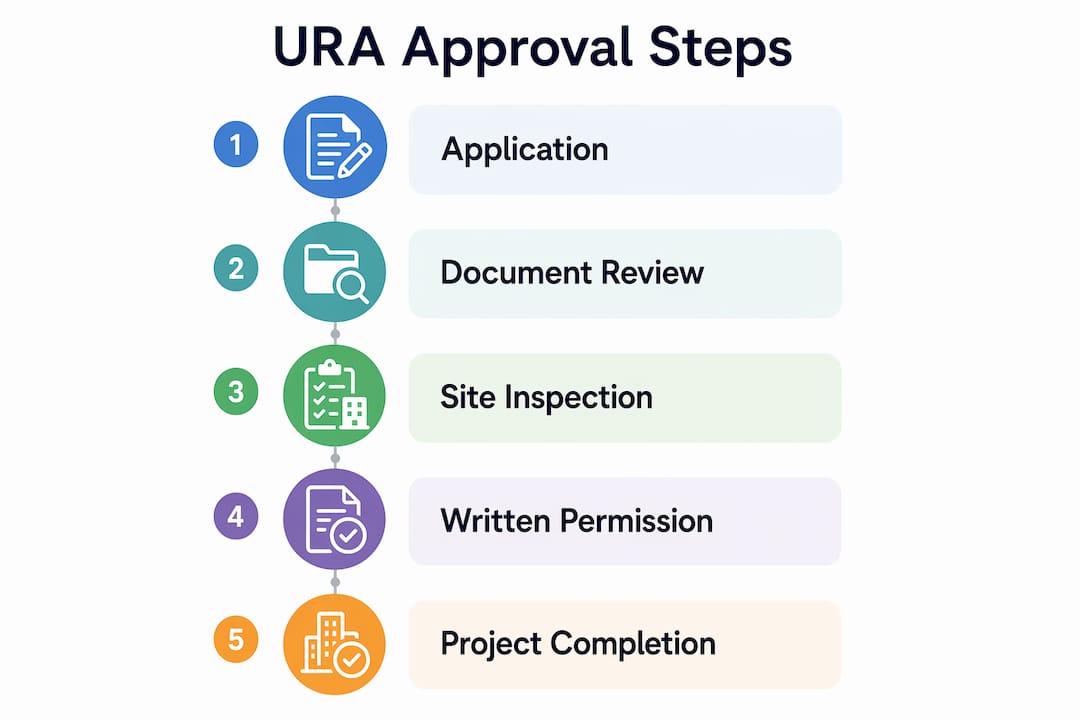
How does the URA process to apply for planning permission work step by step?
The URA approval process follows a defined sequence. Deviating from this sequence, or skipping steps, results in delays and potential enforcement exposure.
-
Engage a Qualified Person (QP). A Qualified Person is a registered architect or professional engineer authorized to submit planning applications to URA. The QP is legally responsible for the accuracy and completeness of the submission. Developers cannot submit directly to URA without a QP acting on their behalf.
-
Conduct a pre-application assessment. The QP reviews the Master Plan zoning, plot ratio, use class, and any conservation or special control area designations for the subject site. This assessment determines whether the proposed use is compatible with the site and surrounding context, and whether the proposed works require PP, WP, or fall within an exemption category.
-
Prepare and submit the application. Submissions are made through CoreNET or URA e-Services, depending on the application type. Required documents include site plans, a location plan, floor plans, elevations, a completed application form, supporting documents, a cover letter where required, and payment of the applicable processing fee. The floor plan details and other supporting documents must clearly show the subject premises and the proposed change. Incomplete submissions are the leading cause of processing delays.
-
URA evaluation and queries. URA evaluates the submission against the Master Plan, development control guidelines, planning considerations, and any applicable special requirements, with consultation with other government agencies where relevant. URA may issue queries requesting clarification or additional information. The QP must respond promptly and accurately to keep the application moving.
-
Issuance of Provisional Permission. If the proposal is acceptable in principle, URA issues PP with conditions. These conditions typically require the developer to address specific technical, planning, or conservation requirements before WP is granted.
-
Satisfy PP conditions and apply for Written Permission. The developer fulfills all PP conditions, and the QP submits the updated documentation. URA then issues WP, which authorizes the commencement of the approved works or change of use.
Typical URA processing times run up to three months for standard applications. Complex projects involving conservation areas, rezoning requests, or multiple agency clearances take longer. Factors that extend timelines include incomplete documentation, non-compliance with development control guidelines, and slow responses to URA queries.
**Pro Tip:**Submit a complete, fully coordinated set of drawings on the first attempt. Every query URA raises resets the clock on that review cycle. A QP who front-loads coordination with other agencies, such as BCA, SCDF, and PUB, before submission consistently achieves faster approvals.
How does URA zoning affect approval decisions?
URA’s Master Plan assigns every parcel of land in Singapore a specific use zone and plot ratio. These two parameters define the outer limits of what can be built or operated on any site. Understanding them is the foundation of any development feasibility assessment.
Use classes, change of use, and permitted activities
Use classes categorize the types of activities permitted within a zone. Common use classes include Residential, Commercial, Business 1 (light industrial), Business 2 (general industrial), Health and Medical Care, and Educational Institution. URA zoning and use classifications directly determine which change of use applications will be approved and which will be refused at the outset. URA also assesses the intended property use within the relevant use class; for example, a restaurant in a commercial building may be subject to additional planning checks.
The table below summarizes common use zones and their typical approval implications:
|
Use zone |
Typical permitted uses |
Change of use approval required? |
|---|---|---|
|
Residential |
Housing, home offices (limited) |
Yes, for any non-residential use |
|
Commercial |
Retail, F&B, offices |
Yes, if changing between sub-categories, with restaurant use one example |
|
Business 1 |
Light industrial, ancillary offices |
Yes, for retail or F&B uses |
|
Business 2 |
General and heavy industrial |
Yes, for any non-industrial use |
|
White |
Mixed uses as specified |
Depends on proposed use and GFA split |
Plot ratio, approved use, and development intensity
Plot ratio defines maximum GFA relative to site area. A developer who has already maximized the plot ratio on a site cannot add floor area without a formal rezoning or development baseline application. Developers acquiring sites for redevelopment must verify the existing approved GFA against the Master Plan plot ratio before structuring any deal.
The following factors further shape approval decisions:
-
Special control areas: Certain zones, such as the Central Area, Orchard Road, and Marina Bay, carry additional urban design guidelines that govern building height, setbacks, and facade treatment.
-
Conservation status: Properties gazetted under the Conservation Areas Act face strict controls on external appearance and structural modifications.
-
Road line plans: Proposed road widening reserves can reduce the effective developable area of a site, affecting plot ratio calculations.
Requirements may also differ for a particular commercial building because of urban design controls and site-specific restrictions.
The URA SPACE portal provides layered maps and search tools that allow developers to verify allowable uses, conservation status, plot ratio, and prior approvals for any individual property. Using URA SPACE at the start of every feasibility study eliminates avoidable surprises late in the approval process.
What are the most common pitfalls in the URA approval process?
Most compliance failures in the URA approval process stem from inadequate pre-application due diligence, not from the complexity of the regulations themselves.
-
Assuming exemptions apply without verification. Developers frequently assume that internal works are exempt, without confirming that the property is not a conservation building or subject to special zoning controls. Early consultation with URA and review of the Conservation and Additions and Alterations (A&A) Guidelines resolves this before work begins.
-
Proceeding on verbal assurances. Verbal guidance from agents or contractors does not constitute URA approval, and owner consent may also be required where the premises are leased. Only a written PP or WP from URA carries legal authority.
-
Incomplete or inconsistent submissions. Correct classification of works and precise documentation are critical. Drawings that conflict with each other, omit required information, or lack consent letters from a landlord generate queries and extend processing times significantly.
-
Ignoring conservation requirements. Heritage shophouses and conservation terraces carry specific material, color, and design requirements. Submitting a proposal that violates these requirements without prior consultation with URA’s Conservation Department results in rejection.
-
Misreading the Change of Use Lodgment Scheme scope. The Lodgment Scheme applies to a defined list of uses and property types. Applying it to an ineligible use does not confer approval and may trigger enforcement.
-
Starting renovation works before approval. Do not begin renovation works until the necessary approval has been obtained.
**Pro Tip:**When the regulatory position of a project is genuinely ambiguous, write formally to URA’s Conservation Department or the relevant Development Control Group for a written ruling. A formal response from URA provides a defensible record and protects the developer if the regulatory interpretation is later disputed.
Key takeaways
URA approval is the mandatory Written Permission issued under the Planning Act that authorizes qualifying development, structural alteration, or change of use on Singapore properties, and no such activity can legally commence without it.
|
Point |
Details |
|---|---|
|
Written Permission is mandatory |
Any development, GFA increase, structural change, or change of use requires URA Written Permission before work starts. |
|
PP precedes WP |
Provisional Permission confirms approval in principle; Written Permission is the final authorization to commence works. |
|
Master Plan governs decisions |
Zoning, use class, and plot ratio in the Master Plan define the outer limits of any approval decision. |
|
Conservation properties face stricter rules |
Gazetted conservation buildings require URA notification or approval even for works that would be exempt on standard properties. |
|
Early QP engagement reduces delays |
Engaging a Qualified Person before submission and front-loading agency coordination consistently shortens processing timelines. |
The regulatory discipline that separates successful developers from costly ones
From years of managing authority submissions across Singapore, the pattern is consistent. Developers who treat URA approval as a late-stage administrative step pay for it. Those who integrate regulatory assessment into the earliest phase of project planning, before site acquisition in many cases, avoid the most expensive surprises.
The URA approval process is not arbitrary. It is a structured, rules-based system grounded in the Master Plan. When a developer understands the zoning, plot ratio, use class, and conservation status of a site before signing a sale and purchase agreement, the approval process becomes predictable. When those checks are skipped, the process becomes a source of costly delays and, in some cases, project-ending constraints.
The increasing emphasis URA places on conservation and sustainability in its development control guidelines reflects a broader policy direction. Projects that align with these priorities, particularly those involving adaptive reuse of heritage buildings or green building standards, tend to receive more constructive engagement from URA during the evaluation process. Developers who understand this dynamic can position their proposals more effectively.
The single most consistent piece of advice I offer is this: engage a Qualified Person with direct URA submission experience at the pre-feasibility stage, not after the design is complete. The cost of that early engagement is a fraction of the cost of redesigning a scheme to meet conditions that could have been anticipated from the start.
— Aman
How Com supports developers through the URA approval process
Aman Engineering Consultancy manages URA planning submissions, change of use applications, and authority approvals as core services for property developers and investors across Singapore. The firm’s Qualified Persons coordinate directly with URA, BCA, SCDF, and other government agencies to prepare complete, compliant submissions from the first attempt, then support follow-up permits and licences required after planning approval.
Com’s integrated approach covers authority approvals across the full regulatory spectrum, from URA Written Permission and conservation clearances to BCA building plan approvals and fire safety submissions. The team also advises on follow-up submissions to relevant government agencies such as the National Environment Agency, Land Transport Authority, and Singapore Land Authority where applicable. Depending on the approved use, project-specific requirements may include a foodshop licence and related NEA PUB clearances. Developers working on complex or heritage sites benefit from having a single consultancy manage all agency interfaces. For developers and investors who need reliable, experienced support through the URA approval process, Aman Engineering Consultancy provides the technical depth and regulatory knowledge to keep projects on schedule and in compliance.
FAQ
What is URA approval in Singapore?
URA approval is the Written Permission issued by the Urban Redevelopment Authority under the Planning Act, authorizing a developer or property owner to carry out qualifying development, structural alteration, or change of use on a property in Singapore.
What triggers the need for URA Written Permission?
Any activity that increases Gross Floor Area, alters the building’s structure, changes the approved use class, or modifies the external envelope of a building requires Written Permission, and businesses may also need to apply for planning permission before changing the use of leased premises. Renovation works should wait until the necessary approval is issued. Conservation properties may require approval even for minor works that would be exempt on standard buildings.
How long does the URA approval process take?
Standard URA processing times run up to three months. Complex applications involving conservation areas, multiple agency clearances, or incomplete submissions take longer.
What is the difference between Provisional Permission and Written Permission?
Provisional Permission is an approval in principle issued with conditions. Written Permission is the final authorization that allows construction or change of use to commence. Both are legally distinct and required at different stages of the development process.
Can a property owner submit a URA application without a Qualified Person?
No. URA planning applications must be submitted by a Qualified Person, who is a registered architect or professional engineer authorized to act on behalf of the applicant, though a property owner may engage a consultant or have a business owner coordinate the submission through the QP. The QP bears legal responsibility for the accuracy of the submission. Depending on the proposal, the application may also require supporting documents from agencies e.g. landlord consent, a cover letter, and plans.