

Types of building permits are the mandatory regulatory approvals that property owners, developers, and contractors must secure before commencing any construction, renovation, or installation work in Singapore. The Building and Construction Authority (BCA), Urban Redevelopment Authority (URA), Housing & Development Board (HDB), and Singapore Civil Defence Force (SCDF) each govern distinct permit categories depending on project scope and property type. Singapore’s digital submission platform, CORENET-X, now consolidates approvals across seven agencies, fundamentally changing how permit applications are processed. Understanding which construction permit types apply to your project is the first step toward legal compliance and avoiding costly enforcement action.
1. Types of building permits: an overview of the regulatory framework
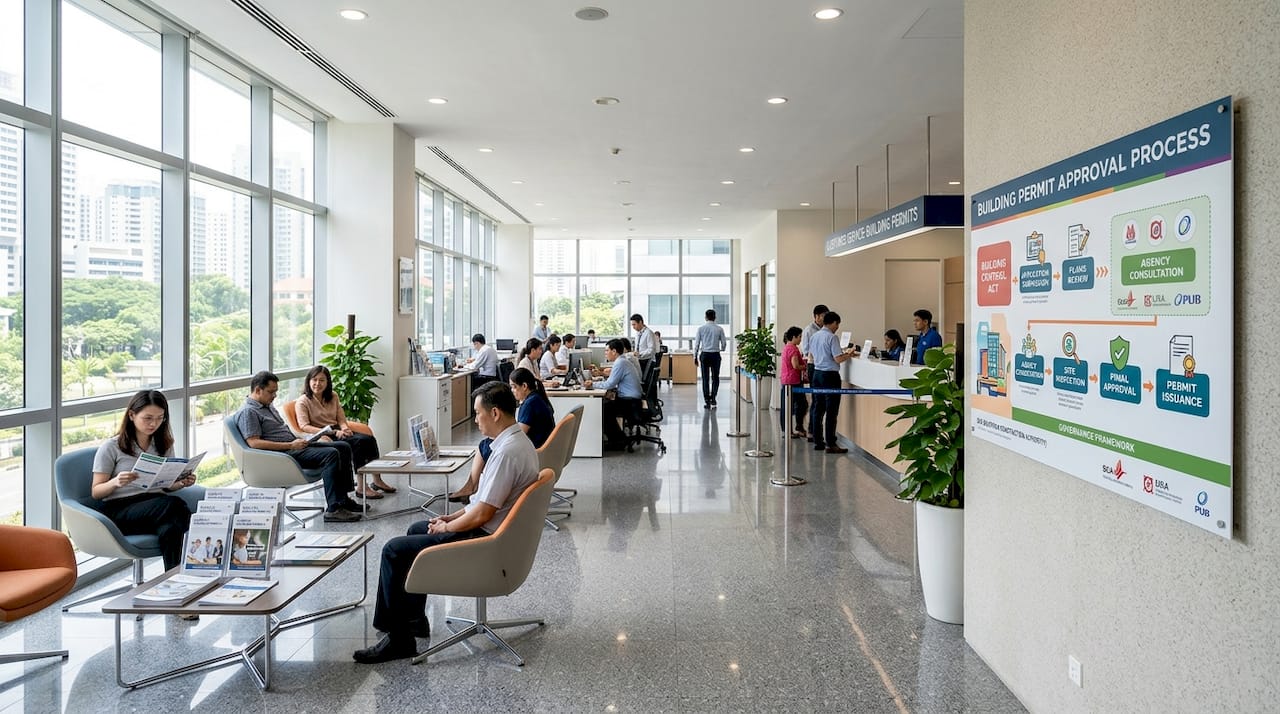
Building permits in Singapore are statutory approvals issued under the Building Control Act, and they are not interchangeable. The permit category required depends on the property type (public housing, private residential, or commercial), the nature of the work (structural, mechanical, or cosmetic), and the contractor’s BCA registration status. Submitting the wrong permit type or applying to the wrong agency is one of the most common causes of project delays. A clear understanding of the four primary categories, residential, commercial, HDB renovation, and trade-specific, allows project teams to sequence applications correctly and avoid regulatory non-compliance.
2. Residential building permits for private properties
Residential building permits apply to new builds, additions and alterations (A&A works), and major renovations on private properties such as landed houses and condominiums. These permits are submitted to BCA and, where relevant, URA for planning permission. The scope of work determines which approvals are triggered: structural changes such as removing load-bearing walls, adding a new floor, or constructing an extension require a full building plan submission and approval before work begins.
For private residential projects, the building plan submission process requires a Qualified Person (QP), either an architect or engineer registered with the relevant professional board, to prepare and submit plans on the owner’s behalf. The QP is legally accountable for the accuracy and compliance of those submissions. Minor works that do not affect structural integrity or the building envelope may fall under a simplified permit process, but owners should not assume exemption without formal verification from BCA.
Pro Tip: Engage your QP before finalizing your design brief. Changes made after plan submission require amendment applications, which extend timelines and increase costs.
3. HDB renovation permits and what triggers them
HDB renovation permits are mandatory for all structural and semi-structural renovation works in public housing flats, and they cannot be obtained retrospectively. This non-retrospective rule is the single most important compliance fact for HDB flat owners: work started without a permit cannot be legalized after the fact, and HDB may require reinstatement at the owner’s expense.
The following categories of work require an HDB renovation permit:
- Hacking of walls, floors, or ceilings
- Relocation of internal doors or partitions
- Replacement of windows beyond standard allowances
- Installation of air-conditioning systems beyond the permitted number of units
- Floor works involving the removal or replacement of existing floor finishes
Conversely, non-structural modifications such as painting, wallpapering, and installing freestanding furniture do not require a permit. The distinction lies in whether the work involves physical changes to the building structure or envelope. Homeowners remain legally responsible for permit compliance even when a contractor applies on their behalf, so verifying permit status before work commences is a non-negotiable step. A detailed compliance checklist is available in Aman Engineering’s HDB renovation permit guide.
Pro Tip: Request a copy of the approved permit from your contractor before any work begins. Do not accept verbal confirmation that a permit has been submitted.
4. Commercial building permits and BCA contractor registration
Commercial building permits govern construction, fit-out, and alteration works on office buildings, retail units, industrial facilities, and mixed-use developments. These permits involve multiple agencies, including BCA for structural compliance, URA for planning use, SCDF for fire safety, and PUB for drainage and utilities. The scope of agency involvement depends on the nature and scale of the commercial project.
A critical factor in commercial permit eligibility is the contractor’s standing in BCA’s Contractors Registration System (CRS). The five CRS categories are:
- CW (Construction Workheads): General building and civil engineering works
- CR (Construction-Related Workheads): Specialist trades such as piling, waterproofing, and demolition
- ME (Mechanical and Electrical Workheads): M&E systems including HVAC, fire protection, and electrical installations
- TR (Trade Heads): Specific trade works such as tiling, painting, and carpentry
- RW (Regulatory Workheads): Works requiring regulatory licenses, such as asbestos removal
CRS grades determine the maximum contract value and project types a contractor can undertake. Engaging a contractor whose CRS registration does not cover the intended scope of work invalidates the permit application and exposes the project owner to enforcement liability. More detail on registration categories is available through Aman Engineering’s BCA CRS guide.
Pro Tip: Verify your contractor’s CRS registration on BCA’s online directory before signing any contract. Registration status can lapse, and an expired registration is treated the same as no registration.
5. Trade-specific permits for electrical, plumbing, and mechanical works
Trade permits are separate regulatory approvals that apply to specialized technical installations within a building, regardless of whether a general building permit is also in place. Trade permits cover electrical, plumbing, mechanical, and HVAC works, and they require contractors who hold the relevant licenses and CRS registrations under the ME or TR workhead categories.
The following numbered list identifies the most common trade-specific permits required in Singapore construction projects:
- Electrical Installation Permit: Required for new electrical installations or modifications to existing systems, governed by the Energy Market Authority (EMA) and requiring a Licensed Electrical Worker (LEW).
- Plumbing and Sanitary Works Permit: Issued by PUB for works involving water supply pipes, sanitary fittings, and drainage connections to the public sewer network.
- Gas Installation Permit: Required for gas pipe installations or modifications, governed by the City Gas or SP Group framework and requiring a licensed gas service worker.
- HVAC and Mechanical Ventilation Permit: Applies to central air-conditioning systems, mechanical ventilation, and pressurization systems in commercial and industrial buildings.
- Fire Protection System Permit: Required for sprinkler systems, fire alarm installations, and suppression systems, with SCDF as the approving authority.
Each trade permit requires the appointed contractor to submit technical drawings, equipment specifications, and proof of licensing before approval is granted. Trade permits are not transferable between contractors, so any change in the appointed trade contractor mid-project requires a fresh permit application.
6. How CORENET-X changes the permit submission process
CORENET-X is Singapore’s mandatory digital regulatory submission platform, and it became mandatory for all new building projects from 1 October 2026 regardless of project size. The platform consolidates submissions to BCA, URA, SCDF, NParks, LTA, PUB, and NEA into a single workflow, enabling concurrent multi-agency reviews rather than sequential approvals. This multi-agency coordinated approach reduces approval time by up to 20% and eliminates conflicting requirements between agencies.
| Agency | Role in CORENET-X | Permit Type Covered |
|---|---|---|
| BCA | Structural and building control | Building plan approval |
| URA | Planning and land use | Development permission |
| SCDF | Fire safety | Fire safety plan approval |
| PUB | Drainage and water supply | Utility connections |
| LTA | Road and transport impact | Access and traffic approvals |
| NParks | Greenery and tree conservation | Tree conservation permits |
| NEA | Environmental compliance | Environmental impact clearance |
The technical requirements for CORENET-X submissions are specific and non-negotiable. BIM models must use correct IFC classifications, Singapore-specific property sets known as SGPset, and the SVY21 coordinate system. Incorrect IFC+SG mapping causes CORENET-X validation failures, which delay approvals and require resubmission. Even models exported directly from Autodesk Revit require careful configuration to meet these standards.
Pro Tip: Run CORENET-X validation checks on your BIM model before formal submission. Validation errors caught internally cost hours to fix; errors caught by the system after submission cost weeks.
7. Comparing construction permit types: a side-by-side reference
The table below provides a direct comparison of the four primary construction permit types applicable in Singapore, covering the key variables that determine which permit applies to a given project.
| Permit Type | Property Type | Approving Agency | Contractor Requirement | Retrospective Approval |
|---|---|---|---|---|
| Residential building permit | Private landed, condo | BCA, URA | Qualified Person (QP) required | Not permitted |
| HDB renovation permit | HDB flats | HDB | HDB-registered contractor | Not permitted |
| Commercial building permit | Office, retail, industrial | BCA, URA, SCDF, PUB | CRS-registered contractor | Not permitted |
| Trade-specific permit | All property types | EMA, PUB, SCDF | Licensed trade contractor | Not permitted |
No permit category in Singapore allows retrospective approval. This applies uniformly across residential, commercial, and trade permit types. Projects that proceed without the required approvals face stop-work orders, reinstatement costs, and potential prosecution under the Building Control Act. When multiple permit types are required for a single project, such as a commercial fit-out involving structural works, electrical installations, and fire protection systems, applications should be sequenced with the building plan approval obtained first, followed by trade permits once the structural scope is confirmed.
For a detailed walkthrough of the application process, Aman Engineering’s building renovations guide covers sequencing and agency coordination for complex projects.
Key takeaways
Securing the correct building permit before commencing any construction or renovation work in Singapore is a legal obligation, and no permit category permits retrospective approval under the Building Control Act.
| Point | Details |
|---|---|
| No retrospective permits | All permit types in Singapore require pre-approval; work started without a permit cannot be legalized after the fact. |
| CORENET-X is now mandatory | From 1 October 2026, all new building projects must submit through CORENET-X regardless of project size. |
| CRS registration governs eligibility | A contractor’s BCA CRS category and grade directly determine which permits they can obtain and the project scale they can undertake. |
| Trade permits are separate approvals | Electrical, plumbing, HVAC, and fire protection works each require distinct trade permits in addition to any general building permit. |
| HDB permits have unique rules | HDB renovation permits apply only to HDB flats and require HDB-registered contractors; homeowners bear legal responsibility for compliance. |
My perspective on permit planning in Singapore
The most consistent mistake I observe across both residential and commercial projects is treating permit applications as an administrative afterthought rather than a project planning input. Clients frequently arrive with finalized designs and contractor appointments, only to discover that their chosen contractor lacks the CRS registration required for the intended scope of work, or that the design triggers agency approvals that were not budgeted into the project timeline.
The shift to CORENET-X has made early permit planning more consequential, not less. The platform’s BIM submission requirements mean that design decisions made at schematic stage directly affect whether a model will pass validation at submission stage. A BIM model built without SGPset compliance or correct IFC classifications will fail CORENET-X validation regardless of how technically sound the design is. That failure costs time and money that could have been avoided with a compliance review at the design development stage.
The non-retrospective rule for HDB renovation permits deserves particular emphasis. Many homeowners still operate under the assumption that a permit can be obtained after work begins, or that a contractor’s verbal assurance of compliance is sufficient. Neither assumption is legally defensible. HDB enforcement is active, and reinstatement orders are issued without exception.
For complex projects involving multiple permit types, the value of engaging a consultancy with direct experience across BCA, URA, SCDF, and HDB workflows is not theoretical. It is the difference between a project that proceeds on schedule and one that accumulates delays at every agency interface.
— Aman
How Aman Engineering supports your permit applications
Aman Engineering Consultancy provides end-to-end support for all types of building permits required in Singapore, from HDB renovation permits and residential building approvals to commercial permits and trade-specific applications. The firm’s qualified persons, engineers, and BIM specialists manage statutory submissions across BCA, URA, SCDF, HDB, PUB, and LTA, with direct experience in CORENET-X compliant BIM modeling that meets IFC+SG mapping and SGPset requirements. Whether you are planning a home renovation, a commercial fit-out, or a new development, Aman Engineering’s consultancy services reduce approval timelines and eliminate compliance risk. Visit Aman Engineering Consultancy to discuss your project requirements with a specialist.
FAQ
What are the main types of building permits in Singapore?
The four primary construction permit types in Singapore are residential building permits, HDB renovation permits, commercial building permits, and trade-specific permits covering electrical, plumbing, mechanical, and fire protection works. Each type is governed by a different regulatory authority and applies to specific property types and work scopes.
Can HDB renovation permits be obtained after work has started?
HDB renovation permits cannot be obtained retrospectively. Work that begins without an approved permit is a regulatory violation, and HDB may issue a stop-work order and require full reinstatement of the original condition at the homeowner’s expense.
What is CORENET-X and does it affect my permit application?
CORENET-X is Singapore’s mandatory digital platform for building permit submissions, and it became compulsory for all new building projects from 1 October 2026. It consolidates reviews from seven agencies including BCA, URA, and SCDF, and requires BIM submissions that meet specific IFC and SGPset standards.
How does BCA CRS registration affect which permits a contractor can obtain?
A contractor’s BCA Contractors Registration System category and grade determine the types and scale of construction work they are legally authorized to perform. Engaging a contractor whose CRS registration does not cover the project scope invalidates the permit application and creates legal liability for the project owner.
Do trade permits replace general building permits?
Trade permits do not replace general building permits. They are separate approvals required for specialized technical installations such as electrical systems, plumbing, and HVAC works, and they must be obtained in addition to any structural or building plan approvals already in place.