
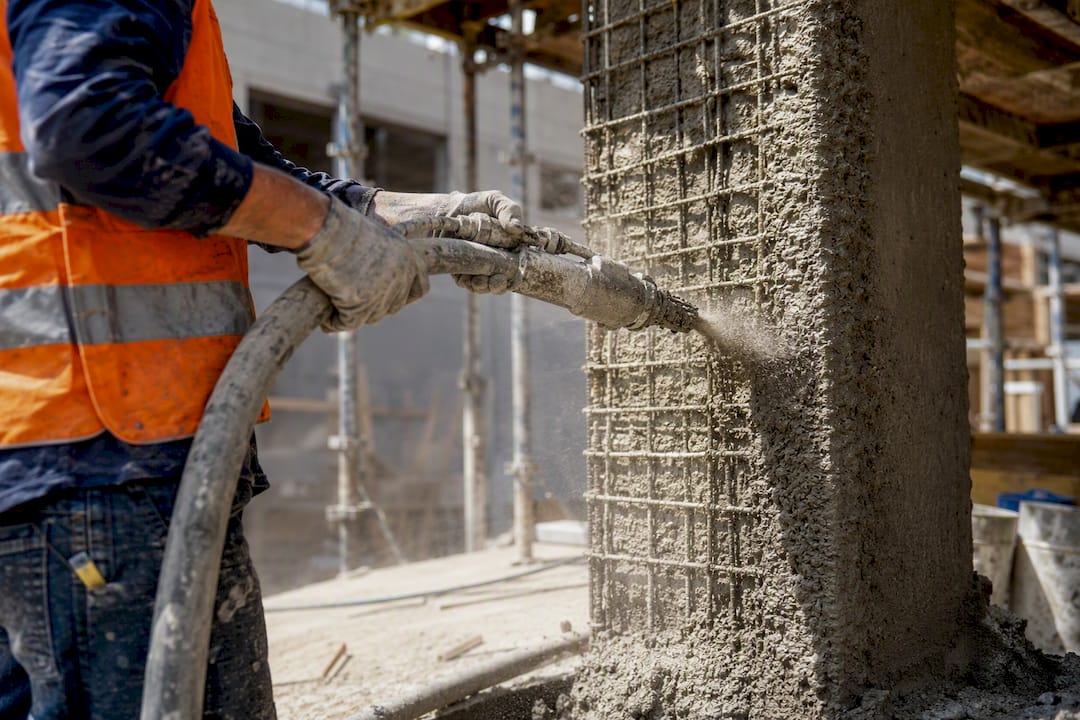
Six method families cover nearly every structural strengthening problem you will face: FRP systems (externally bonded or near-surface mounted), concrete jacketing, steel plate bonding and steel jacketing, external post-tensioning, and shotcrete or foundation-based solutions. FRP suits low-disruption jobs where headroom and dead-load limits matter. Concrete jacketing wins when you need the largest capacity gain on a badly deteriorated element, and external post-tensioning controls deflection on long-span or heavily loaded members. Shotcrete and micropiles solve curved surfaces, tunnels, and foundation deficiencies.
None of these methods is a shelf product. Selecting one without a formal engineering diagnosis, load rating, and code-compliant design is how retrofit projects fail inspection or, worse, fail in service.
- FRP (EBR/NSM): minimal disruption, adds negligible weight, typical flexural gains of 30 to 80 percent
- Concrete jacketing: highest capacity uplift, often the largest increases among common retrofit methods, with high disruption
- Steel plate/jacketing: fast install, strong for axial confinement and seismic ductility
- External post-tensioning: best deflection control, largest capacity increases on long spans
- Shotcrete/micropiles/jet grouting: curved surfaces, tunnels, foundation bearing capacity
Pro Tip: Treat method selection as a design decision, not a procurement decision. The practitioner’s guide on strengthening existing concrete elements makes clear that no single technique fits every deficiency; the controlling variables are access, live-load constraints, and fire rating, not just cost per square meter.
Key Takeaways
Structural strengthening works only when the method is matched to a verified deficiency through engineered design, not selected as a standalone product purchase.
| Point | Details |
|---|---|
| FRP for low disruption | EBR and NSM systems add 30 to 80 percent flexural capacity with minimal added weight. |
| Jacketing for maximum gain | Concrete jacketing delivers 50 to 200 percent or higher capacity increases on badly deteriorated elements. |
| Post-tensioning for long spans | External tendons control deflection and can add up to 300 percent capacity on bridges and transfer beams. |
| Anchorage prevents failure | Mechanical anchors or grooving methods reduce the debonding risk common to EBR and steel plate systems. |
| Diagnosis comes before method | Com’s survey-to-approval process selects the strengthening technique based on verified conditions, not default specification. |
Table of Contents
- What Are FRP Strengthening Systems and How Do EBR and NSM Differ?
- When Does Concrete Jacketing Deliver the Biggest Capacity Gain?
- Steel Plate Bonding and Steel Jacketing: When Metal Still Beats Composites
- External Post-Tensioning: Controlling Deflection on Long Spans
- Shotcrete Overlays and Foundation Strengthening
- How Do You Choose Between Strengthening Methods?
- From Survey to Sign-Off: The Design and Installation Sequence
- Why an Engineering-Led Approach Matters More Than the Method Itself
- Get an Engineering-Led Strengthening Assessment
- Sources
What Are FRP Strengthening Systems and How Do EBR and NSM Differ?
Fiber-reinforced polymer systems dominate modern structural strengthening because they add strength without adding meaningful weight. Carbon FRP (CFRP) offers the highest stiffness and strength, making it the default for flexural and shear upgrades on beams and slabs. Glass FRP (GFRP) costs less and works where stiffness demands are moderate. Aramid FRP (AFRP) shows up in impact-resistant or blast-mitigation applications where its energy absorption matters more than raw stiffness.
Two installation modes cover almost every FRP project. Externally bonded reinforcement (EBR) applies laminates or fabric directly to a prepared concrete surface with epoxy, and it is fast, low-weight, and ideal when you cannot add dead load or lose headroom. Near-surface mounted (NSM) bars sit in grooves cut into the cover concrete, which improves bond performance and gives the reinforcement some protection from fire and mechanical damage that EBR cannot offer.
- Debonding is the most common failure mode in EBR systems; grooving or mechanical anchorage methods (sometimes called EBRIG or EBROG) reduce that risk
- NSM systems generally show better bond behavior in testing than surface-bonded laminates
- Typical flexural capacity increases fall in the 30 to 80 percent range for many beam retrofits, though the actual gain depends on existing reinforcement ratio and failure mode
- Epoxy glass transition temperature (Tg) governs performance in elevated-temperature environments, and fire protection often becomes the limiting design factor rather than strength
Design should reference the ACI PRC-440 family of guidelines alongside the manufacturer’s ICC-ES acceptance criteria, such as ESR-4774 and AC125-referenced systems, which spell out epoxy selection, surface preparation tolerances, and anchorage detailing. A state-of-the-art review of FRP strengthening techniques flags long-term durability and fire performance as the areas where the profession still needs better data, so build in inspection access rather than treating FRP as maintenance-free.
When Does Concrete Jacketing Deliver the Biggest Capacity Gain?
Section enlargement, commonly called concrete jacketing, wraps an existing column, beam, or wall in new reinforced concrete bonded to the original section. It restores or increases capacity by literally growing the structural cross-section, which is why it produces the largest gains of any common retrofit method, often in the 50 to 200 percent range or higher.
Execution follows a fairly fixed sequence, often coordinated with expert architectural drafting services to ensure structural tie-ins and detailing.
- Roughen the existing concrete surface to achieve a mechanical bond, and clean it of laitance, oil, or coatings
- Install shear connectors or dowels to tie new concrete to the old section and transfer load across the interface
- Detail new longitudinal and transverse reinforcement to match the strengthened demand, then splice it properly into existing bars where required
- Pour and cure the new concrete under controlled conditions, checking shrinkage compatibility with the substrate
Jacketing wins where FRP or steel plates cannot: heavily spalled or corrosion-damaged columns, elements that need fire resistance restored (not just strength), or cases where the demand increase is too large for a thin composite layer to handle. The trade-off is disruption and weight. A jacketed column takes up more floor area, adds substantial dead load, and the wet works mean longer downtime than a bonded FRP or steel system.
Steel Plate Bonding and Steel Jacketing: When Metal Still Beats Composites
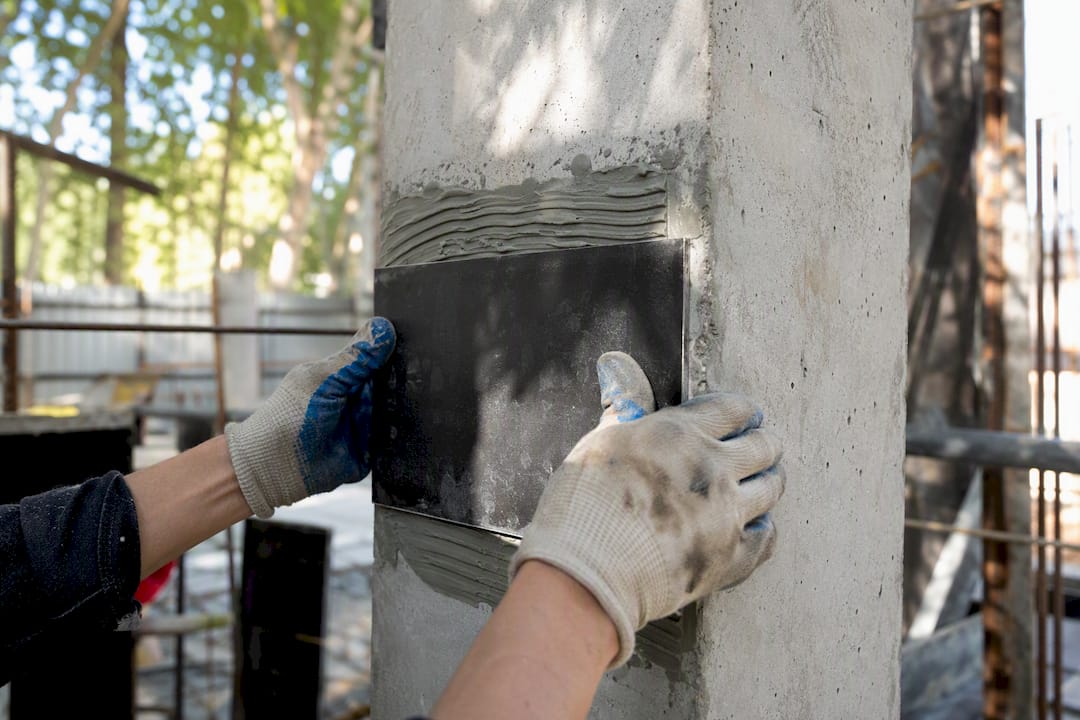
Externally bonded steel plates (EBSP) strengthen beams in flexure using the same bonding principle as FRP, but with mild steel plates instead of composite laminate. Because steel plates are heavier and stiffer than FRP sheets, mechanical anchors (bolts through the plate into the substrate) are standard practice to guard against the same debonding failure that plagues unanchored EBR systems.
Steel jacketing wraps columns in steel plates or angles, either welded or bolted into a continuous confining shell. This method excels at axial confinement and seismic ductility improvement, since the steel casing restrains lateral concrete expansion under compression, delaying spalling and improving post-yield behavior.
- Steel systems generally cost less upfront than proprietary FRP systems but carry higher long-term corrosion risk without fireproofing or protective coating
- Inspection is straightforward visually, but bolted connections need periodic torque checks
- Weight and site access constraints often rule steel out where crane access or floor loading is limited
External Post-Tensioning: Controlling Deflection on Long Spans
External post-tensioning runs new tendons outside the original concrete section, anchored at each end and deviated at intermediate points, then stressed to introduce compressive force that counteracts service loads. This technique reduces tensile stress and controls deflection directly rather than adding passive reinforcement, which is why it produces some of the largest capacity increases available, frequently in the 50 to 300 percent range for suitable applications like transfer beams and bridge girders.
- Anchorage zones need careful detailing to distribute the concentrated stressing force without local crushing
- Tendons must remain accessible for inspection, corrosion protection maintenance, and future re-stressing
- Deviators and saddles require their own load path checks, since they carry the resultant of the tendon’s angle change
Pro Tip: Sequence the stressing operation in stages and monitor deflection at each increment. Stressing a long-span tendon to full force in one pass can overload temporary supports that were sized for the unstressed condition.
Because the structure typically remains partly in service during stressing, temporary works planning is not optional. It is part of the design.
Shotcrete Overlays and Foundation Strengthening
Shotcrete, sprayed concrete reinforced with mesh or fiber, handles geometries that formed concrete jacketing struggles with: curved tunnel linings, retaining walls, and surfaces with restricted formwork access. It builds up section thickness in thin, well-bonded layers and adapts to irregular substrates without custom formwork.
Foundation deficiencies call for a different toolkit entirely. Micropiles transfer load past a weak bearing stratum down to competent soil or rock, often installed through existing footings with minimal excavation. Jet grouting improves soil bearing capacity in place by injecting cementitious grout under high pressure, useful where excavation for underpinning is impractical.
- Shotcrete overlays pair well with mesh or fiber reinforcement for crack control on walls and slabs
- Micropiles and underpinning address settlement or increased load demand at the foundation level, which structural strengthening above grade cannot fix alone
- Drainage sequencing matters: dewatering before jet grouting or micropile installation prevents slurry contamination and maintains site access for equipment
How Do You Choose Between Strengthening Methods?
Run through a short checklist before committing to a method: target capacity increase, element type and failure mode (flexure, shear, or axial), live-load constraints during construction, available headroom, required fire rating, inspection access, budget, and program duration.
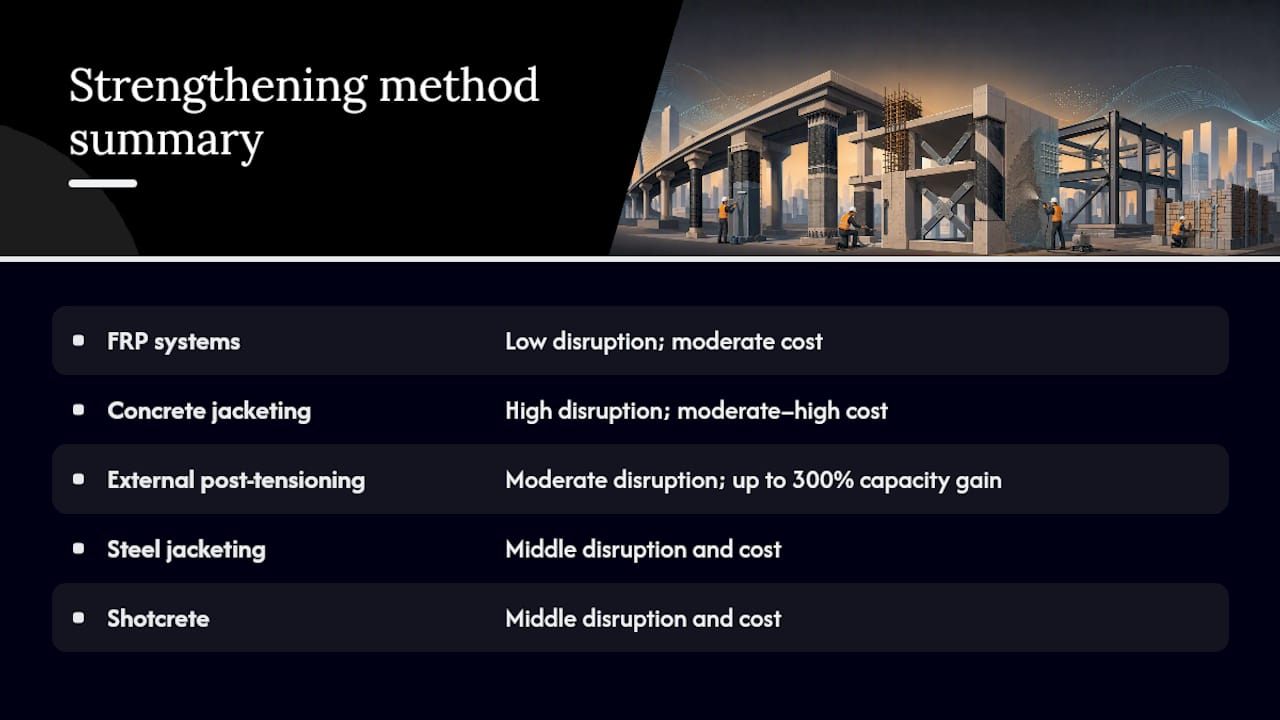
A rough disruption and cost pattern holds across most projects. FRP systems carry low disruption and moderate relative cost. Concrete jacketing brings high disruption and moderate-to-high cost given the formwork and curing time. External post-tensioning sits at moderate disruption but can carry capacity gains up to 300 percent, which often justifies the higher engineering input. Steel jacketing and shotcrete land in the middle on both axes.
When reviewing tenders, ask contractors to specify the exact epoxy system and its ESR or ICC-ES reference, the anchorage detail proposed, and how they plan to verify bond strength after cure. A red flag worth investigating further: any proposal that skips surface preparation specifications or offers a single method for every deficiency on the punch list.
From Survey to Sign-Off: The Design and Installation Sequence
A defensible strengthening scope starts with investigation, not material selection.
- Conduct non-destructive testing, core sampling, rebar mapping, and crack mapping to establish actual as-built conditions, not assumed design values. Assessing concrete spalling accurately before specifying repairs prevents undersized retrofit schemes.
- Select anchorage and bond detailing based on that survey: epoxy type and Tg, mechanical anchors where debonding risk is high, and supplementary anchorage for NSM or steel plate systems.
- Plan temporary works, including shoring sequences if the structure stays partially in service, coordinated through a proper temporary works design process.
- Run verification testing (pull-off tests, load tests where applicable) and compile acceptance documentation for authority submission.
Pro Tip: When the structure cannot be unloaded during works, design for the expected in-service strain state rather than the unloaded condition. A retrofit that only performs once the live load is removed is undersized for the condition it will actually see.
Detailed structural modelling at each stage keeps the design and analysis workflow consistent from diagnosis through final verification.

Why an Engineering-Led Approach Matters More Than the Method Itself
Most strengthening failures trace back to a decision made before any contractor touched the structure: skipping the diagnostic phase or defaulting to whatever method a supplier happened to be selling. Practitioner guidance is consistent on this point. Strengthening is a design-build process, and success depends on how well new material is connected to the existing structure, not just which material gets specified.
Aman Engineering Consultancy approaches every strengthening project through survey, bespoke design, temporary works coordination, installation supervision, and authority submission support, drawing on structural, facade, and regulatory experience across statutory approval processes that most single-discipline contractors never touch. That sequence exists because a strengthening scheme that passes structural review but stalls at BCA or another authority submission has not actually solved the client’s problem. The two failures cost the same in delay.
— Aman
Get an Engineering-Led Strengthening Assessment
If you are scoping a retrofit and weighing FRP against jacketing or post-tensioning, the fastest way to avoid an undersized or over-specified scheme is a diagnosis-first engagement rather than a materials quote. Com works from survey through design, temporary works planning, and authority submission, which means the strengthening method gets selected based on your structure’s actual condition and your project’s live-load and program constraints, not a supplier’s default recommendation.

That engineering-led sequence also covers the statutory approvals that determine whether your retrofit clears BCA or other agency review without rework. For property developers, building owners, and contractors managing an aging asset, Aman Engineering Consultancy’s structural design and approval services start with a site survey and diagnostic report before any method gets locked in. If you want to move from “we suspect a problem” to a scoped, code-compliant strengthening plan, get in touch through Aman Engineering Consultancy to schedule an assessment.