
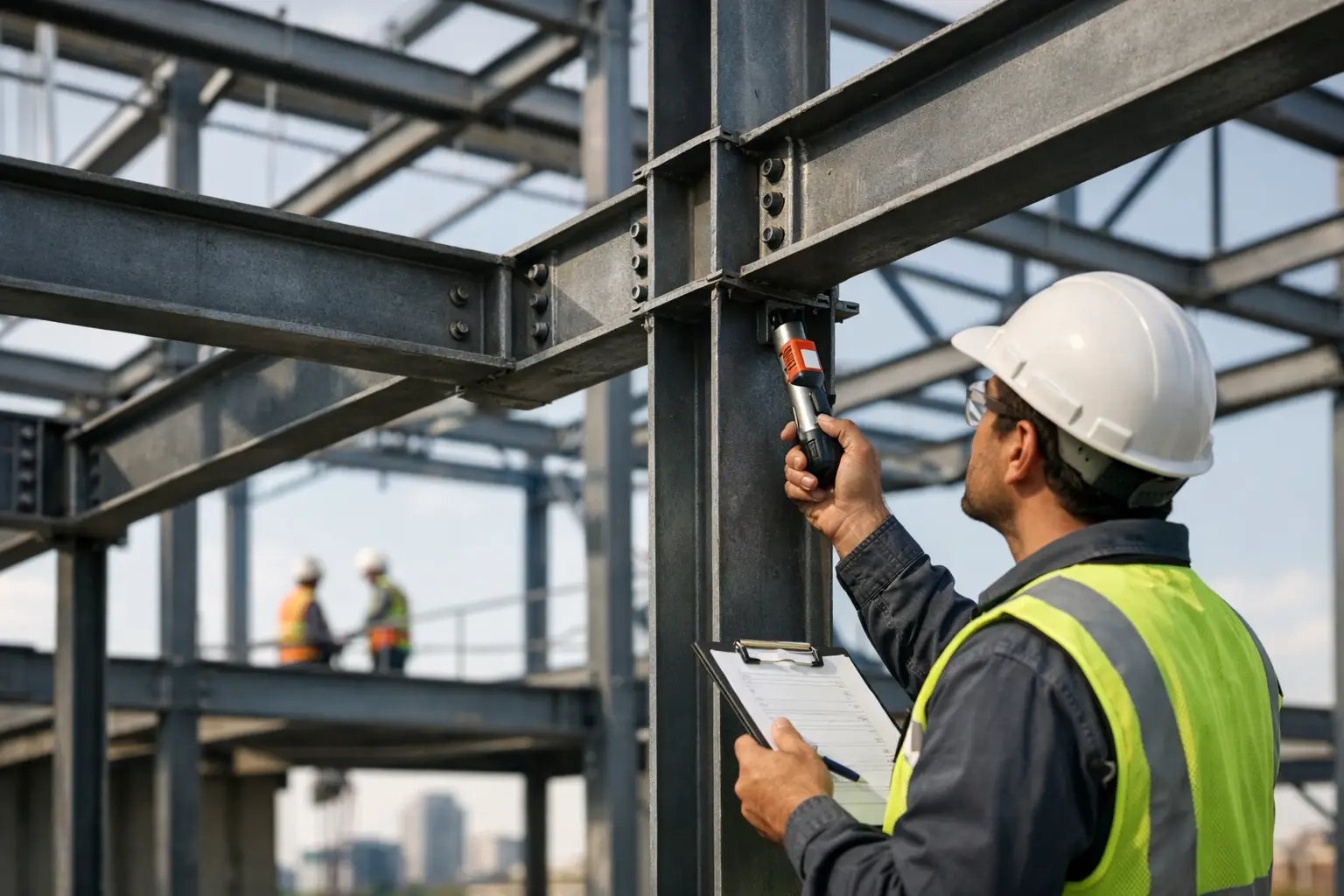
A failed steel inspection rarely starts with a dramatic crack or visible distortion. More often, it begins with missing mill certificates, incomplete weld records, unverified bolt tension, or a site change that never made it back into the approved drawings. That is why structural steel inspection requirements matter long before final handover. They affect safety, code compliance, schedule certainty, and whether a project can move forward without costly rework.
For owners, developers, contractors, and building managers, the challenge is not simply knowing that steel must be inspected. The real issue is understanding what must be checked, when it must be checked, who is qualified to verify it, and how those findings are documented for engineering acceptance and authority review where applicable. On some projects, a straightforward visual inspection may be sufficient for part of the work. On others, welding procedures, nondestructive testing, material traceability, and load-path verification become critical.
What structural steel inspection requirements actually cover
Structural steel inspection requirements typically span the full life cycle of the steelwork, from procurement and fabrication through erection, connection completion, and final acceptance. In practical terms, inspection is not one event. It is a sequence of checks that confirm the installed steel matches the design intent, meets applicable code and specification requirements, and has not been compromised by poor workmanship, unauthorized changes, or field conditions.
That scope usually includes material identification, dimensions, member sizes, connection details, bolt installation, weld quality, alignment, plumbness, bearing conditions, corrosion protection, and any fireproofing interface that affects the steel assembly. If the project involves modifications to an existing building, inspections often extend to the condition of the original steel, signs of overstress, section loss, past repairs, and whether the existing structure can safely support new loads.
The exact inspection requirements depend on the project type. A low-risk canopy support frame does not carry the same level of inspection rigor as a multistory commercial building, industrial platform, transfer structure, or steel element supporting critical equipment. The governing code, project specifications, and engineer of record usually determine how intensive the inspection process needs to be.
The main stages of structural steel inspection requirements
Pre-fabrication and material verification
Inspection starts before steel reaches the site. Fabricated members should match the approved structural drawings and connection details. Material grades, plate thicknesses, section sizes, and coating systems should be verified against the specified requirements. This stage is also where traceability matters. If a steel member cannot be tied back to the required material certification, that gap can become a serious compliance issue later.
For complex projects, reviewers also check shop drawings, welding procedure specifications, and qualification records for welders and inspectors. These are not paperwork exercises. They establish whether the work will be fabricated under controlled conditions and whether the people carrying it out are qualified for the connection type and welding process involved.
Shop inspection during fabrication
Fabrication-stage inspection focuses on accuracy and workmanship. Inspectors may verify cut lengths, hole locations, edge preparation, fit-up, camber, and assembly tolerances. Weld preparation and sequence are especially important because poor fit-up can lead to defects that are expensive to correct after delivery.
Not every project requires continuous shop surveillance. In some cases, periodic hold-point inspection is enough. In others, especially where there are critical welds or unusual geometry, more direct oversight is justified. The right level of inspection depends on risk, complexity, and contractual requirements.
Site delivery and erection inspection
Once steel arrives on site, it should be checked for transport damage, coating defects, distortion, and proper identification. During erection, inspectors typically verify member orientation, temporary stability, bracing installation, bearing surfaces, and the sequence of erection where that sequence affects structural behavior.
This is often where site-driven deviations appear. Contractors may adjust a connection for access, substitute a plate, or modify a stiffener to accommodate other trades. Even when the change seems minor, it can affect load transfer or local capacity. Any deviation from the approved structural intent should be reviewed by the responsible engineer before it is accepted.
Connection inspection for bolts and welds
Connections are the most inspection-sensitive part of many steel structures. For bolted connections, the inspection may include bolt type, diameter, length, washer placement, surface condition, and installation method. Where pretensioned bolts are specified, verification of proper tightening is essential. A bolt that looks installed is not necessarily a bolt that is performing as designed.
For welded connections, visual inspection is the baseline requirement, but visual checks alone are not always enough. Depending on the weld category and project specification, nondestructive testing such as ultrasonic testing, magnetic particle testing, dye penetrant testing, or radiographic testing may be required. The purpose is to identify discontinuities that cannot be confirmed from the surface but may affect the integrity of the joint.
Who is responsible for inspection
Responsibility is usually shared, but it should never be vague. Fabricators and contractors are responsible for executing the work in accordance with approved documents and quality requirements. Independent inspectors, special inspectors, or quality personnel may verify compliance at defined stages. The engineer of record or a licensed professional engineer typically reviews whether the completed steelwork satisfies the structural design intent, especially when there are field changes, defects, or nonconformance reports.
This distinction matters. Inspection is not only about catching workmanship issues. It is also about making engineering decisions when conditions differ from the design assumptions. If corrosion is discovered in an existing steel beam, if a weld fails testing, or if a connection was built differently from the drawing, the next step is not just reinspection. It may require structural assessment, redesign, or rectification details signed off by the appropriate professional.
Documentation is part of compliance, not an afterthought
One of the most overlooked structural steel inspection requirements is documentation quality. Projects run into delays not because the steel is necessarily unsafe, but because there is no clear record showing that it was inspected, tested, and accepted.
Typical records include mill certificates, shop drawings, inspection reports, weld logs, bolt installation records, nondestructive testing reports, coating records, nonconformance reports, and rectification closeout documentation. On regulated projects, those records may also support authority submissions, engineering certifications, or completion statements.
Good documentation creates traceability. It allows the project team to answer practical questions quickly: Was this weld tested? Was this steel grade approved? Was the field modification reviewed? Without that paper trail, even a technically sound installation can become difficult to certify.
Existing buildings have different inspection priorities
For existing structures, structural steel inspection requirements often shift from installation quality to condition assessment and residual capacity. The inspection may focus on corrosion, deformation, fatigue cracking, failed connections, fire exposure, water ingress, and unauthorized alterations. In adaptive reuse or addition and alteration work, the existing steel must also be checked against the new loading conditions.
This is where experience matters. A heavily rusted steel member is not automatically unsafe, and a clean painted beam is not automatically adequate. Engineers need to assess section loss, connection condition, load path continuity, and the actual demand on the member. In some cases, localized repairs are enough. In others, strengthening or replacement is the safer and more economical decision once lifecycle risk is considered.
Common reasons steel inspections fail
Inspection failures are usually predictable. The recurring issues include mismatched member sizes, missing stiffeners, poor weld quality, inadequate bolt installation, lack of material traceability, unapproved field modifications, coating damage, and incomplete records. Coordination problems between steel, architectural, and MEP trades also create avoidable defects, especially when late openings or support changes are introduced after fabrication.
The cheapest time to solve these problems is before steel is cut. After erection, every correction becomes more disruptive. That is why early review, staged inspections, and timely engineering responses are far more effective than relying on final inspection alone.
When to bring in a specialist engineering consultant
Not every project needs the same level of external support, but some situations clearly justify it. If the steelwork supports critical equipment, involves unusual geometry, requires statutory signoff, includes disputed defects, or forms part of a renovation to an occupied property, specialist inspection and engineering review can reduce both technical and regulatory risk.
A consultancy with design, inspection, rectification, and submission capability can also close the gap between finding a problem and solving it. That matters when projects cannot afford a long chain of separate consultants, test agencies, and approval coordinators. Firms such as Aman Engineering Consultancy are often engaged in these scenarios because inspection findings, engineering judgment, and compliance documentation need to move together rather than in separate tracks.
Structural steel inspection is not just a quality-control checkbox. It is a control point for safety, constructability, and certification. If the inspection plan is clear, the technical review is competent, and the records are complete, steelwork tends to progress with fewer surprises. When those basics are ignored, the project usually pays for it later – in delays, redesign, or avoidable risk. The practical move is to treat inspection as part of delivery from day one, not as a problem-solving exercise at the end.