
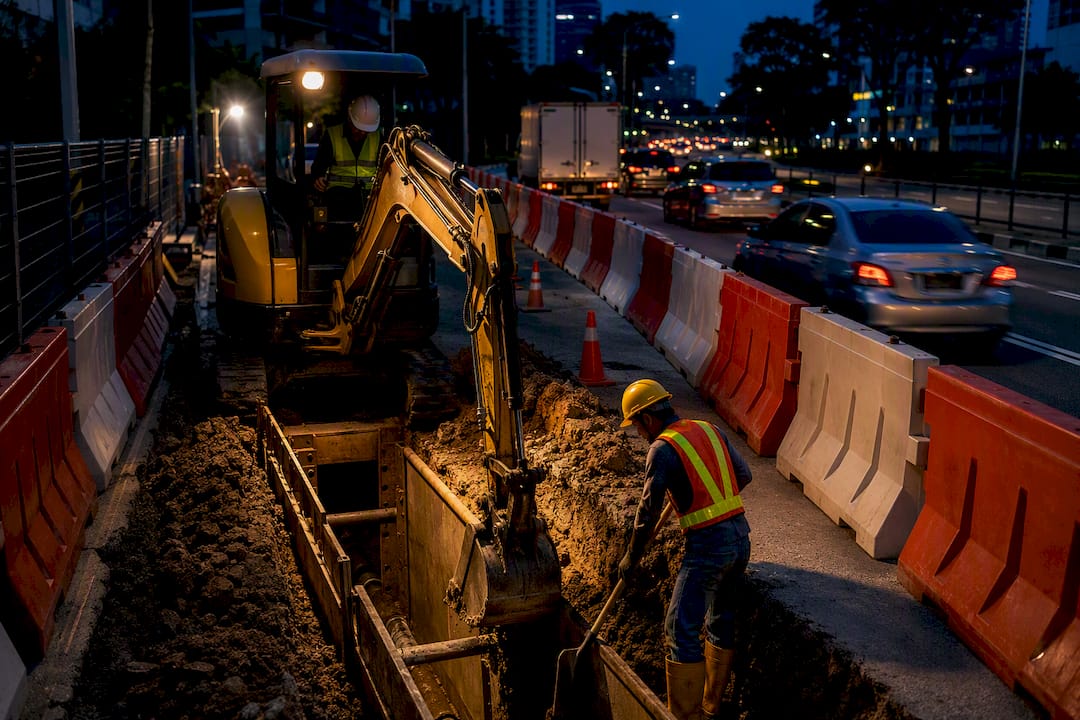
Every contractor performing excavation, lane occupation, or road works on a public street must submit a road opening permit application through LTA.PROMPT, the Land Transport Authority’s dedicated portal. Approval hinges on registering under the correct category, submitting a complete document package including a Traffic Control Plan, and meeting the standard 10 working day processing window. Larger or high-impact projects carry additional obligations, including pre-consultation and, from October 2026, mandatory Road Works Planner scheduling for select roads.
TL;DR:
- Registering in the correct category on LTA.PROMPT is crucial, as mismatched roles can delay or block permit approval, especially for contractors and engineers.
- Applying for high-impact or large projects requires pre-approval and, from October 2026, a schedule submission through the Road Works Planner at least two months in advance.
- A complete application must include accurate site plans, photographs, detailed work methods, and Traffic Control Plans, with site verification needed before submission to reduce rejection risk.
- Traffic Control Plans should clearly show diversion routes, signage, pedestrian protection, and match current site conditions to avoid multiple revision rounds.
- Contractors should consider hiring specialists to coordinate multi-agency approvals and manage submission accuracy, reducing delays and ensuring compliance.
Table of Contents
- What LTA.PROMPT Covers and When You Need a Permit
- Who Can Apply and How Registration Works on LTA.PROMPT
- Documents, Drawings, and Evidence You Must Attach
- Traffic Control Plan: What LTA Looks For and Why TCPs Fail
- Timelines, Fees, Notifications, and Cancellations
- Step-by-Step: Submitting a Road Opening Permit on LTA.PROMPT
- Pre-Consultation, Major Proposals, and High-Impact Roads
- Expert Checklist and Common Pitfalls
- Why Using an Engineering Consultant Reduces Delays
- Managing Your Road Opening Permit
- Sources
- FAQ
What LTA.PROMPT Covers and When You Need a Permit
Land Transport Authority requires electronic submission for nearly every activity that touches a public street: excavation, soil investigation, hoisting operations over a carriageway, and any lane occupation that restricts traffic flow. All of it runs through LTA.PROMPT, the Permit for Road Occupation Management Portal, which functions as the single point of entry for road opening applications regardless of scale.
Not every activity needs a full application. Minor works with negligible traffic impact may qualify for a simplified notification rather than a complete permit review, though the distinction depends on scope and duration rather than a fixed rule of thumb. Works on private roads generally fall outside LTA’s jurisdiction unless they connect to or affect a public street.
Because road works frequently cross into utility corridors or land managed by other agencies, LTA.PROMPT routes applications for parallel review where needed. A single submission can trigger checks from PUB for drainage or water mains, or SCDF where fire access is affected, without the applicant filing separate paperwork for each agency.
Who Can Apply and How Registration Works on LTA.PROMPT
Access to LTA.PROMPT depends entirely on registering under the right category. The portal recognizes several applicant types: authorized officers representing a company, utility provider officers, contractors executing the physical works, Professional Engineers (PE) certifying structural or geotechnical aspects, and site supervisors managing day to day compliance.
Registering under the wrong category is one of the most common reasons a submission stalls before review even begins, since each category carries different upload permissions and sign-off authority. A contractor account, for instance, cannot submit an engineering evaluation that requires a PE’s endorsement.
Registration typically requires a letter of authorization from the applicant’s employer, a valid PE practising certificate for engineers, and a CITI certificate or equivalent competency credential for site supervisors overseeing works.
Documents, Drawings, and Evidence You Must Attach
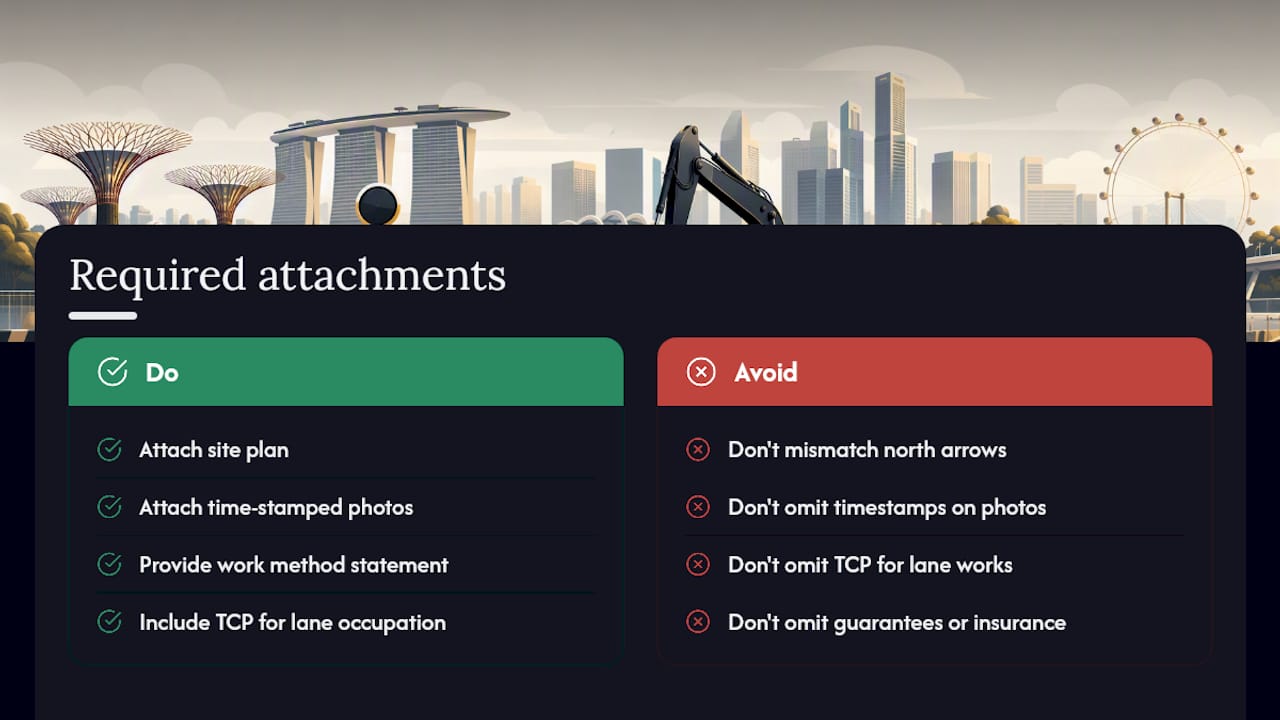
A complete application package includes a location or site plan, photographs documenting existing ground conditions, a detailed work method statement, and a schematic showing proposed road markings or signage changes. LTA.PROMPT’s own guidance confirms this baseline: a site plan, photographs, work method statement, and Traffic Control Plan form the core of nearly every submission involving lane occupation.
Several conditional documents apply depending on project scope. Works involving lane occupation require a full Traffic Control Plan. Projects near property boundaries may need cadastral plans, and structurally sensitive excavations often call for an engineering evaluation report. Larger works may also require a banker’s guarantee or insurance schedules covering third-party liability.
Photographs deserve more care than most applicants give them. Time-stamped, wide-angle shots that clearly show existing signage, curb lines, and pedestrian paths reduce the odds a reviewer requests clarification. Drawings should use consistent scale and orientation across all sheets. Mismatched north arrows between the site plan and the TCP are a small error that reviewers flag disproportionately often.
Traffic Control Plan: What LTA Looks For and Why TCPs Fail
The Traffic Control Plan is where most road opening applications lose time. Reviewers expect clear diversion routes, correctly spaced signage, dedicated pedestrian protection measures, lane diagrams drawn to scale, and stated working hours that match the work method statement. A TCP that omits any one of these elements almost always triggers a resubmission cycle.
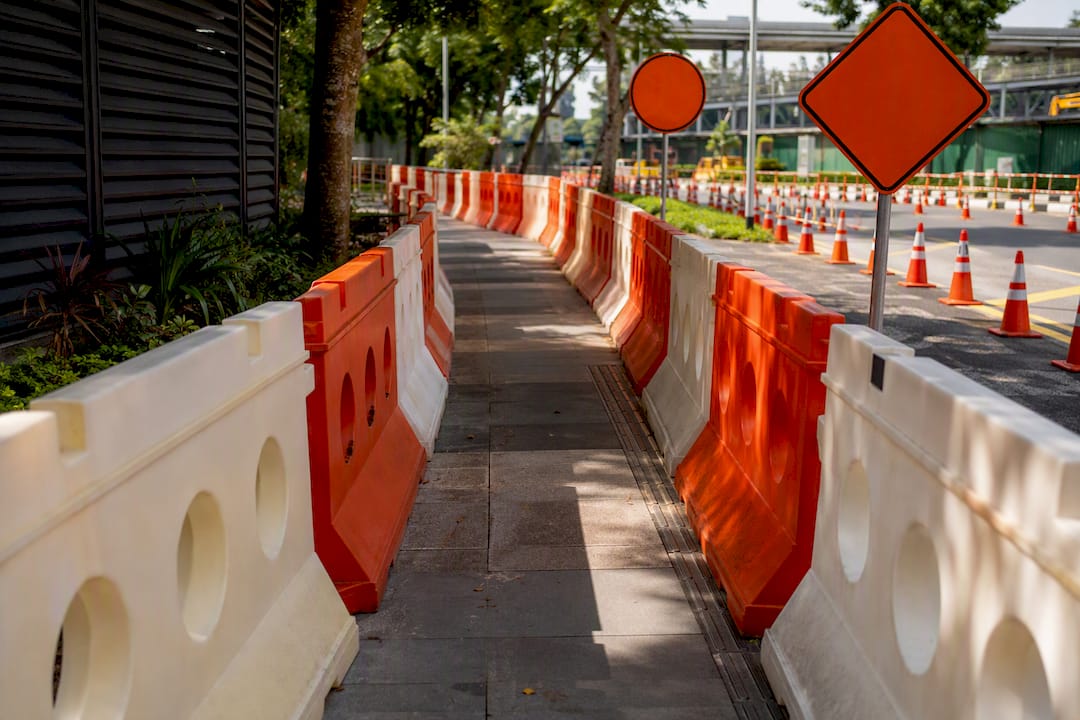
Industry experience consistently points to the same failure pattern: plans that do not match site-specific conditions or fail to show clear pedestrian diversion routes generate the majority of revision requests. A generic TCP template copied from a previous project rarely survives review once a reviewer cross-checks it against current site photos.
Reviewers also prioritize maintaining traffic flow alongside pedestrian safety, and TCP clarity in labeling, sign types, and sequencing correlates directly with fewer review rounds.
Three habits cut rejection risk substantially:
- Annotate every dimension on the TCP, including lane widths and buffer distances, rather than leaving them to reviewer interpretation.
- Reconcile the TCP against current site photographs before submission, not against an older survey.
- Break multi-phase works into separate TCP diagrams for each phase rather than one crowded sheet.
Pro Tip: Before finalizing a TCP, walk the actual site with the drawing in hand and check every signage point against what currently exists on the ground. Discrepancies caught this way rarely surface in a desk review, and they are exactly what triggers a query letter from LTA.
Timelines, Fees, Notifications, and Cancellations
Standard processing takes 10 working days, though applications involving lane occupation must be submitted at least 10 working days in advance of the intended start date. Once approved, the Code of Practice requires notifying actual commencement in advance before works start (https://www.lta.gov.sg/content/dam/ltagov/industry_innovations/industry_matters/development_construction_resources/Street_Work_Proposals/codes_of_practice/Code_of_Practice_for_Works_on_Public_Streets_Apr_2026.pdf), and completion must be reported promptly along with post-condition photographic survey reports.
Starting October 1, 2026, road works planned on 30 identified high-impact roads require a separate schedule submission through the Road Works Planner (RWP) at least two months before each calendar quarter. Permits for those specific roads will not be issued without a corresponding RWP entry, so contractors working near major corridors should check the affected list well ahead of mobilizing.
On fees, processing charges are non-refundable regardless of outcome, but the daily occupation charge can be refunded if an approved application is cancelled through the correct portal procedure. Extensions and revocations follow the same portal workflow as the original submission.
Step-by-Step: Submitting a Road Opening Permit on LTA.PROMPT
Getting from a blank application to an approved permit follows a predictable sequence, provided the groundwork is done first.
- Confirm prerequisite approvals. LTA.PROMPT’s own guidance is explicit that applicants must secure prior planning approvals from BCA, URA, or PUB before applying, and any pre-consultation needs should be resolved at this stage.
- Register under the correct category. Choose authorized officer, contractor, PE, or site supervisor based on the role in the project, and wait for LTA to confirm submission rights.
- Prepare files to portal standards. Assemble the site plan, photographs, work method statement, and TCP in the file formats the portal accepts, and select every land-managing agency the works will affect.
- Pay the processing fee and submit. The application enters LTA’s queue once payment clears.
- Set the commencement date. After approval, log back into the portal to declare the start date, giving at least 3 days notice.
- Notify completion. Upload reinstatement photos within 7 days of finishing works, or file for a time extension if the schedule slips.
Pre-Consultation, Major Proposals, and High-Impact Roads
Requesting an informal review from Road Works Regulation & Licensing (RWRL) before formal submission catches conflicts with buried utilities or planned works that a standalone application would miss. This step alone reduces formal rejections or revision rounds for many applicants.
Major proposals, particularly deep excavation, tunnelling, or anything touching Master Plan infrastructure, require in-principle LTA approval at least 6 months ahead of the standard application. For the 30 high-impact roads under the new RWP rule, contractors should reach out to LTA-ROCC directly to confirm whether a planned route is on the restricted list before scheduling any works.
Expert Checklist and Common Pitfalls
Most rejected applications share the same handful of root causes: mismatched registration category, an outdated TCP template, missing insurance schedules, or a commencement notice filed too close to the actual start date. Correcting these before submission, not after a query letter arrives, is what separates a clean approval from a multi-week back and forth.
A pre-submission checklist worth running every time:
- Confirm the registration category matches the role actually performing the work.
- Verify all planning approvals from BCA, URA, or PUB are in hand before touching LTA.PROMPT.
- Cross-check the TCP against current site photographs, not archived ones.
- Confirm insurance schedules and any required banker’s guarantee are current and correctly scoped.
- Check whether the site falls under RWP scheduling obligations for high-impact roads.
Pro Tip: In the week before submission, print the TCP and physically compare it against the site rather than reviewing it only on screen. The week you submit, upload everything in one session rather than piecemeal, since partial uploads often confuse the review queue and add days to the timeline.
Contractors managing recurring lane closures often keep a standing internal checklist for road closure permit submissions to avoid repeating the same corrections project after project.
Why Using an Engineering Consultant Reduces Delays
Coordinating a road opening permit across LTA, PUB, and sometimes URA in parallel is where most in-house teams lose weeks, not because the rules are unclear but because reconciling one agency’s requirements against another’s takes dedicated attention. An engineering consultant who prepares the TCP and manages multi-agency coordination as a matter of routine tends to compress that back and forth substantially, since revision cycles shrink when the first submission is already aligned with what each reviewer expects.
— Aman
Managing Your Road Opening Permit
Handling a road opening permit application alongside an active construction schedule pulls attention away from the job site at exactly the wrong moment. Specialized engineering consultancies prepare statutory submissions, Traffic Control Plans, and multi-agency coordination for road and street works so that contractors are not the ones chasing LTA, PUB, and URA approvals in parallel.

Aman’s role covers the parts of the process that most often cause delay: registering under the correct category, assembling a document package that matches what LTA.PROMPT reviewers expect, and handling pre-consultation with RWRL before conflicts surface mid-review. For projects that also involve driveway access or connections, Aman’s guide on LTA submission for driveway works covers the scheduling considerations specific to that scope. Broader statutory submission strategy for 2026 projects is outlined in Aman’s developer’s guide to LTA submissions.
Contractors ready to move a road opening application forward without absorbing the coordination burden internally can visit Aman Engineering Consultancy to discuss a specific project scope and timeline.
Sources
- Permit to Carry Out Works – LTA.PROMPT (FAQ)
- Code of Practice for Works on Public Streets (April 2026 ed.)
FAQ
What is the application fee for an LTA road opening permit?
LTA.PROMPT charges a processing fee that is non-refundable once submitted, separate from any daily occupation charge, which can be refunded if an approved application is properly cancelled through the portal.
What are the new road works rules in Singapore for 2026?
Starting October 1, 2026, road works planned on 30 identified high-impact roads require a schedule submitted through the Road Works Planner at least two months ahead of each calendar quarter, and permits for those roads will not be issued without it.
What is an entry permit in Singapore?
An entry permit typically refers to immigration or work pass documentation and is unrelated to a road opening permit, which governs physical access to and works on public streets and is issued exclusively through LTA.PROMPT.
How long does it take to get a road opening permit approved?
Standard processing takes 10 working days, and applications involving lane occupation must be submitted at least 10 working days before the intended start date to allow for that review window.