

Hire a local construction project-management and statutory-submissions consultancy that manages LADBS plan check workflows, RTI/PermitLA issuance, inspections, and on-site coordination. That single decision determines whether your project moves on schedule or stalls in a queue.
- A qualified consultancy accelerates plan check by submitting complete, pre-validated packages through ePlanLA, reducing correction cycles.
- It manages stop-work risk by coordinating phased inspections and maintaining the Building Card (B-8) at every stage.
- It tracks multi-agency clearances (Fire, DWP, AQMD, Public Works) so no single department holds up permit issuance.
Before engaging any firm, request proof of LADBS plan-check experience, a current CSLB license verification, and a sample RTI/permit dashboard output.
Pro Tip: Ask the firm to show a completed ePlanLA submittal log from a recent project. A firm that cannot produce one has not used the system under live conditions.
Table of Contents
- What are the 8 stages of the Los Angeles building permit process?
- How does the LADBS inspection workflow operate on site?
- Which outside agencies require clearances before a permit issues in LA?
- What are the realistic timelines and costs for LA plan checks?
- How do you select a project management firm for LADBS permitting?
- What is a realistic end-to-end timeline for LA building permit project management?
- What does a full cost breakdown look like for LA construction permitting?
- Key Takeaways
- What experienced LADBS project management actually requires
- Authoritative LA resources for permit verification and license checks
What are the 8 stages of the Los Angeles building permit process?
The eight-stage LADBS workflow runs from initial zoning confirmation through Certificate of Occupancy issuance.
- Zoning check via ZIMAS. Confirm land use, height limits, setbacks, and overlay districts using the ZIMAS portal before preparing any plans.
- Application and plan submittal — Submit drawings and supporting documents to LADBS, either at the counter or electronically through ePlanLA.
How does the LADBS inspection workflow operate on site?
Schedule inspections at least one business day in advance through the LADBS inspection portal. Three documents must be present on site at every inspection: the issued permit, the approved plans, and the Building Card (B-8). The B-8 is the physical record of every phased approval; a missing or unsigned B-8 phase forces reinspection and delays the schedule.
Off-hour inspections (evenings, weekends) are available but carry additional fees and minimum travel charges. Where LADBS cannot provide continuous inspection, certified Deputy Inspectors may be engaged. Deputy Inspectors must hold LADBS-recognized certification; their reports are accepted only when that certification is current and on file. A project manager who coordinates Deputy Inspector credentials with LADBS in advance avoids reinspection costs on large or complex builds.
For a detailed inspection readiness checklist, including document requirements and after-hours protocols, Com’s published guide covers the standard steps applicable across jurisdictions.
Which outside agencies require clearances before a permit issues in LA?
The LADBS building permits page lists the agencies most commonly requiring separate approvals:
- Los Angeles City Planning (zoning entitlements, discretionary approvals)
- Los Angeles Fire Department (fire-life safety, sprinkler systems)
- Bureau of Engineering / Public Works (grading, sewer, street improvements)
- Los Angeles Department of Transportation
- Los Angeles Department of Water and Power (DWP)
- South Coast Air Quality Management District (AQMD)
- Los Angeles Unified School District (LAUSD) (school impact fees)
- Los Angeles County Department of Public Works (for projects in unincorporated areas or with county infrastructure ties)
- California Division of Oil, Gas, and Geothermal Resources (sites near oil wells)
- Cal OSHA (certain occupancy types)
Each agency operates on its own timeline. A project manager tracking all clearances in parallel, rather than sequentially, can compress the overall schedule by weeks.
What are the realistic timelines and costs for LA plan checks?
Plan check timelines depend on project complexity, submittal completeness, and current LADBS queue depth. CPC and ECPC are same-day services when the submittal is complete. RPC queues for large commercial or multi-family projects can extend to several weeks or longer during peak periods. Incomplete MEP or grading packages are the most common cause of resubmittal delays; a project manager who pre-validates structural and MEP deliverables before submittal reduces queue time materially.
Permit fees are calculated by LADBS based on project valuation and scope. For RTI online payments, LADBS sets a maximum electronic check amount of $200,000; credit card payments carry a 2.7% service charge. Budget for these transaction costs when forecasting permit expenditure. Off-hour inspection fees and Deputy Inspector daily rates add to the overall cost on complex projects.
How do you select a project management firm for LADBS permitting?
The criteria that distinguish a capable LA construction project manager from a generalist are specific and verifiable.
Criteria to confirm before engagement:
- Demonstrated LADBS plan-check experience across CPC, ECPC, and RPC project types
- Active CSLB license verification (minimum license types for RTI eligibility: B for general building, C10 for electrical, C20 for HVAC, C36 for plumbing, C11 for elevator, C16 for fire sprinkler)
- Documented ePlanLA submittal history and ePermit RTI issuance capability
- Established relationships with outside agencies (Fire, DWP, Public Works) for clearance coordination
- Familiarity with ZIMAS, the Interactive Web-Based Zoning Code, and DCP zoning plan check procedures
Questions to ask shortlisted firms:
- What is your correction-cycle rate on RPC submittals, and how do you pre-validate packages?
- How do you manage Building Card B-8 sign-offs across phased inspections?
- Can you provide a reference from a project where you coordinated more than four outside-agency clearances?
Red flags: A firm that cannot name the plan check type used on its last three projects, or that lacks a current CSLB license on file, has not operated within the LADBS system at the level a developer or building owner requires. Reviewing the project compliance workflow Com publishes gives a clear picture of the deliverables a qualified consultancy should manage.
What is a realistic end-to-end timeline for LA building permit project management?
| Phase | Typical Duration |
|---|---|
| Zoning check (ZIMAS) and pre-application | 1–2 weeks |
| Plan preparation and ePlanLA submittal | 2–6 weeks (project-dependent) |
| CPC / ECPC plan check | Same day |
| RPC plan check (first review) | 3–8 weeks (queue-dependent) |
| Corrections and resubmittal cycle | 2–4 weeks per cycle |
| Outside-agency clearances | 2 weeks or more (agency-dependent) |
| Permit issuance (RTI) | 1–3 business days after clearances |
| Phased inspections (construction period) | Concurrent with construction |
| Final inspection and Certificate of Occupancy | 1–2 weeks after construction completion |
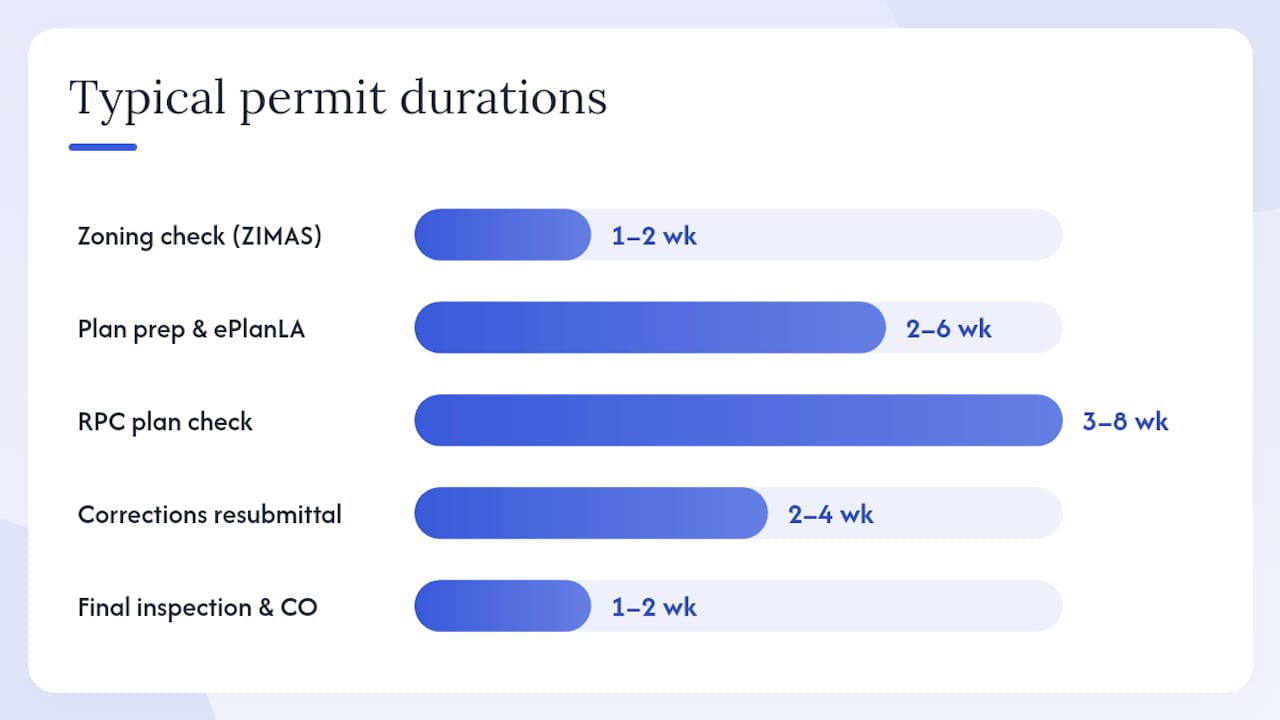
Multi-agency projects with discretionary Planning approvals or AQMD conditions sit at the longer end of every range. A project manager who initiates outside-agency submissions in parallel with the LADBS plan check compresses the overall schedule.
What does a full cost breakdown look like for LA construction permitting?
Costs fall into four categories:
Permit and plan check fees: Calculated by LADBS on project valuation. Fees vary by project type and scope; LADBS publishes its current fee schedule on the plan review and permitting page.
Transaction fees: Credit card payments for RTI issuance carry a 2.7% service charge. Electronic check payments are capped at $200,000 per transaction.
Inspection fees: Standard inspections are included within the permit fee structure. Off-hour inspections carry additional charges. Deputy Inspector daily rates are a separate line item on complex or high-rise projects.
Project management and consultancy fees: Typically structured as a percentage of construction value or a fixed fee per phase. Scope should cover ZIMAS review, plan preparation coordination, ePlanLA submittal management, correction-cycle response, outside-agency clearance tracking, B-8 inspection management, and RTI issuance.
Engaging engineering consultancy services early in the design phase, before plans are drawn, reduces the cost of corrections and resubmittals, which are the largest variable cost in the permitting process.
Key Takeaways
Effective construction project management in Los Angeles requires a consultancy with verified LADBS plan-check experience, active CSLB licensing, and the operational capability to coordinate multi-agency clearances in parallel with the plan review process.
| Point | Details |
|---|---|
| Start with ZIMAS | Confirm zoning, overlays, and height limits before preparing any plans or engaging a contractor. |
| Match plan check type to project scope | CPC suits simple projects (same-day); RPC applies to complex builds and requires queue management. |
| Verify CSLB license before RTI | Confirm the contractor holds the correct license type (B, C10, C20, C36, C11, or C16) for online RTI eligibility. |
| Manage B-8 as a critical deliverable | Every phased inspection sign-off on the Building Card must precede concealment to avoid reinspection costs. |
| Budget for transaction and off-hour fees | Credit card RTI payments carry a 2.7% service charge; off-hour inspections carry separate travel and time charges. |
What experienced LADBS project management actually requires
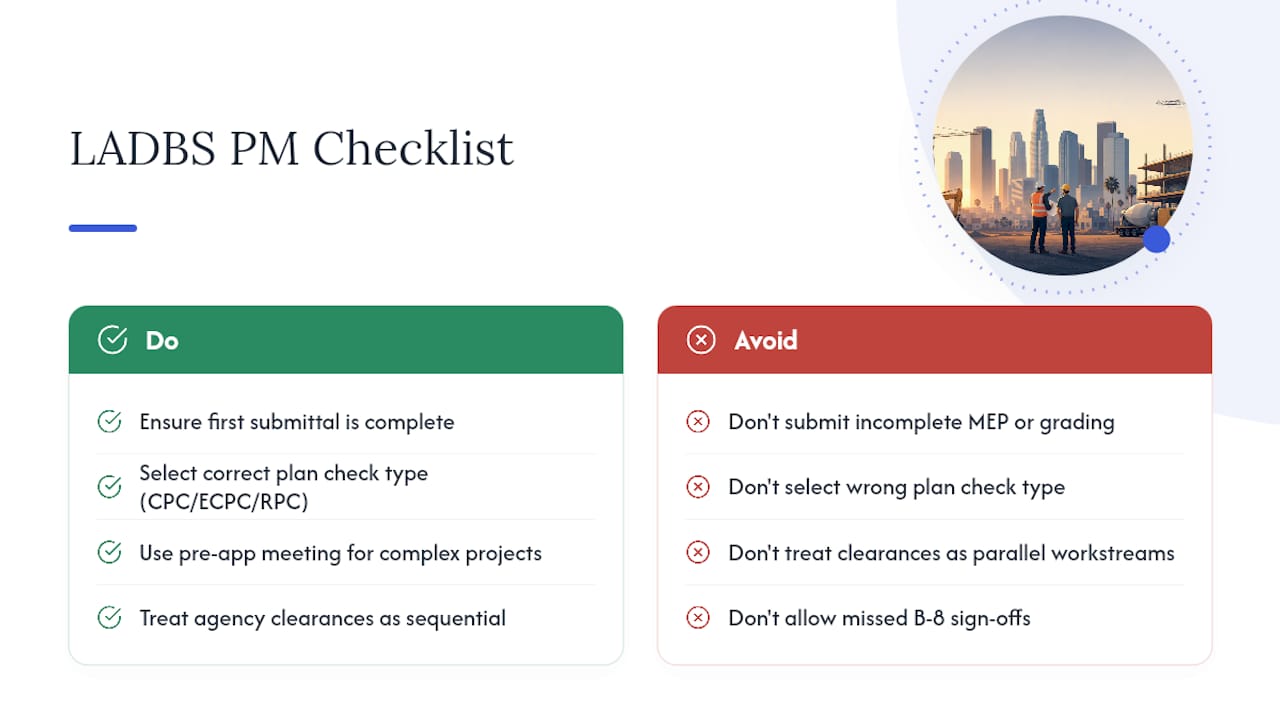
The most consequential errors on Los Angeles building projects do not occur during construction. They occur at the plan check submittal stage, when incomplete MEP or grading packages enter the RPC queue and trigger correction cycles that each consume weeks. A project manager’s value is measured most directly by the quality of the first submittal, not by the speed of response to correction notices.
The distinction between CPC, ECPC, and RPC is not merely administrative. Selecting the wrong plan check type, or submitting an RPC-scope project without a pre-application meeting, adds correction rounds that compound across the schedule. The pre-application meeting with a LADBS plan-check engineer is underused precisely because it adds a step at the front end. It consistently reduces total review time on complex projects.
Multi-agency clearance management is where most developers underestimate the coordination burden. Planning, Fire, DWP, AQMD, and LAUSD each operate on independent timelines and have no obligation to align with LADBS. A project manager who treats each clearance as a parallel workstream, rather than a sequential dependency, is the operational difference between a six-month permit process and a twelve-month one.
Pro Tip: Treat the Building Card (B-8) as a project-critical document from day one. Assign one person on site to verify each phase sign-off before any concealment begins. A single missed sign-off can require opening completed work for reinspection, at full contractor cost.
Authoritative LA resources for permit verification and license checks
| Task | Resource | Where to go |
|---|---|---|
| Zoning check | ZIMAS | zoning.lacity.gov |
| Plan submittal (electronic) | ePlanLA | dbs.lacity.gov/services/plan-review-permitting |
| Express permit / RTI issuance | PermitLA / ePermit | dbs.lacity.gov/services/plan-review-permitting |
| Permit process overview | LADBS 8-step guide | dbs.lacity.gov/node/2337 |
| Inspection scheduling and B-8 | LADBS Inspection | dbs.lacity.gov/services/inspection |
| Contractor license verification | CSLB | cslb.ca.gov |
| Business owner permit steps | LADBS step-by-step | dbs.lacity.gov/services/business-owner-step-by-step |
Key document names to reference: Building Card (B-8), Ready to Issue (RTI) sheet, ePlanLA submittal confirmation, DCP Zoning Plan Check clearance letter.
CSLB license types required for LADBS RTI eligibility: B (General Building), C10 (Electrical), C11 (Elevator), C16 (Fire Sprinkler), C20 (HVAC), C36 (Plumbing). Verify any contractor’s license status and expiration date directly on the CSLB website before signing an engagement or accepting a permit application on their behalf.
This article provides general information about the Los Angeles building permit process. Confirm current fees, timelines, and regulatory requirements directly with LADBS, the relevant outside agencies, or a licensed professional before making project decisions.