
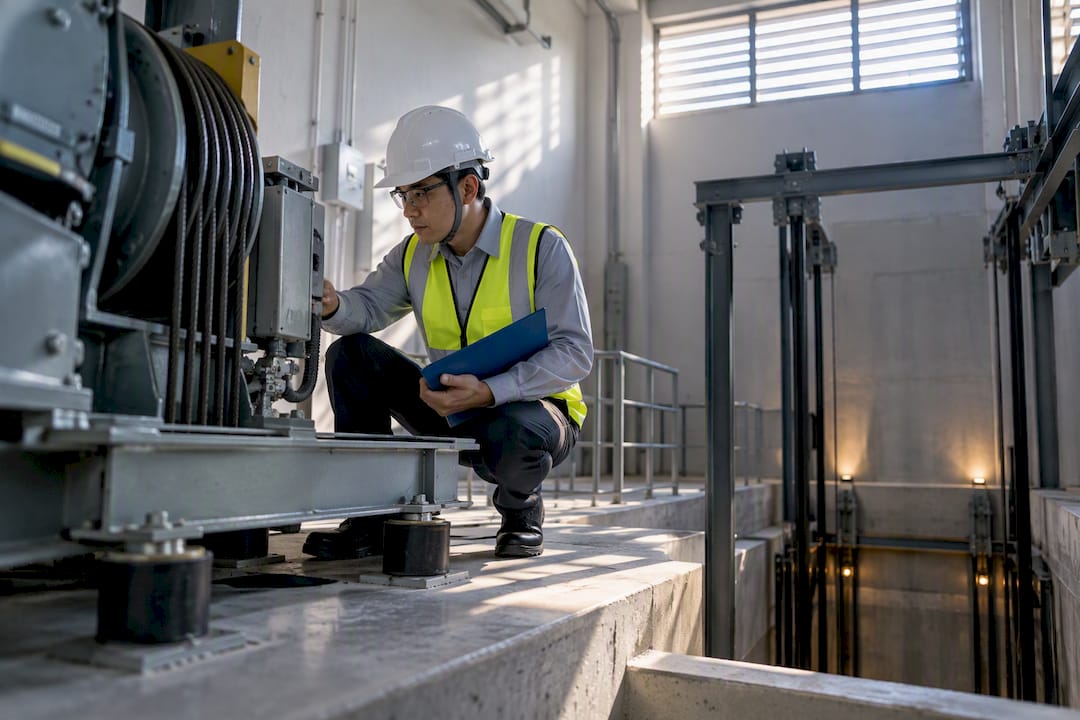
A valid Permit to Operate (PTO) must be secured before any lift in Singapore may run, and every PTO action, whether new, renewed, or recommissioned, goes through the LEAP portal. Owners undertaking Category A or other major fixed installation works must also secure FI plan approval before any physical work begins, a requirement introduced under the Building Control (Fixed Installations) Regulations 2025. That means appointing a QP(Plan) and a Specialist Professional Engineer (SPE) early, not once installation is already underway.
TL;DR:
- FI plan approval must be obtained before starting Category A or major lift installation and modernization works since October 2025, shifting compliance earlier in projects.
- The complete FI plan submission includes detailed drawings, 13 type-test certificates, structural proofs, electrical schematics, and manufacturer documents, with mismatch certificates causing most rejections.
- The PTO process involves supervised installation, signed EITC reports, and digital SPE signatures, with early preparation and tracking critical to avoid delays or enforcement actions.
- Annual maintenance and testing, including SPE digital signatures on inspection reports, are mandatory for PTO renewal, and failure to meet these standards jeopardizes lift operation legality.
- Engaging a qualified team early and maintaining rigorous documentation can significantly reduce resubmission cycles and streamline lift approval in Singapore.
Table of Contents
- Understanding Lift Approval in Singapore: PTO, LEAP, and BC(FI) Regs 2026
- FI Plan Submission: Documents That Get Scrutinized Most
- Applying for or Renewing a PTO in LEAP: The Practical Workflow
- Maintenance, Annual Inspection, and How SPE Sign-Off Affects PTO Validity
- Roles and Documents: Who Delivers What
- Timelines, Pitfalls, and a Ready-to-Submit Checklist
- Aman’s Practitioner Perspective: Why Early Coordination Beats Late Fixes
- How Aman Engineering Consultancy Supports Lift Approval Projects
- Official BCA Resources for Lift Approval
- Sources
- FAQ
Understanding Lift Approval in Singapore: PTO, LEAP, and BC(FI) Regs 2026
Lift approval in Singapore runs through two connected systems, and confusing them is the fastest way to stall a project. The first is the Permit to Operate, the ongoing license that allows a lift to run and that must be renewed, transferred, or reissued through LEAP. The second is FI plan approval, a newer gate that applies before certain works even start.
LEAP functions as a lifecycle management tool rather than a one-time application form. Owners, contractors, and specialist engineers use it to:
- Apply for a new PTO after installation or major alteration
- Renew an existing PTO before it lapses
- Apply for recommissioning after a lift has been out of service
- Update ownership or management agent records tied to a registered lift
The Building Control (Fixed Installations) Regulations 2025 changed the sequencing for many projects. Previously, plan review for lift works often happened alongside or even after physical installation began, with compliance checked retroactively. Since October 1, 2025, works classified under Category A or otherwise deemed major require FI plan approval before any installation or modernization activity commences. This shifts the compliance burden earlier in the timeline and places new documentation duties on the QP(Plan) and QP(Supervisor).
Review times vary by submission completeness and project complexity, but owners should expect FI plan review to take several weeks, not days. Engaging a qualified person at the design stage, rather than after tendering, is what separates projects that clear review on the first pass from those cycling through resubmissions.
FI Plan Submission: Documents That Get Scrutinized Most
The QP(Plan) submits the FI plan application, and this step is mandatory whenever a project falls under Category A or major works as defined by the BC(FI) Regs 2025, including most lift modernization, replacement, and new installation projects in taller developments. Submissions that skip this pre-approval step, or start construction before approval comes through, face enforcement action and forced work stoppages.
A complete FI plan package generally includes:
- Layout and schematic drawings showing the lift shaft, machine room, pit, and interface with building structure
- The 13 required type-test certificates covering components such as the traction machine, governor, buffers, safety gear, suspension ropes, and control system, each matching the specific model installed
- Structural adequacy documentation confirming the shaft and supporting structure can bear the installed equipment’s loads
- Electrical schematics detailing power supply, emergency communication, and fire mode override wiring
- Manufacturer specification sheets cross-referenced against the type-test certificates to confirm consistency
The most common rejection trigger is a mismatch between the type-test certificate and the actual equipment model listed in the drawings. A close second is submitting expired or superseded certificates, since manufacturers periodically update test documentation and older versions get quietly retired. Incomplete structural calculations, particularly for retrofits into older buildings never designed for a specific car weight, also send submissions back for revision.
Pro Tip: Build a document tracker the moment the project scope is fixed. List all 13 type-test certificates by component, note the issue date and expiry, and flag any certificate older than two years for a validity check before submission, not after a rejection letter arrives.
Owners can shorten this stage considerably by confirming, before the QP(Plan) drafts anything, that the type-test certificates and EITC templates match the equipment actually being ordered, rather than a generic manufacturer catalog.
Applying for or Renewing a PTO in LEAP: The Practical Workflow
LEAP access requires a Singpass login for individuals or a Corppass login for organizations, with the owner or an authorized representative registered against the specific lift record. Getting this access set up correctly before works finish avoids a scramble at the finish line.
The practical sequence for a new PTO runs like this:
- Examination, inspection, and testing (EITC) takes place under the supervision of the supervisor QP once installation or alteration work is physically complete
- The SPE reviews and digitally signs the inspection report; LEAP does not accept unsigned or paper-only reports for PTO processing
- The supervisor QP or SPE initiates the PTO application in LEAP once the signed EITC report is ready
- The owner reviews, pays the applicable fee, and submits, then tracks status through the portal dashboard
Renewals follow a different clock. LEAP guidance confirms owners can start the renewal process up to three months before the current PTO expires, and starting early is not optional caution, it is the only way to guarantee continuous lawful operation if the annual test surfaces an issue that needs fixing before resubmission. Recommissioning after a lift has been idle follows the same EITC and SPE sign off sequence as a brand-new PTO application.
Owners managing multiple properties or unfamiliar with LEAP’s interface can lean on a Lift Engineering Inspectorate (LEI) representative or an engaged consultant to handle submission mechanics, though the legal responsibility for a valid PTO always sits with the owner.
Maintenance, Annual Inspection, and How SPE Sign-Off Affects PTO Validity
A PTO’s validity is not a one-time achievement. It depends on an ongoing chain of maintenance and testing that, if broken, puts the permit itself at risk.
Monthly maintenance must be performed by a BCA-registered FI service contractor, following either the manufacturer’s maintenance schedule or BCA’s minimum standard, whichever is more stringent. This is distinct from annual testing, which is a more rigorous examination covering safety devices, brake performance, and structural fittings.
The annual inspection report must carry the SPE’s digital signature before LEAP will process it for PTO renewal purposes. This requirement is strictly enforced: a scanned signature on a PDF, or a report signed but not digitally certified through the correct channel, will be rejected, forcing owners back to the SPE for reprocessing.
Every lift in Singapore is legally required to undergo annual examination, inspection, and testing, with the resulting report forming a direct input into PTO renewal processing in LEAP.
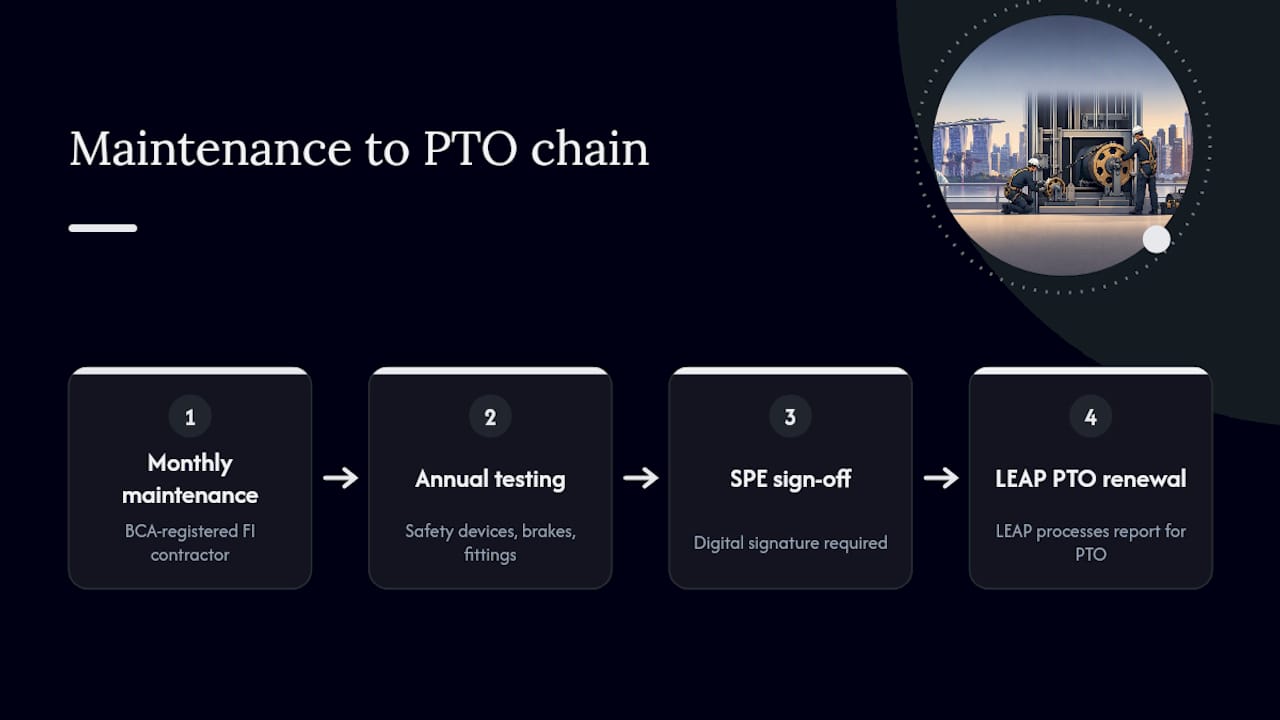
When a lift fails annual testing, the FI service contractor must rectify the defect, and the SPE re-inspects before signing off. Owners should keep a running log of maintenance visits, defect reports, and rectification dates, since LEAP and BCA enforcement officers can request this history during any compliance review. Incidents involving lift malfunction or entrapment carry separate reporting obligations to BCA that run alongside, not instead of, routine maintenance documentation.
Roles and Documents: Who Delivers What
Lift approval in Singapore involves more parties than most owners expect, and confusion over who owns which document is a frequent source of delay. Here is how the responsibilities break down.
- QP(Plan) designs the fixed installation works and submits the FI plan application, bearing responsibility for drawing accuracy and structural coordination
- QP(Supervisor) oversees construction against the approved plan and certifies that built works match what was approved
- Supervisor QP supervises the EITC process once installation is physically complete and confirms readiness for SPE review
- SPE independently reviews the EITC results and digitally signs the annual inspection report and, where required, the commissioning report that feeds into PTO issuance
- LEI (Lift Engineering Inspectorate) representative can assist owners with LEAP procedural steps and portal navigation
- FI works contractor performs the physical installation, alteration, or maintenance and must be BCA-registered for the relevant category of work
Type-test certificates originate with the equipment manufacturer and must be gathered before the QP(Plan) finalizes drawings. The EITC report is produced under supervisor QP oversight and finalized with SPE digital sign off. The PTO application itself is typically initiated by whoever holds the signed EITC in hand, most often the supervisor QP or SPE, with the owner completing payment and submission tracking.
Pro Tip: Assign one internal point of contact, even on a small project, to chase document handoffs between the QP(Plan), the contractor, and the SPE. Most delays trace back to a certificate sitting in someone’s inbox, not to a genuine technical problem. Reviewing how a QP’s role and appointment sequencing fits into the broader statutory submission workflow helps clarify who should be engaged first.
Timelines, Pitfalls, and a Ready-to-Submit Checklist
FI plan approvals, once granted, remain valid for 24 months, giving owners a defined window to complete works before needing to resubmit or seek an extension. Budget several weeks for FI plan review and additional time for PTO processing once EITC and SPE sign off are complete, plus the three-month runway LEAP recommends before any renewal deadline.
The pitfalls that recur most often across lift projects:
- Starting installation or modernization work before FI plan approval is granted, which triggers stop-work orders
- Submitting expired type-test certificates that no longer match the manufacturer’s current documentation
- Applying under the wrong PTO category in LEAP, such as filing a renewal when the works actually require a new PTO
- Submitting an incomplete EITC report missing supervisor QP sign off before requesting SPE review
| Checklist item | Confirm before submission |
|---|---|
| QP(Plan) appointed | Yes, before design finalization |
| All 13 type-test certificates | Valid and matched to installed model |
| Structural adequacy proof | Signed off for the specific shaft |
| EITC supervised | By supervisor QP, dated |
| SPE digital signature | Applied to annual/commissioning report |
| PTO application type | Correct category selected in LEAP |
| Renewal timing | Started 3 months before expiry |
Owners managing several buildings often find it useful to run this checklist against a broader construction compliance checklist so lift approval does not get siloed away from other statutory obligations on the same project.
Aman’s Practitioner Perspective: Why Early Coordination Beats Late Fixes
The BC(FI) Regs 2025 reward projects that treat lift works as a design exercise from day one, not a mechanical afterthought once civil works are underway. Appointing a QP(Plan) early lets structural, electrical, and mechanical disciplines align before drawings are locked, which cuts the resubmission cycles that eat months on projects where the lift package gets bolted on late.
Coordinated BIM documentation matters here in a way many owners underestimate. When the FI plan, structural model, and M&E schematics live in one integrated file set rather than disconnected PDFs, discrepancies between approved plans and built conditions surface before installation, not during a failed EITC.
— Aman
How Aman Engineering Consultancy Supports Lift Approval Projects
Coordinating a lift approval in Singapore means managing a QP(Plan), a supervisor QP, an SPE, and a BCA-registered contractor, often on a timeline where one missing signature holds up the entire PTO. Aman Engineering Consultancy is the option for owners who want a single team handling that coordination instead of chasing five separate parties through email threads.

The firm’s Authority Approvals service includes statutory submission management for FI plans and PTO applications, along with PE endorsement support to facilitate structural and electrical sign offs during review. For projects where the lift package intersects with broader building works, 3D BIM coordination helps align approved drawings with constructed elements, aiming to improve the connection between plan approval and EITC. This can help reduce resubmission cycles and support better project timeline clarity. Visit Amanengineering for more information on submission timelines related to lift projects.
Official BCA Resources for Lift Approval
Confirm requirements directly against BCA’s own pages before finalizing any submission:
- PTO application guidance
- LEAP FAQ for portal procedures
- Forms and certificates including EITC templates
- Regulatory updates on BC(FI) Regs 2025
Sources
- Application for permit to operate (PTO) | Building and Construction Authority
- LEAP FAQ (Dec 2025) | Building and Construction Authority (LEAP resources)
- Forms and certificates for lifts | Building and Construction Authority
FAQ
What Are BCA’s Lift Maintenance Requirements?
BCA requires monthly maintenance by a BCA-registered FI service contractor plus mandatory annual examination, inspection, and testing. The annual report must carry a Specialist Professional Engineer’s digital signature before it can support PTO processing.
How Much Does It Cost to Install a Lift in a House in Singapore?
Home lift installation costs depend heavily on lift type, shaft construction, and building modifications required, and no fixed published rate applies across all projects. Aman Engineering Consultancy offers feasibility studies that can help owners scope a realistic project budget before committing to a specific system.
Who Is Responsible for Lift Maintenance?
The building owner holds ultimate responsibility for ensuring the lift is maintained and safe to operate, even though the physical work is carried out by a registered FI service contractor. Owners must keep maintenance records and ensure annual testing and SPE sign off happen on schedule to keep the PTO valid.
What Is a Lift PTO?
A Permit to Operate (PTO) is the legal authorization required before any lift can be used in Singapore. It is applied for, renewed, and tracked through the LEAP portal, and it lapses if maintenance, annual testing, or renewal deadlines are missed.
When Is FI Plan Approval Required Before PTO?
FI plan approval is required before work begins on Category A and other major fixed installation projects under the Building Control (Fixed Installations) Regulations 2025, effective October 1, 2025. Smaller routine maintenance work generally does not trigger this pre-approval requirement, but owners should confirm project classification with a QP(Plan) before assuming an exemption applies.