
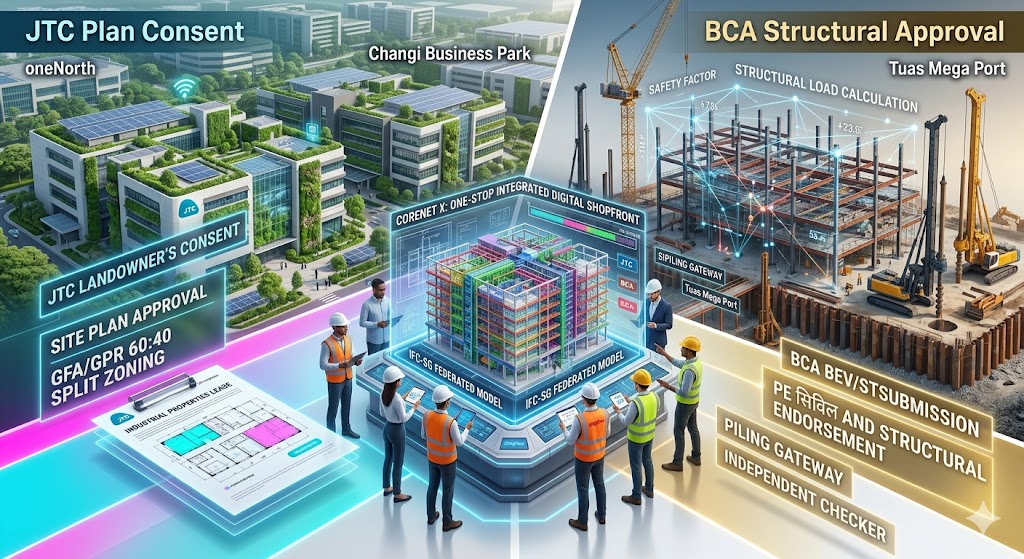
JTC Plan Consent vs BCA Approval: Understanding the Landlord-Authority Relationship
SEO Metadata
SEO Title: JTC Plan Consent vs BCA Approval: The Ultimate Guide
Focus Keyphrase: JTC plan consent vs BCA approval
Keywords: JTC plan consent, BCA approval, structural plan submission, CORENET X, URA change of use, QP endorsement, land betterment charge, JTC plan consent vs BCA approval.
Tags: #JTC #BCA #RealEstate #RegulatoryCompliance #Singapore #CORENETX
Meta Description: Discover the crucial differences between JTC plan consent and BCA approval. Understand regulatory compliance, structural plan submissions, and QP endorsements.
Introduction
Singapore maintains a highly regulated industrial real estate environment. Consequently, property developments demand meticulous planning and compliance. Developers frequently misunderstand the roles of statutory boards. This dual framework involves landlord consents and regulatory approvals.
JTC Corporation operates as the primary statutory landlord. Meanwhile, the Building and Construction Authority regulates safety. Therefore, understanding JTC plan consent vs BCA approval is vital. Both agencies serve distinct but complementary regulatory objectives. JTC protects industrial ecosystems and land asset values.
Conversely, BCA protects public safety and building integrity. This report explores these complex landlord-authority dynamics exhaustively. It provides nuanced insights into statutory submissions and compliance. Furthermore, it details the digital transformation through CORENET X.
The Statutory Landlord: JTC Plan Consent
JTC plan consent represents the crucial first regulatory step. It serves as the initial in-principle approval.1 Tenants must seek permission before modifying any JTC property. You cannot start physical work without this green light.1
This mandate applies to temporary and permanent renovation works.1 Ultimately, JTC ensures modifications align with industrial zoning policies. Furthermore, it protects the structural warranties of its buildings.
Qualified Person (QP) Submissions
Many projects require a Qualified Person (QP) endorsement. A QP is a registered architect or professional engineer.2 If statutory authorities require a QP, JTC requires one.2 QP submissions cover major additions, alterations, and erections.2
The submission demands exhaustive documentation and exact formatting. First, a cover letter must summarize the proposed development.3 Second, applicants must provide an assumption of liability form.3 This relates to potential Land Betterment Charge obligations.3 Third, specific self-declaration forms are strictly mandatory.3 These forms must use the exact XFDX file format.3
Additionally, proposed drawings must follow stringent color-coding rules.3 Existing layouts must appear distinctly in cyan.3
New works must be highlighted clearly in magenta.3 Demolished or removed structures must be colored yellow.3 These visual standards prevent misinterpretation during the review process.
The following table outlines the mandatory forms for QP submissions.
| Form Name | Purpose | Format | Source |
| Cover Letter | Summarizes the proposed development proposal. | 3 | |
| Assumption of Liability | Addresses potential Land Betterment Charge obligations. | 3 | |
| Letter of Consent | Allows JTC to forward SLA liability forms. | 3 | |
| Authorisation Letter | Grants tenant permission for sub-tenant works. | 3 | |
| JTC_LPD_SD.XDFX | Official JTC self-declaration form for QPs. | XFDX | 3 |
| SD-LD Form | Declaration for Plan Consent stamped by tenant. | 3 | |
| URA EDA Form | Required for Enterprise District lodgment submissions. | EDF | 3 |
Non-Qualified Person (Non-QP) Submissions
Not all projects demand a registered professional engineer. Non-QP submissions handle simpler, lower-risk property modifications.4 For instance, continued dormitory use falls under this category.4
Minor electrical works and plumbing changes also qualify.4 The installation of solar deployment panels is a non-QP submission.4 Moreover, change of use without structural works qualifies.4
Even without a QP, strict guidelines apply. Applicants must provide key site plans and unit plans.4
They must submit Gross Floor Area (GFA) distribution tables.4 For solar deployment, detailed AutoCAD drawings are required.3 These drawings must show the photovoltaic layout plans.3
The table below details specific Non-QP solar deployment requirements.
| Solar Requirement | Description | Source |
| File Format | AutoCAD drawings in DWG format. | 3 |
| System Layout | Photovoltaic (PV) and Lightning Protection System. | 3 |
| Elevation Data | Highest existing and proposed platform levels. | 3 |
| Panel Dimensions | Size and depth of solar panels in millimeters. | 3 |
| Installation Angle | Angle of panel installation in degrees. | 3 |
| Capacity Specs | PV Capacity DC kWp and AC kWac. | 3 |
| Weight Metrics | Total weight in kilograms. | 3 |
| Area Metrics | Total area occupied in square meters. | 3 |
Submission Systems and Processing Timelines
Submissions utilize centralized, highly secure electronic portals. Currently, CORENET 2.0 handles these essential regulatory filings.3
QPs use the Electronic Submission for Professionals (ESPro) system.3 Meanwhile, non-QPs use the standard CORENET 2.0 portal.3
JTC offers efficient processing timelines for complete applications. They inform applicants of outcomes within ten working days.3
However, non-compliant submissions face immediate regulatory rejection. Incomplete applications are typically rejected within two days.3 Therefore, accuracy during the initial submission is absolutely paramount.
The National Regulator: BCA Approval Process
Obtaining JTC landowner consent is only the beginning. It serves merely as an in-principle approval mechanism.1 Subsequently, projects must satisfy rigorous national safety standards. The Building and Construction Authority (BCA) enforces these strict standards. BCA approval ensures total structural safety and urban compliance.
Building Plan (BP) vs Structural Plan (ST)
BCA approvals broadly split into two distinct categories. These are Building Plan (BP) and Structural Plan (ST) submissions. They serve entirely different regulatory and engineering functions.5
Building Plan submissions detail the architectural design framework.5 They ensure compliance with urban development standards.5 BP focuses on spatial layout, accessibility, and environmental sustainability.5 BCA’s Development Control Group primarily reviews these BP submissions.5
Conversely, Structural Plan submissions focus entirely on engineering.5 They guarantee the structural safety and longevity of buildings.5
ST submissions involve deep mathematical calculations and load assessments.5 BCA’s Structural Engineering Branch carefully scrutinizes these exact submissions.5
The Critical Role of the Qualified Person
The QP holds immense legal and professional responsibility. Only a registered Professional Engineer can submit structural plans.6 They must hold a valid practicing certificate.7 The QP essentially guarantees the structural safety of designs.
Before applying, the QP completes several mandatory prerequisites. First, they must obtain written permission from URA.7 Second, they ensure compliance with the Building Control Regulations.7 They sign and endorse every detailed structural plan.6 Furthermore, they must endorse all structural design calculations.6 The QP also jointly applies for structural works permits.6
The Accredited Checker (AC) Framework
Singapore employs a robust peer-review system for building safety. High-value or complex projects require an Accredited Checker (AC).6 The AC performs an independent structural analysis.6 They conduct a completely fresh, independent design check.6 Consequently, this eliminates single points of engineering failure.
The AC prepares a comprehensive independent evaluation report.6 They must submit an Accredited Checker’s Certificate.6 They also provide an evaluation checklist directly to BCA.6 This rigorous dual-check system prevents catastrophic structural failures.
Registered Accredited Checking Organisations (ACO)
BCA strictly regulates who can act as an AC. Individual ACs handle projects valued under fifteen million dollars.6 Accredited Checking Organisations (ACO) handle larger, unlimited-value projects.6 The following table lists prominent ACOs and their registered checkers.
| ACO Name | AC Registration No. | Accredited Checker Name |
| AECOM Singapore Pte. Ltd. | A004 | Rengasamy Selvaraju (1166) |
| Arup Singapore Private Limited | A024 | See Lin Ming (1154), Lim Keong Liam (1177) |
| BCK & Partners Pte. Ltd. | A075 | Koh Bock Cheng (1088) |
| Beca Carter Hollings & Ferner | A040 | Tan Keok Siew (1148) |
| Bureau Veritas Buildings | A069 | Ho Chong Leong (1136) |
| C P Lim & Partners LLP | A032 | Lim Chin Pau (1104) |
| Chong & Lee Consulting | A065 | Lee Foh Sang (1059) |
| CKMbT International Pte. Ltd. | A066 | Chitaldroog Keshava (1031) |
| CPG Consultants Pte Ltd | A021 | Kueh Lip Kuang (1121) |
| DP Engineers Pte. Ltd. | A073 | Tan Chin Hock (1170) |
| ECAS Consultants Pte. Ltd. | A029 | Chan Ewe Jin (1152) |
| Engineers 2002 Private Limited | A068 | Chen Hao (1078) |
| Engineers Alliance Pte. Ltd. | A061 | Soh Lian Seng (1158) |
| Fong Consult Pte. Ltd. | A030 | Lee Swee Hong (1159) |
| GeoAlliance Consultants | A060 | Tham Poh Kuan (1127) |
| JIB Specialist Consultants | A052 | Goh Kok Sin (1095) |
| KCL Consultants Pte. Ltd. | A076 | Chen Yuefeng (1171) |
| KK Lim & Associates Pte Ltd | A050 | Lim Kok Kim (1151) |
| KTP Consultants Pte Ltd | A005 | Yeo Choon Chong (1155) |
| LSW Consulting Engineers | A049 | Lauw Su Wee (1147) |
| Meinhardt (Singapore) Pte Ltd | A009 | Nasim Shahzad (1097) |
| P&T Consultants Pte. Ltd. | A036 | Leung Wai Man (1139) |
| PH Consulting Pte. Ltd. | A054 | Kok King Min (1089) |
| Rankine & Hill (Singapore) | A055 | Lim Yan Ping (1050) |
| Ronnie & Koh Consultants | A033 | Chong Kim Beng (1132) |
| Sterling Engineers Pte. Ltd. | A074 | Lai Kin Sin (1113) |
| Surbana Jurong Consultants | A062 | Chua Chim Huee (1145) |
| T Y Lin International | A008 | Lim Tuan Cheow (1138) |
| Tritech Consultants Pte. Ltd. | A063 | Koh Kay Tee (1087) |
| WSP Consultancy Pte Ltd | A067 | Thung Sek Kwang (1161) |
The availability of specialized checking organizations guarantees rigorous oversight.6 Furthermore, complex Geotechnical works require Specialist Accredited Checkers.6 These specialists review complex foundation and deep tunneling projects.6
Permit to Carry Out Structural Works
Approved plans alone do not permit immediate site construction. A Permit to Carry Out Structural Works is mandatory.6 The developer, QP, and builder must apply jointly.6 BCA generally processes this permit within seven working days.6
During construction, engineering designs often require site-specific adjustments. BCA categorizes these modifications into two distinct types.6
Material changes require a total redesign of structural elements.6 These require explicit BCA approval before site execution.6
Immaterial changes do not affect key structural safety.6 QPs can proceed with immaterial changes without prior approval.6 However, they must maintain meticulous records of these deviations.6
Statistical Gross Floor Area (SGFA) and Plan Fees
BCA plan fees correlate directly with overall project scale.6 Fees rely on the Statistical Gross Floor Area (SGFA).6 SGFA encompasses all covered spaces within the proposed development.6 General buildings and specified buildings have distinct fee models.6
A streamlined fee structure applies from October 2025.6 This structured system ensures fees remain proportionate to regulatory effort. The following table provides a comprehensive breakdown of BCA plan fees.
| Building Type | SGFA / Area Specification | Fee Rate | Source |
| General/Specified | A1 below sublevel | $400 per 100m² | 6 |
| General/Specified | B1 above sublevel (1st 2500m²) | $300 per 100m² | 6 |
| General/Specified | B1 above sublevel (Subsequent) | $270 per 100m² | 6 |
| Type 1 Industrial | A3 below sublevel | $400 per 100m² | 6 |
| Type 1 Industrial | B3 above sublevel (1st 10,000m²) | $150 per 100m² | 6 |
| Type 1 Industrial | B3 above sublevel (Subsequent) | $220 per 100m² | 6 |
| A/A Works | Non-Residential with ST plan | $400 per storey | 6 |
| A/A Works | Residential with ST plan | $200 per storey | 6 |
| Facade A/A Works | Flat fee per design | $500 per design | 6 |
| Demolition | Entire Building | $200 per storey | 6 |
Integrating Additional Statutory Authorities
JTC and BCA do not operate in a regulatory vacuum. Other statutory boards heavily influence the entire approval workflow. QPs must navigate URA and SCDF regulations concurrently.
Urban Redevelopment Authority (URA) Zoning
URA governs national land use and long-term urban planning. It controls the specific zoning of all land parcels.8 Changing a property’s intended use requires explicit URA approval.9 Change of use applications prevent localized community amenity problems.8
Industrial properties face particularly strict URA zoning rules. The sixty-forty space usage regulation is rigorously enforced.10 At least sixty percent of space serves industrial purposes.10 Only forty percent can support ancillary commercial activities.10
However, JTC has recently streamlined specific commercial change applications. Change of use within certain business parks is simplified.3 Applicants no longer need a separate URA application.3 They only need prior JTC landowner consent.3 This reduces bureaucratic friction and accelerates strategic business deployments.3
Singapore Civil Defence Force (SCDF) Compliance
Fire safety is absolutely critical in dense industrial developments. SCDF’s Fire Safety and Shelter Department (FSSD) manages this.11 FSSD submissions are legally mandatory for commercial buildings.11
The FSSD submission process is highly structured and sequential.12 First, a QP prepares the detailed fire safety plans.12 Second, plans are submitted electronically via the CORENET portal.12 SCDF reviews the fire protection and mechanical ventilation plans.13
A Temporary Fire Permit (TFP) allows initial conditional occupancy.13 Ultimately, a final Fire Safety Certificate (FSC) is required.13
Furthermore, high-risk premises must renew their Fire Certificate annually.14 Failure to secure SCDF approval leads to severe consequences. SCDF can issue stop-work orders or force building closures.14
SCDF charges specific plan fees based on floor area. The following table illustrates the FSSD fee structure.
| Type of Fire Safety Work | Plan Fee Rate | Source |
| New fire safety works (SGFA) | $160 per 100 square meters | 15 |
| Amendment to approved works | $90 per storey | 15 |
| Change of Use / A&A works | $90 per storey | 15 |
Financial Implications: Land Betterment Charge (LBC)
Regulatory approvals often trigger significant hidden financial mechanisms. The Land Betterment Charge (LBC) is a critical consideration.16 SLA administers the LBC across all Singaporean developments.16
Understanding the Land Betterment Charge
LBC taxes the calculated increase in land value.16 If planning permission allows higher-value use, value increases.17 This financial uplift is shared with the wider community.17 LBC replaces older levies like the Development Charge.16
Real-world transactions demonstrate the significant impact of LBC rates. For example, industrial Sector 98 saw notable LBC increases.18
This followed the sale of Katospring for fourteen million dollars.18 Additionally, an Upper Thomson site sold for 351 million dollars.18 These massive transactions constantly drive periodic LBC rate revisions.18
Liability and Transfer Mechanisms
Legally, the landowner is the default liable paying party.16 For JTC properties, JTC is the actual statutory landowner.16 However, the tenant’s business proposal creates the value uplift.16 Therefore, JTC legally transfers the LBC liability to tenants.16
This transfer requires a formal Notice of Assumption of Liability.16 Tenants submit this form upfront during the consent phase.16 A Letter of Consent allows JTC to forward it.16 SLA then issues a Liability Order directly to tenants.16
Payment deadlines are extremely strict and legally binding. Tenants must pay the LBC within exactly one month.16
URA will not issue planning permission until payment clears.16 If a tenant refuses payment, the proposal is completely aborted.16 This upfront integration prevents massive delays in written permissions.16
Digital Transformation: The CORENET X System
The regulatory submission landscape is undergoing a massive paradigm shift. Legacy systems like CORENET 2.0 are being systematically retired.13 CORENET X is the new, integrated digital regulatory platform.13
Mandatory Adoption Timelines
CORENET X completely transforms Government-to-Business regulatory interaction frameworks.13 From October 2025, large new projects must utilize it.13 By October 2026, it becomes legally mandatory for all projects.13 It shifts the industry toward Building Information Modelling (BIM).13
The Key Gateway Workflows
CORENET X eliminates fragmented, piecemeal statutory agency submissions. Instead, it utilizes three primary integrated regulatory gateways.13
The first stage is the collaborative Design Gateway.13 Here, basic parameters and urban architectural designs are approved.13 The Direct Submission Process simplifies smaller projects within this gateway.13
The second stage is the complex Construction Gateway.13 This replaces multiple individual structural and mechanical engineering submissions.13 The QP submits a fully federated structural and architectural model.13 Agencies perform highly efficient cross-agency reviews simultaneously.13 This slashes processing time to just twenty working days.6
An optional Piling Gateway allows early foundation site works.13 This accelerates overall project construction timelines significantly and effectively.13
The final phase is the comprehensive Completion Gateway.13 QPs obtain technical clearances from all statutory agencies concurrently.13 The portal provides a comprehensive tracking dashboard for clearances.13 Once cleared, BCA issues the Temporary Occupation Permit (TOP).13
IFC+SG Data Standards
CORENET X mandates the use of IFC+SG digital models.13 Traditional 2D CAD drawings are now effectively rendered obsolete. Status parameters replace legacy cyan and magenta color codes.13 The system uses digital checksums for maximum authentication security.13 These alphanumeric fingerprints guarantee the integrity of approved plans.13
Enforcement and Compliance: Unauthorized Works
Failure to navigate these frameworks results in severe penalties. Both JTC and BCA actively police unauthorized building alterations.
JTC Enforcement Actions
JTC treats unauthorized structures as highly serious lease breaches.19 Unapproved renovations damage common property and industrial aesthetics.19 Furthermore, they potentially void critical building structural warranties.20
JTC conducts strict inspections during and after renovation works.20 Tenants cannot drill into floor structures without written consent.20
Any breach results in immediate and severe enforcement action. JTC can impose fines up to five thousand dollars.19 Severe breaches can trigger complete statutory lease terminations.21
Contractors must submit specific Renovation Guide forms before commencing. The table below lists the necessary JTC renovation forms.
| Form Number | Form Purpose | Source |
| Form R1-R2 | Application for Security Clearance and site access. | 22 |
| Form R3 | Inspection of common areas on commencement of works. | 22 |
| Form R4 | Inspection of common areas on completion of works. | 22 |
BCA Dangerous Building Orders
BCA enforcement is vastly more severe than landlord penalties. Unauthorized structures threaten the physical lives of building occupants.23 Between 2020 and 2023, BCA investigated 120 cases annually.23
If structures are deemed unsafe, BCA takes immediate action.23 They issue a dangerous building order to the property owner.23 This legally forces the owner to demolish the structure.23
Real-world cases highlight the severity of these regulatory breaches. In 2024, BCA investigated unauthorized rooftop structures on Haig Avenue.23
Penthouses at Rose Maison and EiS Residences were implicated.23 In 2023, an unapproved mezzanine at The Alexcier resulted heavily.23 The property agency co-owner was fined fifty thousand dollars.23
The financial and legal penalties are massively punitive. Carrying out unapproved works invites fines up to $200,000.23 Furthermore, offenders face potential imprisonment for up to two years.23 Management corporations (MCSTs) also face liability for common breaches.23
The Complex Regularization Process
Sometimes, safe unauthorized structures can be legally retained. This requires a rigorous statutory regularization process.23 Regularization is essentially a retroactive BCA and URA approval.24
The property owner must engage a PE immediately.23 The PE assesses the existing unauthorized structure’s load capacity.23
They formally certify that the building remains structurally sound.23 The owner must pay fees for the additional GFA.23 Furthermore, they pay premium regularization penalty charges.6 Regularization is costly, highly stressful, and entirely avoidable.
Strategic Inter-Agency Synergies
Understanding the system requires viewing it holistically and strategically. JTC acts as the gatekeeper to the industrial land. URA dictates the exact functional purpose of the space. SCDF ensures the premises will not succumb to fire. BCA ensures the building will not structurally collapse.
These agencies are increasingly and inextricably integrated today. A demolition permit requires both URA and BCA joint approval.13
LBC collection requires SLA, JTC, and URA coordination.16 The new CORENET X platform mathematically enforces this synergy.13
Therefore, QPs must adopt a holistic project management approach. Treating BCA submissions as isolated paperwork exercises causes critical delays.25
The physical works must match the statutory documents perfectly.25 Proper compliance is a continuous and proactive project execution strategy.25
Detailed Comparison: JTC Consent vs BCA Approval
To fully understand the dichotomy, we must compare their parameters. The following table illustrates the core differences between the approvals.
| Parameter | JTC Plan Consent | BCA Structural Approval |
| Primary Objective | Lease compliance, zoning, asset protection. | Public safety, structural integrity, engineering. |
| Authority Type | Statutory Landlord. | National Building Regulator. |
| Pre-requisite | Tenancy agreement, LBC liability assumption. | URA Written Permission, JTC Consent. |
| Review Focus | GFA limits, usage rules, visual impact. | Load calculations, soil stability, materials. |
| Submission Portal | CORENET 2.0 / CORENET X. | CORENET X (Mandatory for large projects). |
| Approval Output | In-Principle Landowner Consent. | Permit to Commence Structural Works. |
| Financial Trigger | Land Betterment Charge (LBC). | Structural Plan SGFA Fees. |
| Max Penalty | $5,000 fine, lease termination. | $200,000 fine, 2 years imprisonment. |
This clear division of labor protects the national interest. JTC curates a highly efficient, economically productive industrial landscape. BCA ensures that this landscape remains physically impregnable.
The Vital Role of Professional Endorsements
The system heavily relies on strict professional engineering accountability. PE endorsement is the absolute bedrock of building safety.26 It prevents catastrophic risks like structural instability during renovations.26
Even simple works like hacking non-load-bearing walls require oversight.26 Ignorance of load transfers can cause severe building damage.27 The PE endorsement serves as a necessary safeguard against mistakes.26 It acts as a recognized seal of guaranteed quality.27
Obtaining this endorsement demands significant engineering expertise and dedication.26 PEs must pass rigorous exams and accumulate vast experience.26
They must completely understand deep technical codes and complex regulations.26 Without this endorsement, projects face severe fines and demolition orders.26
Navigating the complexities of Industrial Leasing
Understanding the intersection of leasing and regulations is paramount. Industrial leasing goes far beyond paying monthly rent correctly. It involves understanding the entire lifecycle of statutory building compliance.
When a tenant plans a major factory expansion, preparation begins early. They must first consult their designated JTC Customer Engagement Officer.3
This pre-consultation is crucial for developments in specific enterprise districts.3 Punggol Digital District and Jurong Innovation District require this pre-consultation.28
If the expansion involves hazardous materials, further clearances arise. Diesel and Petroleum & Flammable Material storage requires special attention.3
Tenants must secure clearances from the National Environment Agency.29 They must also submit forms endorsed by JTC officers.3 This demonstrates how deeply intertwined operational needs and regulations are.
The Impact of Geotechnical Building Works
Structural plans often extend far below the visible ground level. Geotechnical Building Works (GBW) form a highly specialized regulatory subset. They deal with complex foundation works and deep soil stabilization.
BCA treats GBW with an exceptionally high degree of scrutiny. These works require dedicated Geotechnical Professional Engineers for submissions.6 Furthermore, they mandate independent checks by Specialist Accredited Checkers.6
These specialists evaluate deep excavation and complex tunneling works.6 They ensure adjacent buildings do not suffer dangerous soil settlement.6
This highly specialized oversight prevents catastrophic sinkholes and foundation collapses.
The following table lists prominent Specialist Accredited Checkers in Singapore.
| Specialist AC Name | Registration No. | Affiliated Consultancy |
| Chong Yit Wah | 7021 | GCS Consult |
| Chua Tong Seng | 7011 | Kiso-Jiban Singapore Pte Ltd |
| Indrayogan Yogarajah | 7009 | GeoEngg Consultants |
| Kam Mun Wai | 7018 | Meinhardt (Singapore) Pte Ltd |
| Khoo Kok Sing | 7015 | KTP Consultants Pte Ltd |
| Lee Kah Chan | 7006 | Geoconsult Asia Singapore |
| Lim Peng Hong | 7013 | PH Consulting Pte Ltd |
| Oskar Sigl | 7020 | Geoconsult Asia Singapore |
| Poh Teoh Yaw | 7031 | Building and Construction Authority |
| Vallipuram Ganeshan | 7005 | AECOM Singapore Pte Ltd |
Best Practices for Seamless Statutory Compliance
Project delays usually stem from poor regulatory preparation strategies. Successful developers treat compliance as a core project management function.
First, engage Qualified Persons at the earliest possible conceptual stage.30 Do not wait until designs are finalized to seek endorsements. Early QP engagement minimizes risks and accelerates the approval process.30
Second, maintain immaculate and comprehensive site documentation continuously.30 Accurate site investigation reports prevent extremely costly construction delays.30 Proper fire safety files ensure smooth SCDF handover inspections.30
Third, utilize simplified lodgment schemes wherever legally applicable.30 Low-risk works can obtain much faster deemed approvals through lodgment.30 However, project teams must remain perfectly prepared for sudden audits.30
Fourth, master the intricacies of the new CORENET X portal. Project coordinators must effectively manage digital access and Singpass settings.13
They must establish clear roles for all appointed QPs.13 Utilizing the portal’s built-in preview model feature prevents technical errors.13
Conclusion
Navigating Singapore’s regulatory landscape demands meticulous preparation and deep knowledge. JTC plan consent and BCA approval are non-negotiable twin pillars.
JTC ensures that land use remains economically viable and compliant. BCA ensures that structures remain safe for human occupation.
The transition to CORENET X highlights a modernizing regulatory framework. Inter-agency workflows are becoming seamlessly digitized and highly collaborative.
Consequently, industry professionals must adapt to Building Information Modelling standards.
Understanding the Land Betterment Charge protects developers from financial shocks. Properly engaging Qualified Persons mitigates catastrophic legal and physical risks.
Ultimately, treating statutory compliance as an integrated strategy ensures success. By respecting both landlord prerogatives and statutory laws, developments thrive securely.
Works cited
- JTC Guidelines for Fitting Out Works: 5 Easy Steps – Ad-Evo Pte Ltd, accessed May 18, 2026, https://www.adevo.sg/jtc-guidelines-for-fitting-out-works/
- Plan consent for qualified person submission – Singapore – JTC, accessed May 18, 2026, https://www.jtc.gov.sg/get-help/development-and-renovation-works/qp-submission
- Guide to Apply for Plan Consent | JTC, accessed May 18, 2026, https://www.jtc.gov.sg/get-help/development-and-renovation-works/guide-to-apply-for-plan-consent
- Plan consent for non-qualified person submission – Singapore – JTC, accessed May 18, 2026, https://www.jtc.gov.sg/get-help/development-and-renovation-works/non-qp-submission
- Understanding BP and ST in BCA Drawings Submission, accessed May 18, 2026, https://tcadesignbuild.com/blog/f/understanding-bp-and-st-in-bca-drawings-submission
- Structural Plan submission – Building and Construction Authority, accessed May 18, 2026, https://www1.bca.gov.sg/safety-and-standards/applications-and-licenses/structural-plan-submission/
- Building Plan submission | Building and Construction Authority, accessed May 18, 2026, https://www1.bca.gov.sg/safety-and-standards/applications-and-licenses/building-plan-submission/
- How to Apply for Change Of Use? URA | JTC | BCA | SCDF ? – SpaceLookUp Singapore, accessed May 18, 2026, https://spacelookup.com.sg/how-to-apply-for-change-of-use/
- Change of Use Approval | Licence & Accreditation – GoBusiness Licensing, accessed May 18, 2026, https://licensing.gobusiness.gov.sg/licence-directory/ura/change-of-use-approval
- Changing the use of your industrial property | JTC, accessed May 18, 2026, https://www.jtc.gov.sg/get-help/managing-your-tenancy-or-lease/changing-the-use-of-your-industrial-property
- FSSD Submission Singapore | Fire Safety Shelter Department, accessed May 18, 2026, https://www.falconfire.com.sg/fssd-submissions
- Step-by-Step Guide to the FSSD Submission Process in Singapore – FSRM PTE LTD, accessed May 18, 2026, https://www.fsrm.com.sg/step-by-step-guide-to-the-fssd-submission-process-in-singapore/
- Submission Workflows – Singapore – CORENET X, accessed May 18, 2026, https://info.corenet.gov.sg/regulatory-process/about-the-new-submission-process/submission-workflows
- SCDF Fire Safety Submission Singapore: What Building Owners & Contractors Need to Know – CVC Engineers, accessed May 18, 2026, https://www.cvcengineers.com/post/scdf-fire-safety-submission-singapore-what-building-owners-contractors-need-to-know
- Plan Approval – Singapore – SCDF, accessed May 18, 2026, https://www.scdf.gov.sg/fire-safety-services-listing/plans-submission-process/plan-approval
- Land Betterment Charge (LBC) Act – Singapore – JTC, accessed May 18, 2026, https://www.jtc.gov.sg/-/media/project/jtc-cx/corpweb/land-betterment-charge-act.pdf
- #SLAExplains: Demystifying the Land Betterment Charge (LBC) | Singapore Land Authority, accessed May 18, 2026, https://www.sla.gov.sg/articles/demystifying-the-lbc/
- Commentary on the Revision of Land Betterment Charge Rates from 1 March 2026 | CBRE Singapore, accessed May 18, 2026, https://www.cbre.com.sg/press-releases/commentary-on-the-revision-of-land-betterment-charge-rates-from-1-march-2026
- Enforcement fees and fines |JTC | JTC, accessed May 18, 2026, https://www.jtc.gov.sg/get-help/payments-fees-and-fines/enforcements-and-fines
- fitting-out / renovation works guidelines – JTC, accessed May 18, 2026, https://www.jtc.gov.sg/-/media/project/jtc-cx/corpweb/assets/get-help/fitting-out-and-renovation-works-guidelines.pdf
- Over-budget project, suspected illegal subletting flagged | The Straits Times, accessed May 18, 2026, https://www.straitstimes.com/politics/over-budget-project-suspected-illegal-subletting-flagged
- Annex D – Renovation Forms R1 to R4 Renovation Guide – JTC, accessed May 18, 2026, https://www.jtc.gov.sg/-/media/project/jtc-cx/corpweb/assets/get-help/annex-d—renovation-forms-r1-to-r4-renovation-guide.pdf
- BCA reviewing scope of alteration works that can be done without …, accessed May 18, 2026, https://www.straitstimes.com/singapore/investigations-into-unauthorised-building-alterations-on-the-rise-bca-review-into-such-works-underway
- BCA Submission Service Singapore: 2026 Complete Guide – CVC Engineers, accessed May 18, 2026, https://www.cvcengineers.com/post/bca-submission-service-singapore-complete-guide
- How to Prepare BCA Submission Properly – Aman Engineering Consultancy, accessed May 18, 2026, https://www.amanengineering.com.sg/how-to-prepare-bca-submission-properly/
- PE endorsement for renovation works in residential and commercial properties such as hacking of non load bearing walls – Aman Engineering Consultancy, accessed May 18, 2026, https://www.amanengineering.com.sg/pe-endorsement-for-renovation-works-in-residential-and-commercial-properties-such-as-hacking-of-non-load-bearing-walls/
- PE endorsement for renovation works in Singapore, accessed May 18, 2026, https://www.aectechnicalsg.com/pe-endorsement-for-renovation-works-in-singapore/
- Fitting-out and renovation works – Singapore – JTC, accessed May 18, 2026, https://www.jtc.gov.sg/get-help/development-and-renovation-works/fitting-out-and-renovation-works
- JTC Plan Consent Submission Guide | PDF | Lease | Government – Scribd, accessed May 18, 2026, https://www.scribd.com/document/253866261/Step-by-Step-Guide
Singapore Construction Compliance Checklist: Ensure Project Approval, accessed May 18, 2026, https://www.amanengineering.com.sg/singapore-construction-compliance-checklist/