

JTC development requirements define the criteria, documentation standards, and procedural obligations that property developers and construction firms must satisfy to develop industrial land in Singapore under the Jurong Town Corporation’s administration. JTC serves as Singapore’s primary industrial land master planner and developer, controlling the allocation, use, and development of industrial sites across the island. Industrial land parcels are leased for 30 to 60 years, requiring developers to commit significant capital while assuming full construction risk. Meeting JTC development guidelines is not optional. Non-compliance directly affects project viability, tender success, and regulatory approval across agencies including URA, BCA, and SLA.
What are the key JTC development requirements for land tenders?
JTC land tender evaluation in 2026 assesses financial proposals, technical feasibility, and business plans together rather than selecting solely on bid price. This multi-criteria approach means developers who submit the highest financial offer but fail to demonstrate operational alignment with JTC’s industrial objectives will not automatically win. Understanding this distinction separates well-prepared submissions from rejected ones.
The evaluation framework covers three interconnected areas:
- Financial proposal: The land premium offer and payment structure must reflect realistic project financing. JTC reviews whether the developer has the capital capacity to complete construction within the required timeline.
- Technical feasibility: Construction methodology, phasing plans, and proposed timelines are assessed for credibility. JTC evaluates whether the site’s utility availability, infrastructure access, and physical constraints are addressed in the technical submission.
- Business plan alignment: The proposed facility use must align with Singapore’s industrial and economic objectives. JTC prioritizes developments that generate productive industrial activity, not speculative or underutilized assets.
Successful bids demonstrate compatibility with permitted land use and site-specific utility availability. That compatibility requirement means developers must conduct detailed due diligence before preparing any tender document.
Pro Tip: Engage a Qualified Person (QP) and a property consultant with direct JTC tender experience before drafting your business plan. Their input on technical feasibility and land use alignment will materially strengthen your submission.

How do permitted land use categories affect development proposals?
JTC defines land use categories that control what activities and facility types are permissible on each site. Major categories include general industry, light industry, business park, logistics and warehousing, and special industries. Each category carries distinct development allowances, plot ratio limits, and operational restrictions that directly shape facility design.
The table below summarizes the primary JTC land use categories and their key development implications:
| Land Use Category | Permitted Activities | Key Development Consideration |
|---|---|---|
| General Industry | Heavy manufacturing, processing | Higher setback and buffer requirements |
| Light Industry | Assembly, light manufacturing | Stricter noise and emission controls |
| Business Park | R&D, tech, knowledge industries | Higher ancillary retail and amenity allowances |
| Logistics/Warehousing | Storage, distribution, cold chain | Loading bay ratios and floor loading specs |
| Special Industries | Petrochemical, defense-related | Site-specific safety and separation standards |
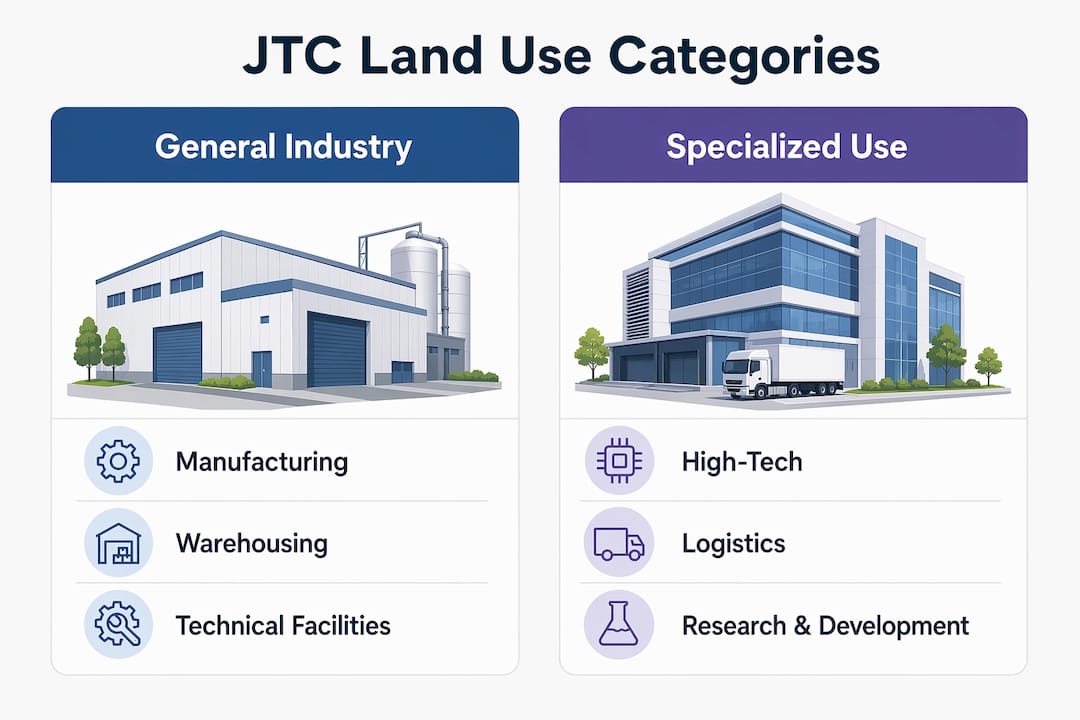
Land use designation controls more than just permitted activities. It governs facility design parameters including floor-to-floor heights, loading provisions, and ancillary space ratios. A developer proposing a logistics facility on a business park site will face rejection regardless of bid price or financial strength.
Understanding business activity compatibility with land use designation is critical before tendering. Developers who skip this due diligence step expose their submissions to outright rejection and lose the tender deposit.
Pro Tip: Cross-reference the JTC land use designation with URA’s Master Plan zoning before preparing any concept design. Misalignment between the two is one of the most common causes of JTC submission rejections at the plan consent stage.
For developments that include drainage infrastructure or sustainable urban drainage systems, commercial drainage planning must align with site-specific utility requirements from the outset of design.
What documentation does JTC require for plan consent submissions?
Plan consent submission to JTC requires a defined set of documents, and incomplete submissions are returned without approval. Required documentation includes architectural plans, structural drawings, site plans, elevation drawings, unit layout plans, and statutory forms such as the Notice of Assumption of Liability for the Land Betterment Charge (LBC).
The submission process follows a structured sequence:
- Prepare architectural and structural drawings to the standard required by BCA and JTC, including floor plans, sections, elevations, and site layout with setback dimensions clearly annotated.
- Complete the Notice of Assumption of Liability for LBC. This statutory form acknowledges the developer’s obligation to pay the Land Betterment Charge if development consent increases the land value.
- Obtain lessee and tenant endorsements. Where the site has an existing lessee or tenant, their written consent and endorsement of the submission are mandatory before JTC will process the application.
- Submit through CORENET. JTC plan consent submissions are processed via the CORENET e-submission system. Timing matters. Submissions made without complete documentation will be rejected at the gateway check, adding weeks to the approval timeline.
- Confirm QP or non-QP submission pathway. A Qualified Person submission covers structural and architectural works requiring professional certification. Non-QP submissions apply to minor works within defined parameters. The non-QP submission process has its own document checklist and scope limitations that developers must verify before proceeding.
Key documents that developers frequently omit include:
- Letter of consent from the existing lessee authorizing the submission
- Completed LBC assumption of liability form signed by the authorized representative
- Updated site plan reflecting current site conditions, not the original tender plan
- Structural engineer’s certification for any works affecting load-bearing elements
The JTC plan consent submission process for industrial units in Singapore requires strict adherence to document completeness. Missing a single statutory form delays the entire approval chain across JTC, URA, and SLA.
How does JTC monitor compliance during and after development?
JTC monitors compliance through a combination of timeline obligations, progress reporting requirements, and financial penalties for breach. Development must be completed within the timelines specified in the tender conditions. Failure to meet these milestones triggers penalties and, in serious cases, can result in lease termination.
The compliance framework involves several concurrent obligations:
- Development completion deadlines: JTC specifies a completion date in the tender award. Developers must obtain Temporary Occupation Permit (TOP) or Certificate of Statutory Completion (CSC) within that period.
- Progress reporting: JTC requires periodic updates on construction progress. Developers who fall behind schedule must notify JTC proactively and submit a revised program with justification.
- Land Betterment Charge (LBC) payment: LBC replaced several prior development taxes and is payable when development consent increases land value. SLA assesses and collects the charge, with JTC coordinating the process. Completing the assumption of liability forms accurately and on time prevents delays in URA planning permission issuance.
- URA and SLA coordination: JTC development projects must satisfy URA’s planning conditions alongside JTC’s own requirements. Developers must track both sets of conditions simultaneously, as a breach of URA conditions can invalidate JTC approvals.
- Post-completion use compliance: JTC conducts periodic checks to confirm the completed facility is used in accordance with the permitted land use category. Operating outside the approved use constitutes a lease breach.
Engaging professional advisors with JTC tender experience significantly improves compliance management. Their expertise in navigating documentation, coordinating with regulatory bodies, and managing construction timelines reduces the risk of penalties and approval delays.
The JTC submission process guide provides a structured overview of each stage from tender award through to post-completion compliance, which developers should review before project commencement.
Key Takeaways
Meeting JTC development requirements demands alignment across financial capacity, land use compatibility, documentation completeness, and post-award compliance, with no single factor sufficient on its own.
| Point | Details |
|---|---|
| Tender evaluation is multi-criteria | JTC assesses financial offers, technical feasibility, and business plan alignment together, not price alone. |
| Land use designation controls design | Developers must verify permitted activities and facility parameters before preparing any concept design. |
| Documentation completeness is mandatory | Missing statutory forms such as the LBC assumption of liability will delay the entire approval chain. |
| Compliance obligations continue post-award | Developers must meet construction timelines, report progress, and maintain approved land use after completion. |
| Professional advisory support is decisive | Experienced QPs and property consultants materially improve submission quality and reduce rejection risk. |
What I have learned from working with JTC development projects
The single most consistent mistake I see from developers approaching JTC tenders is treating the business plan as a formality. It is not. JTC prioritizes quality and business impact over financial bids, and a weak business plan will cost a developer the tender even when their financial offer is competitive.
The developers who succeed are those who invest time before the tender closes. They verify land use compatibility, confirm utility availability with JTC’s technical team, and build a business plan that articulates the facility’s contribution to Singapore’s industrial ecosystem. That preparation is not bureaucratic box-ticking. It is the difference between a winning submission and an expensive rejection.
The LBC process is another area where I see unnecessary delays. Developers who treat the assumption of liability form as a post-submission task rather than a pre-submission requirement consistently face approval bottlenecks at the SLA and URA coordination stage. Completing that form early, with accurate figures, keeps the entire approval chain moving.
My strongest recommendation is early engagement with a consultancy that has direct JTC experience. Well-prepared submissions demonstrate financial capacity, credible timelines, and broader economic benefit. That combination does not happen without structured preparation and professional input from the earliest stage of project planning.
— Aman
Com’s support for developers navigating JTC requirements
Com, Aman Engineering Consultancy, provides end-to-end support for property developers and construction firms working through JTC development guidelines and approval processes in Singapore.
Com’s services cover architectural and structural design aligned with JTC’s land use and technical standards, plan consent submissions through CORENET, statutory documentation preparation including LBC forms and lessee endorsements, and coordination with URA, BCA, SLA, and JTC throughout the approval process. The firm also provides value engineering to optimize construction cost and compliance simultaneously. Developers who engage Com early in the tender preparation stage benefit from submission quality that reflects both technical rigor and alignment with JTC’s economic objectives. Contact Aman Engineering Consultancy to discuss your project requirements.
FAQ
What is the lease term for JTC industrial land?
JTC leases industrial land parcels for 30 to 60 years. Developers must complete construction and meet all development conditions within the timelines specified in the tender award.
How does JTC evaluate land tender submissions?
JTC assesses financial proposals, technical feasibility, and business plans together. Submissions must demonstrate land use compatibility, construction credibility, and alignment with Singapore’s industrial objectives.
What is the Land Betterment Charge in JTC developments?
The Land Betterment Charge (LBC) is payable when development consent increases land value. SLA assesses and collects it, with JTC coordinating the process through the assumption of liability form submitted during plan consent.
What is the difference between QP and non-QP submissions to JTC?
A Qualified Person (QP) submission covers structural and architectural works requiring professional certification. Non-QP submissions apply to minor works within defined scope limits and follow a separate document checklist.
What happens if a developer misses JTC’s development completion deadline?
JTC enforces penalties for delayed or non-compliant developments. Serious or repeated breaches can result in lease termination, making proactive progress reporting and timeline management critical obligations.
Recommended
- JTC Submission Process: A Guide for Singapore Developers
- JTC Lease Renewal 2026: Update Building Plans for Approval – Aman Engineering Consultancy
- JTC Solar Deployment Guide 2026: Mandatory Requirements & Regulations – Aman Engineering Consultancy
- Common JTC Submission Rejections (And How to Avoid Them) – Aman Engineering Consultancy