

The infrastructure project planning process is the structured sequence of phases, from strategic feasibility through long-term asset maintenance, that governs the compliant and efficient delivery of infrastructure projects in Singapore. Property developers, construction project managers, and engineers operating in Singapore must navigate a multi-agency regulatory environment that includes the Building and Construction Authority (BCA), Urban Redevelopment Authority (URA), Land Transport Authority (LTA), Public Utilities Board (PUB), National Environment Agency (NEA), National Parks Board (NParks), and Singapore Civil Defence Force (SCDF). Successful project delivery depends on integrating digital tools such as CORENET X and Building Information Modeling (BIM) standards into every phase of the process. Compliance with the Planning Act 1998, Building Control (Environmental Sustainability) Regulations 2008, and Sewerage and Drainage Regulations is not optional. It is a prerequisite for project approval and continued construction authorization.
What are the main phases of the infrastructure project planning process?
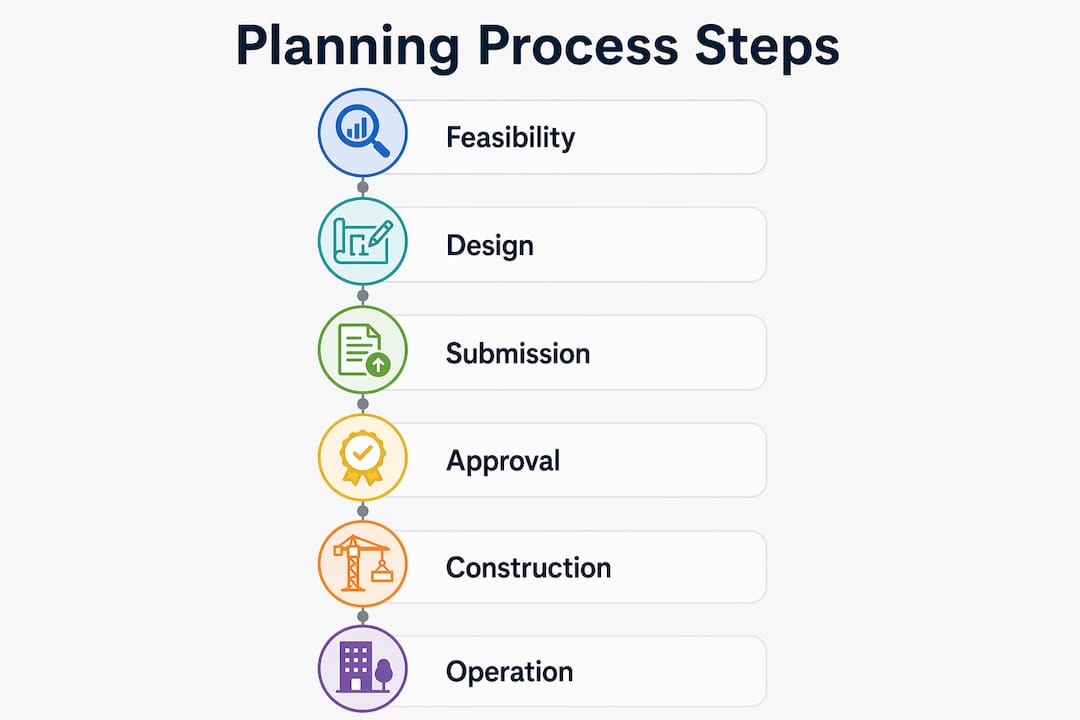
Successful infrastructure project delivery follows six defined phases, each with distinct deliverables, responsible parties, and regulatory checkpoints. These phases are not independent stages. They form a continuous lifecycle where decisions made in early phases directly affect compliance outcomes in later ones.
-
Strategic planning and feasibility. This phase defines project objectives, assesses site constraints, and determines financial and technical viability. Deliverables include a feasibility study, site analysis reports, and preliminary cost estimates. Qualified persons are engaged at this stage to assess statutory requirements and identify approval pathways with BCA, URA, and other relevant agencies.
-
Design and engineering. Architectural, structural, mechanical, and electrical engineering designs are developed and coordinated. BIM models are produced to IFC and IFC+SG standards for regulatory submission. Qualified persons sign off on design documentation, and preliminary submissions to agencies may begin during this phase.
-
Procurement and contracting. Contractors, subcontractors, and specialist suppliers are selected through competitive tender or negotiated contracts. Procurement documentation must align with approved design specifications to avoid discrepancies during construction that could trigger regulatory non-compliance.
-
Construction and implementation. Physical works commence following receipt of all required approvals. Qualified persons supervise construction to verify adherence to approved plans. Compliance checkpoints with PUB, LTA, and SCDF are managed throughout this phase, and any design deviations require formal amendment submissions.
-
Testing and commissioning. Completed systems, including fire safety, drainage, and mechanical and electrical installations, are tested against approved specifications. Certificates of statutory completion and temporary occupation permits are obtained from BCA and relevant agencies.
-
Operations and maintenance. The asset enters its operational lifecycle. Ongoing compliance obligations, including periodic inspections and maintenance of sustainability performance, continue beyond project handover. As-built documentation is maintained for regulatory reference and future development applications.
How does multi-agency regulatory compliance integrate into project planning in Singapore?
Singapore’s regulatory framework for infrastructure projects requires coordinated engagement with seven agencies simultaneously. CORENET X enables concurrent review by BCA, URA, NParks, LTA, SCDF, PUB, and NEA, reducing approval time by up to 20% compared to sequential submission processes. This means that a project team submitting a federated BIM model through CORENET X receives consolidated feedback from all agencies within a single coordinated workflow rather than managing separate submission tracks.
Key statutory obligations that govern the planning process include:
- Planning Act 1998. Singapore’s Planning Act requires all development to align with the Master Plan and mandates that qualified persons submit professional declarations alongside planning permission applications. Permissions carry expiry timelines, and development must commence within the authorized period to remain valid.
- Building Control (Environmental Sustainability) Regulations 2008. Projects must achieve minimum Environmental Sustainability (ES) scores. As-built verification is required post-construction, and non-compliance carries financial penalties.
- Sewerage and Drainage (Surface Water Drainage) Regulations. Drainage approvals are subject to strict commencement windows. Failure to commence works within six months of approval may result in deemed withdrawal of the permission, requiring reapplication.
- Qualified person accountability. Under Planning Act Section 24, qualified persons bear statutory duties for accuracy and compliance throughout the design and construction phases. This is not a delegable responsibility.
Pro Tip: Engage qualified persons and prepare agency-specific submission packages before design is finalized. Retroactive compliance adjustments after design lock-in are significantly more costly and time-consuming than front-loaded regulatory coordination.
Coordinating multi-agency requirements early through integrated BIM submissions produces fewer approval delays and greater project certainty. Teams that treat regulatory engagement as a parallel workstream rather than a sequential step consistently achieve faster approval outcomes.
What tools and standards support efficient infrastructure project planning?
Digital tools and established standards are central to managing the complexity of Singapore’s infrastructure project planning steps. The following table summarizes the primary tools and their functions within the planning process.

| Tool or Standard | Purpose | Key Benefit |
|---|---|---|
| CORENET X | Centralized digital submission portal for multi-agency review | Concurrent agency feedback; up to 20% reduction in approval time |
| IFC (Industry Foundation Classes) | Open BIM data format for model exchange | Cross-discipline model coordination and data interoperability |
| IFC+SG | Singapore-specific BIM submission standard | Compliance with local regulatory submission requirements |
| Federated BIM models | Combined architectural, structural, and M&E models | Reduces rework by identifying clashes before construction |
| Digital twins | Real-time virtual representations of physical assets | Supports lifecycle management and maintenance planning |
| Green Mark certification | BCA’s sustainability rating system | Benchmarks environmental performance against national standards |
Federated BIM models submitted through CORENET X combine architectural, structural, mechanical, and electrical engineering disciplines under a single coordinated data environment. This approach reduces cross-discipline clashes before construction begins, which directly lowers the risk of costly on-site variations and regulatory amendment submissions. Aman Engineering Consultancy’s BIM modeling services are aligned to IFC and IFC+SG standards, supporting compliant submissions across all relevant agencies.
Pro Tip: Establish model governance protocols at the start of the design phase. Assign clear ownership of each discipline model and define clash detection review cycles. Managing federated BIM model governance is a complex but necessary discipline to reduce cross-agency friction and iteration during the approval process.
Qualified persons must maintain oversight of all BIM submissions and design documentation. Their declarations carry legal weight under the Planning Act, and any inaccuracies in submitted models or drawings create direct liability exposure for the responsible professional.
How to manage timelines, approvals, and common challenges during project planning?
Timeline management is a compliance function in Singapore’s infrastructure project planning guide, not merely a scheduling exercise. Statutory deadlines govern when approvals lapse, when works must commence, and when documentation must be submitted.
-
Map all statutory deadlines at project inception. Identify expiry dates for planning permissions, drainage approvals, and other agency authorizations at the outset. Drainage approval commencement windows of six months are treated as critical compliance KPIs by experienced project teams. Missing these windows requires reapplication and resets the approval timeline.
-
Synchronize agency submissions. Use CORENET X to submit to all relevant agencies simultaneously rather than sequentially. Sequential submissions extend the overall approval period and create misalignment between agency-specific conditions that must be reconciled before construction can proceed.
-
Maintain documentation consistency across all submissions. Fragmented submission processes lead to documentation inconsistencies that trigger rejection or requests for additional information. A single federated BIM model as the master data source eliminates version discrepancies between agency submissions.
-
Assign a dedicated compliance coordinator. On projects involving multiple agencies, a single point of accountability for tracking submission status, agency feedback, and response deadlines prevents items from falling through the gaps. This role is distinct from the qualified person function and focuses on process management rather than technical certification.
-
Plan for amendment submissions. Design changes during construction are common. Pre-establish internal protocols for identifying when a change triggers a formal amendment submission to BCA or other agencies, and build amendment processing time into the construction program.
Pro Tip: Request pre-application consultations with BCA and URA before formal submission. These consultations are available for complex projects and allow project teams to resolve agency concerns before the formal review clock starts, reducing the risk of rejection.
Common rejection causes include incomplete qualified person declarations, BIM model non-conformance with IFC+SG standards, and sustainability scoring documentation that does not align with design specifications. Addressing these issues before submission, through internal review against the Singapore construction compliance checklist, reduces iteration cycles and protects the project schedule.
What are best practices for sustainability and long-term compliance in infrastructure projects?
Sustainability obligations under the Building Control (Environmental Sustainability) Regulations 2008 apply from the design phase through to post-construction reporting. Projects that treat sustainability as a late-stage checklist item consistently encounter costly redesign requirements and delayed as-built certifications.
Effective sustainability integration requires the following practices:
- Capture sustainability data during design. Early integration of sustainability data during the design phase is the most cost-effective way to meet as-built reporting requirements. Retrofitting sustainability measures after construction is complete is significantly more expensive than designing to the required ES score from the outset.
- Target Green Mark certification from project inception. BCA’s Green Mark scheme provides a structured framework for achieving and documenting sustainability performance. Aligning design decisions with Green Mark criteria from the start creates a clear audit trail for as-built verification.
- Integrate sustainability metrics into BIM models. Embedding energy performance, material specifications, and water efficiency data into the federated BIM model allows sustainability scoring to be tracked and verified throughout the design and construction process.
- Plan for post-construction reporting obligations. Environmental sustainability obligations extend through design, construction, and final reporting stages. Project teams must allocate resources for as-built documentation, independent verification, and submission to BCA after construction is complete.
- Align maintenance planning with sustainability performance targets. Long-term compliance requires that building systems continue to perform at the levels certified during construction. Maintenance programs should include periodic performance verification against the original ES score to identify degradation before it becomes a compliance issue.
Projects that integrate sustainability planning from the feasibility stage consistently achieve better approval outcomes and lower lifecycle costs. The cost of early sustainability integration is substantially lower than the cost of non-compliance penalties or post-construction remediation.
Key takeaways
The infrastructure project planning process in Singapore requires integrated regulatory coordination, qualified person oversight, and digital BIM submissions from feasibility through to long-term asset maintenance.
| Point | Details |
|---|---|
| Six-phase lifecycle | Every project follows strategic planning, design, procurement, construction, testing, and operations phases with distinct compliance checkpoints. |
| CORENET X concurrent review | Submitting through CORENET X enables simultaneous agency review by seven bodies, reducing approval time by up to 20%. |
| Statutory timeline compliance | Drainage and planning approvals carry strict commencement windows; missing the six-month rule triggers reapplication and schedule delays. |
| BIM to IFC+SG standards | Federated BIM models submitted to IFC+SG standards reduce cross-agency friction and documentation inconsistencies. |
| Early sustainability integration | Capturing environmental sustainability data during design prevents costly retrofits and supports accurate as-built reporting. |
What I have learned from managing infrastructure projects in Singapore
After working through numerous multi-agency submissions and qualified person coordination cycles, the most consistent finding is that project teams underestimate the administrative complexity of the approval process relative to the technical complexity of the design. Engineers and developers focus heavily on structural and M&E design quality, which is appropriate, but the projects that stall most often do so because of documentation gaps, missed statutory deadlines, or BIM model non-conformance rather than technical design failures.
CORENET X has materially improved the coordination experience. The ability to receive consolidated agency feedback through a single platform reduces the back-and-forth that previously consumed weeks of project time. However, the platform’s effectiveness depends entirely on the quality of the federated model submitted. A poorly governed BIM model produces fragmented agency responses that are harder to resolve than the sequential submissions it replaced.
The qualified person regime under the Planning Act is frequently misunderstood as a formality. It is not. The statutory duties assigned to qualified persons create real professional liability, and the documentation discipline required to discharge those duties properly is substantial. Teams that invest in qualified person supervision from the design phase rather than engaging qualified persons only at submission milestones consistently produce cleaner approval records and fewer amendment submissions during construction.
The single most underutilized practice in infrastructure project management is the pre-application consultation. Agencies offer these for complex projects, and the intelligence gathered in a pre-application meeting routinely prevents the most common rejection causes before the formal review process begins.
— Aman
How Aman Engineering Consultancy supports your infrastructure project
Aman Engineering Consultancy provides end-to-end support across the full infrastructure project planning process, from initial feasibility assessment through statutory submissions, BIM modeling, qualified person supervision, and post-construction compliance reporting. The firm’s experience with CORENET X submissions, IFC+SG BIM standards, and multi-agency coordination across BCA, URA, LTA, PUB, SCDF, and NEA positions it as a specialist resource for projects requiring precise regulatory management.
Whether you are managing a greenfield development, a major infrastructure upgrade, or a complex mixed-use project, Aman Engineering’s infrastructure planning consultancy provides the technical and regulatory expertise to protect your approval timeline and project budget. The firm also offers value engineering services to optimize design and cost outcomes without compromising regulatory compliance. Contact Aman Engineering Consultancy to discuss your project requirements and submission strategy.
FAQ
What is the infrastructure project planning process?
The infrastructure project planning process is the structured sequence of phases, from feasibility and design through construction, testing, and operations, that governs the compliant delivery of infrastructure projects. In Singapore, this process is governed by the Planning Act 1998, Building Control regulations, and multi-agency approval requirements coordinated through CORENET X.
What is an infrastructure feasibility study?
An infrastructure feasibility study assesses the technical, financial, and regulatory viability of a proposed project before design and construction resources are committed. It identifies statutory requirements, site constraints, and approval pathways with agencies such as BCA and URA, forming the foundation of the infrastructure project planning steps.
How does CORENET X improve the approval process?
CORENET X enables concurrent regulatory review by seven agencies, including BCA, URA, LTA, SCDF, PUB, NParks, and NEA, through a single digital submission platform. This concurrent review process reduces approval time by up to 20% compared to sequential agency submissions.
What are the consequences of missing a drainage approval commencement deadline?
Under the Sewerage and Drainage (Surface Water Drainage) Regulations, failure to commence or continue approved works within six months may result in deemed withdrawal of the approval. The project team must then reapply, which resets the approval timeline and can cause significant schedule and cost impacts.
Why do qualified persons play a central role in Singapore infrastructure projects?
Under Planning Act Section 24, qualified persons bear statutory duties for the accuracy of submitted plans and the supervision of construction compliance. Their professional declarations carry legal weight, and inaccuracies in submitted documentation create direct liability exposure for the responsible qualified person.