

Submitting BCA plans is the process of preparing, compiling, and electronically filing all required project documents and fees for regulatory approval by Singapore’s Building and Construction Authority, typically coordinated by a licensed architect or professional engineer. The BCA plan submission process is governed by the Building Control Act and executed through the CORENET e-Submission System, which is the mandatory digital platform for all regulated building projects in Singapore. Property developers, contractors, and building owners who understand this process avoid costly project delays and legal exposure. This guide covers every stage of the submission process, from document preparation to fee payment and status tracking.
What documents and fees are required for BCA plan submission?
A complete BCA submission package requires several categories of documents, each serving a distinct regulatory purpose. Architectural plans show the building’s layout, dimensions, and spatial relationships. Structural plans detail load-bearing systems, foundations, and material specifications. Supporting documents include project proposals, site surveys, soil investigation reports, and material test certifications. Specific forms and certificates are also required for specialized systems such as fixed installations, lifts, and mechanized parking.
Accuracy and completeness are non-negotiable. BCA reviewers reject submissions that contain missing signatures, absent supporting documents, or mismatched information between plan sets. A single omission can set a project back by weeks. Developers and contractors must treat the document checklist as a binding requirement, not a suggestion.

BCA plan fees vary by building type and plan category. Reduced fees apply to specific categories such as agricultural buildings. Applicants calculate and pay fees directly through CORENET during the submission process. Incorrect fee payments trigger automatic rejection, which means the entire submission must be restarted.
| Document Type | Contents | Submission Notes |
|---|---|---|
| Architectural plans | Floor plans, elevations, sections, dimensions | Must be stamped by registered architect |
| Structural plans | Foundation design, beam and column layouts, load calculations | Must be endorsed by professional engineer |
| Material specifications | Concrete grade, steel type, facade materials | Attached as separate schedule or within plans |
| Project proposal | Scope, site description, intended use | Required for new developments and major additions |
| Forms and certificates | Fixed installation design plans, completion records | Downloaded from BCA or go.gov.sg portals |
| Fee payment record | CORENET transaction receipt | Generated automatically upon successful payment |
Pro Tip: Engage your Qualified Person at least four weeks before your target submission date. Early coordination gives the QP time to verify the complete document checklist and catch discrepancies before they reach BCA.
Who is eligible and responsible for submitting BCA plans?
Only a Qualified Person can submit building plans to BCA. A Qualified Person is defined as a registered architect or professional engineer holding a valid practicing certificate issued under the Architects Act or the Professional Engineers Act. This is a legal requirement under the Building Control Act, not a procedural preference.
The QP carries full professional and legal liability for the accuracy of every document submitted. Responsibilities include:
- Coordinating all discipline inputs, including architectural, structural, mechanical, and electrical plans
- Verifying that all documents comply with the Building Control Regulations and relevant codes of practice
- Uploading the complete submission package through CORENET
- Paying prescribed fees on behalf of the project
- Responding to BCA queries and requests for clarification within stipulated timeframes
Property owners and contractors do not submit plans directly. Their role is to provide the QP with accurate project information, signed authorizations, and timely approvals. Delays on the owner’s side translate directly into submission delays. Written consent from property owners is also required in cases where approved building plans are requested for reference or resale purposes.
The most common misconception is that BCA submissions are routine paperwork. They carry significant professional liability managed entirely by the QP. Choosing an experienced QP with a track record of successful submissions is one of the highest-value decisions a developer or building owner can make.
Pro Tip: When selecting a QP, ask for their submission approval rate and average turnaround time. An experienced QP who knows BCA’s current review standards will flag compliance issues before submission, not after rejection.
How to submit BCA plans via the CORENET e-submission system
The CORENET e-Submission System is the mandatory platform for all building plan submissions in Singapore. The process follows a defined sequence, and deviating from it causes processing errors or outright rejection.
-
Register for CORENET access. The QP must hold an active CORENET account linked to their professional registration. New QPs apply through the CORENET portal with their practicing certificate details. Owners and developers do not require their own accounts for plan submission.
-
Prepare and compile all documents. All plans must be in the prescribed file format and size. Each drawing file must carry the QP’s digital stamp and signature. Supporting documents must be labeled according to CORENET’s naming conventions to avoid upload errors.
-
Create a new submission case. Log in to CORENET, select the relevant submission type (Building Plan, Structural Plan, or other category), and enter the project details including address, development type, and gross floor area.
-
Upload all required documents. Attach architectural plans, structural plans, material specifications, and all supporting forms. CORENET validates file formats automatically. Any file that fails validation must be corrected and re-uploaded before proceeding.
-
Calculate and pay the prescribed fees. CORENET generates the applicable fee based on the project parameters entered. Fee accuracy is critical because incorrect payments result in submission rejection. Payment is made online through the portal using approved payment methods.
-
Submit and record the case reference number. After successful payment, CORENET generates a case reference number. The QP should save this number immediately. It is the primary identifier for all future correspondence with BCA regarding the submission.
-
Monitor submission status and respond to queries. BCA reviewers may issue Requests for Information or Requests for Clarification through CORENET. The QP must respond within the timeframe specified in each request. Delayed responses extend the overall approval timeline.
-
Receive approval or resubmit. BCA issues approval in principle or conditional approval through CORENET. If conditions are attached, the QP must address each condition and resubmit the relevant documents before construction can begin.
Pro Tip: Submit at least two weeks before your project’s required start date. Early submission gives you buffer time to address BCA queries without disrupting the construction schedule.
What are the most common BCA submission mistakes to avoid?
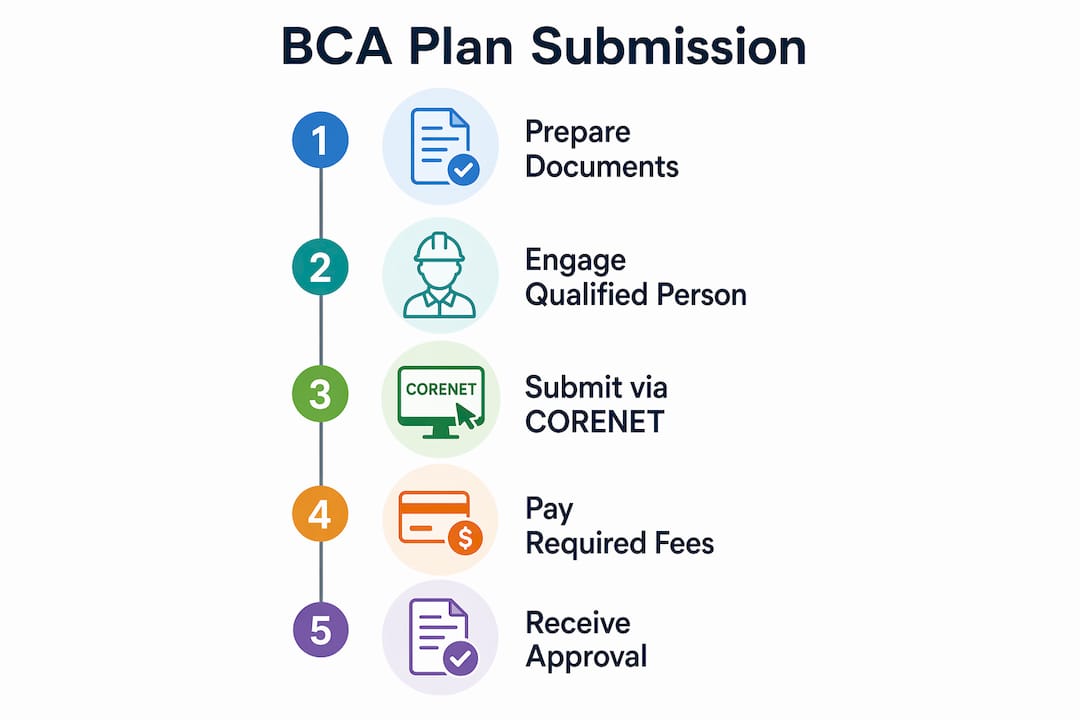
Incomplete or inaccurate documentation is the primary cause of submission rejection and project delay. Understanding the most frequent errors allows developers, contractors, and building owners to apply targeted quality checks before submission.
The following mistakes account for the majority of BCA rejections and delays:
- Missing signatures or stamps. Every plan set must carry the QP’s wet or digital signature and professional stamp. Unsigned drawings are automatically invalid.
- Inconsistent information across disciplines. Architectural and structural plans must align on dimensions, column positions, and floor levels. Discrepancies trigger mandatory clarification requests.
- Incorrect or unpaid fees. Fee calculations based on wrong building categories or gross floor area figures result in payment shortfalls. CORENET rejects submissions with fee errors before BCA review even begins.
- Absent supporting documents. Material specifications, soil investigation reports, and statutory forms are frequently omitted. Each missing item generates a separate query from BCA.
- Non-compliant file formats. CORENET enforces strict file naming and format requirements. Files that do not meet these standards fail the system’s automated validation check.
- Late responses to BCA queries. Missing the response deadline on a Request for Information suspends the review process and may require a full resubmission.
Missing BCA submission deadlines delays project approval and halts construction work. The financial consequences compound quickly when contractors are on standby and site costs continue to accrue. A structured pre-submission review by the QP, covering every checklist item, is the most reliable way to prevent these outcomes.
Professionally coordinated submissions are more cost-effective than rectifying violations after construction begins. Engaging qualified professionals early reduces the risk of non-compliance and rework, saving both time and money. Developers who treat the QP as a strategic partner from project inception, rather than a last-minute compliance resource, consistently achieve faster approvals.
For a detailed breakdown of structural submission pitfalls, the common BCA rejection reasons guide from Com covers the technical non-compliances that most frequently derail projects.
Key Takeaways
Successful BCA plan submission requires a Qualified Person, complete documentation, accurate fee payment through CORENET, and proactive response to BCA queries before construction can legally begin.
| Point | Details |
|---|---|
| QP is legally required | Only a registered architect or professional engineer can submit plans to BCA. |
| CORENET is mandatory | All building plan submissions must go through the CORENET e-Submission System. |
| Documentation must be complete | Missing signatures, forms, or supporting documents trigger automatic rejection. |
| Fees must be calculated accurately | Incorrect fee payments cause submission rejection before BCA review begins. |
| Early submission prevents delays | Submitting at least two weeks ahead provides buffer time for BCA queries and corrections. |
What I’ve learned from years of BCA submission work
The most persistent problem I see is not technical incompetence. It is poor timing. Developers routinely engage a QP after the project design is already locked, leaving no room to identify compliance gaps before the submission deadline. By that point, any structural or architectural non-compliance requires redesign, which costs far more than early consultation would have.
Document control is the second area where projects consistently lose time. Plans from different disciplines arrive in different versions, with different revision dates, and no one has reconciled them before submission. BCA reviewers catch these inconsistencies immediately. A single version-control failure can generate three or four separate queries, each adding days to the review cycle.
The CORENET system itself is reliable when used correctly. The errors I see are almost always human, not systemic. QPs who invest time in understanding CORENET’s file requirements and submission workflows before their first project submission avoid the majority of technical rejections. The BCA submission preparation guide from Com is a resource I recommend to any team approaching their first submission.
My strongest advice to property owners and developers: treat BCA submission as a project phase, not an administrative task. Assign it a start date, a responsible party, and a completion deadline. Projects that plan the submission process with the same rigor as the design process get approved faster, with fewer interruptions.
— Aman
How Com supports your BCA plan submission
Com, operating as Aman Engineering Consultancy, provides end-to-end support for the BCA plan submission process, from initial document preparation and fee calculation to CORENET filing and query management.
The consultancy’s team includes registered architects and professional engineers who serve as Qualified Persons across a wide range of project types, including residential, commercial, and industrial developments. Com’s services cover integrated engineering solutions spanning structural, facade, mechanical and electrical, and fire safety submissions. Developers and building owners who need reliable QP coordination and compliance support can contact Aman Engineering Consultancy directly through the website to discuss their next project.
FAQ
What is BCA submission?
BCA submission is the process of filing building plans, supporting documents, and prescribed fees with Singapore’s Building and Construction Authority through the CORENET e-Submission System for regulatory approval before construction begins.
Who can submit plans to BCA?
Only a Qualified Person, defined as a registered architect or professional engineer with a valid practicing certificate, can submit building plans to BCA under the Building Control Act.
How long does BCA plan approval take?
Approval timelines vary by project complexity and submission completeness. A realistic approval timeline depends on the number of BCA queries raised and how quickly the QP responds to each one.
What happens if my BCA submission is rejected?
BCA issues a rejection notice through CORENET specifying the reasons. The QP must correct all identified issues and resubmit the complete package, including any revised fee payments, before the review process restarts.
What is the difference between a BP submission and an ST submission?
A BP submission covers architectural building plans, while an ST submission covers structural plans. Both are required for most construction projects, and the BP vs. ST submission distinction affects which QP disciplines are responsible for each filing.