
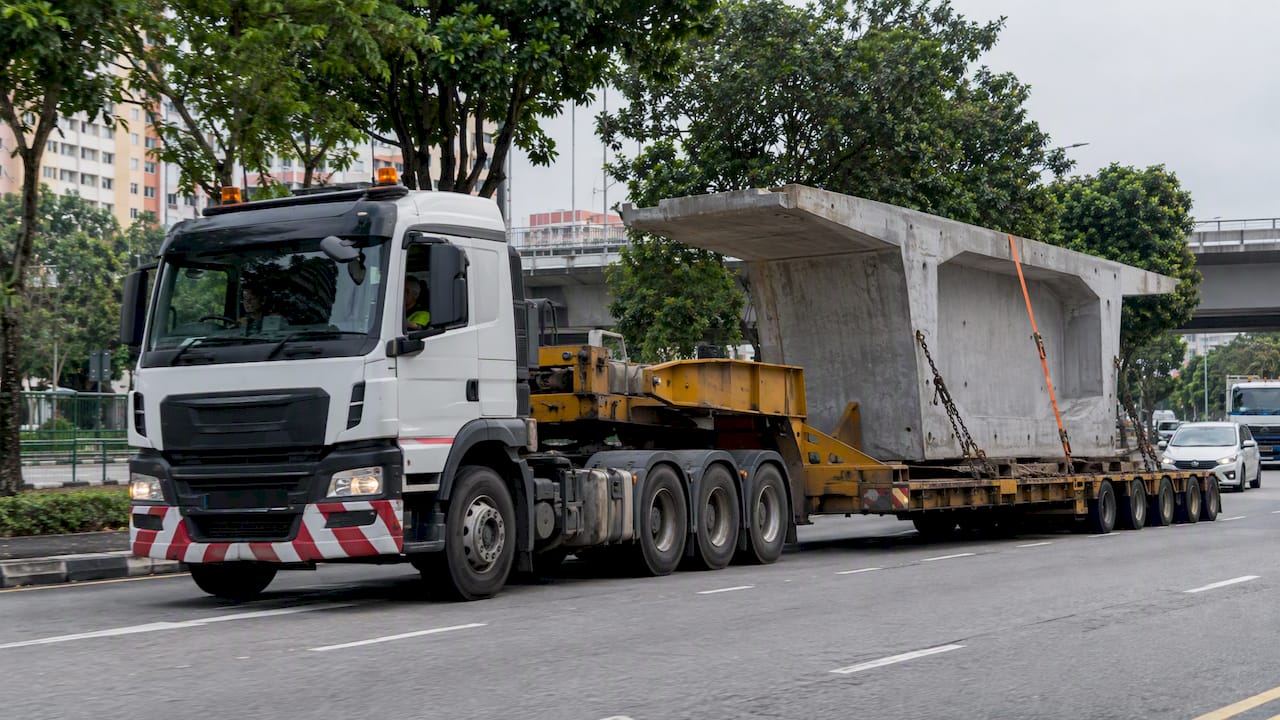
You must apply for an LTA Oversized Vehicle Movement (OVM) permit whenever your vehicle or load exceeds the width, length or weight thresholds that the Land Transport Authority sets for road use, and the application runs through LTA.PROMPT. Depending on the dimensions involved, you may also need an auxiliary police escort and a professional engineer’s report before LTA approves the movement.
TL;DR:
- Check width against the 3.0 meter limit, or 2.6 meters on controlled roads; rear overhang triggers a permit at the lower of 40% or 1.8 meters.
- Submit through LTA.PROMPT at least 3 working days ahead; late day filings may count from the next workday, so allow time for supporting documents.
- A laden height of 4.5 meters triggers an auxiliary police escort; book it after approval because the permit and escort require separate arrangements.
- For exceptionally heavy or wide loads near bridges or gantries, arrange a professional engineer’s report or route survey early to prevent structural review delays.
- Operators repeating an established route can request a term permit, reducing the need to submit a fresh application for every scheduled movement.
Table of Contents
- What an OVM Permit Covers and Why LTA Requires It
- Dimensional and Weight Thresholds That Trigger a Permit
- When an Auxiliary Police Escort Is Required
- How to Apply Through LTA.PROMPT Step by Step
- Supporting Documents and When a PE Report Is Required
- Timing, Validity and Fees You Should Plan Around
- Compliance, Speed Limiters and Worker Transport Safety
- Practical Checklist for Operators Before and During Movement
- Why Early Technical Preparation Prevents Costly Delays
- How We Help You Prepare an LTA Haulage Permit Submission
- FAQ
- Sources
What an OVM Permit Covers and Why LTA Requires It
An Oversized Vehicle Movement permit exists to protect road infrastructure and public safety when a vehicle or its load pushes past standard dimensional or weight allowances. Bridges, flyovers, road shoulders and traffic signal gantries are built to defined tolerances, and a haulage vehicle that exceeds those tolerances without clearance risks structural damage, traffic disruption or a collision.
We issue this distinction clearly because operators sometimes confuse OVM permits with other LTA paperwork. An OVM permit governs movement on public roads, which differs from a construction vehicle entry permit or a worksite access pass. Under the LTA framework for commercial vehicles, the OVM permit specifically addresses:
- Oversized or overweight loads traveling on public roads between two points.
- Repeated or one-time haulage movements that cross designated road categories.
- Movements that may require a police escort because of height, width or route sensitivity.
LTA.PROMPT is the single portal for this process. Every OVM application, from a one-off crane transfer to a recurring precast delivery route, is submitted and tracked there, which removes the need to approach multiple counters or departments separately.
Dimensional and Weight Thresholds That Trigger a Permit
Before you book a route or schedule a driver, measure the vehicle and load against LTA’s published thresholds. These figures decide whether you need a permit at all, and they are worth checking twice because a measurement taken at the wrong point understates the real figure.
According to LTA’s guidance for commercial vehicles, a permit becomes mandatory when:
- Overall width exceeds 3.0 meters, or 2.6 meters on controlled roads, measured laden.
- Rear overhang reaches 40% of the vehicle’s overall length or 1.8 meters, whichever is less.
- Overall laden weight exceeds the laden weight limit set for that vehicle type.
Rear overhang trips up more operators than any other threshold because it is calculated as a proportion, not a fixed figure. Always apply whichever limit is lower for your specific vehicle length.
Width measurements should be taken at the widest laden point, including any load that protrudes beyond the vehicle body, mirrors excluded. Controlled roads, which include expressways and other designated routes, carry the tighter 2.6 meter width threshold, so a load that clears the 3.0 meter mark on an ordinary road may still require a permit if your route touches a controlled road.

Some expressway-excluded vehicle categories carry separate restrictions regardless of dimensions, and enforcement records show this remains a common source of violations, so route planning should confirm expressway eligibility before dimensions are even checked.
When an Auxiliary Police Escort Is Required
Height is the trigger most operators overlook because width and weight dominate the conversation. Once a laden vehicle or load reaches 4.5 meters in height, an auxiliary police escort becomes part of the movement, alongside any width or route condition that LTA flags during review.
The distinction between escort types matters operationally:
- An auxiliary police force (APF) escort is a uniformed, authorized escort arranged through an approved provider and is required when LTA’s permit conditions specify it, typically tied to the 4.5 meter height threshold or sensitive route segments.
- A company-provided vehicle escort, sometimes a pilot car with warning signage, is permitted for lower-risk movements where LTA’s conditions do not call for a police escort but still require visual warning to other road users.
Booking sequence affects your timeline more than most applicants expect. LTA’s permit approval and the APF escort booking are separate processes, and an approved permit with no escort booked still leaves you unable to move. Confirm escort requirements from your LTA.PROMPT approval conditions before finalizing your movement date, since escort providers often need their own lead time once the permit condition is known.
Pro Tip: Submit your LTA.PROMPT application first, then book your APF escort as soon as the permit conditions confirm it is required, rather than booking both in parallel and risking a mismatch between approved dates.
How to Apply Through LTA.PROMPT Step by Step
LTA.PROMPT consolidates width, length and weight permit requests into a single submission workflow, which LTA.PROMPT’s own FAQ confirms is the intended design. Before you touch the portal, confirm that your organization has business-user access, since OVM applications are submitted under a registered business entity rather than an individual driver’s account.
The practical sequence runs as follows:
- Register your business on LTA.PROMPT using your UEN and Corppass credentials, since vehicle movement permit administration has sat with LTA since 2010 and requires business-user access rather than personal login.
- Prepare your route and vehicle details, including the exact dimensions and weight that triggered the permit requirement.
- Submit the application through LTA.PROMPT at least 3 working days before your intended travel date, as stated in the LTA.PROMPT FAQ.
- Attach supporting documents, covering vehicle specifications, load description and route information.
- Monitor the application status on the portal and respond promptly if LTA requests clarification or additional documents.
Submission timing carries a practical quirk worth planning around: applications lodged later in the working day are commonly treated as received the next working day for the purpose of counting the 3-day lead time, so a submission made in the afternoon may not start its clock until the following morning. Build in a buffer rather than submitting exactly 3 days out.
Your submission checklist should include:
- A route map showing the full path from origin to destination, including any controlled road segments.
- Vehicle and load specifications, covering width, length, rear overhang and laden weight.
- Photographs of the vehicle and load, particularly at points where dimensions are critical.
- A traffic control plan where the movement affects traffic flow or requires lane closures.
- Proof of insurance coverage for the vehicle and the movement.
- A named contact person reachable during the movement window.
For operators running the same route regularly, such as a fixed delivery corridor between a port and an industrial site, LTA.PROMPT’s consolidated workflow allows repeated-route applications to be processed faster once a route history is established, and term permits may be requested for recurring movements rather than filing a fresh application each time.
Supporting Documents and When a PE Report Is Required
LTA reviews OVM applications against the documents you attach, so incomplete packages are the most common cause of delay. Beyond the submission checklist, LTA typically expects scaled drawings of the vehicle and load configuration, clear photographs of critical route points such as narrow junctions or low clearances, and a traffic control plan whenever the movement affects other road users.
- Photographs of the vehicle, load and critical route points, especially junctions, bridges and narrow carriageways.
- Scaled drawings showing exact vehicle and load dimensions.
- A traffic control plan for movements that require lane closures or escorted convoys.
- Proof of insurance covering the specific movement.
Exceptionally heavy or wide loads, particularly those that may interact with bridges, overhead structures or weight-sensitive road sections, often require a professional engineer’s report or a route survey before LTA approves the permit. That report should assess structural clearance along the proposed route, confirm bridge and overhead gantry limits, and flag any section requiring temporary reinforcement or an alternate path. Engaging a PE early, before you lock in a route, avoids a late-stage request from LTA for additional structural checks that can push your timeline back by weeks.
Timing, Validity and Fees You Should Plan Around
The 3 working day minimum lead time set out in the LTA.PROMPT FAQ applies to standard OVM submissions, and the portal’s processing quirk around midday cutoffs means a submission filed late in the day may effectively lose a day of lead time. Plan your submission date with that buffer built in rather than relying on the bare minimum.
Permit validity is generally tied to the specific travel period you declare in your application, which means a one-off movement gets a permit scoped to that trip. Operators running the same route repeatedly can request term permits once a route history is established with LTA, which reduces the need to file a fresh application for every trip. A change in vehicle ownership during a permit’s validity period typically requires a fresh application, since the permit is tied to the vehicle and operator combination approved by LTA.
- Confirm your travel window matches the permit’s validity before departure.
- Request a term permit if your route repeats on a predictable schedule.
- Re-apply promptly if vehicle ownership or registration changes mid-permit.
- Budget separately for any auxiliary police escort charges, which are billed apart from the LTA permit itself.
Fee structures and payment routes are referenced on LTA’s own portal pages rather than published as a flat schedule here, so confirm the current payment method directly through LTA.PROMPT at the point of submission.
Compliance, Speed Limiters and Worker Transport Safety
Haulage compliance extends past the permit itself into how the vehicle operates day to day. A three-day island-wide enforcement operation in May 2025 stopped 192 heavy vehicles and issued 87 summonses, with 94 violations tied to LTA rules including excluded vehicles on expressways and missing speed-limiter labels, according to the Singapore Police Force. That scale of enforcement signals active monitoring rather than a one-time campaign.
Speed limiters are a recurring enforcement focus. Traffic Police have outlined phased mandatory installation deadlines for lorries by maximum laden weight band, and visible label display is part of the compliance check, not an optional detail.
Worker transport rules intersect directly with haulage operation when lorries carry workers alongside or instead of cargo. The joint factsheet from LTA, MOM and SPF and MOM’s inter-agency advisory set out specific requirements:
- Rain covers over the lorry deck where workers are transported.
- A speed limit of 60 km/h for worker-carrying lorries, or the road’s posted limit where lower.
- Railing of specified height around the deck and defined rest-period rules for drivers.
- A vehicle-buddy arrangement for certain worker transport scenarios.
Practical Checklist for Operators Before and During Movement
A smooth LTA.PROMPT approval depends on preparation that happens before you ever open the portal. Measure your vehicle and load twice against the width, rear overhang and weight thresholds, since a measurement error at this stage is the single most common cause of a rejected or delayed application.
- Confirm Corppass and UEN access on LTA.PROMPT before your target submission date, not on the day itself.
- Compile route photographs and scaled drawings covering every junction, bridge and narrow segment on the proposed path.
- Engage a professional engineer early if the load’s dimensions or weight suggest structural interaction with bridges or gantries.
- Pre-book an APF escort once your permit conditions confirm the 4.5 meter height threshold or another escort trigger applies.
- Submit through LTA.PROMPT at least 3 working days ahead, with an extra buffer for the midday cutoff quirk.
On the road, the checklist shifts to operational detail: a visible speed-limiter label where required, a securely fastened load matching the dimensions declared in your permit, correct warning signage for oversized movements, a vehicle buddy where worker transport rules apply, and a reachable contact person whose details match what LTA approved.
Pro Tip: Keep a printed copy of your approved LTA.PROMPT permit and escort confirmation in the cab. A roadside check that cannot immediately verify your paperwork against the physical vehicle often escalates into a longer stop than the documentation issue itself warrants.
We package these submissions as part of our authority approvals work, where PE endorsements and route documentation come together before a single form reaches LTA.PROMPT, which is where most of the back-and-forth on complex loads actually originates.
Why Early Technical Preparation Prevents Costly Delays
The most common cause of a stalled OVM application is not a missing signature, it is a route or load detail that only a PE review would have caught before submission. Operators who bring in engineering input at the planning stage, rather than after LTA raises a query, consistently move through the process with fewer rounds of clarification.
Correct documentation at the first submission is not a formality. It is the difference between a permit approved within its standard lead time and one that stalls for weeks while a structural question gets resolved mid-review.
— Aman
How We Help You Prepare an LTA Haulage Permit Submission
We handle the statutory submission side of haulage movements for property developers, contractors and building owners who need an OVM permit processed without repeated rounds of LTA queries. Our authority approvals service covers the documentation package, from scaled drawings to route survey coordination, so your LTA.PROMPT submission arrives complete the first time.

Where a load’s weight or dimensions raise a structural question along the route, the PE endorsement is provided directly rather than sending you to coordinate a separate consultant, and liaison across LTA, MOM and Traffic Police requirements is managed as a single point of contact.
- Document packaging for LTA.PROMPT submissions, including route surveys and scaled drawings.
- PE endorsements for loads that interact with bridges, gantries or weight-sensitive road sections.
- Multi-agency liaison so you are not managing LTA, MOM and Traffic Police separately.
If you have a haulage movement that needs an OVM permit, a PE report or an escort coordination plan, reach out through our authority approvals page to start the submission.
This article is general information, not a substitute for advice from a qualified lawyer. Consult a qualified legal professional about your own circumstances before acting on anything here.
FAQ
What are the new rules for lorries in Singapore?
Recent changes center on speed limiters, with Traffic Police outlining phased mandatory installation deadlines for lorries based on maximum laden weight bands. Worker-transport safety measures from the joint LTA, MOM and SPF factsheet also continue to apply, covering rain covers and rest-period rules.
What is considered a heavy vehicle in Singapore?
A heavy vehicle generally refers to a lorry or goods vehicle whose laden weight, dimensions or configuration exceed standard passenger vehicle limits, and the exact OVM thresholds are set by LTA’s commercial vehicle guidance. Vehicles exceeding 3.0 meters in width, 1.8 meters of rear overhang or their vehicle-type laden weight limit fall under permit requirements.
What are the safety regulations for lorries carrying workers?
Lorries carrying workers must meet requirements set by MOM’s inter-agency advisory, including rain covers, specified railing heights and a speed limit of 60 km/h or the posted road limit, whichever is lower. The joint LTA, MOM and SPF factsheet adds vehicle-buddy arrangements and driver rest-period rules.
What is the speed limit for lorries in Singapore?
Lorries carrying workers on the deck are capped at 60 km/h or the road’s posted speed limit, whichever is lower, under MOM’s inter-agency advisory. Standard road speed limits apply otherwise, alongside any route-specific conditions attached to an OVM permit.
How long does it take to get an LTA haulage permit approved?
Standard OVM applications require a minimum lead time of 3 working days before travel, as stated in the LTA.PROMPT FAQ. Complex loads requiring a PE report or route survey typically take longer, so engaging engineering review early reduces the risk of delay.
Sources
- LTA | Commercial Vehicles
- LTA | Joint factsheet by LTA, MOM & SPF – Update on measures to enhance safety of worker transportation
- MOM — Inter-agency advisory on safe transportation of workers
- SPF | Three-day island-wide enforcement blitz against errant heavy vehicle drivers
- LTA.PROMPT FAQ