

Government agency approvals in 2026 are defined as the statutory authorizations required from regulatory bodies such as the Building and Construction Authority (BCA), Urban Redevelopment Authority (URA), Public Utilities Board (PUB), and Singapore Civil Defence Force (SCDF) before any property development or construction project may legally proceed. The 2026 regulatory environment has shifted materially, with expedited permit pathways, digital submission mandates, and cross-border reform influences reshaping how developers must plan and execute their approval strategies. Delays caused by incomplete submissions or missed agency requirements now carry greater financial and legal consequences than in prior years. Understanding the current framework is the first step toward protecting your project timeline.
What are the major 2026 regulatory changes affecting government agency approvals?
The most consequential reform of 2026 is the U.S. EPA’s proposed mandate requiring all Environmental Impact Statements to be completed within 2 years, down from 4. That reduction cuts the average review cycle in half and sets a global benchmark that Singapore’s regulatory agencies are watching closely. Faster federal timelines create pressure on local agencies to justify prolonged review periods.
Alongside the EIS deadline reform, federal agencies in the United States have adopted over 195 new categorical exclusions in 2026, allowing low-impact projects to bypass full environmental review entirely. This tool is the fastest-growing mechanism for approval acceleration globally. Singapore developers working on projects with limited environmental footprint should understand how analogous local exemption categories operate under BCA and URA frameworks.
The Department of Interior has introduced emergency NEPA procedures that permit energy and critical mineral projects to receive approvals in under 28 days, with fiscal year 2026 recording the highest volume of drilling permit applications in 15 years. That pace demonstrates what is achievable when procedural bottlenecks are removed by design. The lesson for Singapore developers is that expedited pathways exist and must be actively identified rather than assumed unavailable.
The KPMG Mid-Year Regulatory Insights report for 2026 identifies regulatory fragmentation as the defining compliance challenge of the year. Overlapping federal, state, and local jurisdictions create multi-layered compliance stacks that require active management rather than passive monitoring. Singapore projects with cross-border components or international financing face this complexity directly.
Key regulatory shifts shaping 2026 approvals include:
- NEPA EIS deadline reform: Firm 2-year completion mandate replacing open-ended review cycles.
- Categorical exclusions expansion: 195+ new CEs across U.S. federal agencies, signaling a global shift toward tiered review.
- Emergency permitting procedures: Sub-28-day approvals for qualifying infrastructure projects under Department of Interior rules.
- Regulatory fragmentation: Multi-jurisdictional compliance stacks now require real-time monitoring systems, not static manuals.
- AI and technology regulation: Emerging rules governing AI-assisted design and BIM submissions are entering agency review criteria.
Pro Tip: Identify whether your project qualifies for any categorical exclusion or expedited review category before submitting your primary application. Qualifying projects can avoid full environmental review entirely, saving months of processing time.
How does the government approvals process work for Singapore property projects?
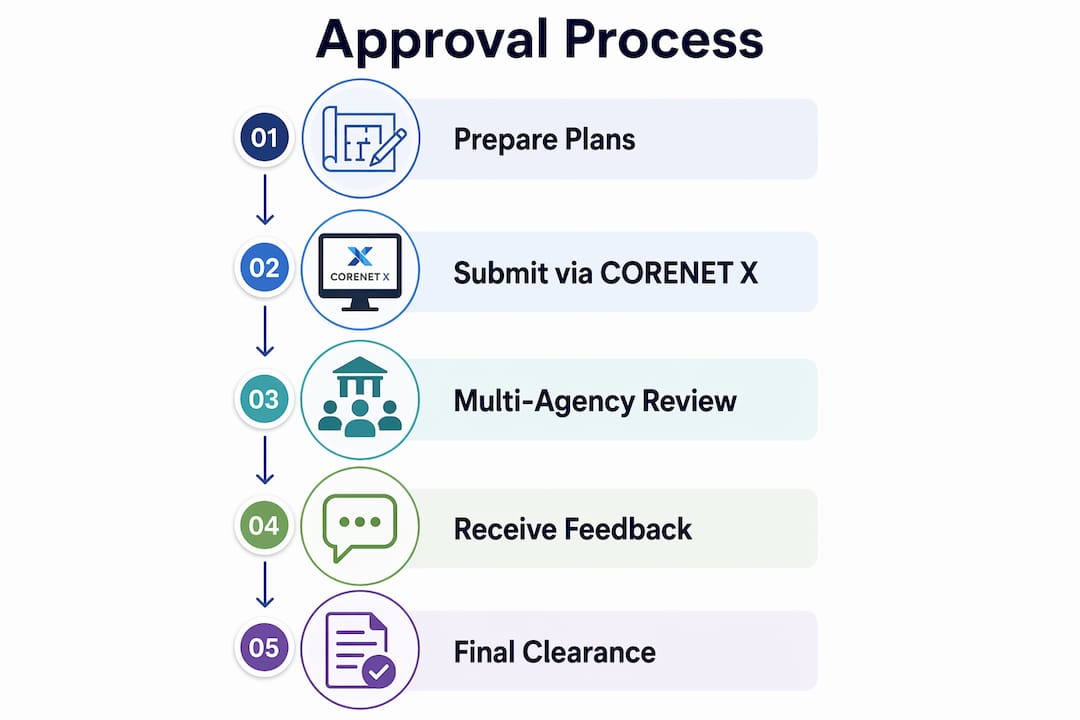
Singapore’s statutory approval process for property development involves sequential and concurrent submissions across multiple agencies, each with distinct mandates and documentation requirements. The engineering approvals required span structural, fire safety, drainage, and utilities clearances, and no single submission satisfies all agencies simultaneously.
The primary agencies and their roles are as follows:
- Building and Construction Authority (BCA): Governs structural safety, building plan submissions, and construction supervision. BCA plan examination is typically the first statutory gate for any new development or major addition and alteration works.
- Urban Redevelopment Authority (URA): Controls land use, development control, and planning permission. URA approval must precede BCA plan submission for most development types.
- Public Utilities Board (PUB): Regulates drainage, sewerage, and water supply connections. PUB approval requirements include drainage impact assessments and sewer connection approvals that are critical path items for any development with significant site coverage.
- Singapore Civil Defence Force (SCDF): Administers fire safety regulations, including fire certificate applications and fire safety plans for all buildings above a defined occupancy threshold.
- Land Transport Authority (LTA): Reviews road reserve requirements, vehicular access, and traffic impact for developments affecting public roads.
The CORENET X platform is now the mandatory electronic submission channel for building plans in Singapore. CORENET X submissions improve workflow efficiency by centralizing multi-agency plan examination, but they demand a higher standard of documentation accuracy than paper-based processes. A single inconsistency between structural drawings and architectural plans triggers an automatic rejection, resetting the review clock.
Typical timelines for BCA building plan clearance in 2026 range from several weeks for straightforward landed housing to several months for complex commercial or industrial developments. The BCA building plan clearance timeline is directly affected by the completeness of the initial submission and the number of agencies requiring concurrent review.

Pro Tip: Submit drainage and utilities applications to PUB concurrently with your BCA plan submission rather than sequentially. Overlapping these reviews can remove four to eight weeks from your critical path without any additional regulatory risk.
What practical strategies help developers navigate 2026 approvals efficiently?
Effective management of 2026 regulatory compliance requires deliberate planning before the first submission is made. Reactive compliance, where developers respond to agency queries after submission, consistently produces longer approval cycles and higher costs. The following strategies address the most common causes of delay.
- Engage agencies early and formally. Pre-application consultations with BCA, URA, and SCDF allow developers to identify technical objections before drawings are finalized. Agencies in Singapore generally welcome pre-submission meetings for complex projects, and the feedback received is binding guidance that reduces rejection risk.
- Map concurrent review opportunities. Not all agency submissions are sequential by regulation. Identifying which approvals can run in parallel and structuring your submission program accordingly is the single most effective timeline reduction strategy available.
- Implement a real-time regulatory monitoring system. Regulatory fragmentation in 2026 means that policy updates from BCA, URA, or PUB can affect in-progress submissions without advance notice. Static compliance checklists become outdated within months. Dynamic monitoring systems flag changes as they occur.
- Use digital tools for submission accuracy. Digital tools in 2026 construction projects reduce documentation errors that trigger agency rejections. BIM-coordinated drawings submitted through CORENET X carry a materially lower rejection rate than manually drafted plans.
- Qualify for expedited pathways where available. Projects meeting low-impact criteria under Singapore’s regulatory framework may qualify for streamlined review. Proactively identifying and documenting eligibility before submission positions the project for faster processing.
- Assign a dedicated compliance coordinator. Multi-agency submissions require a single point of accountability who tracks each agency’s review status, responds to queries within required timeframes, and escalates stalled reviews before they affect the critical path.
The project compliance workflow for construction projects in 2026 must treat regulatory compliance as a live function, not a pre-construction checklist. Developers who build compliance management into their project governance structure from day one consistently achieve faster approvals than those who treat it as a back-office task.
How do U.S. federal agency reforms influence Singapore’s 2026 approval environment?
U.S. federal regulatory reforms set global benchmarks that influence how Singapore’s agencies calibrate their own review standards and timelines. The FDA’s Commissioner’s National Priority Voucher program, which reduces critical project review times from 10–12 months to 53 days, demonstrates that expedited review is operationally achievable at scale. Singapore’s regulatory agencies observe these international precedents when evaluating their own process efficiency.
The cross-border influence operates through three primary channels: international financing requirements, multinational developer standards, and global ESG compliance frameworks. A Singapore developer with institutional financing from U.S. or European funds must often demonstrate alignment with international environmental and governance standards, not just local statutory compliance. Non-alignment creates financing risk that is distinct from, and additional to, regulatory risk.
| Reform Area | U.S. Federal Position | Singapore Relevance |
|---|---|---|
| Environmental review timelines | EIS capped at 2 years by EPA mandate | Signals acceptable review duration benchmarks |
| Expedited permitting | Sub-28-day approvals for qualifying projects | Informs expectations for fast-track local pathways |
| Categorical exclusions | 195+ CEs adopted across agencies | Analogous exemption categories exist under BCA and URA |
| Regulatory fragmentation | Multi-jurisdictional compliance stacks identified by KPMG | Directly applicable to Singapore projects with cross-border components |
| Technology in submissions | AI and digital tools entering agency review criteria | CORENET X mandates align with this global direction |
Developers who align their compliance programs with both local Singapore requirements and evolving international standards reduce their exposure to regulatory risk on two fronts simultaneously. The 2026 BCA policy updates on structural safety reflect this dual-track pressure, incorporating international best practices into local statutory requirements.
Regulatory compliance in 2026 is no longer a passive administrative function. It is a proactive, technology-enabled strategic function that directly determines whether a project proceeds on schedule or stalls at a critical gate.
Key Takeaways
Government agency approvals in 2026 require Singapore developers to manage concurrent multi-agency submissions, monitor real-time regulatory changes, and align local compliance with international standards to protect project timelines and financing.
| Point | Details |
|---|---|
| Multi-agency coordination is mandatory | BCA, URA, PUB, SCDF, and LTA each hold independent approval authority over distinct project elements. |
| Concurrent submissions reduce timelines | Running PUB and BCA reviews in parallel can remove four to eight weeks from the critical path. |
| CORENET X demands documentation accuracy | A single drawing inconsistency triggers automatic rejection and resets the review clock. |
| 195+ categorical exclusions now exist globally | Developers should assess project eligibility for expedited or exempted review before primary submission. |
| Real-time compliance monitoring is now standard | Static checklists become outdated; dynamic regulatory tracking reduces delay and litigation risk. |
Regulatory complexity in 2026 is not a problem to solve once
From my experience working with developers across Singapore’s construction sector, the most consistent mistake I observe is treating government agency approvals as a linear checklist rather than a dynamic, multi-threaded process. Developers who submit to BCA and then wait before engaging PUB or SCDF are building delay into their program by design, not by accident.
The 2026 regulatory environment rewards preparation. Agencies have less tolerance for incomplete submissions than in prior years, partly because digital platforms like CORENET X create an automatic audit trail of every submission and query. That transparency cuts both ways. It protects developers who submit correctly the first time, and it exposes those who submit speculatively and revise under agency pressure.
The international reform signals from the U.S. EPA and Department of Interior are worth taking seriously. They indicate a global direction toward tiered review, where low-impact projects move faster and complex projects face more rigorous scrutiny. Singapore’s agencies are moving in the same direction. Developers who proactively identify their project’s risk profile and match it to the appropriate approval pathway will consistently outperform those who apply a one-size-fits-all submission strategy.
The firms that perform best in this environment are those that treat compliance as a core project management discipline, not a legal formality. That means dedicated resources, real-time monitoring, and early agency engagement on every project, regardless of scale.
— Aman
How Com supports your 2026 government approval submissions
Com, operating as Aman Engineering Consultancy, provides integrated engineering, architectural, and compliance services specifically structured for Singapore’s 2026 regulatory environment. The firm manages statutory submissions across BCA, URA, PUB, SCDF, LTA, JTC, and HDB, coordinating multi-agency approval programs from pre-application consultation through final certification.
Developers working with Com benefit from a team that tracks regulatory changes in real time and applies current agency requirements to every submission. The firm’s civil and structural design services are coordinated directly with its statutory submission practice, reducing the documentation inconsistencies that cause CORENET X rejections. For developers managing complex or time-sensitive projects, Com’s full consultancy services cover the complete approval lifecycle from feasibility through occupation permit.
FAQ
What agencies must Singapore developers engage for project approvals?
Singapore property developments require approvals from BCA, URA, PUB, SCDF, and LTA as a minimum, with JTC and HDB involvement for industrial and public housing projects respectively.
How long does BCA building plan clearance take in 2026?
Timelines vary by project complexity, from several weeks for straightforward landed housing to several months for commercial or industrial developments, with CORENET X submission accuracy being the primary variable.
What is a categorical exclusion and does it apply in Singapore?
A categorical exclusion allows low-impact projects to bypass full environmental review. Over 195 CEs were adopted across U.S. federal agencies in 2026, and analogous exemption categories exist within Singapore’s BCA and URA frameworks for qualifying projects.
How does CORENET X affect the approval process?
CORENET X is Singapore’s mandatory electronic platform for building plan submissions. It centralizes multi-agency review but requires complete documentation accuracy, as any inconsistency between submitted drawings triggers automatic rejection.
Why do U.S. regulatory reforms matter to Singapore developers?
U.S. EPA and Department of Interior reforms set international benchmarks for review timelines and expedited pathways. Singapore developers with international financing or cross-border project components must align with these standards to satisfy lender and investor requirements alongside local statutory obligations.