
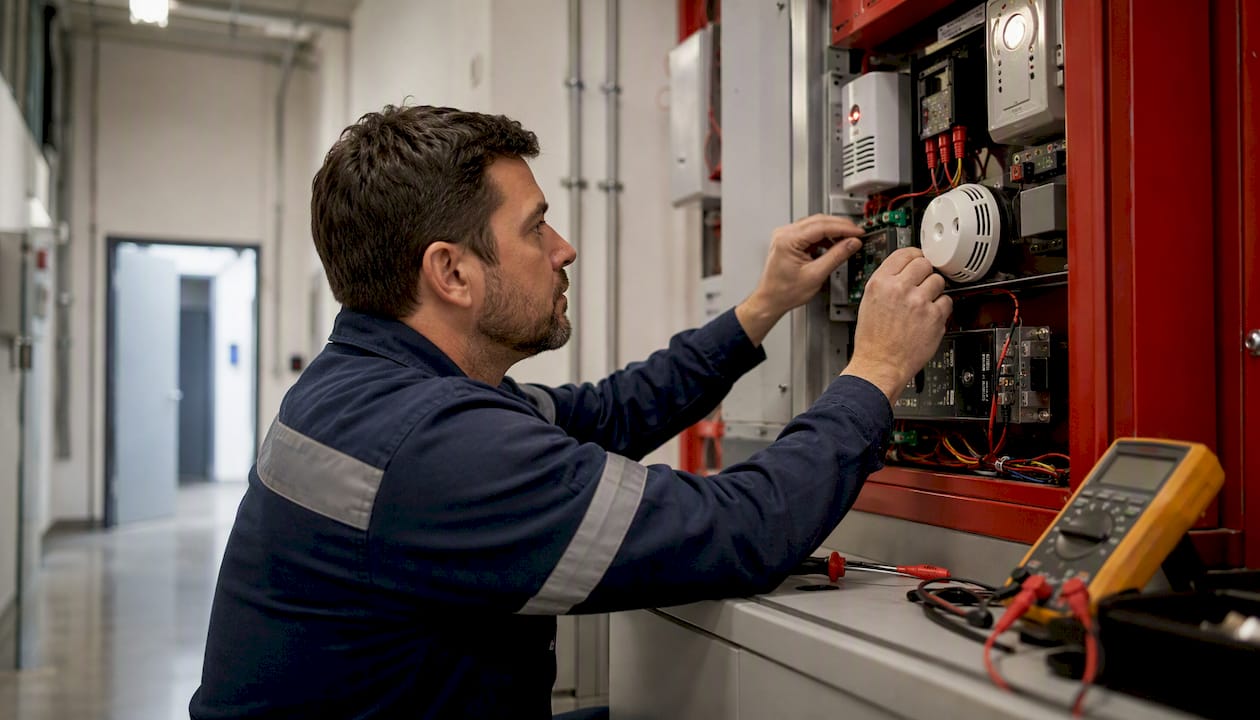
Fire safety engineering, known formally in the United States as fire protection engineering, is the application of science and engineering principles to protect people, property, and the environment from the destructive effects of fire. The Society of Fire Protection Engineers (SFPE) defines the discipline as encompassing hazard analysis, mitigation design, active and passive fire protection systems, and post-fire investigation. The National Fire Protection Association (NFPA) and SFPE together set the professional standards and career frameworks that practitioners follow across the United States.
Practitioners in this field typically conduct fire risk assessments, design suppression and detection systems, develop performance-based egress strategies, and review building plans for code compliance. The career suits individuals with strong foundations in mathematics and physical sciences, those who approach complex problems analytically, and professionals committed to continuous technical learning as new hazards and materials reshape the built environment.
This article covers accredited degree programs, the FE/EIT-to-PE licensure pathway, core tools and methods, U.S. salary context, emerging technical challenges, and practical steps to build a competitive portfolio before graduation.
Key Takeaways
Fire protection engineering is a technically demanding, high-demand discipline where accredited education, structured licensure, and continuous skill development in emerging hazards determine long-term career trajectory.
| Point | Details |
|---|---|
| Start with an accredited program | Choose an ABET-accredited B.S. in fire protection engineering or FPSET to qualify for the FE/PE licensure pathway. |
| Follow the FE-to-PE roadmap | Pass the FE exam after graduation, accumulate supervised experience, then sit the NCEES PE Fire Protection examination. |
| Build a modeling portfolio early | Document FDS or CFAST simulations with validation data; consulting firms evaluate this as direct evidence of technical competence. |
| Prioritize emerging specializations | Mass timber, lithium-ion battery systems, and wildland-urban interface fire engineering are the highest-demand growth areas. |
| Engage Com for project compliance | Com provides fire safety engineering consultancy for statutory submissions, system design review, and authority approvals. |
Table of Contents
- What fire safety engineers actually do on the job
- Which sectors and employers hire fire protection engineers?
- How to choose the right degree program
- How to become a fire protection engineer: the step-by-step pathway
- Core skills, tools, and methods practitioners use
- What the U.S. career outlook and salary data show
- Professional organizations and standards every practitioner should know
- Emerging technical challenges reshaping the field
- How to gain practical experience while still in school
- A consultancy’s perspective on what firms actually look for
- Com’s fire safety engineering consultancy services
- Sources
What fire safety engineers actually do on the job
The role of fire safety engineers spans analysis, design, review, and investigation. Day-to-day responsibilities vary by employer type, but the core technical functions remain consistent across sectors.
Common responsibilities include:
- Conducting fire risk analysis and hazard identification for new and existing buildings
- Designing egress systems, including exit widths, travel distances, and refuge areas
- Specifying and reviewing active fire protection systems such as sprinklers, detection, and suppression
- Designing passive systems including compartmentation, fire-rated assemblies, and structural steel fire protection
- Developing performance-based design alternatives to prescriptive code requirements
- Reviewing architectural and structural drawings for fire code compliance
- Conducting post-fire investigations to determine origin, cause, and contributing factors
- Preparing technical reports, engineering judgement memos, and authority submissions
A typical fire safety engineer in a consulting firm begins the day reviewing a set of architectural drawings for a high-rise residential project, identifying egress deficiencies, and drafting a performance-based design memo to justify a proposed alternative exit arrangement. The afternoon may involve a site visit to inspect passive fire protection installations, followed by a client call to explain code requirements and document engineering decisions.
The role differs meaningfully by employer. Consulting engineers handle design, review, and client communication across diverse project types. Authority inspectors and plan reviewers focus on code enforcement and statutory submissions. System manufacturers employ engineers in product testing, listing, and technical sales support. Insurance and risk-control engineers assess fire risk exposure for underwriting decisions. Research and academic engineers advance fire science through experimental testing and computational modeling.

Which sectors and employers hire fire protection engineers?
Demand for fire protection engineers exists across a wider range of sectors than most prospective students anticipate. Each sector carries distinct expectations for technical depth, communication style, and project type.
- Consulting firms: Design, code review, and performance-based engineering for commercial, residential, industrial, and infrastructure projects; client communication and deliverable quality are primary expectations.
- Authorities having jurisdiction (AHJs) and government agencies: Plan review, code enforcement, inspection, and policy development; engineers must interpret and apply model codes such as NFPA 101 and IBC consistently.
- Fire protection system manufacturers: Product development, testing, listing support, and technical documentation; engineers work closely with UL and FM Global listing processes.
- Insurance and risk-control organizations: Fire risk assessment, loss-control surveys, and underwriting support; FM Global and similar carriers employ engineers to evaluate property risk.
- Research institutions and universities: Experimental fire testing, computational modeling, and publication; graduate degrees are typically required.
- Construction developers and owner-operators: In-house compliance oversight, project coordination, and authority liaison for large development portfolios.
- Fire investigation units: Origin and cause determination for insurance claims, litigation support, and code-compliance reviews following incidents.
Geographic demand in the United States concentrates in several distinct market segments. High-rise urban centers such as New York, Chicago, Los Angeles, and Houston generate sustained consulting and authority-review work. Wildfire-prone regions across California, Colorado, and the Pacific Northwest are driving demand for engineers with wildland-urban interface expertise. Renewable energy infrastructure, EV charging installations, and battery storage facilities represent a rapidly growing project category in nearly every U.S. metropolitan area. For a detailed look at how EV charging fire safety requirements are shaping structural and fire engineering practice, the intersection of battery technology and building design is particularly instructive.
How to choose the right degree program
The standard entry route into fire protection engineering in the United States is a Bachelor of Science in fire protection engineering or a related engineering discipline, supplemented by graduate study or a specialized undergraduate program such as a Fire Protection and Safety Engineering Technology (FPSET) degree.
Must-have coursework and laboratory experience for a competitive graduate includes:
- Fire dynamics and combustion fundamentals
- Material behavior in fire, including steel, concrete, timber, and composites
- Structural response to fire loading
- Egress design and human behavior in fire
- Fire modeling and computational methods
- Experimental fire testing and laboratory instrumentation
- Active and passive fire protection system design
- Smoke control and management systems
Oklahoma State University’s FPSET program illustrates how an undergraduate curriculum maps directly to career-ready technical skills, preparing graduates to assess and reduce fire loss potential across building types and occupancies. The program is available in online and on-site formats, making it accessible to working professionals and career changers. The University of Edinburgh’s fire safety engineering program similarly emphasizes hands-on laboratory work in fire behavior, material response, structural response, experimental fire testing, and computer fire modeling, demonstrating that strong programs combine theory with applied experimentation. Graduate programs, such as those offered through Maryland Applied Graduate Engineering, provide targeted fire protection coursework and applied research opportunities for engineers seeking advanced specialization or research careers.
ABET accreditation is the critical quality signal for undergraduate programs. An ABET-accredited program satisfies the educational requirements for the Fundamentals of Engineering (FE) examination and, subsequently, the Professional Engineer (PE) licensure pathway. Graduates of non-accredited programs may face additional scrutiny from state licensing boards when applying to sit the PE exam.
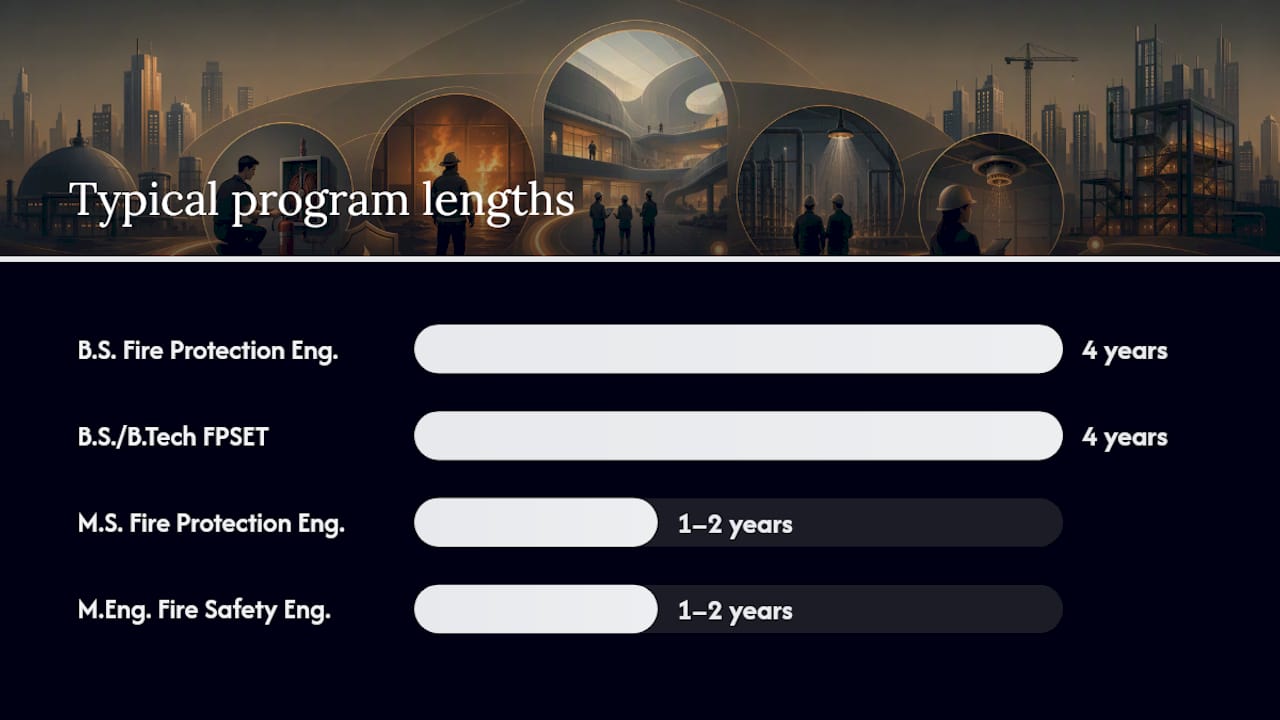
| Degree type | Typical length | Common accreditation | Career-ready skills delivered |
|---|---|---|---|
| B.S. Fire Protection Engineering | 4 years | ABET EAC | System design, code application, performance-based analysis |
| B.S./B.Tech FPSET | 4 years | ABET TAC | Applied system design, inspection, loss-control assessment |
| M.S. Fire Protection Engineering | 1–2 years | Program-dependent | Advanced modeling, research, specialized design |
| M.Eng. Fire Safety Engineering | 1–2 years | Program-dependent | Applied graduate specialization, consulting-ready skills |
How to become a fire protection engineer: the step-by-step pathway
The typical U.S. pathway is: accredited degree → FE/EIT examination → supervised engineering experience → PE licensure; supplement with specialized certifications and active SFPE and NFPA involvement throughout.
- Select an ABET-accredited program. Prioritize programs with fire protection engineering or FPSET curricula, laboratory facilities, and faculty with active industry connections.
- Complete relevant internships during undergraduate study. Target consulting firms, AHJs, and system manufacturers; internship experience is the single most effective differentiator at the entry level.
- Pass the Fundamentals of Engineering (FE) examination. The FE is administered by NCEES and is available in multiple engineering disciplines; most fire protection engineering candidates sit the FE Civil or FE Other Disciplines exam.
- Accumulate supervised professional experience. Most states require four years of progressive engineering experience under a licensed PE before PE examination eligibility.
- Pass the PE Fire Protection examination. NCEES administers the PE Fire Protection exam, which covers fire dynamics, suppression systems, detection and alarm, egress, and passive protection; this is the primary licensure credential for the discipline in the United States.
- Pursue the Certified Fire Protection Specialist (CFPS) credential. Offered by NFPA, the CFPS validates broad technical knowledge across fire protection and is recognized by employers in consulting, insurance, and authority roles.
- Engage with SFPE and NFPA. Membership provides access to technical publications, continuing education, networking events, and mentorship programs that accelerate career development.
Portfolio-building tips for early-career engineers include documenting fire modeling projects with validation data, writing concise technical notes on code interpretation challenges, and compiling plan-review comments with engineering rationale. A GitHub repository containing documented FDS or CFAST simulation files with input assumptions and output analysis demonstrates computational competence to prospective employers.
Important licensure caveat: State licensing boards vary in how they classify fire protection engineering as a recognized PE discipline. Some states offer a dedicated fire protection PE; others require candidates to sit a civil or mechanical PE exam and demonstrate fire protection specialization through experience. Prospective candidates should verify current requirements directly with their state’s engineering licensing board before selecting an examination pathway.
Core skills, tools, and methods practitioners use
Fire protection engineering practice draws on six core skill clusters: fire science and combustion, structural behavior under fire loading, active and passive systems design, human behavior and egress analysis, computational modeling and data analysis, and technical communication and report writing.
Skills by level:
- Introductory: Fire dynamics fundamentals, prescriptive code application (NFPA 13, NFPA 72, NFPA 101, IBC), basic egress calculations, sprinkler system hydraulics
- Intermediate: Performance-based design methodology, smoke control analysis, structural fire resistance assessment, fire risk assessment frameworks, FDS and CFAST modeling
- Advanced: CFD fire modeling with validation, pyrolysis and combustion parameter development, probabilistic risk assessment, mass timber and novel material behavior, machine-learning-assisted data analysis
The primary computational tools in practice include:
- FDS (Fire Dynamics Simulator): NIST-developed CFD tool for smoke and fire behavior modeling; the industry standard for performance-based design submissions
- CFAST: Zone-model tool for compartment fire analysis; faster to run than CFD and appropriate for many prescriptive-alternative calculations
- Pathfinder and similar egress modeling packages: Simulate occupant movement and evacuation timing for complex buildings
- Pyrosim: A graphical interface for FDS that reduces model setup time for practicing engineers
- BIM integration: BIM workflows increasingly support fire protection coordination, clash detection, and documentation in large projects
Pro Tip: When proposing a performance-based solution, present validated modeling results alongside targeted physical testing data and a clearly documented engineering judgement rationale. Building officials and peer reviewers accept or reject alternative designs based on the defensibility of that rationale, not the sophistication of the model alone — a point the Australian fire engineering guidelines make explicit in their process-based framework.
What the U.S. career outlook and salary data show
Demand for fire protection engineers is steady to growing, with the strongest near-term growth in regions facing wildfire risk and in sectors deploying new materials or battery-based energy systems. O*NET’s occupation summary for Fire-Prevention and Protection Engineers carries a “Bright Outlook” designation in its current update, indicating positive near-term demand relative to the broader labor market.
Salary ranges vary substantially by experience, credentials, geographic market, and employer type. NFPA’s career overview confirms that U.S. fire protection engineers earn average yearly salaries that differ considerably based on these factors. General ranges reported across industry sources:
- Entry-level (0–3 years, EIT or early PE): Approximately $60,000–$80,000 annually, varying by region and employer type
- Mid-career (4–10 years, PE licensed, CFPS): Approximately $85,000–$115,000 annually
- Senior/specialist (10+ years, niche expertise, management): Approximately $120,000 and above, with significant variation by market
Credentials, niche expertise, and geographic market are the primary levers on earning potential. Engineers with PE licensure, CFPS certification, and demonstrated competence in high-demand specializations such as mass timber fire design, battery energy storage system (BESS) fire mitigation, or wildland-urban interface risk assessment command premiums in consulting and insurance markets.
Professional organizations and standards every practitioner should know
SFPE, NFPA, ABET, and the model building codes collectively define the professional and regulatory framework for fire protection engineering practice in the United States.
- SFPE (Society of Fire Protection Engineers): The primary professional body for fire protection engineers globally; publishes the SFPE Handbook of Fire Protection Engineering, offers continuing education, and provides the professional community through chapters and technical committees. Membership delivers access to peer-reviewed journals, exam preparation resources, and mentorship networks.
- NFPA (National Fire Protection Association): Publishes the model codes and standards that govern fire protection practice, including NFPA 1 (Fire Code), NFPA 13 (Sprinkler Systems), NFPA 72 (Fire Alarm), and NFPA 101 (Life Safety Code). NFPA also administers the CFPS certification and provides career development resources.
- ABET: Accredits undergraduate engineering and engineering technology programs; ABET accreditation is the recognized quality benchmark for fire protection engineering and FPSET programs and is a prerequisite for FE/PE examination eligibility in most states.
- Model building codes (IBC, IFC): The International Building Code and International Fire Code, published by the International Code Council (ICC), are adopted with amendments by most U.S. jurisdictions and form the prescriptive baseline against which performance-based alternatives are measured.
- NCEES: Administers the FE and PE examinations; the PE Fire Protection exam is the primary licensure credential for the discipline. The fire safety certificate and statutory submission process illustrates how licensure connects to formal authority approvals in practice.
Emerging technical challenges reshaping the field
SFPE identifies that new hazards, including lithium-ion battery fires, mass timber construction, and wildland-urban interface fires, are driving demand for specialists and for engineers capable of developing performance-based solutions where prescriptive codes have not yet caught up with material and technology advances. Advances in CFD, fire modeling, materials science, and digital tools are simultaneously reshaping how engineers analyze and document these problems.
Major hazards and practice shifts currently affecting the field:
- Lithium-ion battery fires: Thermal runaway in EV batteries and battery energy storage systems presents suppression and ventilation challenges that existing sprinkler standards do not fully address; active research and interim guidance are evolving rapidly.
- Mass timber and CLT construction: Cross-laminated timber and other engineered wood products introduce charring behavior, self-extinction uncertainty, and structural fire resistance questions that require performance-based analysis beyond standard prescriptive tables.
- Wildland-urban interface (WUI) fires: Ember transport, exterior ignition pathways, and community-scale fire spread require engineers to work at scales and with probabilistic methods not typical in conventional building fire engineering.
- Façade systems and cladding fires: High-rise façade fires have demonstrated that prescriptive cladding requirements in some jurisdictions are insufficient; fire spread modeling and material testing are increasingly required for complex façade assemblies.
- EV charging infrastructure: Structural and fire safety requirements for EV charging installations in parking structures are an active regulatory development area in 2026.
- Computational and data-driven methods: Machine learning applications in fire detection, CFD model calibration, and risk assessment are entering practice; engineers who can evaluate and apply these tools critically will be well positioned.
- Rooftop solar and PV systems: Fire risk mitigation for photovoltaic installations involves isolation switch requirements, clearance standards, and suppression access that intersect fire and electrical engineering.
Students preparing for these challenges should prioritize elective coursework in combustion chemistry, structural fire engineering, and probabilistic risk assessment, and seek laboratory or research assistant roles involving experimental fire testing or CFD model validation.
How to gain practical experience while still in school
Practical experience before graduation is the most reliable predictor of early-career employability in fire protection engineering. Prioritize hands-on laboratory work, internship roles, and demonstrable modeling projects from the first year of study.
Actionable steps for enrolled students:
- Apply for internships at consulting firms, AHJs, and system manufacturers by the end of the sophomore year; competition for fire protection-specific internships is lower than for civil or mechanical roles, making early applications more effective.
- Join the SFPE student chapter at your institution or the nearest regional chapter; student membership provides access to webinars, mentorship programs, and the annual conference at reduced rates.
- Seek research assistant positions in fire testing laboratories; even one semester of experimental work produces portfolio-ready data and demonstrates laboratory competence.
- Publish technical notes or model documentation on GitHub or ResearchGate; a documented FDS simulation with clearly stated assumptions, boundary conditions, and output analysis is a concrete deliverable that hiring managers can evaluate.
- Complete NFPA online training courses in NFPA 13, NFPA 72, and NFPA 101 to build code literacy before entering the workforce.
Portfolio entries that employers in consulting and authority roles consistently value include laboratory fire test reports with data analysis, CFD simulations with validation against published experimental data, performance-based design memos with engineering judgement rationale, and annotated plan-review comments demonstrating code interpretation skills. University programs that combine experimental fire testing, computer fire modeling, and multidisciplinary projects produce graduates who are immediately productive in consulting and authority environments.
A consultancy’s perspective on what firms actually look for
Consulting firms hiring early-career fire protection engineers consistently prioritize three attributes above all others: technical fundamentals, communication clarity, and deliverable quality. A candidate who can produce a well-structured, defensible engineering memo on the first attempt is more valuable than one with impressive credentials but unclear written output.
From a consultancy hiring standpoint, the checklist looks like this: an accredited degree, demonstrated FE passage or active candidacy, at least one substantive internship with a fire protection-specific deliverable, and evidence of self-directed learning in a current technical area such as battery fire mitigation or mass timber design. Onboarding expectations at most mid-size consulting firms assume that new hires can apply prescriptive codes independently within three months and begin contributing to performance-based projects within twelve months.
The single most consistent differentiator among otherwise comparable candidates is the ability to write concisely and technically. Engineers who arrive with validated model experience, BIM coordination exposure, and a portfolio of concise technical writing require substantially less onboarding investment. Firms engaged in integrated engineering and compliance services place particular value on candidates who understand how fire safety intersects with structural, façade, and mechanical engineering disciplines.
Com’s fire safety engineering consultancy services
For property developers, construction firms, and building owners who need expert fire safety engineering support, Com offers a direct path to statutory compliance and project approval. Rather than navigating fire code requirements, authority submissions, and performance-based design documentation independently, clients engage Com for end-to-end consultancy: fire risk assessment, system design review, passive and active protection specifications, and authority liaison across the full project lifecycle.

Com’s consultancy model is structured around project-based engagements, meaning clients receive focused technical expertise for the specific submission, inspection, or design challenge at hand, without the overhead of a retained generalist firm. The firm’s experience spans structural, façade, M&E, and fire safety disciplines, which is particularly relevant for complex projects where fire engineering decisions interact with structural fire resistance and façade system performance. To discuss a project or understand how Com’s fire safety engineering services apply to your specific compliance requirements, contact the team directly or visit the Aman Engineering Consultancy firm overview.
Sources
SFPE, NFPA, ABET, and O*NET are the four primary references for program selection, career statistics, credentialing requirements, and professional standards in U.S. fire protection engineering practice.
- What Is FPE? – SFPE
- NFPA – Fire protection engineer (career growth overview)
- 17-2111.02 – Fire-Prevention and Protection Engineers
- Fire Protection and Safety Engineering Technology
- NCC 2025 Australian fire engineering guidelines