
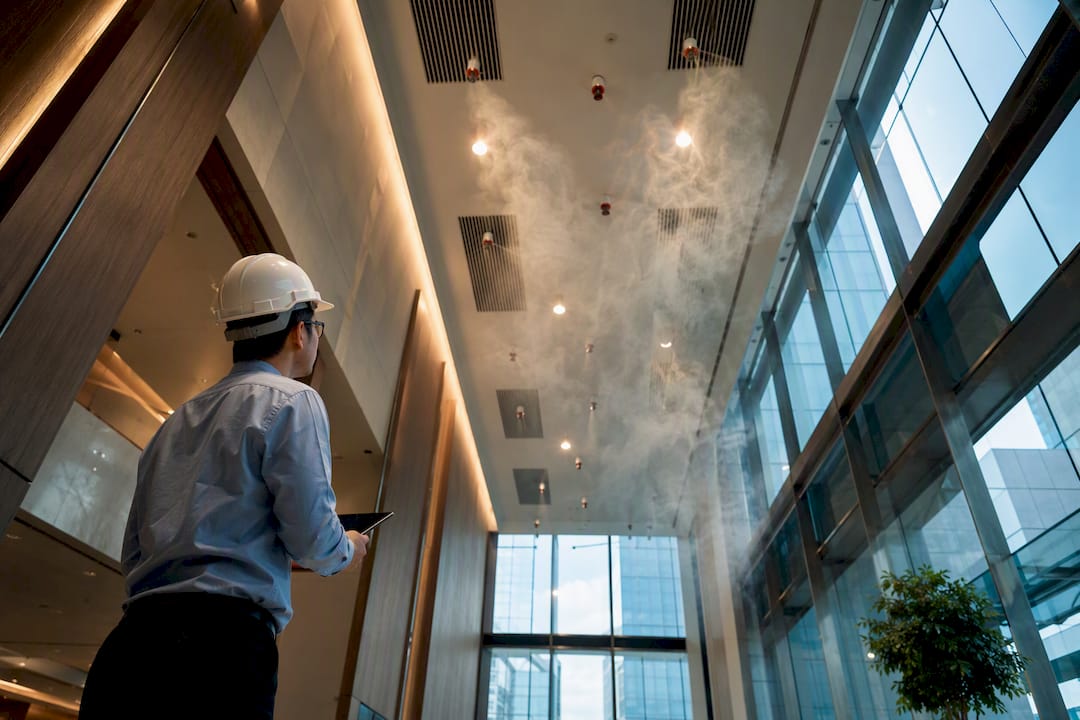
The fire engineering approach, more formally the performance-based (PB) approach, lets project teams satisfy Fire Code intentions through engineering analysis rather than fixed prescriptive clauses. Under the Singapore Fire Engineering Guidelines.pdf), that route runs through four deliverables: a Fire Safety Engineering Design Brief for in-principle agreement, a Fire Safety Engineering Report, then an Operations and Maintenance Manual. It is a recognized alternative to prescriptive compliance, reserved for cases where prescriptive rules genuinely cannot serve the design.
TL;DR:
- The performance-based approach relies on detailed engineering analysis, such as CFD and evacuation modelling, to demonstrate fire safety tailored to a specific building.
- It is most suitable for heritage projects, complex spaces, retrofits, or cases where prescriptive rules are impractical or overly conservative.
- Proper SCDF submission involves sequential deliverables: a design brief, in-principle agreement, detailed report, and maintenance manual, with early peer review helping prevent delays.
- Failures often stem from vague objectives, weak sensitivity analysis, or late peer review engagement, making early planning and clear documentation essential.
- Coordinated consultancy services can streamline multi-disciplinary documentation, improving approval speed and reducing the risk of stalls or overlooked cross-references.
Table of Contents
- What Is the Fire Engineering Approach in Practice?
- When Should You Choose Performance-Based Over Prescriptive Design?
- How Does the SCDF Submission Workflow Actually Work?
- What Technical Methods Do PB Designs Rely On?
- What Causes PB Submissions to Get Rejected or Delayed?
- Getting Started: What Developers and QPs Should Do First
- How Aman Engineering Consultancy Supports Your PB Submission
- Where to Verify These Requirements Yourself
- Sources
- FAQ
What Is the Fire Engineering Approach in Practice?
Performance-based fire safety design is engineering analysis grounded in scientific principles, applied to the specific conditions of a building rather than a generic checklist. Where the Fire Code sets fixed dimensions and clearances, a PB submission asks a different question: does this particular design, with its particular geometry and occupant load, deliver an equivalent or better safety outcome?
That question gets answered through two broad categories of analysis. Deterministic analyses model a defined fire scenario and trace its consequences step by step. Probabilistic analyses weigh a range of scenarios and their likelihoods, useful when a single “worst case” design fire would be either unrealistic or overly conservative. Both draw on qualitative judgment (which scenarios matter) and quantitative calculation (what actually happens in those scenarios).
The technical toolkit a fire safety engineer (FSE) reaches for typically includes:
- CFD modelling for fire and smoke behavior, simulating heat release, smoke layer development, and visibility over time
- Evacuation and egress modelling, using platforms such as Pathfinder, to estimate how long occupants take to reach safety
- Design fire selection, choosing representative growth curves and heat release rates for the space in question
- Suppression interaction analysis, checking how sprinklers or other systems alter fire growth and smoke conditions
The SIT course description for fire engineering science confirms CFD’s role as the standard method for simulating fire development, smoke spread, and evacuation whenever prescriptive rules fall short of the design intent.
When Should You Choose Performance-Based Over Prescriptive Design?
The PB route earns its complexity in several common situations. Choosing it without a genuine driver just adds review time for no benefit.
- Heritage and conservation projects, where existing fabric cannot accommodate prescriptive travel distances or compartmentation without destroying the character being preserved.
- Atypical atria, voids, or façade systems, where smoke behavior does not follow the assumptions baked into standard clauses.
- Retrofit and refurbishment constraints, where structural or spatial limits make prescriptive compliance physically impossible without major demolition.
- Mezzanine levels or special-use areas, such as industrial mezzanines or unusual occupancy mixes, where standard clauses were never written with that layout in mind.
- Cases where prescriptive compliance is achievable but wasteful, and value engineering through PB analysis can preserve design intent while cutting unnecessary cost.
Each of these buys flexibility at a price: heavier modelling, more documentation, and a longer review cycle than a straightforward prescriptive submission. SCDF’s own guidance frames PB as an alternative means of meeting Fire Code objectives, not a shortcut around them. SCDF expects a justification for departing from prescriptive rules, never a substitution chosen for convenience.
How Does the SCDF Submission Workflow Actually Work?
The submission sequence follows a fixed order, and skipping a step is a very common cause of delay.
- Fire Safety Engineering Design Brief (FEDB): states the project’s fire safety objectives, the scenarios selected for analysis, the performance criteria being targeted, and the methods proposed to test them.
- In-principle agreement (IPA): SCDF’s sign-off on the FEDB’s scope and logic before detailed modelling begins, confirming the approach is admissible before the FSE invests in full analysis.
- Fire Safety Engineering Report (FER/FSER): the full modelling package, including CFD and evacuation results, sensitivity studies, and demonstration that the proposed design meets the agreed performance criteria.
- Operations and Maintenance (O&M) Manual: documents how life safety systems tied to the PB design must be maintained, tested, and operated after handover.
A Peer Reviewer is required for certain complex or higher-risk PB designs, and that review sits between the FER draft and final SCDF acceptance, so building it into the program early avoids a late-stage bottleneck.
Pro Tip: Treat the FEDB as a justification document, not a checklist. State the objectives, the scenarios you rejected and why, and the validation steps you intend to run. Reviewers approve logic, not paperwork volume.
What Technical Methods Do PB Designs Rely On?
CFD modelling recreates fire and smoke behavior in three dimensions, and its outputs are only as good as its inputs. Reviewers expect clearly stated geometry, a justified fire growth curve, realistic ventilation conditions, and an honest accounting of when suppression systems activate and how that changes the smoke picture.
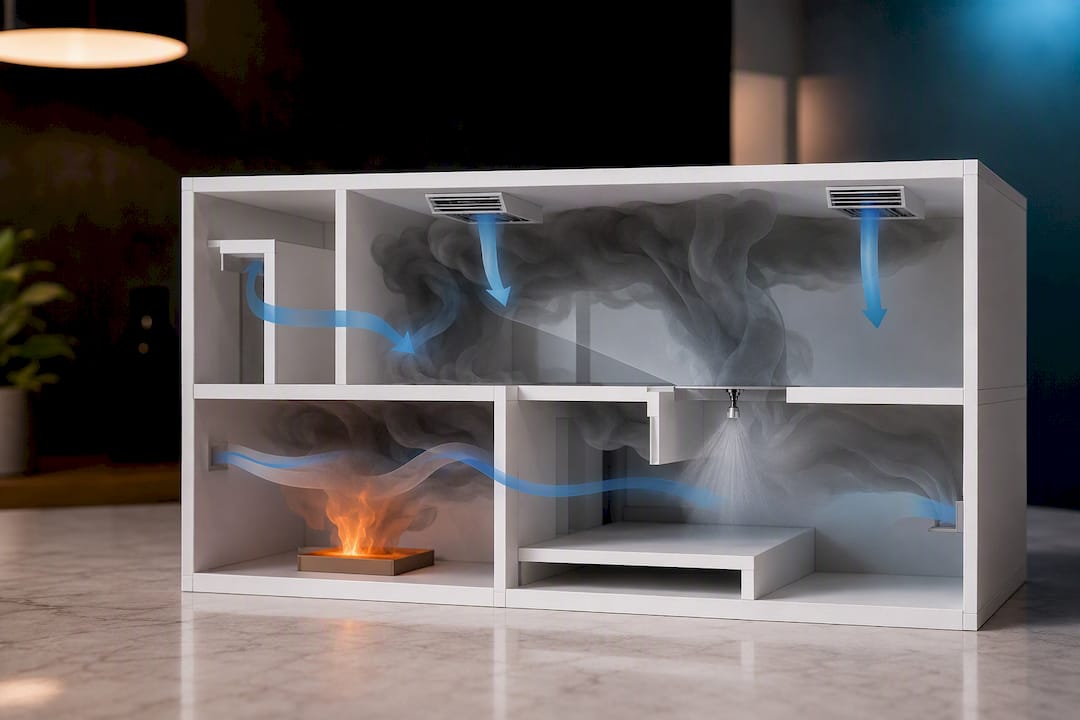
Evacuation modelling works alongside CFD to answer a different question: can occupants get out before conditions become untenable? Inputs include occupant density profiles, walking speeds, and whether the design assumes staged evacuation (floor by floor, as in many high-rises) or simultaneous evacuation of the whole building. The acceptance criterion is typically a margin ensuring occupants can safely evacuate in time, and that margin has to survive scrutiny, not just clear it narrowly.
Design fire selection separates pre-flashover fires (smaller, developing) from post-flashover fires (fully involved, structurally significant), and a competent FER usually tests both alongside suppression-modified scenarios.
None of this counts for much without sensitivity analysis. The SFEG requires FSEs to test how robust their conclusions are against reasonable variation in key assumptions, and the IStructE guide to advanced fire safety engineering reinforces verification and validation as non-negotiable stages of any modelling exercise, not an optional add-on.
- Vary the fire growth rate and check whether conclusions hold
- Test ventilation assumptions against realistic worst-case configurations
- Confirm the model itself has been validated against known benchmark cases before trusting its output
A design that passes only under one narrow set of assumptions has not really demonstrated equivalent safety. Reviewers know this, and it is the single fastest way to trigger a request for more work.
What Causes PB Submissions to Get Rejected or Delayed?
Most rework traces back to a small set of recurring mistakes, and nearly all of them are avoidable with earlier planning.
- A vague FEDB scope that lists analyses without stating the objectives or performance criteria they are meant to prove
- Missing or thin sensitivity studies, leaving reviewers unable to judge how robust the design actually is
- Unjustified CFD or egress modelling assumptions, especially fire growth curves or occupant density figures pulled without site-specific reasoning
- Engaging a Peer Reviewer too late, after the FER is largely finished, when review comments should have shaped earlier decisions
Practitioner experience suggests peer review works best as a quality-assurance step woven into the process from the FEDB stage, not a final hurdle bolted on before submission.
The obligations do not end at approval. Operations and Maintenance manuals are routinely audited, and a building that fails to maintain the systems its PB design depended on can put its Fire Safety Certificate at risk, regardless of how sound the original engineering was.
Pro Tip: Write the O&M manual as if the facility manager has never seen the FER. Specify testing frequency, responsible parties, and what “compliant operation” looks like in concrete terms, not cross-references to the modelling report.
Getting Started: What Developers and QPs Should Do First
Scope the FEDB early, before design freezes options you will later need to justify. Appoint the fire safety engineer and Peer Reviewer during the planning stage, not after drawings are locked. Document O&M responsibilities from day one so maintenance obligations are clear before handover, not negotiated afterward.
Early engagement with SCDF, framed around the SFEG structure, consistently shortens the path from FEDB to approval. Projects that treat the statutory submission sequence as a single coordinated program, rather than four separate hurdles, tend to move faster through review.
— Aman
How Aman Engineering Consultancy Supports Your PB Submission
Navigating four sequential deliverables across multiple technical disciplines is where most projects lose time, and it is exactly where a coordinated consultancy earns its fee. Consultants typically work across FEDB and FER drafting, coordinate the CFD and evacuation modelling packages, manage Peer Reviewer engagement, and draft O&M manuals that facility teams can actually use, all under a single point of contact instead of scattered across separate specialists.
That single-point coordination matters most on multi-agency projects, where fire safety submissions have to line up with structural, façade, and M&E approvals rather than run on separate tracks. A coordinated consultancy brings multidisciplinary professional engineers together on one programme, which can be the difference between a submission that moves cleanly through SCDF and one that stalls on a missed cross-reference. If your project is weighing the PB route against prescriptive compliance, Aman’s authority approvals team can scope your FEDB and map the submission timeline before you commit design resources to modelling that may not be necessary. Start with a scoped proposal to see exactly what your project needs.
Where to Verify These Requirements Yourself
For primary confirmation, consult SCDF’s SFEG, the Fire Code plans submission page, and SCDF’s circular on fire engineering assessments for waivers. The IStructE advanced fire safety guide remains a useful technical reference for modelling verification standards.
Sources
- SIT course description: FDM6100 Fire Engineering Science
- Guide to the advanced fire safety engineering of structures (IStructE)
FAQ
What Is the Difference Between PB and Prescriptive Fire Design?
Prescriptive design follows fixed Fire Code clauses on distances, ratings, and dimensions. The fire engineering approach instead uses modelling and analysis to demonstrate equivalent or better safety for a specific building’s conditions.
When Is a Peer Reviewer Required for a PB Submission?
SCDF requires a Peer Reviewer for certain complex or higher-risk PB designs, and reviewers should be engaged during FEDB development rather than after the FER is drafted.
What Happens if the O&M Manual Is Not Maintained?
Failing to maintain fire safety systems as specified in the O&M manual can jeopardize the building’s Fire Safety Certificate, regardless of how the original design performed during approval.
Can Aman Engineering Consultancy Help With a PB Submission?
Yes. Aman Engineering Consultancy coordinates FEDB and FER drafting, CFD and evacuation modelling, Peer Reviewer engagement, and O&M documentation through its authority approvals services.
Is the PB Approach More Expensive Than Prescriptive Compliance?
PB submissions often require more extensive modelling and documentation efforts upfront, but they can reduce overall project cost when prescriptive compliance would force expensive structural or spatial changes.