
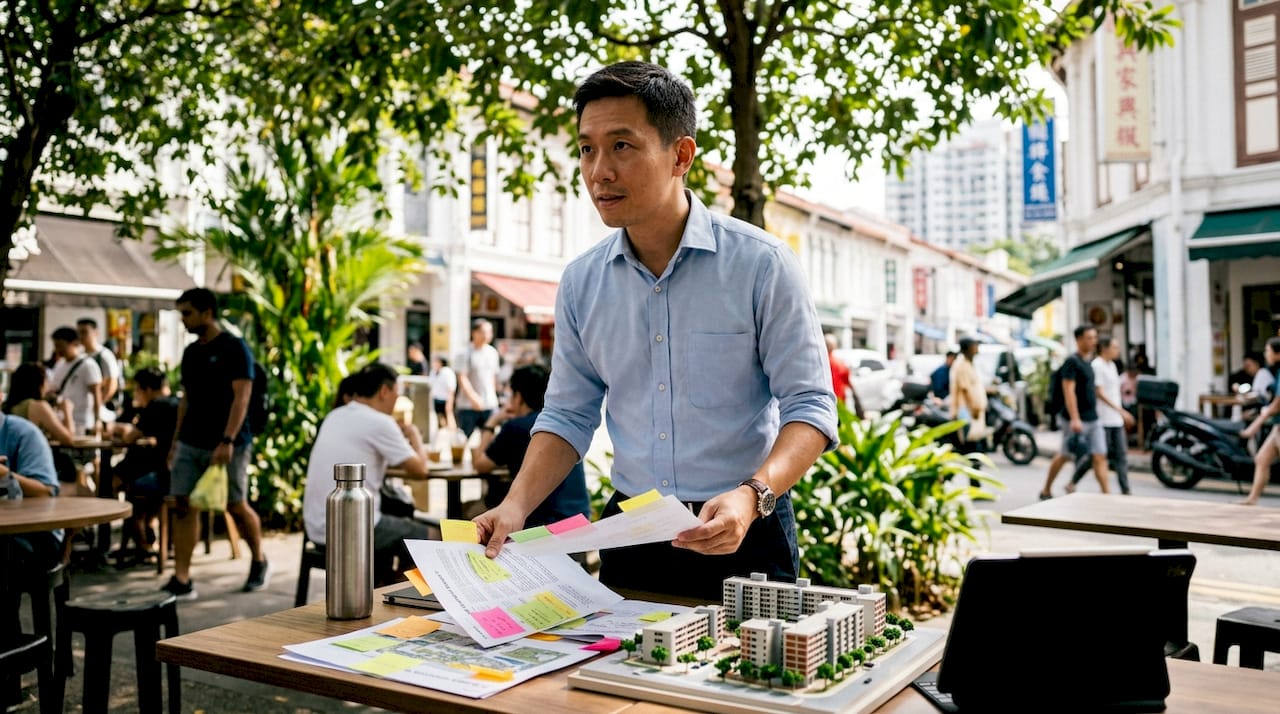
A feasibility study workflow in Singapore’s construction and real estate sector is defined as a structured, multi-stage process that evaluates a project’s technical, financial, market, operational, and regulatory viability before significant capital is committed. The industry term for this process is “project feasibility assessment,” and it encompasses far more than a financial projection. Singapore’s regulatory environment, governed by agencies including the Building and Construction Authority (BCA), Urban Redevelopment Authority (URA), and the Economic Development Board (EDB), makes this workflow especially demanding. Feasibility studies conducted early in the project lifecycle deliver the highest value because findings can still meaningfully redirect plans before costs escalate. This guide walks property developers, investors, and government officials through every stage of the feasibility study workflow Singapore practitioners rely on.
What are the critical stages of a feasibility study workflow in Singapore?
A comprehensive feasibility study includes five core assessment types: market, technical, financial, operational, and legal. Each stage addresses a distinct dimension of project viability, and skipping any one of them creates blind spots that surface as costly problems during construction or approval.
The stages follow a deliberate sequence:
-
Initial project definition and scope setting. Define the project’s purpose, boundaries, and success criteria before any data collection begins. This prevents scope creep and ensures all subsequent assessments measure the right variables.
-
Market feasibility. Analyze demand, target occupancy or absorption rates, and competitive supply. Critically, market sizing alone is insufficient. Behavioral validation through focus groups, interviews, and pilot testing confirms whether identified demand can actually be captured.
-
Technical feasibility. Assess site conditions, soil reports, infrastructure capacity, and architectural constraints. In Singapore, this stage must account for CORENET X submission requirements, BCA structural standards, and any URA planning parameters applicable to the site.
-
Financial feasibility. Produce cost estimates, identify funding sources, and calculate projected ROI. Financial assessment must reflect Singapore’s construction cost benchmarks, prevailing land prices, and financing conditions rather than generic regional figures.
-
Operational feasibility. Evaluate manpower availability, supply chain capacity, and organizational readiness to deliver and manage the completed asset.
-
Legal and regulatory feasibility. Confirm compliance with Singapore statutes, including BCA approvals and environmental impact assessments. This stage also covers JTC, HDB, SCDF, PUB, and LTA requirements where applicable.
-
Decision gate. Apply go/no-go criteria based on aggregated findings. Document the rationale regardless of the outcome.
Pro Tip: Set the go/no-go criteria at the start of the workflow, not after the analysis is complete. Pre-defined thresholds prevent confirmation bias from distorting the final recommendation.
What tools and data sources are essential for a thorough feasibility study?
Accurate feasibility analysis depends on credible, current data. Singapore offers several authoritative sources that developers and officials should use systematically.
Government and regulatory data sources:
- Singapore Department of Statistics: population data, household income distribution, and economic indicators
- Urban Redevelopment Authority: property price indices, development charge tables, and planning parameters
- Economic Development Board: sector investment data and industrial land demand forecasts
- BCA: construction cost indices, Green Mark standards, and structural submission guidelines
- JTC Corporation: industrial land availability and lease conditions
Digital compliance platforms:
CORENET X is Singapore’s centralized online platform for regulatory submissions covering building plan approvals, structural submissions, and M&E clearances. Setting up a CORENET X account is a non-negotiable early step. Digital compliance readiness must be established before mobilization, not during construction phases.
Market research methods:
| Method | Application in Singapore feasibility studies |
|---|---|
| Focus groups | Validate price acceptance and product preferences for residential or commercial units |
| In-depth interviews | Assess operator or tenant demand for specialized asset types |
| Pilot leasing or pre-sales | Test real absorption rates before full commitment |
| Comparable transaction analysis | Benchmark against recent URA caveats and JTC lease data |
Financial modeling tools should incorporate Singapore-specific construction cost benchmarks published by BCA and quantity surveying firms. Generic global cost databases produce unreliable outputs for Singapore projects.
Pro Tip: Cross-reference URA’s Master Plan zoning with JTC’s industrial land maps before finalizing site selection. Zoning mismatches discovered late can void months of technical and financial analysis.
How to execute the feasibility study workflow step by step
A structured execution process prevents gaps and keeps the assessment defensible to stakeholders and regulators. The following six steps reflect standard workflow stages adapted for Singapore’s construction and real estate context.
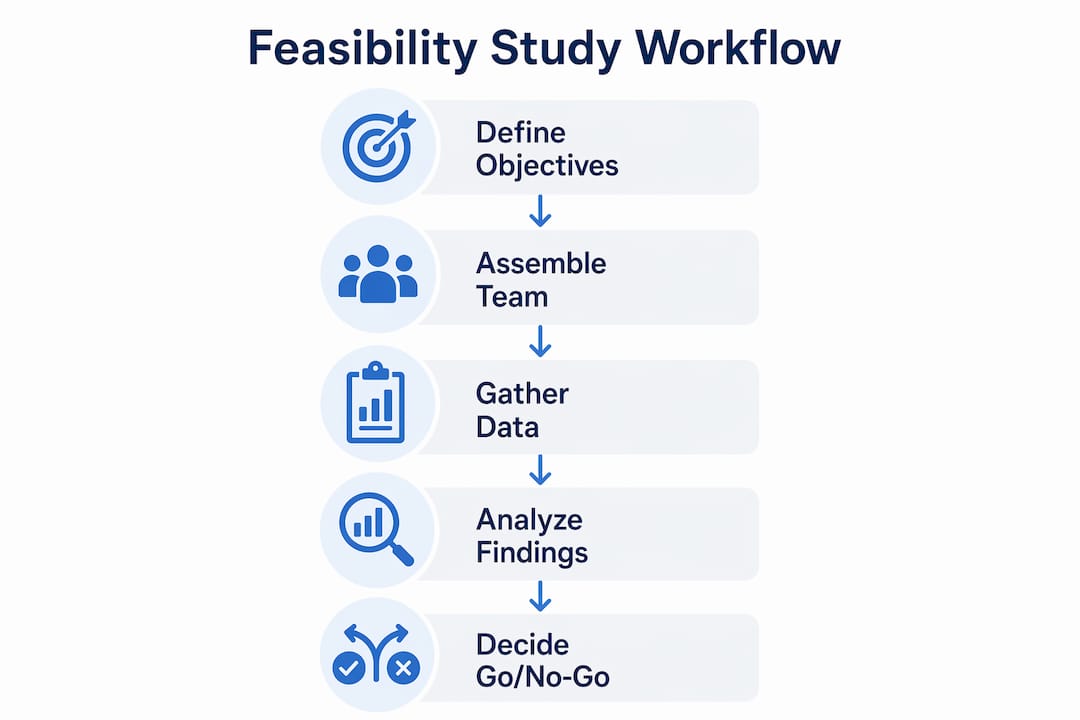
Step 1: Define project objectives and alternatives.
State the intended use, target occupancy or yield, and the minimum acceptable return. Identify at least two alternative development scenarios so the assessment can compare options rather than simply justify a predetermined outcome.
Step 2: Assemble a multidisciplinary assessment team.
A multi-disciplinary team covering finance, structural engineering, architecture, M&E, legal, and market research is the standard for objective analysis. In Singapore, the team should also include a qualified person (QP) familiar with BCA submission requirements and a regulatory specialist who understands URA planning conditions.
Step 3: Gather and validate data.
Collect technical reports, market surveys, financial projections, and regulatory pre-consultation responses. Validate market assumptions with behavioral research. A developer planning a mixed-use project in Jurong, for example, should conduct tenant interviews and pre-leasing tests rather than relying solely on published vacancy statistics.

Step 4: Analyze findings in local context.
Interpret data against Singapore’s current regulatory requirements, construction cost environment, and market absorption rates. A financial model that ignores prevailing development charges or stamp duty implications will produce a misleading ROI figure.
Step 5: Document and present findings.
The feasibility study document must clearly outline findings, recommendations, and any conditions attached to proceeding. Present the report to all decision-making stakeholders, including financiers and relevant government agencies, before the decision gate.
Step 6: Obtain and record the go/no-go decision.
Record the decision, the criteria applied, and the rationale. This documentation protects developers and officials if project conditions change and the decision is later reviewed.
A feasibility study that reaches a “no-go” conclusion is not a failure. It is a cost-effective intervention that prevents a far larger loss. The discipline to act on a negative finding is what separates professional developers from speculative ones.
The Singapore construction compliance checklist provides a practical reference for confirming that all regulatory touchpoints are addressed before the decision gate.
What common pitfalls should Singapore developers and officials avoid?
Feasibility studies fail most often not because of missing data but because of flawed assumptions and process shortcuts. The following pitfalls are consistently observed in Singapore construction and real estate projects.
-
Overreliance on spreadsheet economics. Behavioral checks like focus groups provide validation that theoretical data cannot. A model showing strong demand means nothing if target tenants or buyers reject the product at the tested price point.
-
Late CORENET X readiness. Developers who treat CORENET X account setup as an administrative afterthought routinely face submission delays that push project timelines by weeks or months. Regulatory compliance infrastructure must be in place before the technical assessment phase concludes.
-
Underestimating operational constraints. Singapore’s tight labor market and supply chain lead times affect construction feasibility directly. A project that is financially viable on paper may be operationally undeliverable within the planned timeline.
-
Insufficient stakeholder involvement. Excluding end-users, future operators, or relevant government agencies from the assessment process produces a study that cannot withstand scrutiny. Pre-application consultations with URA and BCA are available and should be used.
-
Misaligned workflow timing. Running financial modeling before technical site investigations are complete forces assumptions that often prove wrong. The workflow stages must proceed in sequence, not in parallel, when dependencies exist.
Pro Tip: Request a pre-application consultation with URA before finalizing the technical feasibility stage. The feedback received can prevent fundamental design changes after submission.
Private sector construction practitioners, including construction services specialists, consistently identify late regulatory engagement as the single most avoidable source of project delay in Singapore.
Key Takeaways
A feasibility study workflow in Singapore requires five integrated assessments, early regulatory compliance, and behavioral market validation to produce a defensible go/no-go decision.
| Point | Details |
|---|---|
| Five-stage assessment structure | Market, technical, financial, operational, and legal assessments must all be completed before a go/no-go decision. |
| Early CORENET X setup | Establish digital compliance infrastructure before the technical assessment phase ends to prevent submission delays. |
| Behavioral market validation | Supplement market sizing with focus groups and pilot testing to confirm real demand, not just theoretical demand. |
| Multidisciplinary team requirement | Include finance, engineering, architecture, legal, and regulatory specialists to produce an objective assessment. |
| Document the decision rationale | Record the go/no-go decision and its basis to protect developers and officials if project conditions change later. |
What I’ve learned about feasibility workflows that most guides don’t say
The most common mistake I see in Singapore feasibility studies is treating regulatory compliance as a downstream concern. Developers invest months in market research and financial modeling, then discover that a URA planning parameter or a BCA structural requirement fundamentally changes the project economics. That sequence is backwards.
The second observation is about behavioral testing. Spreadsheet-based demand analysis is necessary but not sufficient. I have seen projects with compelling market sizing data fail at the pre-sales stage because the product design or pricing did not match what target buyers actually wanted. The fix is simple: test assumptions with real people before the financial model is finalized.
The third point concerns team composition. A feasibility study assembled by a single discipline, typically finance, consistently underestimates technical and operational constraints. The project planning process works best when engineers, architects, and legal specialists contribute to the assessment simultaneously, not sequentially.
Singapore’s regulatory environment is also evolving. CORENET X requirements, BCA Green Mark standards, and URA planning parameters are updated regularly. A feasibility study based on outdated regulatory assumptions can produce a recommendation that is no longer valid by the time the project reaches submission. Build a compliance verification step into the workflow at the decision gate stage, not just at the beginning.
— Aman
How Com supports feasibility study workflows for Singapore developers
Com, Aman Engineering Consultancy, provides end-to-end support for property developers, investors, and government officials navigating Singapore’s project feasibility assessment process. The firm’s expertise covers statutory submissions to BCA, URA, JTC, HDB, SCDF, PUB, and LTA, as well as structural, M&E, facade, and fire safety engineering assessments integral to technical feasibility.
Com’s feasibility study services include financial and technical assessment support calibrated to Singapore’s current regulatory and market conditions. The team’s familiarity with CORENET X submissions and BCA approval processes means compliance risks are identified and addressed at the workflow stage where they cost the least to resolve. Developers and officials seeking a qualified local partner for their next project can contact Com directly through Aman Engineering Consultancy.
FAQ
What is a feasibility study workflow in Singapore?
A feasibility study workflow in Singapore is a structured process that evaluates a construction or real estate project across market, technical, financial, operational, and legal dimensions before investment is committed. It is designed to produce a defensible go/no-go recommendation aligned with Singapore’s regulatory requirements.
How long does a feasibility study take for a Singapore construction project?
The duration varies by project complexity, but most Singapore construction feasibility assessments require several weeks to several months to complete all five assessment stages and obtain pre-application regulatory feedback.
Why is CORENET X relevant to feasibility studies?
CORENET X is Singapore’s centralized regulatory submission platform for building plan and structural approvals. Setting up a CORENET X account early in the feasibility workflow prevents submission delays that can extend project timelines significantly.
What is the difference between market sizing and feasibility testing?
Market sizing estimates the total potential demand for a product or asset type. Feasibility testing validates whether that demand can realistically be captured, given behavioral preferences, price acceptance, and operational constraints specific to the Singapore market.
Which Singapore government agencies are involved in construction feasibility assessments?
BCA, URA, JTC, HDB, SCDF, PUB, and LTA are the primary agencies whose requirements must be assessed during the legal and regulatory feasibility stage of a Singapore construction project.