

An engineering compliance workflow in Singapore is a structured, multi-stage process that integrates digital permit systems, defined safety roles, and coordinated multi-agency submissions to satisfy regulatory requirements across construction projects. For construction professionals operating under frameworks governed by the Building and Construction Authority (BCA), the Ministry of Manpower (MOM), and agencies such as URA, SCDF, and LTA, this workflow is not optional. It is the operational backbone of every project approval cycle. Platforms like Corenet X and electronic permit-to-work (ePTW) systems have redefined how compliance management in Singapore is executed, replacing fragmented paper-based processes with traceable, auditable digital records. This guide details the tools, roles, implementation steps, and troubleshooting strategies construction teams need to operate these workflows effectively in 2026.
What tools and roles are essential for an engineering compliance workflow in Singapore?
An effective engineering compliance workflow in Singapore depends on three foundational components: the right digital platforms, qualified personnel with current registrations, and standardized data formats for submissions. Each element must be in place before a project advances past the design stage.
Electronic permit-to-work systems
Projects above $1 million in public-sector construction require the use of electronic permit-to-work (ePTW) systems as a mandatory compliance tool. This means contractors tendering for qualifying public projects must include ePTW as part of their compliance package from the tender stage, not as an afterthought during site mobilization. The ePTW system ensures no hazardous work starts without digitally approved permits and safety validation, creating a pre-start assurance mechanism that surfaces conflicts before workers are exposed to risk.

Corenet X for multi-agency coordination
Corenet X integrates seven regulatory agencies into a single digital platform, enabling concurrent multi-agency submissions and consolidated approvals. This eliminates the sequential bottleneck of submitting to BCA, URA, SCDF, and PUB separately and waiting for each response before proceeding. For large projects, this coordination capability directly reduces design inconsistencies and approval delays.
WSHO registration and BIM data standards
Workplace Safety and Health Officers (WSHOs) are a required role in any compliant construction workflow. Applying for WSHO registration involves an online process, a $110 fee, documentation uploads, and carries a two-year renewable validity period. Project teams must track these renewal dates within the workflow itself, since a lapsed WSHO registration can invalidate safety approvals and halt site activities. Digital submissions must also use BIM models with the IFC+SG standard, which enables clash detection and integrated agency review across architecture, structural, and MEP disciplines.
| Tool / Role | Function | Regulatory Requirement |
|---|---|---|
| ePTW System | Digital permit approval and conflict detection | Mandatory for public projects above $1M |
| Corenet X | Multi-agency concurrent submission platform | Required for coordinated building approvals |
| WSHO | Onsite safety compliance management | Registration valid for 2 years, renewable |
| BIM IFC+SG | Federated model submission standard | Required for digital plan submissions |
Pro Tip: Register your WSHO and configure your ePTW system before the tender award stage. Agencies review compliance infrastructure readiness as part of pre-qualification for public sector projects above $3 million.
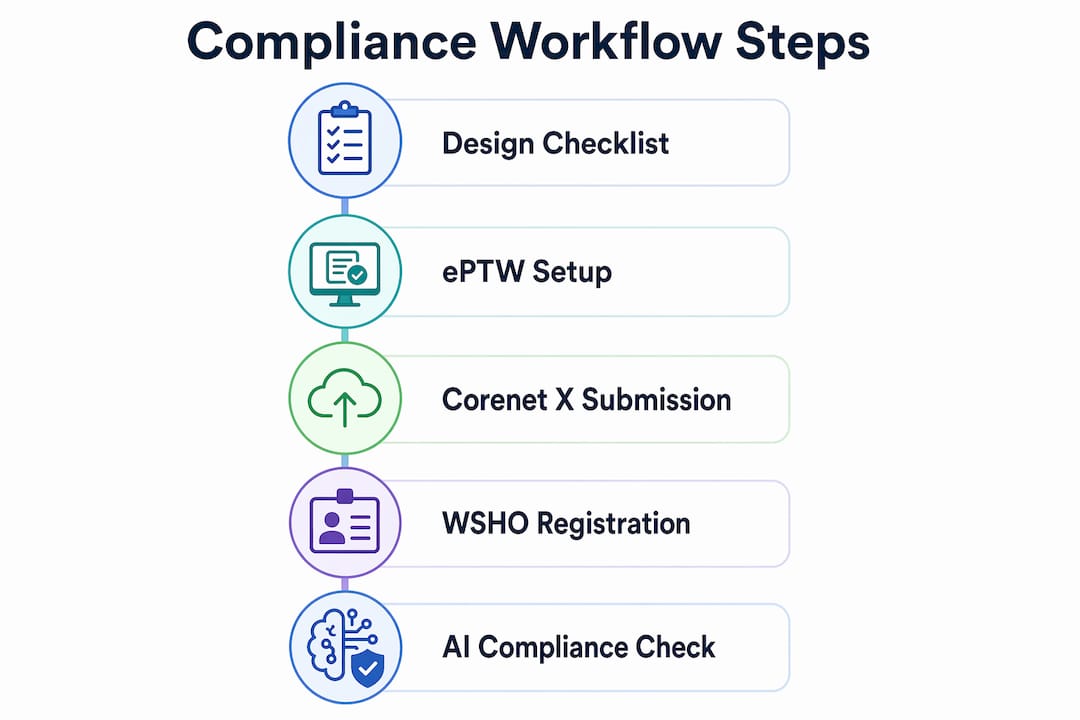
How to design and implement your engineering compliance workflow step by step
Designing a compliance workflow for a Singapore construction project requires sequencing approval gates, assigning accountable roles, and building exception-handling logic before a single permit is issued. The following steps reflect current regulatory requirements and digital platform capabilities.
-
Map all hazardous activities and permit categories. Identify every high-risk task on the project, including confined space entry, hot work, working at height, and lifting operations. Each activity category requires a distinct permit type within the ePTW system, and the workflow must route each permit to the correct approving authority.
-
Configure ePTW conflict detection logic. For public sector tenders at or above $3 million, the ePTW workflow must include digital conflict resolution logic and audit trails as part of the pre-award compliance package. Configure the system to flag overlapping permits for adjacent work zones automatically.
-
Register all competent persons and embed validity tracking. Load WSHO registration details, expiry dates, and renewal schedules into the workflow management system. Role validity lapses can disrupt safety compliance, so automated alerts at 60 and 30 days before expiry are a minimum control.
-
Synchronize submissions through Corenet X. Prepare federated BIM models in IFC+SG format and upload to Corenet X for concurrent agency review. Assign a dedicated submission coordinator responsible for monitoring agency feedback and consolidating responses within defined service level agreements (SLAs).
-
Design exception-handling protocols. Structured submission processes across Singapore’s regulatory environment show that 10 to 20% of submissions may fail validation on first pass. This figure, drawn from the GST InvoiceNow implementation, applies directly to engineering submissions: design a triage process with named owners, correction timelines, and resubmission checkpoints.
-
Assign SLA ownership for each workflow stage. Every stage from permit request to agency approval must have a named owner, a target turnaround time, and an escalation path. Workflows without explicit ownership stall at the first exception.
-
Leverage government grants for technology adoption. MOM and BCA offer grants to offset the cost of WSH technology adoption, including ePTW platforms. Factor these into the project budget during the pre-tender phase to reduce net technology costs.
Pro Tip: Build your compliance workflow checklist before the design development stage. Retrofitting compliance gates into an active project schedule is significantly more disruptive than embedding them at project inception.
What are common compliance challenges and how to troubleshoot them?
Even well-designed workflows encounter operational failures. The most frequent causes of compliance stalls in Singapore construction projects fall into four categories: permit conflicts, role validity lapses, submission rejections, and cross-team communication breakdowns.
-
Permit conflicts from overlapping hazardous activities. When two trades operate in adjacent zones simultaneously, ePTW systems may flag a conflict that blocks both permits. The fix is a pre-activity coordination meeting, documented in the system, where the site supervisor confirms zone separation or sequences the activities. Workflows must include a conflict resolution step with a designated decision-maker, not just an automated flag.
-
WSHO registration lapses. A WSHO whose registration has expired cannot legally fulfill the compliance role, which can invalidate permits already issued under their authority. The workflow must enforce a hard stop on permit issuance when a WSHO’s registration is within 30 days of expiry and has no renewal application on file.
-
Rejected structured submissions. Cross-functional governance and explicit exception-handling are critical for technology-enabled compliance processes to avoid bottlenecks. When a Corenet X submission is rejected, the correction cycle must have a named owner, a 48-hour triage window, and a resubmission SLA. Without this structure, rejected submissions sit unresolved and delay the entire approval chain.
-
Cross-functional communication failures. Structural, M&E, and facade teams often operate on separate submission timelines. A federated BIM model that is not updated after a design change will generate agency comments that reference superseded drawings, creating rework loops. Establish a weekly model coordination meeting with a single version-controlled BIM file as the submission source.
Compliance failures in Singapore construction projects are rarely caused by regulatory complexity alone. They are caused by workflow gaps: missing owners, undefined escalation paths, and role validity tracking that exists only in someone’s email inbox.
Pro Tip: Review your BCA structural submission rejection history before designing your exception-handling protocol. Patterns in past rejections reveal the specific data quality gaps your workflow needs to address.
How do digital innovations enhance construction regulatory compliance in Singapore?
Digital technology is reshaping regulatory compliance processes in Singapore construction at the platform, model, and process levels. The impact is measurable in approval timelines, rework reduction, and audit trail quality.
Corenet X’s platform reduces manual agency submissions by consolidating multi-agency feedback, supporting concurrent reviews, and accelerating project delivery timelines. This means a project that previously required sequential submissions to BCA, URA, and SCDF can now receive consolidated feedback in a single review cycle. The reduction in abortive work from misaligned agency comments alone justifies the platform investment for projects of significant scale.
BIM integration under the IFC+SG standard adds a further layer of compliance assurance. Federated models allow structural, architectural, and MEP disciplines to be reviewed simultaneously, with clash detection identifying coordination errors before they become site defects. For construction professionals managing structural design approvals, this means fewer resubmission cycles and faster clearance from BCA.
AI-assisted compliance checking is an emerging capability within workflow platforms. These tools cross-reference submitted drawings against regulatory parameters automatically, flagging non-compliant elements before human review. While full automation of compliance decisions remains outside current regulatory frameworks, AI-assisted pre-screening reduces the error rate in submissions and shortens the agency review period.
| Technology | Compliance Function | Primary Benefit |
|---|---|---|
| Corenet X | Multi-agency concurrent submission | Reduces sequential approval delays |
| BIM IFC+SG | Federated model clash detection | Minimizes rework from design conflicts |
| ePTW System | Digital permit gating and audit trail | Prevents unauthorized hazardous work |
| AI Pre-screening | Automated regulatory parameter checks | Reduces first-pass submission errors |
The WSH 2028 master plan signals continued government investment in WSH technology adoption, with mature digital safety systems becoming a baseline expectation for public sector contractors. Construction teams that build ePTW and BIM capabilities into their standard operating procedures now will be positioned ahead of mandatory adoption timelines.
Key takeaways
An engineering compliance workflow in Singapore requires ePTW systems, Corenet X submissions, current WSHO registrations, and structured exception-handling protocols to satisfy regulatory requirements and maintain project approval timelines.
| Point | Details |
|---|---|
| ePTW is mandatory above $1M | Public sector projects above $1 million must include ePTW systems from the tender stage. |
| Corenet X consolidates agency reviews | Seven agencies review submissions concurrently, reducing sequential approval delays significantly. |
| WSHO validity must be tracked actively | A lapsed WSHO registration can invalidate permits and halt site operations immediately. |
| Exception handling prevents approval stalls | Up to 20% of submissions fail first-pass validation; named owners and SLAs are required. |
| BIM IFC+SG is the submission standard | Federated BIM models reduce clash-related rework and accelerate coordinated agency approvals. |
Why compliance workflow design is where Singapore projects are won or lost
Having worked across structural, facade, and M&E compliance submissions in Singapore, the pattern that separates projects that move efficiently from those that stall is almost always the same. It is not the complexity of the regulations. It is whether the compliance workflow was designed before the project started or assembled reactively once problems appeared.
The teams that treat ePTW configuration, WSHO registration tracking, and Corenet X submission coordination as pre-mobilization deliverables consistently outperform those that treat them as site-phase tasks. The regulatory environment in Singapore is demanding, but it is also predictable. BCA, MOM, URA, and SCDF publish clear requirements. The gap is almost always in execution, not in understanding.
The other observation worth stating directly: compliance is a competitive differentiator in Singapore’s public sector construction market. Contractors who can demonstrate mature WSH technology adoption and structured submission workflows in their tender packages win contracts that less-prepared competitors lose. The engineering compliance processes that feel like administrative overhead are, in practice, the technical capability that agencies are evaluating.
Invest in the workflow infrastructure early. The cost of building it correctly before tender is a fraction of the cost of rebuilding it under project schedule pressure.
— Aman
How Aman Engineering Consultancy supports your compliance workflow
Aman Engineering Consultancy provides end-to-end support for construction professionals managing regulatory compliance workflows in Singapore. From BIM modeling services that meet IFC+SG submission standards to WSH compliance consulting and multi-agency coordination across BCA, URA, SCDF, PUB, and LTA, the firm’s expertise covers every stage of the approval cycle. Whether you are preparing a pre-award compliance package for a public sector tender or resolving a submission rejection on an active project, Aman Engineering’s team delivers structured, agency-ready solutions. Visit Aman Engineering Consultancy to discuss your project’s compliance requirements with a qualified engineering consultant.
FAQ
What is an engineering compliance workflow in Singapore?
An engineering compliance workflow in Singapore is a structured process that integrates digital permit systems, multi-agency submissions, and qualified safety roles to satisfy regulatory requirements from BCA, MOM, URA, SCDF, and other agencies throughout a construction project’s lifecycle.
When is an ePTW system required on a Singapore construction project?
Electronic permit-to-work systems are mandatory for public sector construction projects above $1 million in contract value, and mature WSH technology adoption is required for tenders at or above $3 million.
How does Corenet X improve the compliance submission process?
Corenet X consolidates submissions to seven regulatory agencies into a single digital platform, enabling concurrent review and consolidated feedback that reduces sequential approval delays and design inconsistencies.
What happens if a WSHO registration lapses during a project?
A lapsed WSHO registration invalidates the officer’s authority to manage onsite safety compliance, which can disrupt permit issuance and halt regulated site activities until a valid registration is confirmed or a replacement is appointed.
How should construction teams handle rejected compliance submissions?
Rejected submissions require a structured exception-handling protocol with a named owner, a defined triage window, and a resubmission SLA. Industry data indicates that up to 20% of structured submissions fail first-pass validation, making this protocol a standard workflow requirement rather than an edge case.