
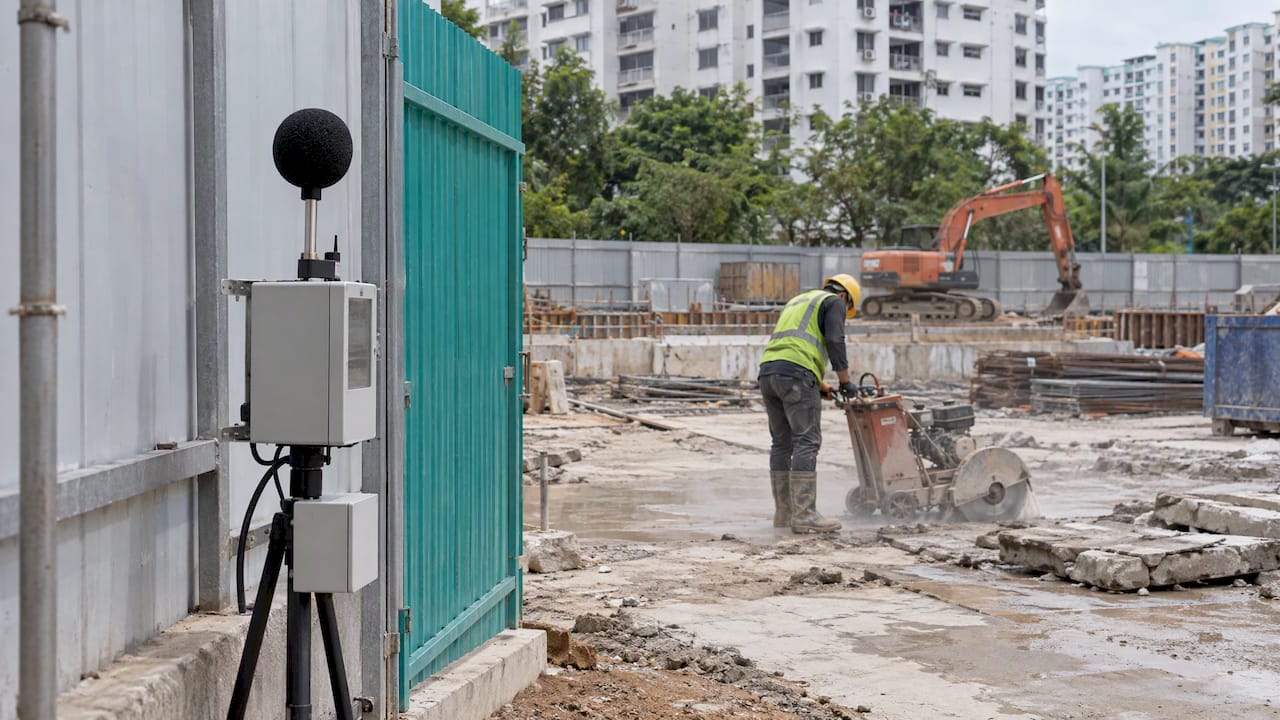
Construction noise in Singapore is controlled by the National Environment Agency (NEA) under the Environmental Protection and Management (Control of Noise at Construction Sites) Regulations. For residential buildings within 150m of a site, the permissible level is 75 dBA over 12 hours (or 90 dBA over any 5 minutes) from 7am to 7pm, tightening to 65 dBA and 70 dBA from 7pm to 10pm, and to 55 dBA from 10pm to 7am. Sites near residences and other noise-sensitive premises may not operate during defined no-work periods on Sundays and public holidays. Non-compliance is an offence with a fine of up to $40,000.
This guide sets out the limits, the hours of work, the monitoring obligations, the mitigation measures NEA expects, the enforcement position and the complaint channels. It is written for developers, contractors, site managers and building owners who must plan programmes and budgets around these rules.
TL;DR
- Residential buildings within 150m of a site are protected by 75 dBA (Leq 12 hrs) or 90 dBA (Leq 5 mins) from 7am to 7pm, then 65/70 dBA from 7pm to 10pm, then 55 dBA from 10pm to 7am.
- Sites within 150m of residential or other noise-sensitive premises face no-work periods from 10pm Saturday to 7am Monday and on the eve of public holidays, unless a permit allows specified work.
- Sites within 150m of noise-sensitive premises must install noise monitoring systems, using Class 1 noise meters.
- A breach of the core limit is punishable by a fine of up to $40,000, with a further daily fine of up to $1,000 for a continuing offence after conviction.
- Residents can report suspected breaches through NEA’s online feedback form, the myENV app or the OneService app.
Table of Contents
- How the limits are structured
- Limits for residential buildings within 150m
- Permitted hours and no-work periods
- Monitoring and measurement obligations
- Noise-control measures that NEA expects
- Enforcement and penalties
- Reporting construction noise
- A compliance routine for developers and contractors
- Perspective: noise compliance belongs in the design stage
- How Aman Engineering Consultancy supports compliant projects
- Frequently asked questions
- Sources
How the limits are structured
The permissible noise table is not a single number. It varies with three factors: the type of affected building, the time of day and the measurement period. The NEA code of practice for environmental control officers distinguishes affected building types, including residential buildings less than 150m from the construction site, and sets limits by time band using Leq measurement periods of 12 hours, 1 hour or 5 minutes.
Leq is the equivalent continuous sound level: the steady level that would contain the same sound energy as the fluctuating noise over the stated period. A short measurement window captures peaks from activities such as breaking, piling or cutting. A longer window reflects the average over the working day. A site can therefore meet its 12-hour average and still breach the 5-minute limit if a single noisy operation is run intensively.
The unit is dBA, the decibel scale weighted to approximate human hearing. Because the decibel scale is logarithmic, a difference of 10 dBA is perceived as roughly a doubling or halving of loudness, which is why the difference between 75 dBA and 55 dBA is substantial for a resident.

Limits for residential buildings within 150m
The figures below apply to residential buildings less than 150m from the construction site, as set out in the NEA code of practice.
| Time band | Leq 12 hrs | Leq 1 hr | Leq 5 mins |
|---|---|---|---|
| 7am to 7pm | 75 dBA | Not applicable | 90 dBA |
| 7pm to 10pm | Not applicable | 65 dBA | 70 dBA |
| 10pm to 7am | Not applicable | 55 dBA | 55 dBA |
The structure makes the intent clear. The daytime limit allows the heaviest work. The evening band cuts the allowable level by 10 dBA on the hourly measure, and the night band by a further 10 dBA. The Ministry of Sustainability and the Environment has explained in a written parliamentary reply that work is permitted if it complies with the applicable noise limits, which become more stringent after 7pm and 10pm, subject to the no-work rule on Sundays and public holidays.
The code also sets limits for other categories of affected premises and for buildings beyond 150m. The full table should be read in the current edition of the code before a noise management plan is finalized, since the building type of each neighbour determines which row applies.
Permitted hours and no-work periods
The limits above are only half of the compliance picture. The hours of work also matter, and they depend on location.
According to NEA’s frequently asked questions on construction noise:
- Construction work is permitted after 7pm on weekdays, subject to more stringent noise limits.
- Work on Saturdays is permitted until 10pm.
- Sites within 150m of residential buildings or noise-sensitive premises are prohibited from work from 10pm on Saturday to 7am on Monday.
- The same prohibition applies from 10pm on the eve of a public holiday to 7am on the day following it.
- Selected sites may receive permits for specified work during these periods.
In practice, programme planners should treat Sundays and public holidays as non-working days for any site in a built-up area, and treat any extension of hours as a permit application that needs evidence of noise control. Operations that are difficult to stop, such as continuous concrete pours or road works that cannot be done in daytime, are the usual candidates for a permit. For guidance on preparing that application, see our article on passing NEA permits first time with Class 1 meters.
Answering a common question about HDB blocks
HDB estates are residential buildings, so the residential limits and no-work periods apply to any site within 150m. There is no separate, longer quiet period for HDB blocks in the published rules: the controlling factors are the time band, the day of the week and the distance from the site. Renovation work inside individual flats is a separate regime governed by HDB’s own renovation rules, not the construction site regulations discussed here.
Monitoring and measurement obligations
Singapore does not rely only on complaints. All construction sites within 150m of the nearest noise-sensitive premises, such as residential buildings, hospitals and schools, must install noise monitoring systems to monitor noise levels generated by construction work.
The instrument matters. NEA requires Class 1 noise meters, which must be calibrated and serviced periodically, and notes that mobile-phone apps may not accurately represent construction noise (NEA FAQ). A reading taken on a phone is therefore not a defensible record for the site.
The reporting route depends on the equipment, according to the code of practice:
- Occupiers using real-time noise meters must submit the username and password to NEA, so that the agency can view the data directly.
- Occupiers using standalone meters must submit monitoring charts weekly to the Pollution Control 2 Division.
Three practical points follow. First, meter positions should represent the nearest affected premises, not a convenient location inside the hoarding. Second, alert thresholds should be set below the legal limit, so that site staff can stop or modify an activity before a breach is recorded. Third, calibration certificates should be filed with the site records, since they are the first thing queried if a reading is disputed.
Noise-control measures that NEA expects
The occupier of a site is responsible for keeping emissions within the limits. The code of practice lists the measures that occupiers should use: quieter equipment and methods, noisier activities restricted to daytime, noise barriers or curtains, generators sited away from residential areas, well-maintained equipment, and advance notice to affected residents about impending noisy work (NEA code of practice).
Barriers and temporary coverings
The material of a barrier determines whether it works. NEA’s guidance on noise mitigation measures describes nettings, tarpaulin and canvas sheets as poor measures, because they do not effectively absorb or shield sound. A barrier needs mass and continuity, with no gaps at the base or joints, and it should sit close to the source or between the source and the receiver. For background on how surface and material choices reduce noise in outdoor settings, see this explanation of how rubber paving reduces noise.
The same NEA page directs contractors to SS 602:2025, the Code of Practice for Noise Control on Construction and Demolition Sites issued by the Building and Construction Standard Committee of Singapore Standards. Contractors who design mitigation against this standard have a documented basis for their choices.
Selection and scheduling
The most effective control is usually upstream:
- Choose methods with lower source levels, for example a different piling method or saw-cutting in place of breaking, where the structural design permits.
- Schedule the noisiest operations in the 7am to 7pm band and avoid overlapping several high-emission activities within the same 5-minute window, since the 90 dBA limit is assessed over short periods.
- Place compressors and generators at the furthest practical point from residential facades, with enclosures.
- Maintain equipment, since worn silencers, loose panels and unlubricated parts raise emissions.
The role of environmental control officers
Under the ECO(SCS) scheme, environmental control officers at specified construction sites advise occupiers on noise-reduction measures (NEA code of practice). The officer is a resource inside the site’s management structure, and the advice carries weight only if the main contractor ensures subcontractors follow it. This is a general principle of subcontractor oversight, and the same discipline is described in this overview of subcontractor oversight steps. For the wider site obligations, the construction safety checklist for Singapore site managers sets out the supervisory routine.
Enforcement and penalties
The regulations, available on Singapore Statutes Online, make non-compliance an offence. Failure to comply with regulation 3(1) or 4A(1), or with specified notices or permit conditions, is liable on conviction to a fine of up to $40,000. If the offence continues after conviction, a further fine of up to $1,000 applies for each day.
The financial penalty is not the only exposure. Under the Environmental Protection and Management Act, the Director-General may issue a notice ordering construction work to stop if requirements or noise regulations are contravened, as recorded in the version of the Act in force from 1 September 2011. A stop-work notice on a critical-path activity can cost far more in delay than the fine itself, and it may affect completion obligations under the construction contract. Developers should therefore reflect noise compliance in the contractor’s scope, programme and contractual risk allocation.
Reporting construction noise
Residents and occupiers who suspect a violation can report it through NEA’s online feedback form, the myENV app or the OneService app (NEA FAQ). A useful report states the address of the site, the date, the time and the type of activity, so that the agency can compare the complaint with the site’s monitoring data.
Site teams should expect that many complaints concern night and weekend work. NEA’s FAQ records that most complaints it received in 2009 related to night-time and weekend work, and that 93% of investigated cases were found to be within legal limits. The figure is dated, but it shows that complaints are often prompted by the timing and the nuisance of noise, not only by measured exceedance. A complaint-handling procedure, with a named contact and advance notices to neighbours, reduces escalation even where the site is compliant.
A compliance routine for developers and contractors
A site that treats noise as a design and procurement issue rather than a site-level reaction is more likely to stay within the limits. The sequence below reflects the requirements described above:
- Map receivers. Identify every residential building, hospital, school and other noise-sensitive premises within 150m, and record the distance and facade orientation.
- Assign limits. Match each receiver to the relevant row and time band in the permissible noise table.
- Plan the programme. Place noisy activities in the 7am to 7pm band and mark the Sunday, public-holiday and eve-of-holiday no-work periods.
- Apply for permits early where unavoidable work must occur in a restricted period.
- Specify monitoring. Procure Class 1 meters, set alert levels below the limits and decide between real-time and standalone reporting.
- Specify mitigation. Select barriers, enclosures and equipment with reference to SS 602:2025, and avoid nettings and tarpaulins as primary measures.
- Communicate. Notify affected residents before impending noisy work and keep a complaints log.
- Review. Compare monitoring data against the programme weekly and adjust methods before a breach occurs.
Noise compliance sits within a wider set of approvals. The Singapore construction compliance checklist and the guide to engineering compliance workflow in Singapore show how it connects with statutory submissions to other agencies.
Perspective: noise compliance belongs in the design stage
We see construction noise most often treated as a site-level problem, addressed only after a complaint or a meter alert. In our experience of coordinating statutory submissions across BCA, URA, JTC, HDB, SCDF, PUB and LTA, the projects that run smoothly are those in which the construction method, the sequence of works and the neighbouring receivers are considered together before the contractor mobilizes.
Three points guide our advice. First, the choice of structural system and demolition or piling method largely fixes the noise a site will generate, so it is a design decision with programme consequences. Second, a monitoring system is evidence as well as a control: accurate, calibrated records protect an occupier who is compliant. Third, a multidisciplinary team that links the structural, mechanical and project management inputs can reduce the number of noisy activities that overlap. Planning for noise early costs less than a stop-work notice.
— Aman
How Aman Engineering Consultancy supports compliant projects
Aman Engineering Consultancy provides engineering, architectural and interior design consultancy for developers, construction firms, building owners and government agencies in Singapore. Our services include authority approvals, PE endorsements, project management and value engineering, which can be used to review construction methods and sequencing against regulatory constraints before work begins.

To discuss a project that sits close to residential or other noise-sensitive premises, contact us through our authority approvals and engineering services page, or see how our project management service can coordinate programme, subcontractors and compliance. Fees are project-based and are quoted on enquiry.
Frequently asked questions
What time must construction noise stop in Singapore?
On weekdays, work may continue after 7pm if it meets the stricter evening and night limits. On Saturdays, work is allowed until 10pm. For sites within 150m of residential buildings or noise-sensitive premises, no work is permitted from 10pm on Saturday to 7am on Monday, nor from 10pm on the eve of a public holiday to 7am on the day after, unless a permit allows specified work.
What is the maximum noise level for construction near homes?
For residential buildings within 150m, the limit from 7am to 7pm is 75 dBA over 12 hours or 90 dBA over any 5 minutes. From 7pm to 10pm it is 65 dBA over one hour or 70 dBA over 5 minutes. From 10pm to 7am it is 55 dBA on both measures.
How can I complain about construction noise in Singapore?
Use NEA’s online feedback form, the myENV app or the OneService app. Include the site address, date, time and the type of work you heard, so that the report can be checked against the site’s monitoring records.
Can a phone app be used to measure construction noise?
Not for compliance purposes. NEA requires Class 1 noise meters that are calibrated and serviced periodically, and it cautions that mobile-phone apps may not accurately represent construction noise.
What is the penalty for exceeding construction noise limits?
A person who fails to comply with the core limit under regulation 3(1) is liable on conviction to a fine of up to $40,000. A further fine of up to $1,000 per day can apply if the offence continues after conviction, and a stop-work notice may also be issued.
Sources
- NEA Code of Practice for Environmental Control Officers (5th Edition)
- NEA construction noise control FAQs
- NEA noise measurements and noise management plan
- NEA guidance on noise mitigation measures for construction work
- MSE written reply to parliamentary questions on construction noise
- Environmental Protection and Management (Control of Noise at Construction Sites) Regulations
- Environmental Protection and Management Act, version effective 1 September 2011
- How rubber paving reduces noise
- Subcontractor oversight steps