
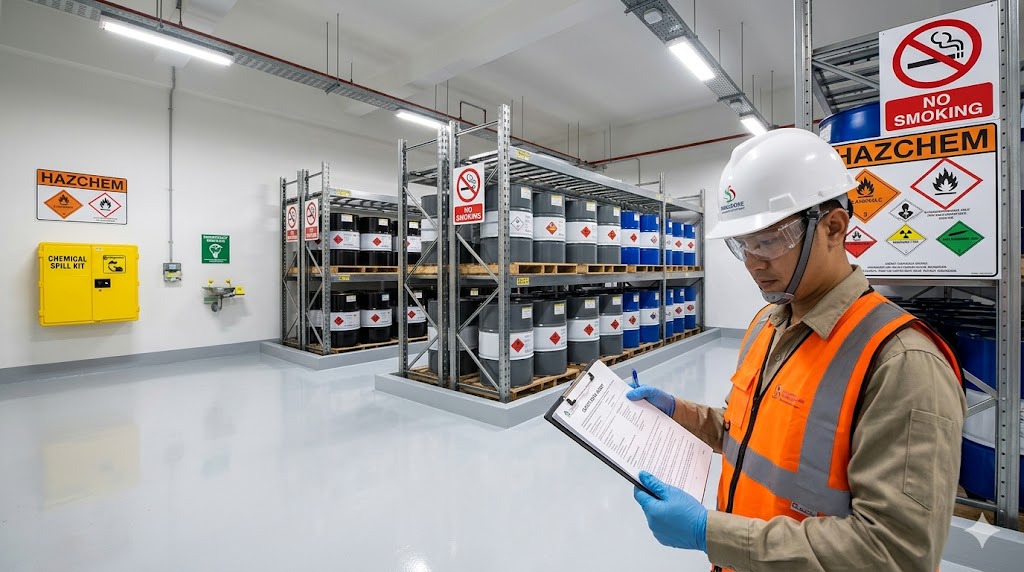
Chemical & Hazardous Material Storage: NEA and JTC Clearances You Need First
Chemical & hazardous material storage demands strict regulatory compliance. Singapore enforces rigorous environmental and industrial safety regulations. Securing NEA clearances remains an absolute operational prerequisite. Securing JTC clearances dictates your industrial facility location. Companies cannot store hazardous materials without these approvals. Furthermore, unauthorized storage invites severe legal and financial penalties. Therefore, compliance management teams must understand these frameworks. This report comprehensively analyzes these interconnected regulatory frameworks. It provides actionable intelligence for industrial facility operators. Ultimately, proactive compliance ensures continuous, safe business operations.
The 2026 Chemical Reporting Framework
Singapore recently overhauled its chemical management strategy. The 2026 Chemical Reporting Framework introduces major changes. It tightens control over chemical & hazardous material storage. The National Environment Agency manages this vital framework.1 Implementation officially begins on January 1, 2026.1 Consequently, affected businesses must prepare their documentation immediately. This framework expands the overall reporting scope drastically. It covers many previously unregulated chemical substances.1
The system introduces two distinct chemical classification tables. Table 1 lists specifically named dangerous chemical substances. Examples include volatile chemicals like chlorine and ammonium nitrate.1 Conversely, Table 2 utilizes globally harmonized hazard categories.1 This catches dangerous substances omitted from Table 1. Furthermore, reporting obligations depend on strict threshold quantities. These volume limits are measured in metric tonnes.1
Companies face a new predictive chemical reporting requirement. They must submit detailed five-year storage forecasts.1 Businesses must project their maximum quantities accurately. These projections must extend fully to the year 2031.1 This forces companies into long-term strategic facility planning. All reports demand standardized electronic submission formats. The agency utilizes a designated online reporting portal.1
This framework represents a paradigm shift in regulation. It moves from reactive tracking to predictive monitoring. Therefore, the government can anticipate future chemical clusters. This prevents dangerous risk accumulation across industrial zones. Furthermore, it drastically improves national emergency response planning. Third-party warehouse operators share this legal responsibility equally. Consequently, outsourcing storage does not eliminate reporting liabilities.1
NEA Clearances: The Hazardous Substances Licence
Moving chemicals across borders requires specific legal permission. The Hazardous Substances Licence serves this exact purpose. It governs the import, export, and sale of chemicals.2 The Environmental Protection and Management Act enforces this mandate. Consequently, unauthorized chemical trading is a severe criminal offense. Only UEN-registered business entities can apply for this licence.3
Currently, Singapore lacks a REACH-like new chemical registration system.4 However, importing chemicals still requires strict NEA clearances. The Pollution Control Department handles these vital applications.2
Licence Eligibility and Application Requirements
Applicants must meet stringent baseline eligibility criteria. The company must possess a valid UEN registration. Furthermore, ACRA business registration is an absolute prerequisite.5 The applicant must secure an approved storage location. This location must comply with all regulatory requirements. Consequently, authorities will scrutinize the facility’s safety infrastructure.
The designated licence holder faces strict educational requirements. They must pass a specialized hazardous substances course.3 The application process happens entirely online via GoBusiness.3 Processing typically requires thirty working days to complete.5 However, complex applications often trigger physical site inspections. This extends the approval timeline significantly. Therefore, companies must apply months ahead of operations.
Licence Fees and Documentation
Licence fees depend on the requested validity period. The financial structure remains transparent and straightforward.
| Licence Type | Validity Period | Government Fee |
| Standard Hazardous Substances Licence | Five Years | S$700 3 |
| Temporary Hazardous Substances Licence | Three Months | S$200 3 |
| Annual Licence Fee (Import/Export/Sale) | One Year | S$525 2 |
Table 1: Hazardous Substances Licence Fee Structure.
Applicants must upload specific supporting documents electronically. Document file names must adhere to strict character limits. File names cannot exceed 130 characters.6 Spaces must be replaced with underscores automatically.3 Furthermore, companies must provide Industrial Allocation Approval documents.
If using a third-party warehouse, consent letters are mandatory. These letters must state exact chemical purities and quantities.3 The warehouse must already hold its own valid licence.3 Consequently, supply chain partners must align their regulatory statuses. Furthermore, bulk fixed storage tanks require special engineering certification. A Professional Engineer must endorse these tank structures.3
NEA Clearances: The Hazardous Substances Permit
Using chemicals locally demands a different regulatory approval. The Hazardous Substances Permit controls chemical storage and usage.3 Consequently, this permit focuses on actual facility operations. It differs fundamentally from the supply-chain-focused licence.7 A permit implies that chemicals are actively processed onsite. Therefore, the operational risks are inherently higher.
Permit Prerequisites and Operational Plans
Permit eligibility mirrors the standard licence requirements closely. However, the permit demands a comprehensive Emergency Response Plan.3 This document is critical for onsite disaster management. It must detail immediate responses to chemical spills. Furthermore, it must outline specific clean-up procedures explicitly.3
Companies must list all available emergency containment equipment. The plan requires a detailed facility site layout. This floor plan must highlight exact chemical storage locations.3 Emergency contact numbers must be prominently displayed onsite. Furthermore, the plan must list engaged toxic waste collectors.3 This ensures rapid disposal of contaminated materials post-accident.
The annual permit fee currently costs S450.5 Processing this permit also takes roughly thirty working days.5 Operating without this permit invites severe financial penalties. Violators face up to S$10,000 in fines. Moreover, courts can impose twelve-month imprisonment terms.8
Transport Approvals and International Protocols
Chemical & hazardous material storage connects to global logistics. Transporting hazardous waste requires specific international protocols. NEA enforces the Basel Convention for hazardous waste transit.2 Consequently, any export or import requires a Basel permit.
The annual Basel permit fee is S165.2 NEA utilizes the Prior Informed Consent procedure strictly.2 For certain substances, the Rotterdam Convention dictates import rules. Exporting countries must seek consent from Singapore authorities.2 Consequently, international chemical logistics require massive documentation.
Traders must utilize the TradeNet system for customs clearance. Declarants must input their Basel permit numbers accurately. Furthermore, they must upload bills of lading and invoices.9 Customs permits must be obtained before goods arrive.9 TradeNet applications process within five working days.9 This ensures efficient port operations and prevents logistical bottlenecks.
Ozone Depleting Substances face additional strict import controls. Trade is forbidden with non-parties to the Montreal Protocol.9 Auto-processing applies only to non-controlled ozone depleting substances.9 Consequently, companies must monitor international treaty ratifications constantly.
Professional Competency and Required Training
Infrastructure cannot prevent chemical disasters without human competence. The Ministry of Manpower enforces strict worker training regulations. Personnel must implement a hazardous chemicals management programme.10 Consequently, specialized education is legally required for compliance officers.
Manage Hazardous Substances Course Details
Licence holders must complete the Manage Hazardous Substances course.3 This module belongs to the Occupational Hygiene Specialist Diploma.11 It grants individuals recognition as legally competent persons.12 The curriculum dives deeply into technical chemical safety management. Participants study the fundamentals of occupational toxicology extensively.11
Furthermore, they learn to apply the hierarchy of risk control.11 The course teaches the interpretation of Safety Data Sheets.11 It also covers ventilation design and personal protective equipment. The program evaluates environmental hazards and chemical risks rigorously.11
The forty-hour course requires substantial financial investment.12 However, the government provides significant training subsidies.
| Trainee Category | Full Course Fee | Nett Fee After Subsidy |
| Foreigners / Non-eligible | S$1,323.00 | S$1,323.00 12 |
| SC/PR (Aged 39 and below) | S$650.00 | S$325.00 13 |
| SC/PR (Aged 40 and above) | S$650.00 | S$195.00 13 |
| SME-sponsored local employees | S$650.00 | S$195.00 13 |
Table 2: Manage Hazardous Substances Course Fee Structure.
If applicants lack this certificate during permit application, flexibility exists. They must sign a formal Letter of Undertaking.3 This letter promises course completion within three months.3 Consequently, companies can commence operations while training their staff.
SCDF Clearances and Fire Safety Codes
Chemical & hazardous material storage involves massive explosion risks. The Singapore Civil Defence Force enforces the strict Fire Code.8 Consequently, architectural designs must prioritize fire separation and suppression. Operating an unapproved dangerous goods store carries hefty fines. Violators face up to S$10,000 and daily continuing penalties.8
Compartment Limits and Volume Restrictions
The Fire Code restricts how much chemical volume occupies one space. Unprotected large compartments fuel uncontrollable, massive infernos. Therefore, SCDF dictates maximum allowable volumes based on safety systems.
| Chemical Hazard | Protection Level | Maximum Allowable Volume |
| Class 3 Liquid | Non-Sprinkler Protected | 3,000 Litres 14 |
| Class 3 Liquid | Sprinkler Protected | 5,000 Litres 14 |
| Class 1 & 2 Liquid | Laboratory Space | 250 Litres 14 |
Table 3: SCDF Volume Limits for Hazardous Materials.
Basement floors are strictly prohibited from storing hazardous materials.14 Underground fires trap toxic gases and severely hinder firefighting efforts. Furthermore, fire-rated roller shutters cannot serve as compartment boundaries alone. They must integrate with automatic smoke detection systems.14 Consequently, this ensures immediate compartmentalization during the incipient fire stage.
Infrastructure and Spill Containment
Physical containment prevents fires from spreading via flowing liquid. Chemical stores must feature raised flooring thresholds or bunds. These bunds must stand at least 150 millimeters high.8 Furthermore, they must contain 110% of the largest container’s volume.8 Alternatively, they must contain 25% of total stored volume.8 This ensures that catastrophic tank ruptures remain entirely contained. The flooring itself must feature chemical-resistant, impermeable epoxy coatings.
Electrical equipment within these zones poses severe ignition threats. Standard lighting fixtures generate heat and occasional electrical arcs. Therefore, all equipment must carry ATEX explosion-proof ratings.8 This applies to fans, lights, and even communication devices. Furthermore, facilities must maintain mechanical ventilation continuously. Enclosed stores require at least six air changes per hour.8 Consequently, explosive chemical vapors cannot accumulate to dangerous atmospheric concentrations.
Fire engine accessways must cover the full external wall stretch.14 Furthermore, 50kg mobile fire extinguishers must be readily available. Their discharge hoses must measure at least six meters.14 Access to these extinguishers must not exceed fifteen meters.14
Major Hazard Installations and QRA
Storing massive volumes of chemicals invites catastrophic disaster risks. Singapore mitigates this through Quantitative Risk Assessments (QRA).15 The Major Hazard Department coordinates this complex clearance.16 This department unites MOM, NEA, and SCDF seamlessly. Consequently, developers face a single regulatory front for major hazards.17
Hazard Identification and Consequence Modelling
The QRA methodology relies on predictive mathematical risk modelling. First, consultants conduct thorough qualitative hazard identification reviews.15 They analyze potential equipment failures and human operational errors. Second, they define specific accident scenarios uniquely. Third, they perform event tree and frequency likelihood analyses. This calculates the exact mathematical probability of a disaster.15
Finally, consultants perform advanced physical consequence modelling. They simulate devastating outcomes like jet fires and pool fires. Furthermore, they model vapour cloud explosions and flash fires.15 They also calculate the radius of a boiling liquid explosion. Consequently, the software maps exact fatality and harm zones. This determines if the hazard extends beyond the facility’s boundaries. If off-site populations are threatened, the project is rejected immediately.
MHI Threshold Quantities
Facilities exceeding specific chemical volumes become Major Hazard Installations (MHI). The WSH Regulations strictly govern these high-risk premises.18 The First Schedule dictates the exact threshold quantities.19
| Named Dangerous Substance | CAS Number | Threshold Quantity |
| Formaldehyde (concentration >90%) | 50-00-0 | 50 Tonnes 19 |
| Hydrogen | 1333-74-0 | 25 Tonnes 19 |
| Hydrogen chloride (anhydrous) | 7647-01-0 | 150 Tonnes 19 |
| Hydrogen fluoride (anhydrous) | 7664-39-3 | 15 Tonnes 19 |
| Hydrogen sulphide | 7783-06-4 | 20 Tonnes 19 |
| Methanol | 67-56-1 | 5,000 Tonnes 19 |
| Oxygen | 7782-44-7 | 2,000 Tonnes 19 |
Table 4: Major Hazard Installation Threshold Quantities.
MHIs must prepare an exhaustive consolidated Safety Case.18 This document proves that all major hazards are controlled. The facility must eliminate risks wherever reasonably practicable.18 If elimination is impossible, they must mitigate the consequences drastically. Furthermore, the design must incorporate safety-related control systems.20 This includes automated emergency shutdown protocols and blast-resistant architecture.
JTC Clearances: Industrial Siting and Pollution Control
Choosing a facility location is a highly strategic decision. The Pollution Control Department evaluates all new industrial developments. They analyze the proposed site’s environmental compatibility extensively.21 This happens during the Industrial Siting Consultation phase.6 Consequently, this clearance must precede any building construction. The department checks the proposed environmental management level.22
Chemical storage facilities cannot neighbor residential zones closely. The regulations mandate strict physical separation distances.6 These buffers protect civilian populations from toxic gas plumes. Singapore Standard SS 593 dictates these exact buffer requirements.6 Furthermore, hospitals and nursing homes require expanded safety buffers. Consequently, highly pollutive industries must locate in designated zones. Jurong Island frequently serves as this designated heavy-industry hub.23
If developers fail the Industrial Siting Consultation, projects halt. Therefore, companies must submit process flow diagrams early. These diagrams must describe overall facility operations explicitly.6 The authorities use these diagrams to calculate potential pollution. They analyze projected air emissions and wastewater discharge. Ultimately, this preliminary clearance dictates the project’s entire viability.24
JTC Clearances: Space Submission Guidelines
Jurong Town Corporation acts as the primary industrial landlord. Modifying a JTC unit requires their explicit plan consent.25 Tenants cannot alter structural components without prior approval. Furthermore, unapproved alterations can compromise building fire safety. JTC utilizes the Corenet digital system for all submissions. This ensures transparent tracking of all architectural changes.26
Exemption Lists and QP Endorsements
JTC categorizes renovation works into three distinct regulatory lists. This system drastically streamlines the submission process. Consequently, minor works face fewer bureaucratic delays.
| Regulatory Category | Description of Works | Submission Requirement |
| List A | Minor works (e.g., floor finish replacement) | Fully Exempted 25 |
| List B | Structural works (e.g., heavy machinery) | Qualified Person (QP) Required 28 |
| List C | Non-structural moderate works | Non-QP Submission Allowed 26 |
Table 5: JTC Space Submission Categories.
List A covers exemptions like repositioning simple washbasins. It also allows window grille installations without consent.27 Portable grease traps under 750kg are also exempted.27 Machinery weighing under 750kg requires no JTC submission.27 However, chemical storage usually involves List B submissions. Installing heavy storage tanks requires a Professional Engineer’s endorsement. The engineer must verify structural load capacities rigorously. Consequently, this prevents catastrophic floor slab collapses under chemical weight.
Racking Systems and Infrastructure Rules
Chemical warehouses rely on specialized heavy-duty racking systems. JTC imposes strict dimensional limits on these structures. For non-QP submissions, racks cannot exceed three meters.25 Furthermore, racking width must remain under 1.2 meters. The gross weight cannot exceed 7.5 kN/m².25 Additionally, operators must maintain 1.2-meter unobstructed passageways.25
These dimensional limits serve a critical fire safety purpose. Exceeding three meters interrupts overhead fire sprinkler distribution patterns. Consequently, a fire could spread rapidly across the upper tiers. To build higher racks, operators must engage a QP. The QP calculates the required in-rack sprinkler systems.
Ceiling fan installations also face strict regulatory rules. Fans suspended from ceilings cannot exceed 35kg.25 Structural bolt penetration cannot exceed 40mm into concrete.25 Furthermore, minimum height clearance must be 2.4 meters.25 Therefore, structural guidelines directly support emergency fire suppression tactics.
JTC Clearances: The Environmental Site Assessment (ESA)
JTC protects its land portfolio from toxic chemical degradation. They enforce this through the Environmental Site Assessment.7 Previously, the industry called this the Environmental Baseline Study. The assessment is an intrusive soil and groundwater investigation.29 It establishes the exact level of subterranean contaminants. Consequently, it creates a historical record of land purity. JTC mandates this for B1 and B2 industrial sites.7
Entry and Exit ESA Dynamics
The assessment process tracks pollution across a tenancy’s lifespan. An Entry ESA establishes the initial baseline conditions.7 It occurs when a tenant obtains a new lease. Alternatively, it happens when changing to pollutive usages. If a tenant skips this, standard default values apply.7 These defaults are the strict Dutch Intervention Values.
Conversely, an Exit ESA occurs upon lease termination. The tenant must prove they did not pollute the land.7 The Exit ESA results are compared against the Entry baseline. If contaminant levels increased, remediation becomes legally mandatory. The tenant bears all decontamination costs completely.30 Therefore, the ESA internalizes environmental costs effectively. Companies can no longer abandon polluted land without financial consequence.
Assignments and transfers trigger ESA requirements immediately. A seller must conduct an Exit ESA prior to leaving. If contamination exceeds Dutch Intervention Values, they must remediate.7 Buyers can assume the baseline, inheriting future liabilities. Consequently, environmental due diligence dictates industrial real estate transactions.
The Six-Step ESA Methodology
Conducting an ESA requires a specialized, NEA-listed consultant.7 The consultant follows a rigorous, internationally recognized six-step procedure.29
- Development of Work Plan: The consultant drafts investigation strategies. This includes comprehensive health and safety protocols.29
- Preliminary Investigation: Consultants perform historical desktop studies. They construct a theoretical Conceptual Site Model.31
- Investigation Strategy: The team finalizes sampling locations. They target areas of highest potential chemical concern.32
- Field Investigation: This involves physical drilling and sampling. Boreholes are drilled to extract undisturbed soil samples.7
- Selection of Quality Standards: The extracted laboratory data undergoes review. Analysts compare findings against the Dutch Intervention Values.33
- Final Reporting: The consultant submits a comprehensive technical report. This includes a mandatory self-declaration compliance checklist.31
This methodology prevents volatile contaminant losses during drilling. For instance, drilling fluids are strictly prohibited during extraction.7 The first 1.5 meters must use non-destructive manual excavation.7 This prevents accidental destruction of hidden underground utility cables. Subsequent soil samples are taken at 1.5-meter intervals.7 Consequently, the laboratory receives highly accurate, untainted chemical samples.
Identifying Pollutive SSIC Activities
JTC categorizes specific industrial activities as inherently pollutive. This categorization relies on standard SSIC business codes.7 Engaging in these activities automatically triggers the ESA requirement. Consequently, companies cannot hide their chemical footprints easily. The classification covers a vast array of manufacturing sectors.
Major Group Categories and SSIC Codes
The SSIC categorization dictates environmental regulatory scrutiny. Heavy industries naturally face the highest compliance burdens.
| Major Group | Industry Sector | Specific SSIC Code Example |
| Group 4 | Bulk Chemical Storage | 46641, 46643, 52103 7 |
| Group 6 | Semiconductor Fabrication | 26112, 26113, 26121 7 |
| Group 8 | Engineering and Machinery | 28111, 28121, 28141 7 |
| Group 21 | Chemical Additives | 20241, 20242, 20292 7 |
| Group 22 | Paints and Varnishes | 20221, 20222, 20229 7 |
| Group 25 | Pharmaceutical Manufacturing | 21012, 21021, 21030 7 |
| Group 26 | Plastic Products | 22211, 22213, 20300 7 |
Table 6: Highly Pollutive Industries Triggering Mandatory ESAs.
Semiconductor fabrication uses ultra-pure electronic chemicals extensively.7 Consequently, their wastewater contains dangerous heavy metals and solvents. Similarly, pharmaceutical manufacturing handles potent biological and chemical reagents. Paint manufacturing processes vast quantities of volatile organic compounds. Furthermore, basic industrial acids and alkalis fall under Group 21.
Even seemingly benign activities trigger pollutive classifications. Laundry and dry cleaning services (SSIC 96011) are considered pollutive.7 The chemicals used in dry cleaning contaminate groundwater severely. Retail sale of automotive fuel (SSIC 47320) also triggers ESAs.7 Underground petrol tanks constantly risk silent, long-term leakage. Therefore, JTC targets these specific SSIC codes aggressively. A simple change of use to these codes triggers immediate assessments.7
ESA Remediation and Reporting Standards
Singapore utilizes the Dutch Standards to evaluate soil health.33 These standards provide objective thresholds for heavy metals. They also cover hydrocarbons, pesticides, and aromatic compounds. If Entry ESA levels exceed these values, trouble ensues. The tenant must submit a detailed human health risk assessment.7
Remediation requires restoring the site to baseline conditions.7 The process involves aggressive soil vapor extraction or excavation. Once completed, the consultant must perform secondary laboratory retests. These retests must verify that all contaminants have vanished. Crucially, the retest must cover all contaminants comprehensively.7
Finally, a certified professional must endorse the successful remediation. They must provide a statement confirming objective, unbiased testing.7 Furthermore, the final report must include accurate borehole coordinates.31 It must also document visual and olfactory field observations.31 Consequently, JTC ensures the land remains usable for future generations.
Storage Operations, Penalties, and Audits
Daily chemical & hazardous material storage operations require unyielding discipline. Strict protocols govern every aspect of warehouse functionality. Incompatible chemicals must remain separated by physical distance. Usually, a three-meter open gap or fire-wall is required.8 Furthermore, facilities must implement rigid Permit-to-Work systems. This system controls high-risk activities like welding or confined space entry.8
Emergency Preparedness and Daily Protocols
Emergency preparedness dictates the placement of critical safety equipment. Twenty-litre chemical spill kits must sit within five meters.8 These kits contain absorbent granules, nitrile gloves, and disposal bags.8 Additionally, medical eyewash stations are mandatory for corrosive storage. Workers must reach these stations within a ten-second travel time.8 They must be inspected and flushed weekly.8
Safety Data Sheets must be updated every three years.8 Furthermore, HAZCHEM signage must display UN numbers clearly. SCDF requires these hazard boards at all DG store entrances.8 Only corrosion-resistant racking like stainless steel is permitted. Wooden racking is strictly prohibited for Class 3 goods.8 Finally, facilities must conduct rigorous annual emergency response drills. Consequently, muscle memory replaces panic during an actual chemical spill.
Penalties for Non-Compliance
Regulatory failures carry devastating financial and legal consequences. The authorities show zero tolerance for negligent storage operations.
| Offense Description | Enforcing Agency | Maximum Penalty |
| Causing death or grievous hurt | MOM (WSH Act) | Up to 2 years jail, S$100,000 fine 8 |
| Operating unapproved DG store | SCDF (Fire Code) | S2,000 daily penalty 8 |
| Operating without HSP Permit | MOM / NEA | S$10,000 fine, 12 months jail 8 |
| Improper toxic waste disposal | NEA (EPMA) | Up to S$40,000 fine, 12 months jail 8 |
| General WSH Act Violation | MOM | S$5,000 fine (first conviction) 8 |
Table 7: Statutory Penalties for Chemical Storage Violations.
Missing an expired MOM permit triggers immediate audits. Bunding capacity falling below 110% invites immediate fines.8 Co-mingling incompatible classes without separation causes severe penalization.8 Consequently, continuous compliance monitoring remains the only viable strategy. Companies should conduct internal gap assessments routinely.8 Hiring a WSH-approved consultant costs between S2,500.8 This investment pales compared to devastating statutory fines.
Strategic Business Recommendations
Mastering Singapore’s chemical storage regulations requires profound organizational foresight. The interplay between NEA clearances and JTC clearances is complex. However, systematic planning transforms compliance into a competitive business advantage. Unprepared competitors will falter under the weight of regulatory fines.
Companies should update their EHS legal registers immediately. The impending 2026 Chemical Reporting Framework demands predictive volume calculations.1 Forecasting storage needs five years ahead requires deep supply chain analysis. Furthermore, engaging an NEA-listed consultant early saves invaluable time. Environmental Site Assessments take roughly four months to complete naturally.7 Delaying this process halts property transactions and business expansions entirely.
Facility design must incorporate QRA and Fire Code parameters initially. Retrofitting fire-rated walls and ATEX ventilation costs significantly more later. Companies should engage the Major Hazard Department during conceptual design stages.17 Furthermore, operators must secure BizSAFE Level 3 or 4 certification.8 Consequently, they avoid discovering fatal architectural flaws during final agency inspections. Ultimately, chemical safety in Singapore is an interconnected regulatory ecosystem. Proactive compliance protects the environment, the workers, and the business.
Works cited
- Singapore Chemical Reporting 2026 Compliance Guide – SimplyEHS, accessed May 20, 2026, https://www.simplyehs.com/post/singapore-2026-chemical-reporting-framework
- Hazardous substances and waste | Import Licensing Procedures – World Trade Organization, accessed May 21, 2026, https://importlicensing.wto.org/content/hazardous-substances-and-waste
- Hazardous Substances (HS) Licence – GoBusiness Licensing, accessed May 21, 2026, https://licensing.gobusiness.gov.sg/licence-directory/nea/hazardous-substances-hs-licence
- Introduction to Chemical Regulations in Singapore – ChemSafetyPro.COM, accessed May 20, 2026, https://www.chemsafetypro.com/Topics/GHS/Introduction_to_Chemical_Regulations_in_Singapore.html
- Hazardous Substances (HS) Permit | Licence & Accreditation – GoBusiness Licensing, accessed May 21, 2026, https://licensing.gobusiness.gov.sg/licence-directory/nea/hazardous-substances-hs-permit
- General Waste Disposal Facility Licence – GoBusiness Licensing, accessed May 20, 2026, https://licensing.gobusiness.gov.sg/licence-directory/nea/general-waste-disposal-facility-licence
- Environmental Site Assessment | JTC | JTC, accessed May 20, 2026, https://www.jtc.gov.sg/get-help/managing-your-tenancy-or-lease/environmental-site-assessment
- Hazardous Goods Storage in Singapore Warehouses: A Practical …, accessed May 20, 2026, https://yktoh.com/hazardous-goods-storage-in-singapore-warehouses-a-practical-guide-to-dg-storage-compliance-3/
- National Environment Agency (NEA) | Singapore Customs, accessed May 21, 2026, https://www.customs.gov.sg/doing-business/quick-links-for-traders/tradenet/competent-authorities-requirements-for-controlled-items/national-environment-agency/
- What are the storage and safety requirements for managing highly volatile chemicals or mixtures? – MOM, accessed May 21, 2026, https://www.mom.gov.sg/faq/hygiene-monitoring/what-are-the-storage-and-safety-requirements-for-managing-highly-volatile-chemicals-or-mixtures
- WSQ Manage Hazardous Substances – Consultancy & Training – ISRC Pte Ltd, accessed May 20, 2026, https://isrc.com.sg/training/wsq-manage-hazardous-substances/
- MHS2: MANAGE HAZARDOUS SUBSTANCES – NTUC LearningHub, accessed May 20, 2026, https://www.ntuclearninghub.com/-/course/manage-hazardous-substances-1
- Manage Hazardous Substances (MHS) – Eversafe Academy, accessed May 20, 2026, https://eversafe.edu.sg/course/mhs/
- FIRE SAFETY REQUIREMENTS FOR CHEMICAL/HAZMAT WAREHOUSES – SCDF, accessed May 21, 2026, https://www.scdf.gov.sg/docs/default-source/fire-safety-docs/downloads/fire-code-2013/appendix-2.pdf?sfvrsn=f8cb6860_1
- Quantitative Risk Analysis: What You Need To Know – ESC – EnviroSolutions & Consulting, accessed May 20, 2026, https://www.envirosc.com/insight/quantitative-risk-analysis-what-you-need-to-know/
- Quantitative Risk Assessment (QRA) – Ministry of Manpower, accessed May 20, 2026, https://www.mom.gov.sg/workplace-safety-and-health/major-hazard-installations/quantitative-risk-assessment
- Quantitative Risk Assessment (QRA) Requirements – SCDF, accessed May 20, 2026, https://www.scdf.gov.sg/fire-safety-services-listing/petroleum-and-flammable-material-licences/quantitative-risk-assessment-(qra)-requirements
- Safety Case Implementation in Singapore – IChemE, accessed May 20, 2026, https://www.icheme.org/media/12363/1-technical-seminar-on-ps-release.pdf
- guide-to-determine-quantities-of-dangerous-substances.pdf – MOM, accessed May 20, 2026, https://www.mom.gov.sg/-/media/mom/documents/safety-health/mhi/guide-to-determine-quantities-of-dangerous-substances.pdf
- Safety case technical guide – Singapore – MOM, accessed May 20, 2026, https://www.mom.gov.sg/-/media/mom/documents/safety-health/mhi/safety-case-technical-guide.pdf
- CODE OF PRACTICE ON POLLUTION CONTROL – SEAISI, accessed May 20, 2026, https://www.seaisi.org/storage/environmental-safetys/regulation/pdf/j5b7cqXMLdHqRAjKVi9oJD0sahvWaXVOiVTorY0P.pdf
- SINGAPORE – LONG TERM ENVIRONMENTAL POLICIES – Pacific Economic Cooperation Council, accessed May 20, 2026, https://www.pecc.org/resources/infrastructure-1/1219-singapore-long-term-environmental-policies/file
- SCHEDULE OF STATUTORY CONTROLS FOR LAND, STANDARD FACTORY AND WORKSHOP CUSTOMER – JTC, accessed May 20, 2026, https://www.jtc.gov.sg/-/media/project/jtc-cx/corpweb/assets/get-help/schedule-of-statutory-controls-for-land_standard-factory-and-workshop-customers_oct-2024.pdf
- SCHEDULE OF STATUTORY CONTROLS FOR LAND, STANDARD FACTORY AND WORKSHOP CUSTOMERS Contents – JTC, accessed May 20, 2026, https://www.jtc.gov.sg/-/media/project/jtc-cx/corpweb/assets/find-land/land-for-tender-and-temp-use/tol/33-jalan-buroh/schedule-of-statutory-controls-for-land_standard-factory-and-workshop-customers.pdf
- space-submission-handbook.pdf – JTC, accessed May 21, 2026, https://www.jtc.gov.sg/-/media/project/jtc-cx/corpweb/assets/get-help/space-submission-handbook.pdf
- Space Submission Handbook PCP-WI-09 Version 5.0, Updated 03.01.2022 1 – JTC, accessed May 21, 2026, https://www.jtc.gov.sg/-/media/project/jtc-cx/corpweb/space-submission-handbook.pdf
- Dear Sir/Madam, I hope this email finds you well. 1. I’m reaching out to you from JTC, a government agency under the Ministry, accessed May 21, 2026, http://aces.org.sg/wp-content/pdf/2025/125_2025-JTC%20Plan%20Consent%20Guidelines%20-%20Update%20to%20Space%20Submission%20Handbook%20and%20Expansion%20of%20Exemption%20List.pdf
- Space Submission Handbook PCP-WI-09 Version 6.0, Updated 25.04.2025 – JTC, accessed May 21, 2026, https://www.jtc.gov.sg/-/media/project/jtc-cx/corpweb/space-submission-handbook-v6.pdf
- JTC Environmental Site Assessment Guidelines | PDF – Scribd, accessed May 20, 2026, https://www.scribd.com/document/538818044/JTC-EBS-Guidelines-2019
- EX-99.3 – SEC.gov, accessed May 20, 2026, https://www.sec.gov/Archives/edgar/data/1095270/000095012309033260/u00329exv99w3.htm
- JTC Environmental Site Assessment (ESA) Requirements and Technical Guideline (2024 EDITION), accessed May 20, 2026, https://www.jtc.gov.sg/-/media/project/jtc-cx/corpweb/assets/get-help/jtc-environmental-site-assessment-requirements-and-technical-guidelines-2024-edition.pdf
- GUIDELINE ON ENVIRONMENTAL BASELINE STUDY (2019 EDITION) – JTC, accessed May 20, 2026, https://www.jtc.gov.sg/-/media/project/jtc-cx/corpweb/assets/get-help/guidelines-on-environmental-baseline-study.pdf
Environmental Baseline Study | TÜV SÜD Indonesia, accessed May 20, 2026, https://www.tuvsud.com/en-id/services/testing/environmental-baseline-study