
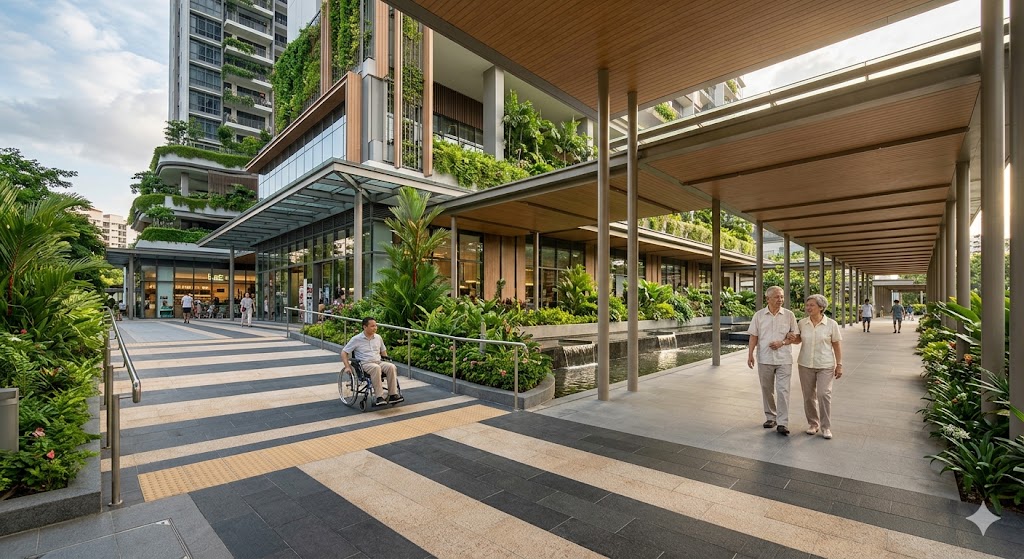
Optimize BP Submission: Accessibility Codes in Singapore Guide
Executive Summary
Singapore faces rapid demographic shifts toward an aging population. Consequently, Accessibility Codes in Singapore require constant evolution. By 2030, citizens aged 65 or older will constitute 25 percent of the population.1 Therefore, making Singapore an inclusive, age-friendly city is imperative.1 The Building and Construction Authority (BCA) governs these standards rigorously. The BCA Code on Accessibility outlines strict baseline requirements.2 These regulations ensure buildings accommodate persons with disabilities. Furthermore, they support the elderly and young families.2
Architects must integrate Universal Design standards during early planning phases.2 This integration prevents costly modifications during the BP submission process.2 Furthermore, achieving BCA compliance requires deep technical knowledge. The latest Code on Accessibility 2025 introduces critical updates.2 Additionally, the digital transition to CORENET X mandates new submission protocols.3 This research report provides an exhaustive analysis of these regulatory frameworks. It details precise dimensions, compliance workflows, and digital validation methods. Moreover, it outlines strategic SEO strategies for architectural firms.4
Legislative Framework and Basic Accessibility
The Building Control Act Amendments
The regulatory landscape relies heavily on robust legislation. In March 2020, authorities amended the Building Control Act.5 This amendment directly targets existing non-barrier-free buildings.5 It mandates basic accessibility features during addition and alteration works.5 Consequently, this legislation applies to buildings exceeding 500 square meters.5 However, buildings used exclusively as residences or factories remain exempt.5
This basic accessibility legislation reinforces Singapore’s commitment to inclusive environments.5 When addition and alteration works commence, a Qualified Person intervenes.5 The appointed Qualified Person must prepare the BP submission.5 BCA subsequently reviews the submission for basic accessibility compliance.5 The mandatory features include a wheelchair-accessible entrance.5 Furthermore, buildings must provide one wheelchair-accessible toilet.5 A barrier-free route connecting the entrance and toilet is mandatory.5
The Compliance Verification Process
The BP submission process requires meticulous technical preparation. Qualified Persons must hold valid registration with professional boards.6 They prepare structural and architectural drawings for BCA evaluation.5 If the submitted plans comply, BCA grants approval immediately.5 Conversely, non-compliant plans receive a Notice to Provide Basic Accessibility Features.5
Building owners must then rectify these structural deficiencies promptly.5 They must engage a Qualified Person to submit revised plans.5 Failure to comply disrupts construction timelines significantly. Moreover, it increases overall project costs exponentially. Therefore, strict adherence to Universal Design standards is economically beneficial. Additionally, proactive compliance streamlines the Temporary Occupation Permit application process.7
Evolution of Accessibility Codes in Singapore
Historical Context and Iterative Improvements
Singapore introduced the first Code on Barrier-Free Accessibility in 1990.1 Since then, authorities have reviewed the code every five years.1 Each revision progressively expanded the scope of mandatory provisions. The 2007 edition incorporated broader Universal Design standards.1 Subsequently, the 2013 and 2019 editions enhanced requirements for families.2
The fifth review in 2019 introduced accessible changing rooms.9 It mandated minimum accessible provisions across diverse development types.9 Later, BCA established a tripartite Code Review Committee in 2023.10 This committee evaluated existing gaps and anticipated future societal needs.8 Representatives from government agencies and social services participated actively.10 This collaborative effort birthed the Code on Accessibility 2025.8
Core Objectives of the 2025 Code Revision
The sixth revision enhances structural clarity immensely. Furthermore, it streamlines complex Universal Design standards.2 It emphasizes performance-based outcomes while offering greater design flexibility.11 The Code 2025 officially takes effect on November 1, 2025.12 It applies to new building works and significant alteration works.12 Your BP submission on or after this date must comply.11
Minister Indranee Rajah highlighted that inclusivity means building better lives.8 The updated standards empower individuals to navigate spaces independently.8 Furthermore, BCA published a Companion Guide alongside the mandatory code.13 This guide provides non-mandatory recommendations to exceed baseline standards.13 It consolidates global research findings and current architectural design trends.13
| Code Edition | Key Focus Areas and Improvements |
| 1990 | First introduction with focus on wheelchair accessibility. |
| 2007 | Introduction of Universal Design principles and family-friendly features. |
| 2013 | Accessibility beyond the strict confines of buildings. |
| 2019 | Enhanced requirements for the elderly and accessible changing rooms. |
| 2025 | Restructured to emphasize performance-based outcomes and enhanced clarity. |
| Table 1: Historical evolution of Accessibility Codes in Singapore.11 |
Detailed Updates in the 2025 Accessibility Code
Enhancements for Wheelchair Users
The 2025 updates significantly improve barrier-free interconnectivity.14 All key building entrances linking to neighboring facilities require wheelchair access.14 This includes connections to commuter facilities and covered walkways.14 When developers provide shelter, priority must go to accessible routes.15 This ensures vulnerable users remain protected during adverse weather conditions.
Lift provisions also received substantial upgrades. Internal lift car sizes must meet new minimum dimensions.16 Clear floor space requirements at lift lobbies provide greater flexibility.16 The code allows spaces for lift doors and call buttons to overlap.16 Lift buttons must feature contrasting colors and precise tactile markings.16 Force-activated buttons must operate within a specific force range.16 This operational range is set between 2.5N and 5.0N.16
Provisions for the Elderly
Aging populations require specific physical support mechanisms. Therefore, the revised code mandates increased toilet cubicles with grab bars.8 Mandatory resting areas must be integrated at passenger alighting points.8 These sheltered points must provide direct barrier-free building access.11 Such Universal Design standards protect seniors from fatigue.
Furthermore, the code enhances ramp safety specifications significantly.8 Color bands will replace traditional tactile ground surface indicators on ramps.8 This modification minimizes tripping hazards for elderly pedestrians.15 Ramp gradients remain strictly regulated based on vertical rise changes.
| Change in Vertical Rise (mm) | Maximum Allowable Gradient |
| 0 to 15 | 1:2 |
| More than 15 to 50 | 1:5 |
| More than 50 to 175 | 1:10 |
| Exceeding 175 | 1:12 |
| Table 2: Allowable ramp gradients under the Code on Accessibility 2025.17 |
Family-Friendly Facilities and Lactation Rooms
The Code 2025 introduces extensive family-friendly provisions. These provisions are consolidated into a specific structural chapter.16 Lactation room requirements now encompass more building types.8 Educational institutions must now provide dedicated lactation rooms.8 These spaces provide privacy for mothers to breastfeed comfortably.17
The code standardizes specifications, requiring essential electrical sockets.8 Lactation rooms cannot be located within public toilets.17 They must measure at least 1200mm by 1500mm.17 The BP submission must clearly indicate these exact dimensions.
| Building Gross Floor Area (GFA) | Minimum Lactation Rooms Required |
| Office/Retail: 5,000 m² to 20,000 m² | 1 |
| Office/Retail: Every subsequent 20,000 m² | 1 additional room |
| Hospitals/Transport: First 20,000 m² | 1 |
| Educational Institutions: 5,000 m² or more | 1 |
| Table 3: Mandatory lactation room provisions based on building usage.17 |
Furthermore, the code outlines specifications for child-friendly sanitary facilities. Wash basins for children must have a maximum tap reach.16 This specific tap reach cannot exceed 350mm.16 Child-friendly urinal rim heights cannot exceed 400mm.16 Water closet cubicles must incorporate specialized child protection seats.16 Diaper changing stations must adhere to strict weight capacities.16
Accommodations for Sensory Impairments
Navigation safety for visually impaired individuals is heavily prioritized. The code standardizes Warning Tactile Ground Surface Indicators.8 These indicators must be installed at staircase landings.17 They must extend across the full width of the stairs.17 The depth must measure exactly 600mm.17 They must commence 300mm back from the staircase edge.17
For the hearing impaired, signage requirements are heavily enhanced.8 Systems operating with a telecoil must display a standardized symbol.8 This symbol incorporates the letter “T” for telecoil.8 It sits alongside the universal symbol of access.8 This visual cue alerts users to activate their personal devices.8
Universal Design Index (UDi) Framework
Transition from UD Mark Certification
Singapore previously utilized the Universal Design Mark certification.7 However, BCA recently shifted to a mandatory framework. Effective September 1, 2022, the Universal Design index replaced it.7 This transition mainstreams Universal Design standards across all architectural developments. It ensures broader adoption of Accessibility Codes in Singapore.
The UDi is a comprehensive self-assessment checklist.7 It is integrated directly into regulatory workflows.7 Applicable projects must submit the UDi checklist during BP submission.7 Furthermore, resubmission occurs during the Temporary Occupation Permit application.7 This ensures intended Universal Design standards are actually constructed.
UDi Scoring and Key User Groups
The UDi builds directly upon the baseline Code on Accessibility.18 It utilizes a structured point system based on usability indicators.19 Qualified Persons input data into standardized Excel templates.19 Users only input data into designated yellow cells.19 The system automatically computes points, highlighting errors for correction.19
The assessment evaluates usability across four distinct demographic categories.20 These categories include persons with disabilities and older people.21 Furthermore, it assesses provisions for expectant mothers and young families.21 The aggregate score determines the building’s overall UDi rating scale.21
| UDi Rating | Performance Indicator Description |
| A | Excellent – Caters well to all user groups |
| B | Good – Caters well to most user groups |
| C | Fair – Caters to some user groups |
| D | Basic – Minimal provisions for universal design |
| E | Meets only the Code’s minimum accessibility standard |
| Table 4: Universal Design Index (UDi) Rating Scale.18 |
Data gathered through UDi submissions informs future policy decisions.22 BCA shares information about user-friendly features through public portals.22 This transparency allows the public to identify accessible buildings effortlessly.22 Exemplary projects may receive the Universal Design Excellence Award.23 Ensuring your BP submission scores highly boosts property value.
Technical Dimensions and Spatial Requirements
Accessible Sanitary Provisions
Accessible toilets demand precise spatial configurations to ensure maneuverability. The 2025 Code mandates larger turning spaces within confined environments.24 A clear turning circle of 1500mm is now the minimum.24 This dimension allows wheelchair users to execute a 360-degree pivot.24 Planners must also provide a 300mm transfer zone.24
Doorway clearances for accessible toilets must measure at least 900mm.24 Doors must swing outward to simplify emergency rescues.24 Horizontal grab bars must sit between 800mm and 900mm high.24 A flip-up grab bar is required on the transfer side.25 Emergency call bells must connect to a continuously staffed location.24 One bell must be mounted below 600mm.24
Changing rooms for persons with severe disabilities have strict guidelines. These accessible changing rooms require specific internal dimensions.26 They must measure 2600mm wide by 2300mm deep.26 A ceiling hoist system must be installed to assist caregivers.17 This crucial provision reduces physical exertion and preserves user dignity.17
Vertical Circulation and Refuge Spaces
Lifts and escalators must comply with stringent mechanical safety standards. The BCA Code emphasizes clear floor spaces and button placements.11 However, fire safety elements intersecting with accessibility are equally critical. The Fire Code requires temporary refuge spaces for evacuation.27 These spaces offer a safe waiting environment during emergencies.27
A standard temporary refuge space must measure 1.5m by 1.5m.28 Alternatively, designers can provide two smaller spaces.28 These smaller spaces must measure 0.75m by 1.5m.28 They must be located within a protected exit lobby.28 Refuge spaces must never reduce the required exit route width.28
Lift modernization projects frequently encounter BP submission rejections.29 Structural drawings must demonstrate adequate load-carrying capacity.29 Furthermore, workers require designated refuge spaces within the lift pit.30 Standard dimensions require at least 500mm clearance in the pit.30 Proper documentation of these technical dimensions prevents regulatory bottlenecks.
Parking Provisions for Diverse Users
Accessible car parking lots must prioritize proximity to entrances.31 The standard dimensions for an accessible lot are 4800mm by 3600mm.31 The surface must be firm and level entirely.31 You cannot use unstable aeration slabs for these lots.31 Whenever feasible, these parking spaces should feature overhead shelter.31
The required accessible lots depend on the total parking capacity. Generally, developments provide one accessible space per fifty standard spaces.32 For hospitals, the ratio shifts to one per hundred spaces.32 Furthermore, the Code 2025 mandates specific family car parking lots.16 At least one family lot must sit near an accessible entrance.16
| Facility Type | Required Accessible Parking Ratio |
| General Parking (up to 1000 spaces) | 1 space for every 50 parking spaces |
| Hospitals (non-outpatient areas) | 1 space for every 100 parking spaces |
| Nursing Homes | 1 space for every 100 parking spaces |
| Schools | 1 space for every 100 parking spaces |
| Table 5: Accessible car parking lot provision requirements.32 |
Case Studies in Universal Design Excellence
Kampung Admiralty
Kampung Admiralty exemplifies the successful integration of Universal Design standards. Designed as a “vertical kampung,” it promotes profound community bonding.33 The mixed-use development integrates an active-ageing hub with childcare.33 This strategic co-location facilitates interactions between seniors and young children.33
The development incorporates numerous elderly-friendly residential features flawlessly. Flats feature non-slip vinyl flooring and strategically placed grab bars.34 Retractable laundry hangers minimize physical exertion for older residents.34 Furthermore, the project utilizes water-sensitive urban design extensively.35 Kampung Admiralty received the Universal Design Mark GoldPLUS Award.36 It proves that Accessibility Codes in Singapore inspire architectural innovation.
The Enabling Village
The Enabling Village represents a masterclass in adaptive repurposing. Situated in Redhill, this project revitalized a 1970s vocational institute.37 SG Enable and the government spearheaded this inclusive initiative.38 The design seamlessly integrates barrier-free movement across terraced terrains.39 Multi-storey blocks feature accessible lifts and gently sloped ramps.39
Universal Design standards permeate every detail of the built environment. Braille signage, hearing loops, and tactile floor indicators ensure navigation.37 Color-coded precinct markers assist individuals with cognitive impairments.37 The village operates as an integrated, inclusive community space.38 It earned the Platinum BCA Universal Design Mark Award.39
Digital Transformation: CORENET X and BIM
The CORENET X Mandate
Singapore is revolutionizing its regulatory submission processes through CORENET X. This integrated platform replaces separate submissions to multiple government agencies.40 It establishes a single source of truth using Building Information Modelling.40 Mandatory implementation begins October 1, 2025, for new projects.41 This applies to projects exceeding 30,000 square meters.42
Smaller projects will progressively onboard in subsequent phases.42 CORENET X mitigates downstream construction conflicts by frontloading design coordination.40 It demands high levels of initial collaboration between architectural disciplines.40 The platform utilizes the IFC+SG standard exclusively.43 This standard incorporates specific parameters required by Singapore’s regulatory authorities.43
Automated Compliance Checking
BCA requires accessibility features to be explicitly captured in BIM.43 To facilitate this, authorities collaborated with AcePLP and Solibri.44 Together, they developed the Compliance Checker for Accessibility.44 This digital validation service performs automated checks against the Code.44 The public beta phase runs from November 2025 to May 2026.44
Design teams upload their IFC+SG models into the portal.44 The system instantly identifies non-compliant elements automatically.44 It links these structural issues directly to relevant code clauses.44 This real-time feedback loop drastically improves design accuracy.44 It provides regulatory authorities with consistent compliance insights quickly.44 Therefore, ensuring your BP submission passes validation becomes significantly easier.
Navigating BP Submissions and Waivers
Standard Procedures and Qualified Persons
Before commencing any building works, plans must receive BCA approval.6 The Building Control Regulations strictly govern this application procedure.6 Submissions must be executed through a registered Qualified Person.6 The Qualified Person must obtain written permission from the URA.6 Subsequently, they ensure all designs meet the performance requirements.6
The BP submission process is not a trivial administrative task. It requires meticulous detailing of all accessibility and structural parameters. Submissions now incorporate relevant aspects of civil defense shelter plans.6 Qualified Persons must submit specific forms like BCA-BE-STAPPV01.45 They bear primary legal responsibility for ensuring total code compliance.29
Common Pitfalls and Rejection Causes
Despite clear guidelines, BCA frequently rejects BP submissions for errors. Refuge space dimensions represent a highly scrutinized compliance area.29 Inadequately documented lift pit refuge spaces frequently trigger plan rejections.29 Structural drawings for lift modernizations often lack load analysis data.29 Qualified Persons must provide precise dynamic and static load calculations.29
Another common pitfall is misunderstanding exemptions within the accessibility code. Certain industrial areas may be exempt from accessibility requirements entirely.46 However, agricultural farms must adhere to industrial building accessibility codes.46 Misclassifying these spaces leads to swift regulatory rejection.46 If BCA rejects a submission, rectifying documented gaps is mandatory.47 Rushing a resubmission guarantees a secondary rejection inevitably.47
Alternative Solutions and Waivers
The BCA Code allows for performance-based alternative design solutions.11 If a design deviates, it may still satisfy the functional intent.11 Qualified Persons must submit alternative solutions during pre-submission consultations.48 They must provide empirical evidence demonstrating equivalent accessibility outcomes.11
For example, an alternative washroom layout must accommodate wheelchair maneuvering.11 If a building faces structural constraints, owners can request waivers.49 The application for modification requires a formal submission fee.50 This specific application fee costs $100 per modification item.50 BCA evaluates these requests meticulously to ensure absolute safety.
Strategic Digital Visibility for Architectural Practices
The Importance of High SEO Ranking
Architectural firms must attract developers seeking competent Qualified Persons. Therefore, strong online visibility is absolutely critical for business growth.51 High SEO ranking ensures firms appear during BCA compliance searches.51 Search engine optimization connects service providers with commercial demand efficiently.51
Building a website without considering SEO architecture is a mistake.52 Retrofitting structural SEO elements post-launch disrupts digital performance heavily.52 Consequently, SEO strategy must integrate seamlessly with initial web design.52 Firms must optimize for high-intent keywords related to BP submissions.
Keyword Optimization and Metadata
Architects should target specific industry keywords to capture qualified traffic. Keywords like “BP submission” and “Universal Design standards” are vital. Furthermore, long-tail variations like “double storey house designs” generate volume.53 Integrating a strong focus keyphrase into the content is essential.
On-page SEO requires meticulous attention to structural technical elements.52 Every webpage needs a single, keyword-optimized H1 heading.52 Unique meta titles and descriptions improve click-through rates.52 Canonical tags prevent search engines from penalizing duplicate content.52 Additionally, logical URL structures enhance both user experience and navigation.52
Image SEO is particularly crucial for architectural design portfolios.4 Image files must utilize descriptive keywords rather than numeric filenames.4 Descriptive alt text containing relevant keywords ensures visual search ranking.4 Submitting an XML image sitemap accelerates search engine indexing significantly.4
Local SEO Strategies in Singapore
Singapore’s unique urban layout demands highly specific local SEO techniques.54 General geographical keywords often fail to capture immediate local intent. Instead, firms should incorporate specific HDB estate names locally.54 Neighborhood shopping complexes generate substantial localized search traffic regularly.54
Commercial hubs like Raffles Place exhibit distinct search patterns.54 Content targeting these areas should address corporate professionals’ needs.54 Furthermore, leveraging Singapore’s precise six-digit postal code system helps.54 Consistent postal code usage across Google Business Profiles strengthens signals.54 Establishing localized authority ensures a steady stream of commercial inquiries.
Financial Support and the Accessibility Fund
Retrofitting existing buildings to meet Universal Design standards is expensive. To mitigate this financial burden, the government established the Accessibility Fund.22 This fund assists private building owners in upgrading accessibility features.22 Eligible buildings must have been constructed between 1990 and 2013.22
The fund co-finances up to 60 percent of construction costs.22 Funding is strictly capped at $100,000 per development project.22 Eligible upgrades include wheelchair-accessible toilets and dedicated lactation rooms.22 Furthermore, BCA offers interim payment options for larger upgrade projects.22 Projects exceeding $200,000 in value qualify for this payment option.22
This flexibility helps developers manage cash flow during extensive installations.22 Building owners must apply for this grant before March 2027.22 Leveraging this fund transforms legislative compliance into a subsidized upgrade. Ultimately, accessible buildings command higher commercial appeal and tenant retention.
Broader Implications of Accessibility Codes in Singapore
Social and Economic Impacts
The enforcement of Accessibility Codes in Singapore generates profound impacts. Socially, it guarantees dignity and independence for marginalized demographic groups. Universal Design standards eliminate physical barriers that cause daily frustration. Economically, inclusive buildings expand the potential consumer and talent pool. Retail spaces with barrier-free access attract more diverse customer bases.
Furthermore, accessible workplaces enable companies to hire persons with disabilities. The Enabling Village demonstrates this economic integration model perfectly.38 By providing accessible training facilities, Singapore reduces welfare dependency rates. Consequently, Universal Design standards act as a catalyst for economic participation.
Future Trends in Universal Design
The Code on Accessibility 2025 represents a significant milestone. However, the evolution of Accessibility Codes in Singapore will continue. Future revisions will likely address neurodivergent design requirements more deeply. Acoustics, lighting, and spatial zoning affect individuals with sensory processing differences. The current code hints at this through enhanced hearing loop signage.8
Moreover, the integration of smart building technologies will redefine accessibility. Automated doors, voice-activated lifts, and indoor navigation apps are emerging. The mandate for CORENET X facilitates this technological integration seamlessly.40 BIM models will eventually interface directly with smart building management systems. Therefore, your BP submission must anticipate these future technological integrations.
Global Leadership in Urban Inclusivity
Singapore’s rigorous approach establishes it as a global urban leader. The meticulous nature of the BP submission process ensures high quality. Other nations frequently study Singapore’s Accessibility Codes for policy inspiration. The structured Universal Design index offers a replicable assessment framework globally.23
The integration of digital tools like the Compliance Checker is groundbreaking.44 It shifts regulatory compliance from a manual burden to automated verification. This digital transformation ensures that Universal Design standards are never compromised. Singapore proves that dense urban environments can achieve total physical inclusivity.
Ensuring BP Submission Success
Pre-Consultation Strategies
To guarantee a successful BP submission, proactive strategy is essential. Qualified Persons should utilize BCA’s pre-submission consultation channels effectively.48 These consultations clarify ambiguous code interpretations before formal submissions occur. Discussing alternative solutions early prevents costly downstream architectural redesigns.11
Furthermore, design teams must run internal automated compliance checks constantly. Utilizing software like Solibri against the IFC+SG model identifies errors.44 Resolving spatial conflicts digitally is cheaper than resolving them physically. Therefore, adopting a BIM-first workflow is no longer optional today.
Documentation and Record Keeping
Meticulous documentation forms the backbone of a successful BP submission. Every deviation from the acceptable solution must possess empirical justification.11 Structural adequacy certificates must accompany all lift modernization plans.29 Furthermore, UDi checklists must accurately reflect the final physical construction.19
Any discrepancy between the approved BP submission and reality causes issues. It will definitely delay the Temporary Occupation Permit issuance.7 Therefore, continuous auditing during the construction phase remains absolutely critical.
Continuous Professional Development
The landscape of Accessibility Codes in Singapore changes rapidly. Qualified Persons must engage in continuous professional development to stay relevant. BCA offers certification courses for Universal Design Assessors regularly.55 These programs cover the latest updates to the UDi framework.55
Furthermore, understanding the evolving CORENET X requirements requires dedicated software training.56 Architectural firms must invest in their employees’ digital BIM capabilities. Only through continuous learning can firms ensure flawless BP submissions consistently.
Final Insights on Compliance
The Accessibility Codes in Singapore reflect a profound societal commitment. The transition toward the Code 2025 mandates stringent architectural standards. Features like standardized lactation rooms and tactile indicators are foundational. They represent the baseline for all future Singaporean urban development.
Furthermore, the Universal Design index enforces systemic architectural accountability.7 By integrating the UDi into BP submissions, BCA guarantees functional execution. Simultaneously, the imminent launch of CORENET X revolutionizes regulatory workflows entirely.41 Automated BIM compliance checking eliminates ambiguity and accelerates permit approvals.44
Architects and developers must master these intersecting regulatory frameworks perfectly. Technical proficiency in spatial requirements prevents costly BP submission rejections. Moreover, mastering digital visibility and high SEO ranking ensures commercial success.4 By embracing Universal Design standards, the industry builds an equitable environment. Consequently, Singapore will remain a beacon of inclusive urban planning.
Works cited
- ANNEX B – FACTSHEET ON BCA’S INITIATIVES FOR AN ACCESSIBLE AND INCLUSIVE BUILT ENVIRONMENT, accessed May 27, 2026, https://isomer-user-content.by.gov.sg/338/0fbfb3e6-5f17-437e-9ec6-1837254c6a00/udea2025_annexb_bca-ud-factsheet.pdf
- Code on Accessibility in the Built Environment | Building and Construction Authority, accessed May 27, 2026, https://www1.bca.gov.sg/safety-and-standards/accessibility/code-on-accessibility-in-the-built-environment/
- Implementation Timeline – Singapore – CORENET X, accessed May 27, 2026, https://info.corenet.gov.sg/overview/about-corenet-x/implementation-timeline
- SEO for Architects: How to Optimize Your Project Portfolio for Maximum Visibility | Hashmeta, accessed May 27, 2026, https://hashmeta.com/blog/seo-for-architects-how-to-optimize-your-project-portfolio-for-maximum-visibility/
- Basic Accessibility Legislation | Building and Construction Authority, accessed May 27, 2026, https://www1.bca.gov.sg/safety-and-standards/accessibility/basic-accessibility-legislation/
- Building Plan submission | Building and Construction Authority, accessed May 27, 2026, https://www1.bca.gov.sg/safety-and-standards/applications-and-licenses/building-plan-submission/
- BCA-C 20220601 – Universal Design Index Self-Assessment Framework | PDF – Scribd, accessed May 27, 2026, https://www.scribd.com/document/1005740488/BCA-C-20220601-Universal-Design-Index-Self-Assessment-Framework
- Revised Code To Enhance Singapore’s Built Environment for an Inclusive Nation, accessed May 27, 2026, https://www1.bca.gov.sg/resources/newsroom/revised-code-to-enhance-singapore-s-built-environment-for-an-inclusive-nation/
- Code on Accessibility in the Built Environment 2019, accessed May 27, 2026, https://isomer-user-content.by.gov.sg/338/57384a60-c5ce-4c3e-a621-1709f60ce428/accessibilitycode2019.pdf
- Public Consultation on Draft Code on Accessibility in the Built Environment 2025 – Reach, accessed May 27, 2026, https://www.reach.gov.sg/latest-happenings/public-consultation-pages/2024/public-consultation-on-draft-code-on-accessibility-in-the-built-environment-2025/
- GOOD DESIGN PRACTICES FOR A SAFE AND • ACCESSIBLE BUILT ENVIRONMENT, accessed May 27, 2026, https://www.bcaa.edu.sg/docs/librariesprovider2/events-seminars/bp-top-seminar-2025/am-bca-industry-sharing-session-on-bptop-regulatory-updates-2025_r2.pdf?sfvrsn=458af834_1
- MEDIA RELEASE REVISED CODE TO ENHANCE SINGAPORE’S BUILT ENVIRONMENT FOR AN INCLUSIVE NATION, accessed May 27, 2026, https://isomer-user-content.by.gov.sg/338/0561281a-4a79-43c6-a47c-2a2929f39d02/bca-media-release—code-on-accessibility-in-the-built-environment-2025.pdf
- [BCA Circular] Companion Guide to Code on Accessibility in the Built Environment 2025 – Singapore Green Building Council, accessed May 27, 2026, https://www.sgbc.sg/bca-circular-companion-guide-to-code-on-accessibility-in-the-built-environment-2025/
- revised code to enhance singapore’s built environment for an inclusive nation – SG Press Centre, accessed May 27, 2026, https://www.sgpc.gov.sg/detail?url=/media_releases/bca/press_release/P-20250407-2&page=/detail&HomePage=home
- Code on Accessibility in the Built Environment Enhanced w.e.f. 1 November 2025 to Address Gaps and Needs of Persons with Disabilities, Elderly and Young Families, accessed May 27, 2026, https://www.rajahtannasia.com/viewpoints/code-on-accessibility-in-the-built-environment-enhanced-w-e-f-1-november-2025-to-address-gaps-and-needs-of-persons-with-disabilities-elderly-and-young-families/
- Our Reference: APPBCA-2025-07 Building Plan & Management Group 7 April 2025 See Distribution List Dear Sir/Madam, CODE ON AC – CORENET X, accessed May 27, 2026, https://info.corenet.gov.sg/docs/default-source/bca-circulars/circular_launch_accessibility-code.pdf?sfvrsn=c3c17cb9_2
- code on accessibility – in the built environment 2025, accessed May 27, 2026, https://file.go.gov.sg/bca-coa2025.pdf
- Universal Design Performance | Building and Construction Authority, accessed May 27, 2026, https://www1.bca.gov.sg/home-and-building-owners/accessibility-and-universal-design/universal-design-performance/
- guide-to-udi.pdf, accessed May 27, 2026, https://isomer-user-content.by.gov.sg/338/c4594f17-6a3a-4cea-8582-717e862910b2/guide-to-udi.pdf
- Universal Design Index (UDi) | Building and Construction Authority, accessed May 27, 2026, https://www1.bca.gov.sg/home-and-building-owners/accessibility-and-universal-design/universal-design-index/
- Singapore’s Universal Design Index – a CUDA post, accessed May 27, 2026, https://universaldesignaustralia.net.au/singapores-universal-design-index/
- 1 Annex A: Factsheet on BCA’s initiatives for an accessible and inclusive Built Environment 1 Accessibility in the built envi, accessed May 27, 2026, https://www.sgpc.gov.sg/api/file/getfile/Media%20Factsheet.pdf?path=/sgpcmedia/media_releases/bca/press_release/P-20250407-1/attachment/Media%20Factsheet.pdf
- Building Code Checklist for Universal Accessibility – Documents & Reports – World Bank, accessed May 27, 2026, https://documents1.worldbank.org/curated/en/099012725142095036/pdf/P1760681fae1720ec1883910910368435cb.pdf
- BCA 2025 Code: Converting Your Toilet For Accessibility – Leong Yik, accessed May 27, 2026, https://www.leongyik.com.sg/bca-2025-code-converting-your-toilet-for-accessibility/
- Accessible Toilet Design Singapore | Disabled & Senior Bathroom Layout, accessed May 27, 2026, https://seniorcaresingapore.com/blog/accessibility-toilet-design-considerations/
- Building and Construction BCA Singapore Updates – Active Aging LLP, accessed May 27, 2026, https://www.activeaging.com.sg/blog/47-building-and-construction-singapore-2019/93-bca-code-on-accessibility-2019.html
- Points to Note: Observations from the Universal Design Award Scheme 2024/25, accessed May 27, 2026, https://www.eoc.org.hk/Upload/content/Points%20to%20Note-Eng.pdf
- Fire Safety Code 2024 Overview | PDF – Scribd, accessed May 27, 2026, https://www.scribd.com/document/934651076/1
- BCA Fixed Installation Plan Submission Requirements: A Complete Guide for Singapore Lift Owners – Hin Chong, accessed May 27, 2026, https://hinchong.com/resources/bca-fi-plan-submission-requirements-complete-guide/
- Uplifting Lift Standards for Safety and Maintainability -, accessed May 27, 2026, https://isomer-user-content.by.gov.sg/338/5bcbe8ba-5f56-4040-adc3-56f015141d1e/topic-2-uplifting-lift-standards-for-safety-and-maintainability—design-compliance-to-ss550-202.pdf
- BCA Barrier-Free Accessibility Code | PDF | Door | Stairs – Scribd, accessed May 27, 2026, https://www.scribd.com/document/781842916/BCA-Accessibility-Code-1995
- Accessible Parking Requirements by Building Class | PDF | Hostel – Scribd, accessed May 27, 2026, https://www.scribd.com/document/429794045/Car-Parking-Numbers-for-People-With-a-Disability
- An Urban Village for the Community Kampung Admiralty (海军部村庄) was designed as a ‘vertical – HDB, accessed May 27, 2026, https://www.hdb.gov.sg/-/media/hdb-pulse/news/2021/kampung-admiralty-and-punggol-town-win-global-awards-for-excellence-in-land-use/18082021-Annex-A.pdf
- People-centric buildings win top BCA Awards | Building and Construction Authority, accessed May 27, 2026, https://www1.bca.gov.sg/resources/newsroom/people-centric-buildings-win-top-bca-awards/
- Kampung Admiralty | Henning Larsen, accessed May 27, 2026, https://henninglarsen.com/projects/kampung-admiralty
- Kampung Admiralty Singapore | Mixed Use Architecture – Keppie Design, accessed May 27, 2026, https://www.keppiedesign.co.uk/project/kampung-admiralty-singapore/
- Enabling Village: Universal Design in Redhill | PDF | Wheelchair | Accessibility – Scribd, accessed May 27, 2026, https://www.scribd.com/document/866755525/Enabling-Village-3
- A Shared Space to Bring Together People With and Without Disabilities – Development Asia, accessed May 27, 2026, https://development.asia/case-study/shared-space-bring-together-people-and-without-disabilities
- Universal Design – Singapore – Enabling Village, accessed May 27, 2026, https://enablingvillage.sg/universal-design/
- Getting Ready for CORENET X, accessed May 27, 2026, https://info.corenet.gov.sg/docs/default-source/default-document-library/getting-ready-for-corenet-x-(spm).pdf?sfvrsn=ccecde5b_2
- annex b: factsheet on updates to corenet x, accessed May 27, 2026, https://isomer-user-content.by.gov.sg/338/7611fc57-a195-47ce-95af-9e2ec904fb83/bcaawardsdinner2025_annexb.pdf
- Circular released on 10 Sep 2025 for your information & dissemination pls. To read the details, please click the link provi – Association of Consulting Engineers Singapore, accessed May 27, 2026, http://aces.org.sg/wp-content/pdf/2025/282_2025-Circular%20released%20on%2010%20Sep%202025%20for%20your%20information.pdf
- CORENET X BIM Requirements & Timeline [2026 Guide] | Bimeco – BIM Services Singapore, accessed May 27, 2026, https://www.bim.com.sg/blog/corenet-guide-singapore/
- Solibri and AcePLP Advance Digital Building Compliance in Singapore, accessed May 27, 2026, https://www.solibri.com/articles/solibri-and-aceplp-advance-digital-building-compliance-in-singapore-with-the-compliance-checker-for-accessibility
- Structural Plan submission – Building and Construction Authority, accessed May 27, 2026, https://www1.bca.gov.sg/safety-and-standards/applications-and-licenses/structural-plan-submission/
- BCA – Plan Approval Processes, Submission Requirements and TOP/CSC under the Building Control Act, accessed May 27, 2026, https://www.sfa.gov.sg/docs/default-source/food-farming/06sep_sfa-workshop_bca-deck.pdf
- What You Should Do If Your BCA License Got Rejected – QES Consultancy, accessed May 27, 2026, https://qesafety.com/what-you-should-do-if-your-bca-license-got-rejected/
- 02 Jun 2025 Building Plan & Management Group See Distribution List Dear Sir/Madam, CONSOLIDATED QUESTIONS & ANSWERS FROM – CORENET X, accessed May 27, 2026, https://info.corenet.gov.sg/docs/default-source/bca-circulars/bca_bpm_annual_sharing_session_2025.pdf?sfvrsn=8e46c4bb_1
- Forms and Certificates | Building and Construction Authority, accessed May 27, 2026, https://www1.bca.gov.sg/safety-and-standards/lifts-escalators-and-mechanised-car-parking-systems/fixed-installations-legislations/forms-and-certificates/
- No. S 614 BUILDING CONTROL ACT 1989 BUILDING CONTROL (FIXED INSTALLATIONS) REGULATIONS 2025, accessed May 27, 2026, https://sso.agc.gov.sg/SL/BCA1989-S614-2025?DocDate=20250926&ViewType=Pdf&_=20250926190241
- SEO for Construction Businesses in 2026 – DMB: Singapore’s Best Digital Marketing Agency, accessed May 27, 2026, https://dmb.sg/blog/seo-for-construction-business/
- Why SEO Must Be Built Into Your Singapore Website From Day One | SgWebDesign, accessed May 27, 2026, https://www.sgwebdesign.sg/articles/seo-web-design-singapore.html
- 100+ Best SEO Keywords for Architects in 2026 | Complete Guide – Vivek ChhimPa, accessed May 27, 2026, https://vivekchhimpa.com/blog/seo-keywords-for-architects/
- Local SEO Techniques Specific to Singapore’s Urban Layout: A Complete Guide | Hashmeta, accessed May 27, 2026, https://hashmeta.com/blog/local-seo-techniques-specific-to-singapores-urban-layout-a-complete-guide/
- Certification Course for Universal Design (UD) Assessors – BCA Academy, accessed May 27, 2026, https://www.bcaa.edu.sg/what-we-offer/courses/Details/certification-course-for-universal-design-(ud)-assessors
CORENET X Code of Practice, accessed May 27, 2026, https://info.corenet.gov.sg/overview/about-corenet-x/corenet-x-code-of-practice