
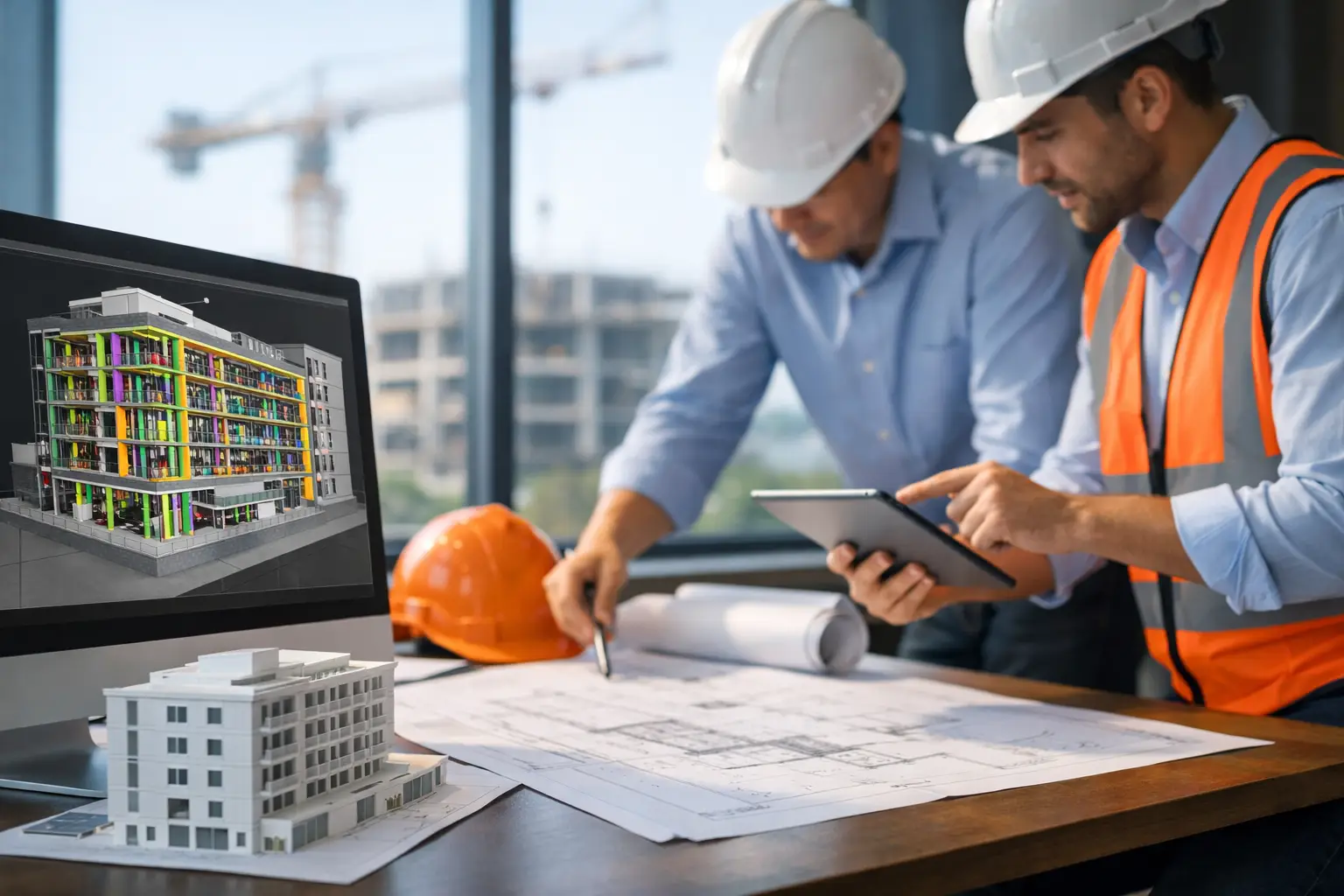
A coordination issue rarely starts on site. It usually starts much earlier – in disconnected drawings, missing dimensions, outdated revisions, or discipline teams working from different assumptions. That is why bim modeling services for construction have become a practical requirement for projects that need tighter coordination, cleaner authority submissions, and fewer surprises during execution.
For owners, developers, architects, and contractors, BIM is not just a 3D model. Used properly, it is a structured project environment that helps align architecture, structure, MEP systems, quantities, and statutory requirements before work advances too far. The value is not the model by itself. The value is better decisions, fewer clashes, clearer documentation, and stronger control over compliance and delivery.
What bim modeling services for construction actually cover
The term BIM is often used broadly, which can create unrealistic expectations. In practice, bim modeling services for construction can include several different scopes depending on project stage and delivery requirements.
At the design stage, BIM may be used to develop coordinated 3D models across architectural, structural, and MEP disciplines. This helps teams review spatial relationships, plant room layouts, ceiling congestion, shaft allocations, and access clearances before drawings are finalized. On projects with authority approvals, the model can also support documentation consistency across submission sets.
During pre-construction, BIM is commonly used for clash detection, constructability review, quantity extraction, and sequencing studies. These services help identify where systems overlap, where access is blocked, or where installation order could create avoidable site problems. Contractors usually benefit here because model-based coordination reduces rework, variation exposure, and installation delays.
For existing buildings, BIM may also include as-built or scan-to-BIM modeling. This is especially useful for renovations, additions and alterations, façade works, MEP upgrading, and fire safety rectification, where record drawings may be incomplete or unreliable. A dependable digital model of current conditions makes later design and submission work more accurate.
Why BIM matters beyond visualization
Many clients first respond to BIM as a visualization tool, and that is understandable. A 3D model is easier to read than layered 2D drawings, especially for non-technical stakeholders. But visualization is only the first level of value.
The more important benefit is coordinated information. When architectural intent, structural framing, and MEP routing are developed in one coordinated environment, teams can test conflicts earlier. That affects project cost, schedule, and quality in ways that static drawing packages often cannot.
This is particularly relevant where authority processes are strict and revisions can affect multiple disciplines at once. A mismatch between reflected ceiling plans, fire protection layouts, and mechanical services is not just a drafting issue. It can affect approval timelines, procurement decisions, and installation sequencing. BIM helps reduce those gaps, although it only works when the model is properly managed and updated.
BIM and compliance-driven construction workflows
On compliance-sensitive projects, BIM can support more than design coordination. It can help teams organize information for statutory review, internal checking, and multi-agency submission readiness. That does not mean every authority accepts or requires the same BIM deliverables. It depends on project type, jurisdiction, and submission pathway.
What remains consistent is the need for coordinated technical information. If the structural model shows beam depths that conflict with MEP routing, or if fire-rated enclosures are not reflected consistently across disciplines, those issues tend to surface later as delays, redesign, or failed inspections. A well-managed BIM workflow helps reduce those risks before formal submissions and site execution reach critical stages.
For consultancy-led project teams, this becomes even more valuable when BIM is handled alongside design, inspections, and authority coordination. The model then supports actual project decisions instead of becoming a parallel drafting exercise. That execution focus is where firms such as Aman Engineering Consultancy can add practical value, particularly on projects with approvals, rectification requirements, and multidisciplinary scope.
Where BIM delivers the strongest return
Not every project needs the same depth of modeling. A simple fit-out may not require the same level of detail as a hospital, industrial facility, mixed-use development, or major addition and alteration works. The strongest return usually appears where coordination complexity is high or the cost of getting it wrong is significant.
Projects with dense MEP systems are a clear example. In ceiling voids, risers, and service corridors, space runs out quickly. A clash identified in the model is relatively inexpensive to resolve. The same clash discovered during installation can affect fabrication, labor sequencing, and completion dates.
Renovation work is another case where BIM can pay off. Existing structures often contain undocumented changes, legacy services, and uneven conditions. Modeling current site conditions before design development creates a more dependable basis for engineering decisions. This is especially helpful when working around occupied spaces, active operations, or phased construction.
Large teams also benefit because BIM creates a common reference point. When multiple consultants, contractors, and specialists are involved, version control becomes a real project risk. A disciplined BIM process helps reduce confusion over who is working from which revision.
Common misconceptions about BIM modeling services for construction
One common misconception is that BIM automatically prevents all site issues. It does not. A model is only as reliable as the information used to build it, the coordination effort behind it, and the discipline of the teams maintaining it. If consultants model late, skip validation, or ignore field conditions, BIM will not solve that problem.
Another misconception is that higher model detail always means better outcomes. More detail can be useful, but only when it serves a project purpose. Over-modeling wastes time and fees if the information is not needed for approval, coordination, fabrication, or operations. The right approach depends on project scope, procurement strategy, and who will use the model.
Some clients also assume BIM is mainly for large developers. In reality, smaller commercial and industrial projects can benefit as well, especially when the work involves authority submissions, fire safety upgrades, structural alterations, or complicated MEP integration. The threshold is not project size alone. It is coordination risk.
What to look for in a BIM service provider
A capable BIM provider should understand more than software. The real requirement is project literacy – how buildings go together, how disciplines interact, where site constraints typically arise, and how documentation affects approvals and construction.
For many clients, the best BIM partner is one that can work across design, compliance, and execution rather than treating modeling as a separate production service. If a provider can identify coordination conflicts but cannot relate them to statutory requirements, inspection standards, or buildability constraints, the model may still leave key risks unresolved.
It is also worth checking how the provider handles model governance. Ask how revisions are tracked, how clash reports are prioritized, how discipline coordination meetings are run, and how model outputs connect to drawings, schedules, and submission documents. Strong BIM delivery depends on process control as much as technical skill.
For existing buildings, survey accuracy matters just as much. If an as-built model is based on poor site verification, later design decisions may be compromised. In those cases, scan-to-BIM capability, field validation, and coordination with inspection findings become important.
BIM works best when tied to project outcomes
The strongest BIM engagements are tied to a defined project need. That might be reducing clashes before construction, improving submission consistency, supporting MEP coordination, developing as-built records, or planning phased alteration works in an occupied facility. When the scope is tied to a practical outcome, the model becomes a working tool rather than a presentation asset.
This is also why early scoping matters. Teams should agree on intended uses, level of development, model ownership, update responsibilities, and required outputs before modeling begins. Without that alignment, expectations drift. One party expects coordination, another expects fabrication-level detail, and a third expects submission-ready documentation. Those are not the same scope.
Construction teams do not need BIM for the sake of BIM. They need clearer coordination, cleaner information, and fewer disruptions between design intent and site reality. If bim modeling services for construction are set up with that purpose in mind, they can reduce uncertainty at the exact points where projects usually lose time and money.
The right model should help people make decisions earlier, resolve conflicts before they reach the field, and move the project closer to approval and execution with fewer avoidable setbacks. That is the standard worth aiming for.