
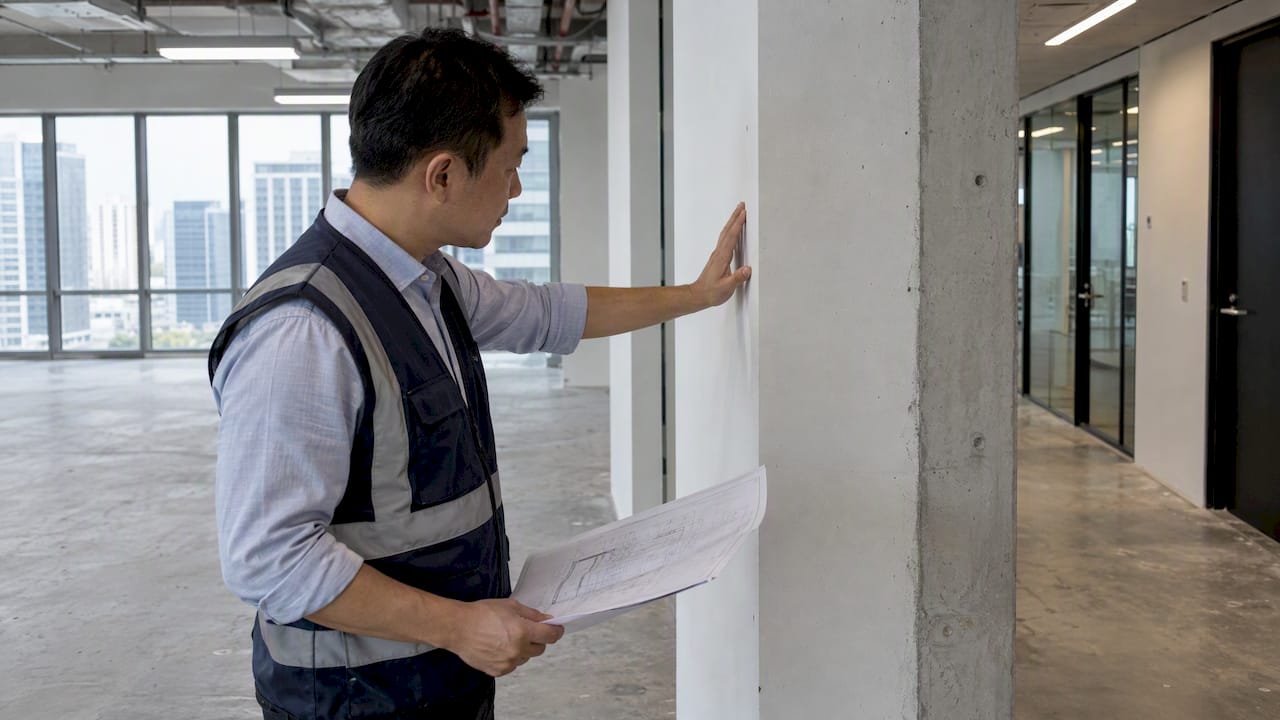
An authority compliance audit is a regulatory review of building works in Singapore against the requirements of agencies such as BCA and SCDF. It is not a financial audit. Before a TOP inspection, confirm that your Qualified Person (QP) will attend, that CORENET submissions are complete, and that Certificates of Supervision and RI certificates are at hand. For a Periodic Structural Inspection, confirm that the Structural Engineer (SE) will conduct it personally.
TL;DR:
- Submit Certificates of Supervision and QP declarations through CORENET at least 3 days before inspection, and ensure the QP attends the TOP inspection.
- For every Periodic Structural Inspection, the Structural Engineer must inspect personally; delegated checks, reused photographs, or incomplete coverage can trigger enforcement.
- BCA processes complete CSC submissions within 7 working days, while SCDF typically responds to FSC and TFP applications within 3 working days.
- Nonresidential buildings need PSI every 5 years, residential buildings every 10 years, and qualifying buildings typically older than 20 years require PFI at set intervals.
- An FSC is issued only after all fire safety works are complete; a TFP may permit limited use before completion.
Table of Contents
- What does an authority compliance audit cover?
- Who must be involved, and what must each person do?
- How do you prepare for the audit step by step?
- Which non-compliances cause the most delays?
- Which forms and CORENET submissions do auditors expect?
- How do PSI and PFI feed into compliance audits?
- Why audits are won on coordination, not on the day
- How we help you pass authority compliance audits
- FAQ
- Sources
What does an authority compliance audit cover?
Auditors test completed works against what was approved, not merely whether construction has finished. BCA, which administers the TOP/CSC process, is the central checkpoint, and SCDF reviews fire safety provisions. Depending on the project, URA, PUB, NEA and LTA contribute specialist clearances.
Auditors compare the building with approved plans, as-built drawings, test reports and statutory codes. Where a fire design is performance-based, they also check it against the agreed engineering basis. The Fire Code sets the minimum fire safety requirements and expects QPs to submit up-to-date documentation to SCDF.
Expect auditors to ask for Certificates of Supervision, QP declarations, RI inspection certificates, O&M manuals and as-built plans. A missing document is treated as a gap in compliance, however sound the physical works are.
Who must be involved, and what must each person do?
The QP must be present for TOP inspections. The BCA TOP/CSC Portal states that QPs submit Certificates of Supervision and declarations before the inspection and may reschedule through the portal if they cannot attend. Authority inspections audit compliance, and QPs are expected to show due diligence and active management during construction.
The SE must conduct each Periodic Structural Inspection personally. A BCA circular on PSI conduct warns against delegating inspection, reusing photographs and inadequate coverage, and flags enforcement risk.

For performance-based fire designs, a Fire Safety Engineer (FSE) prepares the Fire Safety Engineering Design Brief, and an independent Peer Reviewer assesses the documents under SCDF’s performance-based plan approval process. A Registered Inspector (RI) issues the inspection certificates behind the Fire Safety Certificate. For façades, a Competent Person (CP) oversees the inspection, and accredited UAS providers may support visual checks under the PFI requirements.
How do you prepare for the audit step by step?
- Finalize as-built drawings and confirm they match what was built.
- Submit the TOP/CSC documents (Certificates of Supervision and QP declarations) through CORENET at least 3 days before the inspection.
- Assemble the evidence file: laboratory and test reports, RI certificates, O&M manuals.
- Confirm attendance of the QP and SE, and give them the full set.
- Open access to plant rooms, risers and other critical areas on the day.
- Use a virtual or 360-degree capture where the authority’s virtual inspection option applies.
- Answer every recorded non-compliance promptly, log the rectification works, and re-submit evidence for clearance.
On timing, BCA processes a CSC within 7 working days for a complete submission, according to its TOP/CSC guidance. SCDF typically responds to FSC and TFP applications within three working days and may select a project for inspection within about 10 days, per its Fire Safety Certificate guidance. An express TOP inspection exists with a fee. Treat it as a last resort, not a planning assumption.
Pro Tip: Run an internal mock audit before the submission date, with the QP reading the evidence file as an auditor would.
For a longer list, see our Singapore construction compliance checklist.
Which non-compliances cause the most delays?
Most delays trace back to paperwork and attendance, not to defective construction.
- Incomplete certificates: missing Certificates of Supervision or RI inspection forms stall a submission at the first check.
- Absent or delegating engineers: QP or SE absence, reused photographs and off-date evidence undermine the credibility of the whole file.
- Periodic inspection gaps: unreported unauthorized structures, missing floor load diagrams in premises that changed use, and inadequate checks of concealed structures. Owners frequently overlook the diagrams, and they must be rectified before a review will pass.
- Fire submission defects: incomplete Fire Safety Engineering Design Brief material, or a performance-based design submitted without independent peer review, leads to rejection.
Many fire-related failures begin with compartmentation errors, which we cover in our article on SCDF inspection failures. Digital workflows that track document completeness can also help, as shown in this partner insight on audit-ready safety compliance.
Which forms and CORENET submissions do auditors expect?
Prepare these before the inspection date:
- Certificate of Supervision and QP declaration, submitted through the TOP/CSC portal
- As-built plans consistent with the approved scheme
- RI inspection certificates (Forms 1 and 2) for FSC and TFP applications
- Fire Safety Engineering Design Brief and peer review report for performance-based proposals
- BCA’s official PSI and PFI report templates and appointment forms, submitted within the stipulated timeframe
SCDF typically responds to FSC and TFP applications within three working days, and may select a project for inspection within about 10 days (source). Documents must therefore be inspection-ready on the day you submit them.
Note that the FSC is issued only after fire safety works are fully complete, while a TFP may allow limited use beforehand. Buildings under the Fire Certificate scheme also carry ongoing testing obligations, described on SCDF’s Fire Certificate page. Our own Fire Safety Certificate page walks through the document set.
How do PSI and PFI feed into compliance audits?
Periodic inspections are the owner’s standing obligation, and a clean record makes any later audit easier. Under the PSI regime, non-residential buildings are inspected once every 5 years and residential buildings once every 10 years. Owners must appoint an SE and ensure reports are submitted on time using the official templates.

The PFI regime applies to qualifying buildings, typically those older than 20 years, at set intervals. Owners must appoint a CP and rectify defects promptly. Our guide for owners explains why periodic facade inspections matter now.
Scheduling these inspections early, and closing out findings before they escalate, lowers both audit risk and exposure to enforcement under the Building Control Act.
Why audits are won on coordination, not on the day
Most teams treat an audit as an event. In our view it is the end of a long documentation discipline. The projects that clear inspection without findings are rarely those with the best construction. They are the ones where the QP, SE, RI and contractor share an evidence file early, and where nobody discovers on inspection morning that a certificate belonged to a different revision of the plans.
The common instinct is to prepare harder in the final week. That helps less than assigning one coordinator early to own the CORENET submissions, chase the RI and CP, and track every recorded non-compliance to closure. Our team works this way: single-point statutory coordination, a multidisciplinary PE team, and BIM-enabled documentation. Deliverables typically include document collation, CORENET submissions, RI and CP liaison, and rectification management.
— Aman
How we help you pass authority compliance audits
If your project faces a TOP/CSC inspection, an FSC or TFP application, or a periodic inspection cycle, we can take on the statutory coordination so your team does not have to carry it alone. Our work for audit readiness includes:
- Authority Approvals, including PSI, PFI and FSC coordination
- PE Endorsements for the submissions that require them
- Real Estate Inspection for owners who want findings identified before an authority does
- BIM documentation that keeps drawings and records consistent
One point of contact reduces the back-and-forth that delays TOP/CSC and FSC/TFP outcomes. Review our Authority Approvals services and our Real Estate Inspection service, then request a consultation to scope your audit.
FAQ
What is an authority compliance audit in Singapore?
It is a review of building works against the requirements of agencies such as BCA and SCDF, covering approved plans, as-built drawings, test reports and supporting certificates. It checks compliance, not only completion.
Does the QP have to attend the TOP inspection?
Yes. The BCA TOP/CSC Portal states that QPs must be present for TOP inspections. A QP who cannot attend may reschedule through the portal.
How early must TOP/CSC documents be submitted?
Certificates of Supervision and QP declarations must be submitted at least 3 days before the inspection, per the BCA TOP/CSC guidance. Late or incomplete submissions risk delaying the inspection.
How often are PSI and PFI required?
PSI is required once every 5 years for non-residential buildings and once every 10 years for residential buildings. Qualifying buildings older than 20 years also need PFI at set intervals, as BCA’s periodic building inspection guidance explains.