
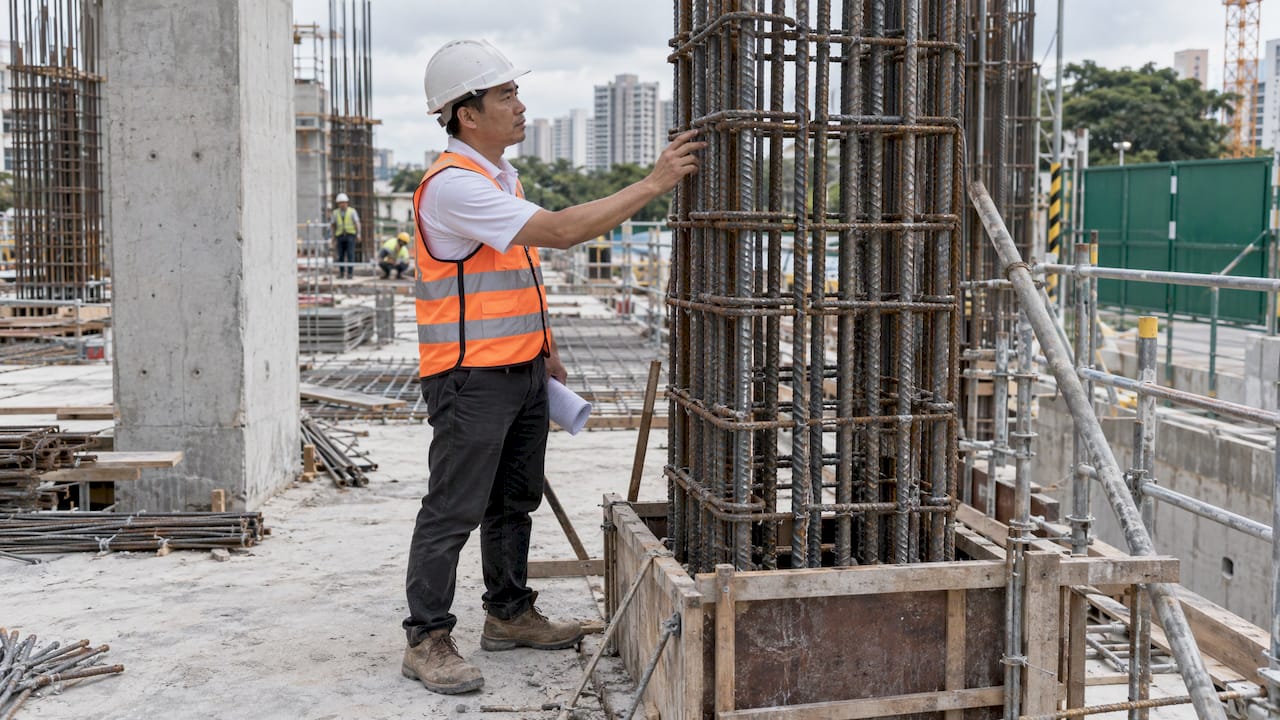
Structural works in Singapore must be supervised on site by persons appointed by the Qualified Person (QP), and the Building and Construction Authority (BCA) sets the type and number of site supervisors according to the value of the building works. Small-scale works of up to $7.5 million require immediate supervision by a QP, a Resident Engineer (RE) or a Resident Technical Officer (RTO). Larger works require full-time supervision by a combination of REs and RTOs, with the combination rising in step with project value. This article sets out the legal basis, the supervisor matrix, the site supervision plan, the records that must be kept and the consequences of non-compliance.
TL;DR
- The Building Control Act 1989 requires structural works to be carried out under the supervision of an appropriate QP and the necessary site supervisors.
- Works valued at up to $7.5 million need immediate supervision; works above $7.5 million need full-time supervision by RTOs and REs, scaled to project value.
- The QP appoints site supervisors during the permit application, and all qualified site supervisors must be accredited under the IES and ACES Joint Accreditation Committee.
- The QP must maintain a structural-works schedule, attendance records, a site record book and inspection records for the duration of the works.
- Any reduction in supervisor numbers at different construction phases must be notified to BCA during the permit application.
Table of Contents
- Legal basis for site supervision
- Who is responsible: QP, RE and RTO
- How many site supervisors are required
- The site supervision plan
- Records and inspections that must be kept
- Consequences of inadequate supervision
- Practical checklist for developers and building owners
- Perspective
- How Aman Engineering supports compliant supervision
- FAQ
- Sources
Legal basis for site supervision
Site supervision of structural works is a statutory obligation, not a contractual preference. The Building Control Act 1989 places the supervision of structural works under the responsibility of the appropriate QP, who must ensure that site supervisors are in place to carry out the supervision on the QP’s behalf. The subsidiary legislation, including the Building Control Regulations 2003, prescribes the records, inspections and approvals that must accompany the works at defined stages.
The supervision obligation attaches to the permit for structural works. When the QP submits the structural plans and applies for the permit, the supervision arrangement is declared as part of that application. For an overview of how the permit sits within the wider submission sequence, see our guide to BCA structural submissions.

Works that attract supervision requirements
Supervision requirements are directed at the structural elements of a building, where an error cannot readily be corrected after completion. Activities that typically fall within scope include:
- Piling and foundation works
- Earth-retaining and excavation-related structures
- Concreting of structural members
- Construction of the structural frame
- Ancillary and external structural works such as external cladding, safety barriers, covered walkways and detached single-storey buildings
Supervision of non-structural work is treated differently. According to the IES registry guidance, accreditation as an RE or RTO is not required for site supervisors who supervise only non-structural work in a development project.
Who is responsible: QP, RE and RTO
Three roles recur in every supervision arrangement, and each carries a distinct function.
| Role | Function in site supervision |
|---|---|
| Qualified Person (QP) | Holds overall responsibility for the supervision of structural works, appoints the site supervisors in the permit application and bears the legal accountability under the Building Control Act |
| Resident Engineer (RE) | Carries out on-site supervision under the QP’s direction, typically on larger or more complex works |
| Resident Technical Officer (RTO) | Carries out on-site supervision under the QP’s direction, monitoring key structural activities and maintaining site records |
The QP is the link between the builder’s activities on site and BCA’s regulatory expectations. Appointing a QP correctly is therefore the first step in any supervision arrangement, and our note on how to appoint QPs for Singapore building works covers the appointment process.
Accreditation of site supervisors
Per BCA’s site supervisor requirements, all qualified site supervisors must be accredited with the Joint Accreditation Committee (JAC) of the Institution of Engineers Singapore (IES) and the Association of Consulting Engineers Singapore (ACES). The IES/ACES C&S RE/RTO Registry administers this accreditation. For applications from 1 September 2026, applicants must hold original physical diploma or degree certificates and academic transcripts before applying, and after submitting online they must email the documents to IES.
Project teams should verify the accreditation status of each proposed RE and RTO before the permit application is lodged, because the names declared in the application form part of the supervision arrangement.
How many site supervisors are required
The number and type of supervisors depend on the value of the building works. BCA distinguishes between immediate supervision for small-scale works and full-time supervision for large works.
Small-scale building works
For structural works in small-scale building works with a value of up to $7.5 million, BCA requires immediate supervision by an appropriate QP, an RE or an RTO.
Large building works
For large building works, full-time supervision applies. The table below reproduces the matrix published by BCA, with the stage headings as BCA defines them. Stage A is piling and foundation works, Stage B is after 80% completion of building works, and Stage C is ancillary and external works.
| Value of building works | All stages except A, B and C | Stage A | Stage B | Stage C |
|---|---|---|---|---|
| More than $7.5 million to $15 million | 1 RTO | 1 RTO | 1 RTO | 1 RTO |
| More than $15 million to $30 million | 1 RE | 1 RE | 1 RE | 1 RTO |
| More than $30 million to $75 million | 1 RE + 1 RTO | 1 RE | 1 RE | 1 RTO |
| More than $75 million to $150 million | 1 RE + 2 RTO | 1 RE + 1 RTO | 1 RE + 1 RTO | 1 RTO |
| More than $150 million | 2 RE + 3 RTO or 1 RE + 5 RTO | 2 RE + 1 RTO or 1 RE + 3 RTO | 1 RE + 1 RTO | 1 RTO |
Source: BCA, Site Supervisor requirements. Project teams should confirm the current figures on the BCA page before finalizing a deployment plan.
How the value of works is determined
The value used to read the matrix is defined by BCA. For underground building works, it is the total cost to be expended in carrying out those works, estimated at the time of application. For other building works, it is the total cost of carrying out the works, including the foundations, basements, structural frame, finishes and the installation of building services, again estimated at the time of application. A project team that estimates only the structural package will place the project in the wrong band, so the estimate should be prepared on the full definition.
Reduced deployment at different phases
The matrix already reflects lower supervisor numbers at Stages A, B and C. Where the QP intends to deploy fewer site supervisors at different construction phases than the standard arrangement, BCA states that the QP must notify BCA during the permit application, using form BCA-BE-PERMIT_A4. Reduced deployment that is not notified is not a permitted arrangement.
The site supervision plan
The site supervision plan documents how the structural and geotechnical works will be supervised on site. BCA provides a Site Supervision Plan template on its permit for structural works page, last updated in April 2024. The QP prepares the plan, and it should be consistent with the supervisor numbers declared in the permit application.
A well-prepared plan typically addresses the following:
- The identity, accreditation and role of each site supervisor
- The structural activities to be supervised, in the sequence in which they will occur
- The supervisor deployment at each construction phase, aligned with the matrix above
- The critical stages at which inspections must take place before work proceeds, such as before concreting
- The mechanism for recording instructions and for escalating non-conformances to the QP
The plan is a working document. When the construction programme changes, the plan should be revised so that it still describes the supervision that is actually taking place. Inconsistencies between the plan, the permit application and the situation on site are a common source of queries from the authority; our review of common reasons for BCA structural submission rejections shows how such gaps arise.
Records and inspections that must be kept
Supervision is demonstrated through documentation. According to BCA’s page on construction site records, the QP must keep:
- A 3-month structural-works schedule
- Attendance records of the site supervisors
- A site record book
- The approved plans and any amendments
- Records of inspections carried out before concreting
- Records of pile load tests
The Building Control Regulations 2003 add further on-site documentation, including records for pile installations, concrete cube tests, welding certificates and inspection approvals at stages such as excavation and installation.
The Building Control Act 1989 expects site supervisors to record the time they spend on site, to enter comments and instructions in the site record book and to monitor the key structural elements. Records that are made contemporaneously, signed and dated are those that withstand scrutiny at audit or at the application for a temporary occupation permit.
Construction programmes that publish regular progress documentation benefit from the same discipline; a developer’s construction progress updates illustrate how dated, stage-by-stage reporting keeps a project’s status traceable, which is the principle behind the supervision record.
Changes to approved structural plans
Where a change is material and requires redesign of key structural elements, BCA states on its permit for structural works page that approval must be obtained before the change is carried out on site. Site supervisors should therefore be instructed not to accept field changes to key structural elements without confirmation from the QP that approval has been secured.
Consequences of inadequate supervision
The Building Control Act requires structural works to be carried out under the supervision of an appropriate QP and the necessary site supervisors. Failure to provide that supervision is a contravention of the Act. In practice the consequences can include enforcement action by the authority, penalties under the Act, and delay to the project when supervision or records cannot be demonstrated at the permit or completion stages. The precise offences and penalties are set out in the Act itself, and project teams should refer to the current text on Singapore Statutes Online.

The project consequences are often more immediate than the legal ones. A missing site record book entry, an unrecorded pre-concreting inspection or an unaccredited supervisor can hold up the next stage of work, and the ensuing delay affects contractors, financiers and end purchasers alike.
Practical checklist for developers and building owners
- Confirm the value of building works on the full BCA definition and read the matrix accordingly.
- Appoint the QP early and confirm which supervisors the QP intends to deploy.
- Verify the JAC accreditation of every proposed RE and RTO.
- Submit form BCA-BE-PERMIT_A4 with the permit application if reduced deployment is planned.
- Prepare the site supervision plan on the current BCA template.
- Set up the site record book, attendance register and 3-month schedule before work starts.
- Schedule and record inspections before concreting and pile load tests.
- Route any change to key structural elements through the QP and BCA before it is built.
For a wider view of the approvals that run alongside supervision, our guide to BCA submissions for Singapore building projects outlines the sequence from plan approval to completion.
Perspective
Our experience with statutory submissions is that supervision failures rarely originate on the day of a concrete pour. They originate earlier, when the supervision arrangement declared in the permit application does not match the programme the contractor intends to build.
We therefore coordinate the structural submission, the site supervision plan and the deployment of accredited supervisors as one workstream. Our multidisciplinary PE team and single-point statutory coordination are designed to keep the declared arrangement, the records and the site reality aligned, so that the authority sees one consistent picture throughout.
Drone-assisted inspection and BIM coordination add a further layer of documented evidence, and in our view documented evidence is what makes supervision defensible. Developers who treat supervision as a planned deliverable, and not as a late-stage formality, are better placed to proceed through each stage without interruption.
Aman
How Aman Engineering supports compliant supervision
Aman Engineering Consultancy provides authority approvals and PE endorsements for building and infrastructure projects in Singapore, and supports project owners with project management from submission through to completion. We claim a 99% authority clearance rate and coordinate statutory requirements across BCA, URA, SCDF, PUB, LTA and other agencies.

Property developers, contractors and building owners who require assistance with the permit application, the supervision arrangement or the related records may contact us through the Aman Engineering website.
FAQ
Who appoints the site supervisors for structural works?
The Qualified Person appoints the site supervisors during the permit application to BCA. The appointed REs and RTOs must be accredited with the IES and ACES Joint Accreditation Committee.
Is full-time supervision required for every project?
No. Works valued at up to $7.5 million require immediate supervision by a QP, an RE or an RTO. Full-time supervision applies to large building works above $7.5 million, with the number of supervisors set by the value band.
Do non-structural site supervisors need RE or RTO accreditation?
Accreditation as an RE or RTO is not required for site supervisors who supervise only non-structural work in a development project, according to IES guidance. The accreditation requirement relates to the supervision of structural works.
Can fewer supervisors be deployed at certain phases?
Yes, provided the QP notifies BCA during the permit application using form BCA-BE-PERMIT_A4. The matrix already provides for different numbers at piling, post-80% completion and ancillary works stages.
What records must be kept on site?
The QP must keep a 3-month structural-works schedule, attendance records, a site record book, the approved plans and amendments, and records of inspections before concreting and of pile load tests.
Sources
- Building Control Act 1989, Singapore Statutes Online
- Building Control Regulations 2003, Singapore Statutes Online
- BCA: Site Supervisor requirements
- BCA: Permit for structural works
- BCA: Construction site records
- IES/ACES C&S RE/RTO Registry