
Introduction
Carbonation depth testing tells you exactly how far atmospheric carbon dioxide has penetrated into your reinforced concrete and whether the embedded steel reinforcement has lost its protective alkaline environment. In concrete structures across Singapore and ASEAN, where high humidity, urban CO₂ concentrations, and marine exposure accelerate this process, measuring carbonation depth with a phenolphthalein indicator test is the most direct way to determine whether reinforcement bars have become unpassivated-and whether remediation is overdue.
The process works like this: when carbon dioxide diffuses through the concrete matrix, it reacts with calcium hydroxide in the pore solution to form calcium carbonate, progressively lowering pH from a healthy 12.5–13.5 range down to below 9.0. Once this carbonation front reaches the reinforcement level, the passive oxide film on the steel surface breaks down, and corrosion initiates in the presence of moisture and oxygen. Phenolphthalein indicator solution, sprayed onto a freshly exposed concrete surface, turns pink or purple where pH remains above approximately 8.3 and stays colourless in carbonated zones-giving engineers a clear, visual map of the carbonation front relative to the concrete cover over reinforcing steel.
Remediation of carbonated and unpassivated zones typically combines localised repairs using high-alkaline, polymer-modified repair mortars to restore pH around embedded reinforcement, followed by the application of anti carbonation coatings across the full exposed surface to block further CO₂ ingress. This article focuses on on-site phenolphthalein indicator testing, interpretation of carbonation test results, and practical remediation strategies. It does not cover cathodic protection systems or chloride-only degradation in depth, though these topics overlap.
This guide is written for facility managers, property owners, and consultants responsible for mid- to high-rise residential buildings, office towers, car parks, and infrastructure in tropical urban and coastal environments-particularly Singapore.
Key takeaways you will gain from this article:
-
How to read and interpret a carbonation depth measurement report, including mean vs maximum depth and comparison with cover
-
When reinforcement bars are considered “unpassivated” and what that means for corrosion risk
-
How anti-carbonation coatings and alkaline repair mortars are selected based on performance criteria and local standards
-
The step-by-step remediation workflow used on Singapore building façades and infrastructure
-
What a multidisciplinary consultancy like AMAN Engineering Consultancy Pte Ltd typically provides, from sampling plans through BIM-integrated monitoring
Understanding Concrete Carbonation and Rebar Unpassivation
Concrete carbonation is a CO₂-driven chemical process that progressively neutralises the alkaline concrete environment protecting embedded steel. As atmospheric carbon dioxide enters through pores and micro-cracks, it dissolves into the pore water to form carbonic acid, which reacts with calcium hydroxide-the primary pH buffer in hardened concrete-to form calcium carbonate. This carbonation reaction consumes hydroxide ions and drives pH reduction from around 12.5–13.5 in healthy concrete down to approximately 8–9 in fully carbonated zones.
In Singapore’s dense urban and coastal setting, this mechanism is particularly aggressive. Average ambient temperatures of around 27°C, persistent high humidity, periodic wetting-drying cycles, marine aerosol exposure, and elevated urban CO₂ from traffic and industry all accelerate carbonation. Studies on Singapore concrete structures aged 7 to 59 years have recorded carbonation constants (K) of approximately 7 mm/√year for typical building-grade concrete, meaning older structures with modest cover depths are highly vulnerable.
What Is Carbonation Depth in Reinforced Concrete?
Carbonation depth is the measured distance from the exposed surface of a concrete element inward to the carbonation front-the boundary where pH has fallen below the protective threshold for steel reinforcement. Healthy concrete maintains a high pH between 12.5 and 13.5, sustained by dissolved calcium hydroxide and calcium silicate hydrates. As the carbonation reaction proceeds, this pH drops progressively. Carbonation lowers concrete pH from 12.5 to below 9.0 in fully carbonated zones, and it is at this reduced pH that the alkaline concrete environment can no longer sustain the passive film on reinforcing steel.
Carbonation depth progresses following an approximate square-root-of-time relationship: depth ≈ K × √t, where K is the carbonation rate constant (in mm/√year) and t is the age of the structure in years. Several material and environmental factors influence K significantly. A lower water-cement ratio and higher compressive strength produce denser concrete with greater carbonation resistance. Concrete quality significantly affects carbonation rates and depth-research by Tam, Lim, and Sisomphon on 21 concrete mixes in Singapore confirmed that after 14 years of natural exposure, the 28-day compressive strength and w/c ratio were the strongest predictors of carbonation depth, while cement content alone had less direct effect. Environmental factors also matter: relative humidity in the 50–70% range favours faster carbonation, carbonation progresses faster in wet-dry cycles than in constant conditions, and carbonation depth increases with higher CO₂ concentrations in urban areas.
The critical connection is straightforward: once the carbonation front reaches the reinforcement level-equalling or exceeding the concrete cover-the embedded steel loses its alkaline protection and corrosion risk rises sharply. Carbonation depth can reach 50% of concrete cover in 20 years for average-quality concrete under tropical exposure, and carbonation depth can reach 63% of concrete cover in older or lower-strength structures assessed in Singapore.
Rebar Passivation vs Unpassivation
“Passivated” steel reinforcement sits within an environment of high-alkaline pore solution, typically above pH ~11, where a thin but stable passive oxide film forms on the steel surface. This film is only nanometres thick yet highly effective: it prevents corrosion of reinforcing steel even when moisture and oxygen are present, provided the alkalinity remains intact.
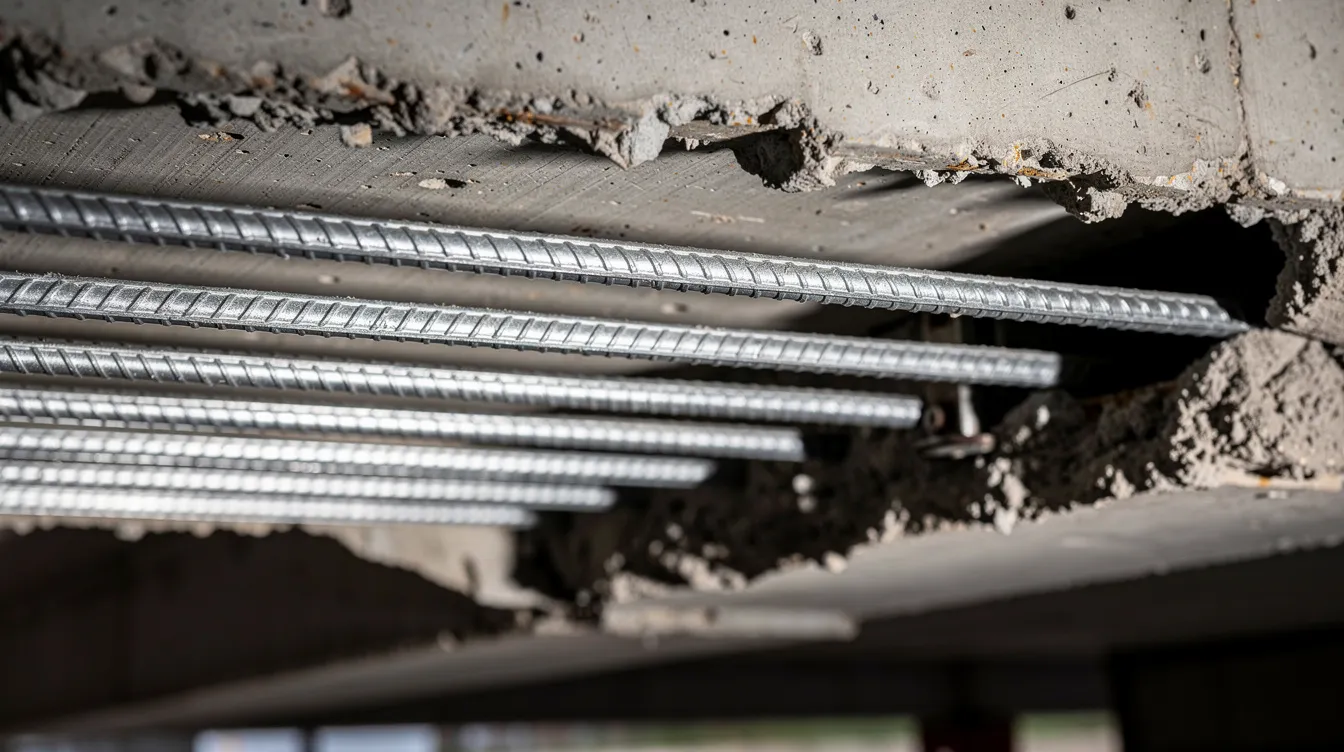
“Unpassivated” reinforcement bars are those where carbonation or other mechanisms have reduced the surrounding pH below approximately 9, destabilising the passive oxide film. At this point, corrosion initiates when carbonation reaches the reinforcement depth-provided moisture and oxygen are available, which they almost always are in Singapore’s climate. Steel corrosion can cause cracking and spalling in concrete as rust products expand to several times the volume of the original steel, generating significant internal tensile stresses. Carbonation can lead to premature failure of reinforced concrete structures if unpassivation goes undetected and untreated.
In practice, engineers look for convergence of several indicators: carbonation depth ≥ concrete cover at the test point, rust staining on the concrete surface, pattern cracking or delamination, and visible damage such as spalled cover exposing corroded areas. In Singapore’s exposure conditions, structural elements often face combined deterioration-carbonation from the atmosphere paired with chloride ingress from marine spray on façade beams, balcony edges, and car park slabs. This combination accelerates the onset of active corrosion beyond what either mechanism would cause alone.
Understanding why rebars become unpassivated leads directly to the question of how to detect this condition reliably in existing structures-and that is where systematic on-site carbonation depth testing becomes essential.
Carbonation Depth and Rebar Unpassivation Testing in Practice
Translating the science of concrete carbonation and steel depassivation into actionable data requires systematic field testing. Without measured carbonation depths compared against actual reinforcement cover at multiple locations across a structure, engineers cannot distinguish between elements that are decades away from corrosion initiation and those where active corrosion is already underway.
AMAN Engineering Consultancy integrates carbonation depth testing into broader structural inspection campaigns and periodic façade inspections (PFI), ensuring that carbonation data feeds directly into remediation design, authority submissions, and long-term maintenance planning.
Phenolphthalein Indicator Test: Core Method for Carbonation Front Detection
Phenolphthalein is a common method for testing carbonation depth in concrete. The chemistry is straightforward: phenolphthalein indicator is a pH-sensitive dye that undergoes a colour change at approximately pH 8.3. When a phenolphthalein indicator solution (typically 1 g dissolved in 70 mL of ethanol, made up to 100 mL with deionised water) is sprayed onto a fresh surface of concrete, uncarbonated zones turn vivid pink or purple-the pink uncarbonated zone-while carbonated concrete remains colourless. The boundary between these two regions marks the carbonation front.
Field and laboratory procedure:
-
Expose a fresh concrete surface by extracting a core, splitting a drilled sample, or carefully chiselling to reveal an undisturbed cross-section. The freshly exposed concrete surface must be free from dust and should not be wetted before testing.
-
Spray the phenolphthalein indicator solution evenly across the exposed surface. The colour change develops within approximately 30 seconds-pink/purple in high-pH zones, colourless where carbonation has occurred.
-
Measure the carbonation depth from the outer concrete surface to the edge of the coloured (uncarbonated) region, recording both mean depth (dk_mean) across the section and maximum depth (dk_max) at any point. Use calipers or a ruler to the nearest millimetre.
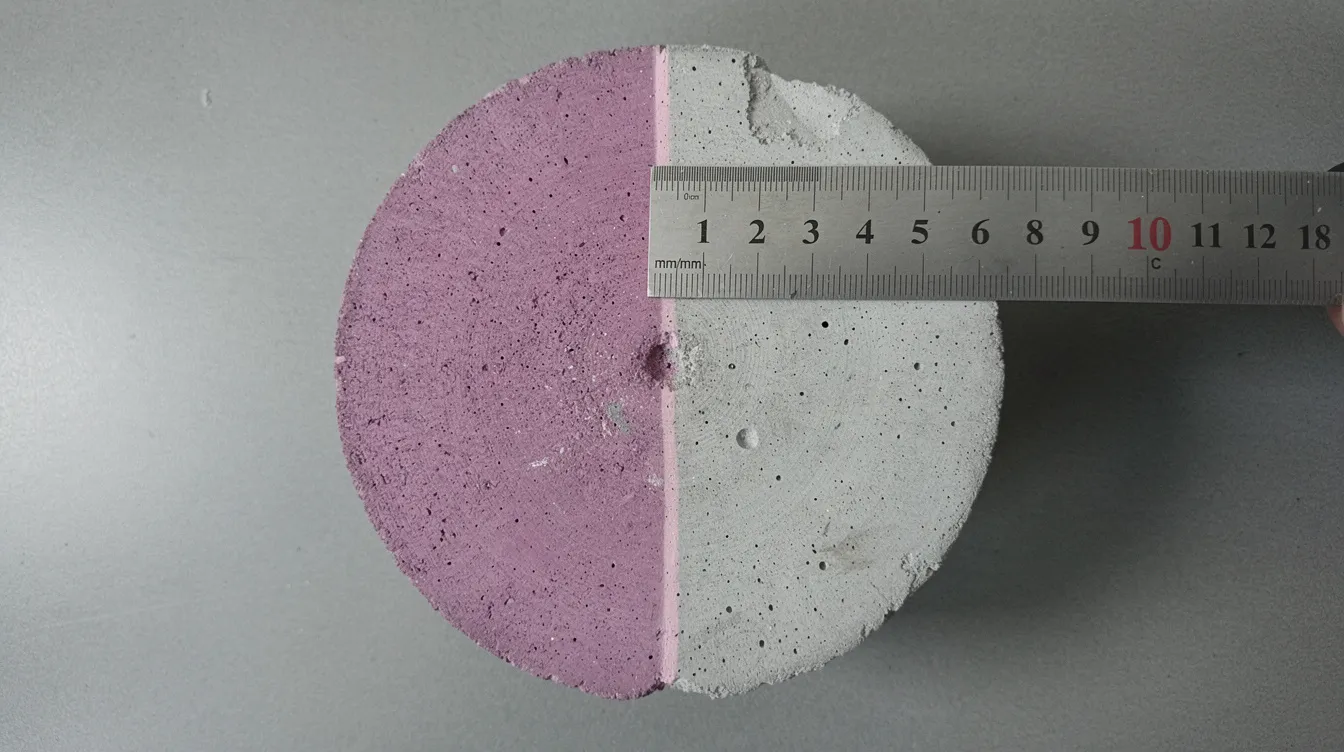
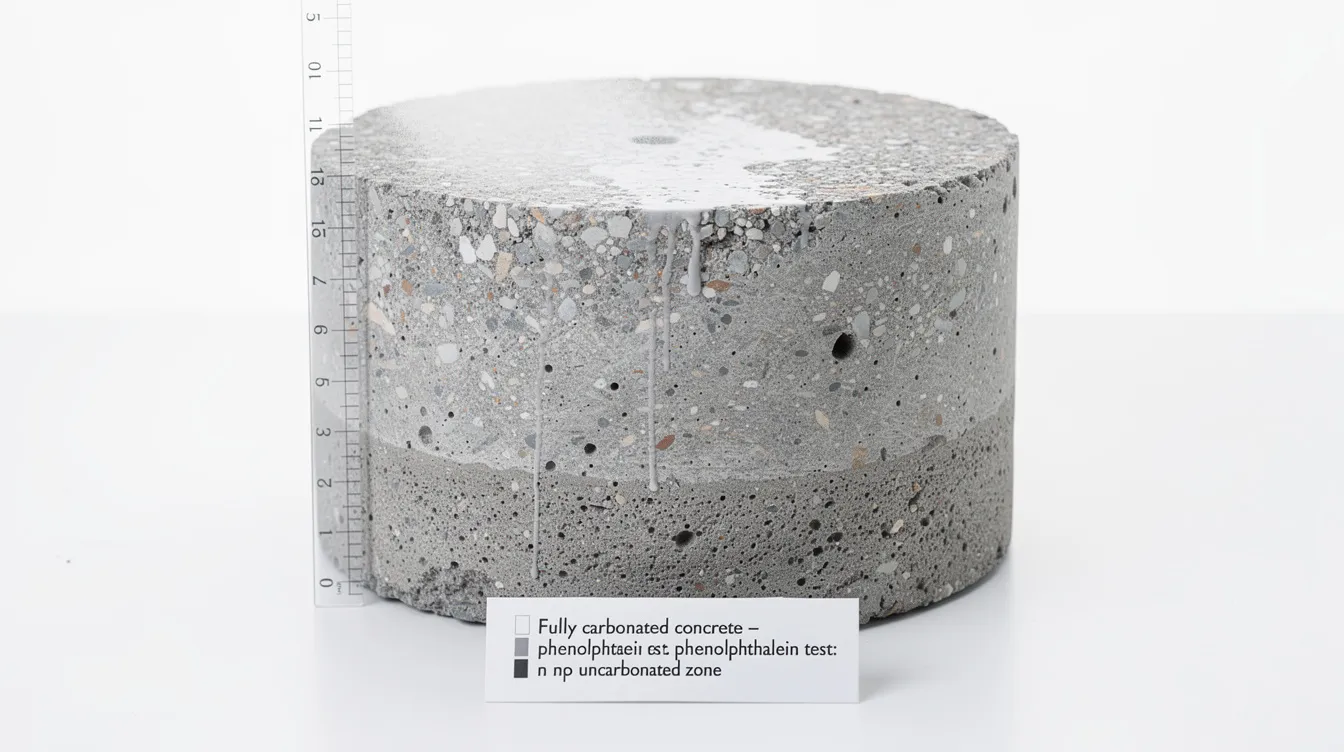
The carbonation depth test follows BS EN 14630 standards, which is the principal reference for phenolphthalein-based carbonation depth measurement. RILEM Recommendation CPC-18 provides complementary guidance, and recent RILEM TC 281-CCC reviews have highlighted the importance of standardized procedures-particularly regarding indicator concentration, reading time (ideally within one hour of exposure), and sample preconditioning-to ensure consistency across tests.
Advantages: The phenolphthalein indicator test is rapid, inexpensive, and widely recognised across international standards. It gives an immediate visual map of the carbonation front that can be photographed and measured on site.
Limitations: The test detects pH transition around 8.2–10, not the higher threshold (~11) where some early depassivation may begin. In concrete containing supplementary cementitious materials such as slag or fly ash, the darker paste colour can mask the indicator response, and the reduced portlandite content in these mixes may produce less distinct colour boundaries. Moisture content at the time of testing also influences visibility-overly wet surfaces can dilute the indicator, while testing must be done immediately after breaking to avoid surface carbonation from air exposure creating false readings. Core samples are used for detailed carbonation analysis when spray tests on broken surfaces are insufficient.
Sampling Strategy and On-Site Execution
Effective carbonation assessment requires testing at multiple locations across a structure, selected to capture the range of exposure conditions and structural risk. Test locations typically prioritise:
-
Highest-exposure elements: External façade beams, balcony soffits and edges, transfer beams, car park slab soffits, and marine-facing structural elements
-
Visibly distressed areas: Zones showing rust staining, pattern cracking, delamination, or spalling-these are candidates for the most advanced carbonation and active corrosion
-
Representative orientations: Windward vs leeward faces, different compass orientations (north/south/east/west), and different storey levels (upper storeys exposed to more wind-driven rain; lower levels to splash zones)
For a typical mid-rise residential block, sampling might include 6–10 cores per elevation, with additional samples concentrated in high-risk bays. Before coring, a calibrated electromagnetic covermeter is used to measure actual concrete cover over the reinforcement at each proposed test location-this cover measurement is essential because the carbonation depth number only becomes meaningful when compared against the actual reinforcement cover at that same point.
Testing must be executed immediately after exposing the fresh surface. Delays allow surface carbonation from ambient air, which can bias the carbonation depth measurement upward and lead to overestimation of risk. Documentation at each test point should include high-resolution photographs with a scale showing the colour change boundary, precise depth measurements, location identified on a building layout plan, concrete age, cover depth from covermeter, and moisture condition of the sample at the time of testing.
Complementary Tests for Corrosion and Structural Condition
Phenolphthalein-based carbonation testing identifies where the alkaline environment has been lost, but it does not directly confirm whether active corrosion is occurring. When carbonation depth testing reveals unpassivation at multiple points, additional tests are typically recommended:
-
Half-cell potential mapping (ASTM C876): Measures the electrochemical potential between embedded reinforcement and a reference electrode placed on the concrete surface. More negative readings indicate higher probability of active corrosion. This is particularly valuable for confirming whether unpassivated zones identified by phenolphthalein are actually corroding or remain dormant.
-
Concrete resistivity testing: Lower resistivity indicates greater ease of ionic flow and faster corrosion rates where steel is already unpassivated.
-
Compressive strength assessment: Rebound hammer screening, ultrasonic pulse velocity, or laboratory testing of extracted cores helps characterise concrete quality and correlate with carbonation rate.
-
Cover thickness surveys: Systematic covermeter mapping across entire elements, not just at carbonation test points, to identify thin-cover zones at highest risk.
These complementary methods feed into the overall structural assessment and help engineers move from raw carbonation data to a prioritised remediation design. Testing is only useful, however, if the results are correctly interpreted-and that requires comparing carbonation front position against actual cover at each location.
Interpreting Carbonation Test Results and Assessing Rebar Unpassivation Risk
Raw carbonation depth numbers become meaningful only when evaluated against the actual reinforcement cover at each test point. In Singapore’s building stock, particularly in structures built between the 1970s and 1990s, typical cover values are often modest: approximately 20–25 mm for interior beams and 30–40 mm for external façade elements and marine-exposed structures. These values, combined with tropical carbonation rates, mean that many existing structures assessed today are approaching or have already passed the point of rebar unpassivation.
Comparing Carbonation Front vs Concrete Cover
Engineers compare the measured carbonation depth from the phenolphthalein test with the actual cover depth from covermeter readings or exposed rebar measurements at each test location. Carbonation depth is critical for assessing the risk of rebar corrosion, and this comparison drives a simple but effective risk categorisation:
-
Safe / Acceptable: Mean carbonation depth < 50% of measured cover. No visible rust staining, no indications of active corrosion. Structure remains well within its protective window.
-
At Risk / Moderate: Mean carbonation depth between 50–90% of cover. Maximum depth may approach or slightly exceed cover at isolated points. Some surface discolouration or minor aesthetic rust staining may be present. Proactive monitoring and preventive surface protection are warranted.
-
Critical / Repair Immediately: Maximum carbonation depth ≥ cover, or carbonation has clearly reached or passed the reinforcement level. Visible damage including spalling, delamination, or exposed corroded areas. Corrosion of reinforcing steel reduces load-bearing capacity significantly at this stage, and structural remediation is urgent.
Partial carbonation around corners and edges of beams or columns often penetrates from two directions simultaneously, creating deeper fronts than flat surface measurements suggest. These corner zones warrant separate evaluation. Simple diagrams mapping the carbonation front profile against cover depth at each test point-rather than relying on single average numbers-give the most accurate risk picture.
Estimating Carbonation Rate and Residual Service Life
Carbonation testing helps assess remaining service life of structures. The average carbonation rate is estimated by dividing the measured carbonation depth by the square root of the concrete’s age at the time of testing: K = d / √t. This rate constant can then be used to project when the carbonation front will reach the full reinforcement cover under similar environmental exposure.
Typical rates observed in tropical urban conditions vary significantly with concrete quality:
|
Concrete Quality |
Compressive Strength |
Approximate K (mm/√year) |
Time to Reach 30 mm Cover |
|---|---|---|---|
|
Poor |
< 20 MPa |
8–9 |
~11–14 years |
|
Average |
20–30 MPa |
5–7 |
~18–36 years |
|
Good |
> 30 MPa |
3–5 |
~36–100 years |
Carbonation rate is influenced by concrete porosity and humidity, and carbonation progresses at a rate influenced by environmental humidity-meaning these projections must account for local exposure conditions, not just material properties. Asset managers should also note that higher future atmospheric CO₂ concentrations and climate variability may shift rates upward from historic values, so projections for a structure’s remaining service life should include conservative safety margins.
AMAN Engineering uses these projections to schedule re-testing intervals-typically 5–10 year cycles depending on the risk category-and to plan preventive works such as surface protection before carbonation reaches the reinforcement level, rather than waiting for visible damage.
Linking Carbonation and Unpassivation to Structural Risk
Unpassivation alone does not automatically mean catastrophic structural loss, but it signals the beginning of corrosion processes that will progressively reduce the cross sectional area of reinforcement bars, degrade bond between steel and concrete, and generate internal pressures that cause cracking and spalling. Carbonation is a progressive process that can lead to structural failure if left unchecked. Carbonation can cause significant internal tensile stresses in concrete as corrosion products expand.
When deciding whether load carrying capacity is compromised, engineers evaluate:
-
Residual bar diameter: How much cross-section has been lost to corrosion? Even modest section loss (10–15%) can significantly reduce load bearing capacity.
-
Extent and pattern of spalling: Large spalled areas expose more steel to the environment, accelerating the corrosion cycle.
-
Crack width and spacing: Cracks wider than 0.3 mm in structural elements accelerate moisture and chloride ingress.
-
Residual anchorage length: Corroded bars may lose bond strength, affecting load transfer.
These findings are translated into risk ratings for building owners: immediate repair for critical zones, 3–5 year monitoring for at-risk areas, and watch-list status for elements that are currently safe but trending toward unpassivation. Once risk is characterised, a structured remediation strategy focused on alkalinity restoration and carbonation control becomes the priority.
Remediation Strategies: Restoring Alkalinity and Protecting Rebars
Effective remediation of carbonated and unpassivated zones combines three elements: localised repairs using alkaline repair mortars to restore the protective pH environment around embedded reinforcement, global application of anti carbonation coatings to prevent further CO₂ ingress, and where corrosion has compromised structural capacity, strengthening measures such as CFRP reinforcement. In Singapore, most significant façade and structural remediation works must align with BCA requirements, and façade rectification works in particular follow structured regulatory processes.
Step-by-Step Repair Workflow for Carbonated and Unpassivated Zones
The following standardised repair process is used on Singapore building façades, car park structures, and infrastructure elements. Each step contributes to re-establishing alkalinity around the reinforcement and controlling future carbonation.
-
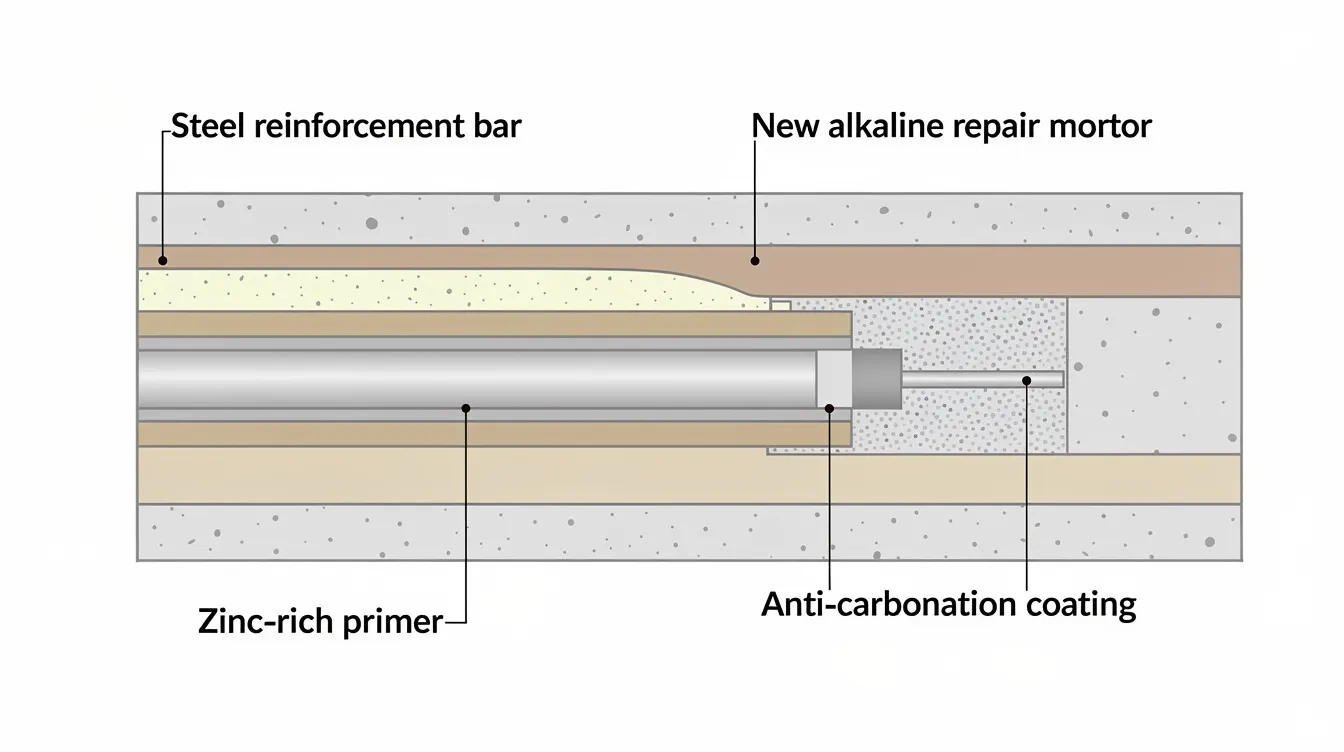
Delamination survey and boundary marking: Conduct hammer sounding or chain drag across suspect areas to identify all zones where concrete has lost bond. Mark repair boundaries extending 20–30 mm beyond the last visible rust or delamination to ensure full removal of compromised material.
-
Controlled removal of carbonated concrete: Using pneumatic breakers or hand chisels, carefully break out all carbonated and loose concrete beyond the corroded bars. Remove material until structurally sound, uncarbonated concrete is exposed-confirmed by phenolphthalein spray on the breakout face.
-
Mechanical cleaning of reinforcement to bright metal: Wire brush or grit-blast all exposed reinforcement steel to remove rust and scale. Measure residual bar diameters to assess section loss. If cross sectional area loss exceeds design thresholds, bars may require supplementation or replacement. CFRP sheets provide external reinforcement for compromised steel, and CFRP rods restore load-bearing capacity in corroded structures where conventional bar replacement is impractical.
-
Anti-corrosion primer application: Apply zinc-rich or polymer-modified primer to all exposed steel surfaces. The primer prevents corrosion during the mortar curing period and must be compatible with the repair mortar system.
-
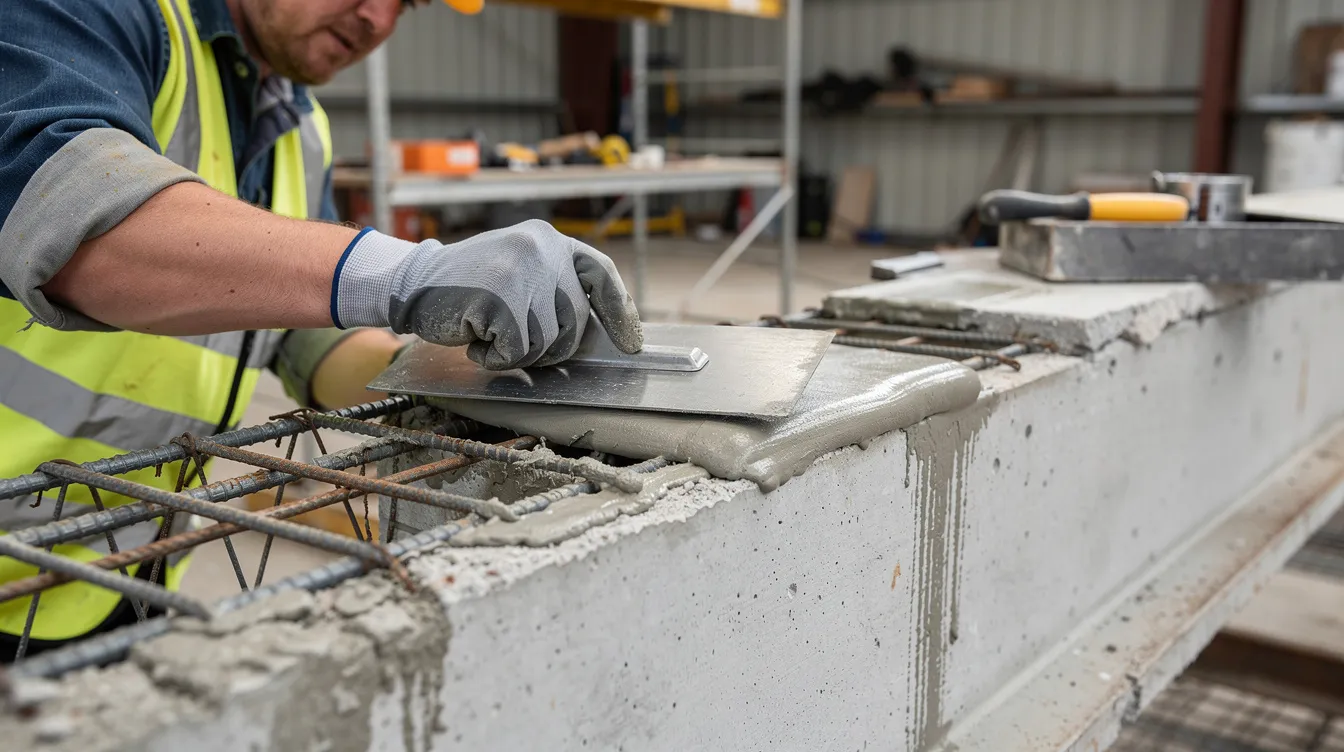
Reprofiling with alkaline repair mortar: Apply high-alkaline, polymer-modified structural repair mortar-such as Sika MonoTop-615 HB ID, which is used for repairing spalled concrete in tropical environments-to rebuild the concrete cover profile. Mortar selection follows EN 1504 class requirements (R2, R3, or R4 depending on structural demand).
-
Curing and surface finishing: Maintain moisture curing for 7–28 days depending on the mortar system. For high-end façades-along Orchard Road, Marina Bay, and similar prominent locations-surface finishing to match adjacent concrete texture and colour is essential for aesthetic continuity.
-
Anti-carbonation coating application: Apply anti-carbonation coatings over both repaired and adjacent intact but carbonated surfaces to provide uniform surface protection against further CO₂ diffusion.
Anti-Carbonation Coatings: Selection and Application
Anti-carbonation coatings function as CO₂ diffusion barriers applied to the concrete surface, while maintaining sufficient vapour permeability to allow moisture to escape from within the structure. Anti-carbonation coatings reduce CO₂ diffusion into concrete and are essential for preventing re-carbonation of both repaired and intact surfaces.
Common coating systems used in Singapore:
|
System Type |
Advantages |
Limitations |
|---|---|---|
|
Acrylic coatings |
Cost-effective, good adhesion, wide colour range, UV-crosslinking formulations available |
Limited crack-bridging, may chalk and fade under intense tropical UV |
|
Elastomeric coatings |
High flexibility (100–300% elongation), excellent crack-bridging for elements with thermal or structural movement |
Higher cost, thicker application required, may trap moisture if substrate preparation is poor |
|
Silane/siloxane systems |
Strong hydrophobicity, natural concrete appearance for fair-faced finishes, good waterproofing |
Thinner films provide less UV protection, may require multiple coats for equivalent CO₂ barrier performance |
Key selection criteria:
-
Low CO₂ diffusion coefficient combined with high resistance to Singapore’s high rainfall intensity and UV index
-
Compatibility with the underlying repair mortar and any existing coatings on the same structure
-
Compliance with EN 1504 standards for surface protection products and local project specifications (LTA, BCA)
Application requirements: The substrate must be sound, clean, and free of laitance. Repair mortars must be fully cured before coating application. Singapore’s LTA specifications require anti-carbonation coatings to be applied in at least two coats with a total dry film thickness of ≥200 µm. Surface moisture content must be checked before application-too damp reduces adhesion, too dry can cause blistering. Adjacent intact but carbonated areas must also be coated, not just the localised repairs, to prevent new carbonation fronts developing around repair margins.
Alkaline Repair Mortars and Re-Alkalisation Techniques
Alkaline repair mortars are pre-packaged, polymer-modified cementitious mixes formulated with high initial pH (≥12) and sufficient reactive calcium hydroxide to buffer the environment around embedded reinforcement. Their dense microstructure reduces permeability to both CO₂ and moisture, addressing both the cause (carbonation) and the consequence (corrosion) of alkalinity loss. Restoration of alkalinity around reinforcing steel is essential after corrosion has been identified and arrested.
Selection criteria for repair mortars:
-
Mortar class: R2 for non-structural cosmetic repairs; R3 for general structural repair; R4 for high-strength, low-shrinkage applications on heavily loaded elements. Classification follows EN 1504-3.
-
Compatibility: The repair mortar must have a similar modulus of elasticity and thermal expansion coefficient to the existing concrete to avoid differential stress and debonding.
-
Workability: Façade and soffit repairs require overhead and vertical application-mortars must be thixotropic, non-slumping, and buildable in layers up to 30–50 mm per pass.
-
Compliance with SS 544 and EN 1504-9, which together define exposure classes, cover requirements, and repair principles applicable to concrete structures in Singapore.
Electrochemical re-alkalisation is a specialist technique where an external DC current is applied between sacrificial anodes and the embedded reinforcement to drive hydroxide ions into the carbonated zone, raising local pH. Electrochemical re-alkalization is used to restore the alkaline environment of carbonated concrete, and re-alkalisation techniques restore alkaline environment around reinforcement where it is impractical to physically remove and replace all carbonated concrete-for example, in heavily carbonated but structurally intact slabs. However, this method remains less common in Singapore’s building stock due to higher cost, power requirements, and the need for specialist equipment and supervision.
Common Challenges and Practical Solutions in Singapore/ASEAN Projects
Site realities in Singapore-high-rise access constraints, tropical weather patterns, occupied buildings, and regulatory complexity-frequently complicate both carbonation assessment and remediation execution. AMAN Engineering Consultancy’s experience across periodic structural inspections and façade works has refined practical approaches to these recurring challenges.
Challenge 1: Limited Access to Façades and Soffits
Issue: Tall façades, cantilevered balconies, and the underside of transfer beams in podium structures are difficult to reach for both visual inspection and invasive carbonation testing. Setting up full scaffolding for an entire building just to test at multiple points is cost-prohibitive.
Solutions:
-
Deploy drones for preliminary visual mapping to identify areas of visible damage-rust staining, spalling, cracking-before committing to scaffold or gondola installation. This narrows the test zones and reduces invasive works.
-
Plan phased gondola or mast climber deployment around building occupancy patterns, concentrating access at high-risk bays identified during the preliminary survey.
-
At representative high-risk bays, conduct concentrated phenolphthalein testing to characterise carbonation rates for the same structure, then extrapolate to similar elements on other elevations where direct access is limited.
Challenge 2: Tropical Climate Effects on Testing and Coatings
Issue: Singapore’s high humidity and frequent rain showers complicate cure conditions for repair mortars and anti-carbonation coatings. Unexpected rain during coating application can ruin adhesion and film integrity.
Solutions:
-
Schedule remediation works during predictable dry windows and provide temporary sheltering (tarpaulins, rain screens) over work zones during mortar curing and coating application.
-
Select mortars and coatings with documented tropical performance-manufacturers should provide test data under high-humidity exposure, rain-impact resistance, and accelerated UV weathering relevant to equatorial conditions. Request warranties of 10–15 years under local exposure conditions.
-
Implement strict on-site QA/QC protocols: check substrate moisture content with calibrated meters before every coating application, measure and record dry film thickness after each coat, and document ambient conditions (temperature, humidity, rain) at the time of application.
Challenge 3: Integrating Remediation with Authority and Safety Requirements
Issue: Significant façade repairs and structural remediation may trigger submissions to BCA and other authorities, particularly for occupied buildings where works affect structural elements or fire compartmentation.
Solutions:
-
Coordinate repair scope early with BCA submissions and obtain Professional Engineer endorsements for any structural elements before works commence. This avoids costly mid-project redesigns.
-
Ensure all temporary works and access systems comply with workplace safety standards and do not obstruct fire escape routes-particularly critical in occupied residential blocks and commercial buildings.
-
Prepare comprehensive documentation packages: method statements, risk assessments, as-built drawings, and material test certificates. These satisfy regulatory, insurance, and building management requirements and create a traceable record for future periodic inspections.
Despite these challenges, a structured and evidence-based approach to carbonation assessment and remediation consistently allows building owners to extend asset life, avoid emergency repairs, and maintain structural integrity over decades.
Conclusion and Next Steps
Carbonation depth testing with phenolphthalein indicator is one of the most informative diagnostic tools available for assessing whether embedded reinforcement in existing structures has lost its protective alkaline environment. When combined with cover depth surveys, half-cell potential mapping, and structural assessment, it provides the evidence base needed to distinguish between structures that are safe, those that need monitoring, and those requiring immediate localised repairs or full surface protection.
Carbonation assessment is a starting point, not an endpoint. The value lies in translating test data into prioritised remediation actions-alkaline repair mortars to restore pH around reinforcing steel, anti-carbonation coatings to arrest further CO₂ penetration, and where reinforcement corrosion has reduced structural capacity, strengthening with CFRP or conventional methods.
Actionable next steps for building owners and facility managers:
-
Commission a targeted carbonation depth and cover survey for any building older than 20–25 years, or any structure showing rust stains, spalling, or pattern cracking on structural elements.
-
Require that inspection reports clearly map areas where carbonation has reached or is approaching the reinforcement level, using both mean and maximum depth values at each test point.
-
Develop a prioritised remediation plan that combines alkaline repair mortars for corroded areas, anti-carbonation coatings for all exposed concrete surfaces, and structural strengthening where load bearing capacity has been reduced.
-
Establish a long-term monitoring plan with re-testing intervals aligned to projected carbonation rates-typically 5–10 years depending on exposure conditions and concrete quality.
-
Engage a multidisciplinary consultancy like AMAN Engineering to coordinate structural, architectural, and regulatory aspects under a single remediation framework, including BIM integration for ongoing asset management.
Related topics worth exploring: façade inspection regimes (PFI/PSI), BIM-based condition modelling and digital twins for deterioration tracking, and integration of corrosion risk into life-cycle cost analysis for ageing building portfolios.
Additional Resources and Practical Checklists
Key international standards and guidelines:
-
BS EN 14630:2006 – Standard test method for determining carbonation depth in hardened concrete using the phenolphthalein method. The primary reference for carbonation depth measurement procedure.
-
EN 1504 (Parts 2, 3, 9, 10) – Framework for products and systems for protection and repair of concrete structures, covering surface protection (coatings), structural and non-structural repair mortars, and principles of repair design.
-
RILEM CPC-18 – Recommendation for carbonation depth measurement with pH indicators, including guidance on indicator selection, reading time, and sample preparation.
-
SS 544 Part 1:2019 – Singapore complement to SS EN 206, providing exposure class designations, cover requirements, and concrete durability provisions for tropical and coastal conditions.
-
ISO 1920-12:2015 – Accelerated carbonation resistance testing for concrete specimens; relevant for evaluating new concrete mixes or comparing carbonation resistance of repair materials.
On-site checklist for facility managers:
-
Visual signs to watch for before commissioning a survey:
-
Rust staining on concrete surfaces, particularly at beam/column junctions and slab soffits
-
Pattern cracking, map cracking, or longitudinal cracks following reinforcement lines
-
Spalling or delamination of concrete cover, especially on exposed façade elements
-
Discolouration or efflorescence on soffits and underside of cantilevered slabs
-
-
Information to prepare for your consulting engineer:
-
As-built structural and architectural drawings showing reinforcement layout and specified cover depths
-
Building age, construction year, and any known cement type or concrete grade
-
Records of past repair works, coating applications, or structural modifications
-
Current access constraints (occupied floors, restricted zones, available anchor points for gondolas)
-
-
Questions to ask contractors about repair materials:
-
What EN 1504 class is the proposed repair mortar, and does it have test data under tropical exposure conditions?
-
What is the specified dry film thickness and expected service life of the anti-carbonation coating system?
-
Does the manufacturer provide warranties for performance under Singapore’s environmental exposure, and what is the warranty period?
-
Are trial patches recommended before full-scale application to verify aesthetic compatibility and adhesion?
-
AMAN Engineering Consultancy can integrate carbonation depth findings, cover survey data, and remediation records into BIM or digital twin platforms, linking structural inspection data with maintenance planning to support informed, long-term asset management decisions.