
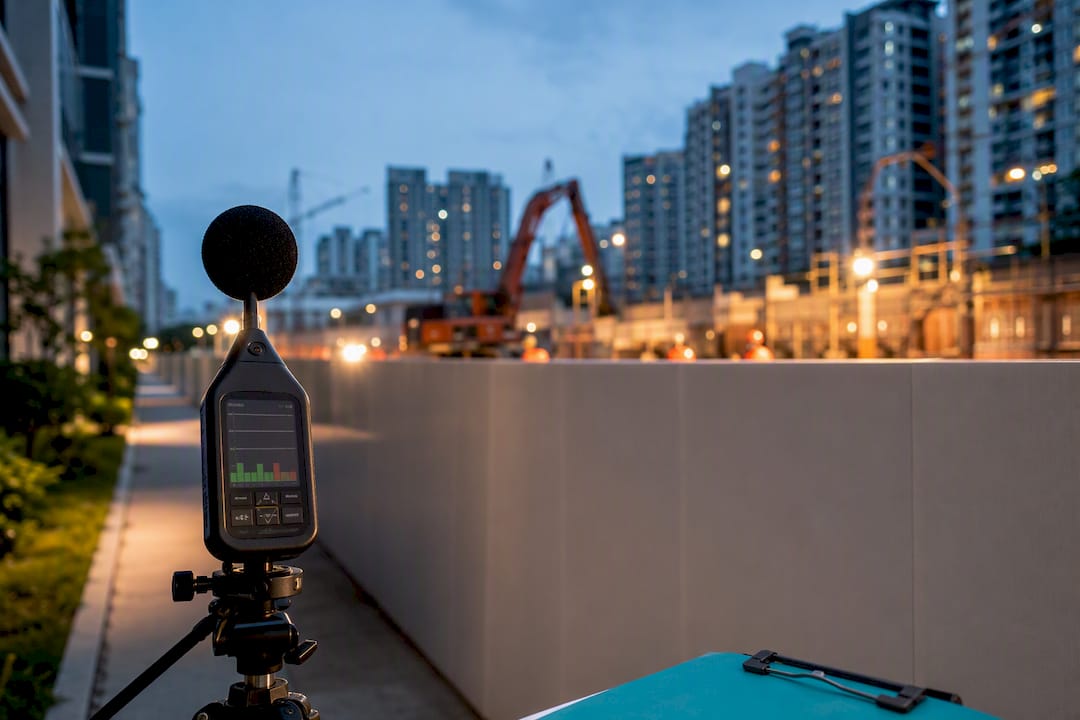
The National Environment Agency, through its Director-General, may grant a written construction noise permit allowing selected work during otherwise prohibited periods, including Sundays and public holidays. These permits apply only to quieter construction activities or work classified as safety-critical or in the public interest, and they come with strict conditions covering timing, monitoring, and mitigation. A permit is never a blanket exemption from Singapore’s noise limits.
TL;DR:
- Construction within 150 meters of noise-sensitive premises typically requires additional noise monitoring or a noise management plan, especially for larger projects.
- Quieter construction activities, such as interior fitting and landscaping, do not generally need permits for Sunday or holiday work within the 150-meter radius.
- Permit applications should focus on exact timing, technical justification, and detailed mitigation plans, with stricter review for open-ended or unjustified requests.
- Using Class 1 noise meters and conducting pre-application baseline measurements can significantly improve likelihood of permit approval and compliance.
- Early engagement with consultants helps ensure proper planning, documentation, and scheduling, reducing the risk of violations and enforcement penalties.
Table of Contents
- What Is a Construction Noise Permit Under Singapore Law?
- Do You Need a Noise Permit? The 150m Rule Explained
- How Do You Apply for a Construction Noise Permit?
- What Are the Maximum Permissible Noise Limits?
- How Do You Monitor and Document Compliance?
- What Happens If You Breach Noise Regulations?
- How a Compliance Consultant Supports Permit Applications
- Why NEA’s Permit System Punishes Contractors Who Treat It as a Backup Plan
- Get Help With Your Noise Permit and NMP From Aman
- Sources
- FAQ
What Is a Construction Noise Permit Under Singapore Law?
The legal foundation sits in the Environmental Protection and Management (Control of Noise at Construction Sites) Regulations, administered under Singapore Statutes Online. Regulation 3 sets prohibited periods for construction noise, but the Director-General holds discretionary power to permit work outside standard hours when there’s a public interest justification or a legitimate technical reason.
That discretion doesn’t translate into an automatic approval. Any permit issued must be in writing, must specify the exact period covered, and must attach conditions the site has to follow for the duration. Site owners and occupiers stay fully responsible for meeting maximum permissible noise levels, permit or no permit. If you’re mapping out which statutory approvals your project needs before ground even breaks, it helps to review the different types of building permits in Singapore alongside your noise obligations, since timelines often overlap.
Do You Need a Noise Permit? The 150m Rule Explained
Distance decides most of your compliance burden. NEA defines noise-sensitive premises as hospitals, schools, and residential buildings, and any construction site within 150 meters of one of these receptors falls under mandatory monitoring requirements. Larger projects within that radius must also submit a Noise Management Plan before work begins.
Not every task inside the 150m zone needs a permit for Sunday or public holiday work. NEA generally treats these as “quieter construction work” that can proceed without triggering the full permit process:
- Architectural finishing and internal fit-out work
- Mechanical and electrical (M&E) installation
- Plumbing and sanitary works
- Waterproofing and planting or landscaping tasks
- Electrical wiring and low-noise fitting installation
Heavy machinery operation, piling, hacking, and breaking works remain excluded from this quieter category. Those activities almost always require you to either stay within standard permitted hours or make a formal case through the permit application process.
How Do You Apply for a Construction Noise Permit?
NEA doesn’t grant permits on assurances. It grants them on evidence. Build your application around these components:
- Define a narrow time window. State the exact dates and hours requested rather than an open-ended range. NEA responds better to a tightly scoped ask than a general one.
- State your technical or public-interest justification. Explain why the work can’t be scheduled within normal hours, whether that’s a structural safety concern, a utility shutdown constraint, or a contractual deadline tied to public infrastructure.
- Attach a complete Noise Management Plan. List every noise source on site, the mitigation measures you’ll apply, your monitoring locations, and your measurement procedures.
- Specify your monitoring setup. Name the Class 1 noise meter model, confirm calibration status, and state measurement durations and the relevant Leq averaging windows.
- Nominate a contact person and complaint-response procedure. NEA and nearby residents both need someone to reach quickly if noise becomes an issue.
Pro Tip: Scope your permit request to the exact hours you need, not a wider buffer “just in case.” Applications with tight, justified windows and firm mitigation commitments tend to move through review faster than open-ended requests.
What Are the Maximum Permissible Noise Limits?
NEA’s permissible noise limits shift by receptor type and time of day, and the tables mix different averaging windows depending on the metric. For residential premises within 150 meters of a construction site, the limits generally look like this:
NEA sets maximum permissible noise limits for residential premises within 150 meters of construction sites that become more stringent in the evening and overnight, with lower allowed decibel levels after 7 PM and again after 10 PM, measured over different time averaging windows.
Limits tighten sharply after 7 PM and again after 10 PM. That means any shift planning has to account for a nearly 20 dBA drop moving from daytime to evening work, and another substantial drop into the overnight band. Reading these tables correctly means knowing which Leq window applies to which activity. A short, intense task might comply under the 5-minute window while still breaching the longer averaging period if it runs continuously.
How Do You Monitor and Document Compliance?
NEA requires Class 1 noise meters for any enforcement-grade measurement. Consumer-grade phone apps don’t meet the standard and won’t hold up if NEA disputes a reading during an inspection.
Set your monitoring practice up around these habits:
- Position meters to capture the actual receptor exposure, not just the site boundary.
- Calibrate meters on a regular schedule and keep the certificates on file.
- Synchronize meter clocks with your logging system to avoid timestamp disputes.
- Pause noisy activities during any NEA-directed spot check so the reading reflects only the relevant source, since contaminated measurements are a common cause of disputed results.
- Log raw readings, Leq calculations, calibration certificates, and every complaint received alongside your response.
Pro Tip: Run your own baseline spot checks before submitting a permit application. If your numbers already match what NEA is likely to measure, you remove the single biggest source of back-and-forth during review.
A construction compliance checklist built around these recordkeeping habits makes it far easier to respond to a complaint or audit without scrambling for documentation after the fact.
What Happens If You Breach Noise Regulations?
Breaching Regulation 3(1) or violating permit conditions is a statutory offense, and the Regulations set out fines that can include continuing daily penalties for ongoing violations. Enforcement usually starts with a public complaint or a routine NEA spot check, and either can lead to a directed measurement request where NEA specifies exactly when and how readings must be taken.
Reduce your exposure with a few practical steps: schedule conservatively rather than banking on a permit coming through, document every mitigation measure you actually implement, run independent pre-measurement checks before NEA gets involved, and make sure your contracts allocate noise compliance risk clearly between the developer and the contractor.
How a Compliance Consultant Supports Permit Applications
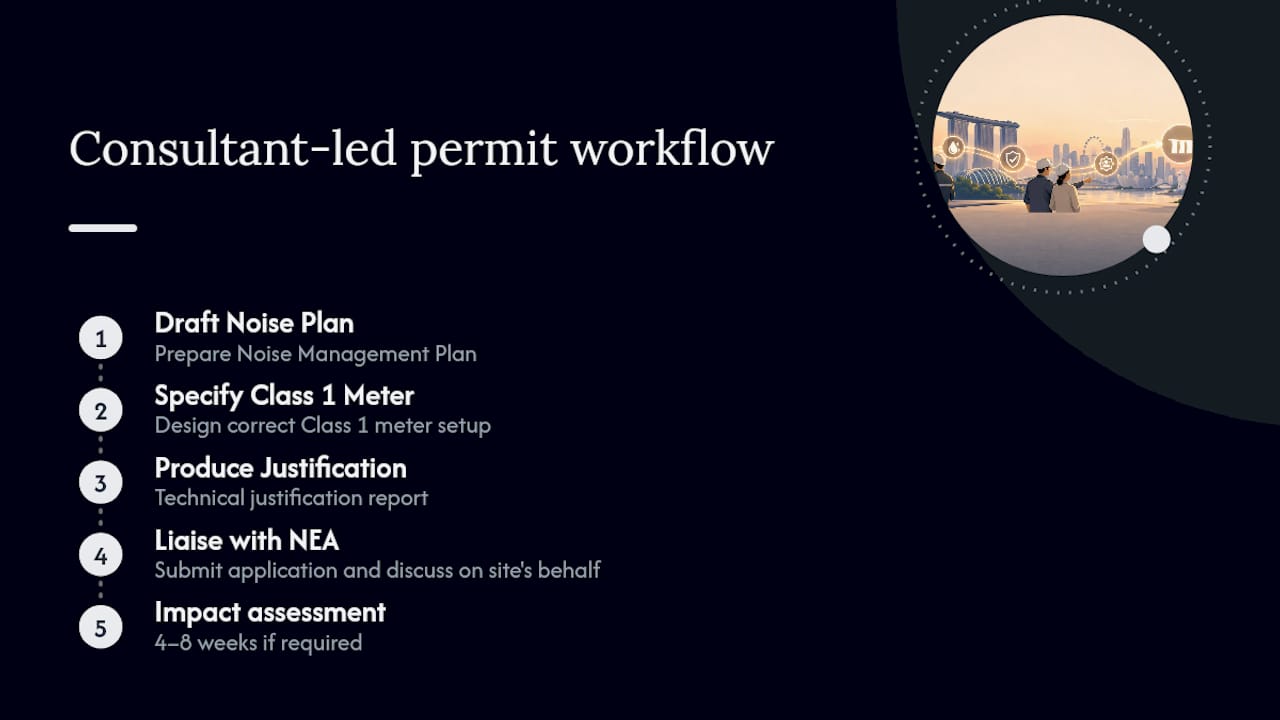
Preparing a permit application that survives scrutiny takes more than filling in a form. A consultant typically drafts the Noise Management Plan, specifies the correct Class 1 meter setup, produces the technical justification report, and liaises directly with NEA on the site’s behalf. Where a formal noise impact assessment is warranted, allow four to eight weeks for the assessment and report drafting, since scope and site complexity both affect the timeline. Engaging that support early, before your construction program locks in, gives you room to adjust scheduling if NEA pushes back on the first submission.
Why NEA’s Permit System Punishes Contractors Who Treat It as a Backup Plan
Too many project teams treat the noise permit as a safety net, something to apply for after the schedule slips and Sunday work becomes unavoidable. That’s backwards, and NEA’s own framing makes the point clearly: permits exist for genuinely quieter work or for safety-critical and public-interest cases, not as a general escape hatch for falling behind. Building a schedule that assumes you’ll get a permit is a bet against an agency that has no obligation to approve your request.
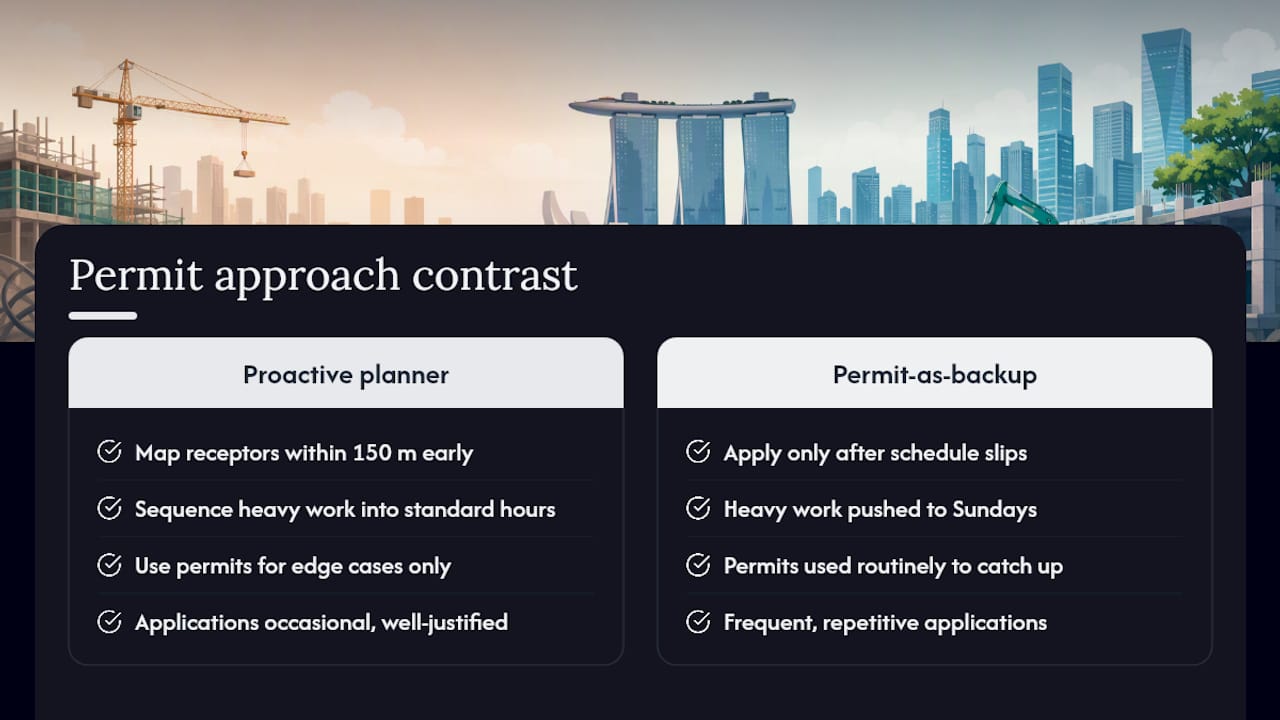
The contractors who handle this well do the opposite. They map every noise-sensitive receptor within 150 meters at the very start of the project, before the program is even finalized, and they sequence heavy work to land inside standard hours by design. Permits then become a tool for the genuine edge cases, a safety-critical repair, a utility tie-in that can’t wait, rather than a routine part of the schedule. That distinction changes how NEA reads your application, too. A contractor requesting an occasional, well-justified permit looks very different from one submitting requests every few weeks because the base schedule never accounted for noise limits in the first place.
The real gap in most compliance failures isn’t the paperwork. It’s the sequencing decision made months before anyone thought about permits at all.
— Aman
Get Help With Your Noise Permit and NMP From Aman
Getting an NEA permit approved on the first attempt often comes down to how well the technical justification and Noise Management Plan are put together, not just what boxes get checked. Consultants can support developers and contractors with NMP preparation, Class 1 monitoring setup, and direct liaison with NEA during the application process.

Bringing a consultant in during early project planning, rather than after a complaint lands, gives you time to build monitoring and mitigation into the schedule instead of retrofitting it under pressure. If you’re weighing whether to handle statutory submissions in house or bring in outside support, our guide on engaging engineering consultants effectively walks through what that process typically involves. For sites where noise compliance is one part of a broader statutory approval workload, A project compliance workflow service can cover the entire submission process. Reach out through Aman Engineering Consultancy to discuss your project’s permit and monitoring needs before your schedule locks in.
Sources
- Noise Measurements & Noise Management Plan — NEA
- Environmental Protection and Management (Control of Noise at Construction Sites) Regulations — Singapore Statutes Online
FAQ
What time must construction noise stop in Singapore?
Standard permissible hours generally run until 7 PM on weekdays and Saturdays for the loudest activities, with stricter limits kicking in during evening and overnight bands; exact cutoffs depend on the day type and receptor, per NEA’s permissible limits.
How can I complain about construction noise in Singapore?
Residents can file a complaint directly with NEA, which may trigger a spot check or a directed measurement request against the site’s permit conditions and permissible noise limits.
What time does construction have to stop on Sundays and public holidays?
Construction work is generally prohibited on Sundays and public holidays unless the site holds an NEA-issued written permit for quieter construction work or safety-critical, public-interest activities.
What is the law governing construction noise in Singapore?
The Environmental Protection and Management (Control of Noise at Construction Sites) Regulations set prohibited periods, permissible noise limits, and the Director-General’s power to grant written permits with specified conditions.
Can a consultant help with an NEA noise permit application?
Yes. A compliance consultant can prepare the Noise Management Plan, specify the correct Class 1 monitoring setup, and liaise with NEA to support the application on a contractor’s behalf.