
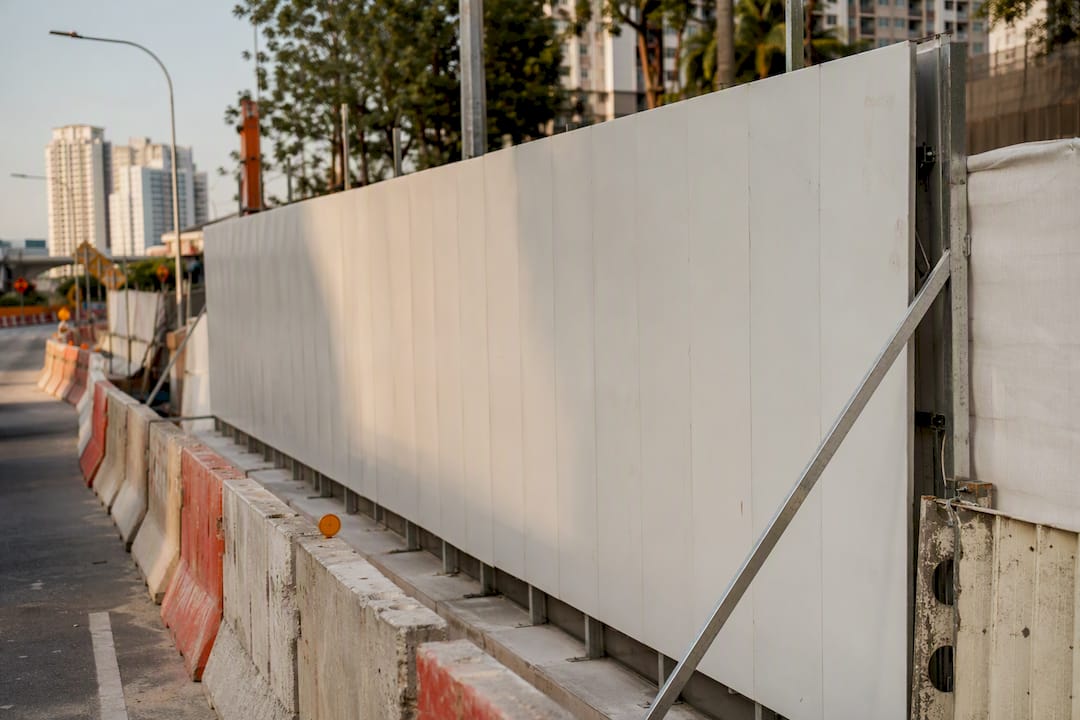
Erecting construction hoarding in Singapore requires approval under the Building Control Regulations 2003 and the Building Control (Temporary Buildings) Regulations 2018, administered by the Building and Construction Authority (BCA). A Professional Engineer (PE) must design and supervise the structure, and the hoarding cannot legally remain in use until a Permit to Use (PTU) is issued through CORENET e-Submission. Where a site sits in a high-visibility zone, a separate creative-hoarding proposal to the Urban Redevelopment Authority (URA) may also apply.
Before mobilizing crews, a project team needs to move through these steps in order:
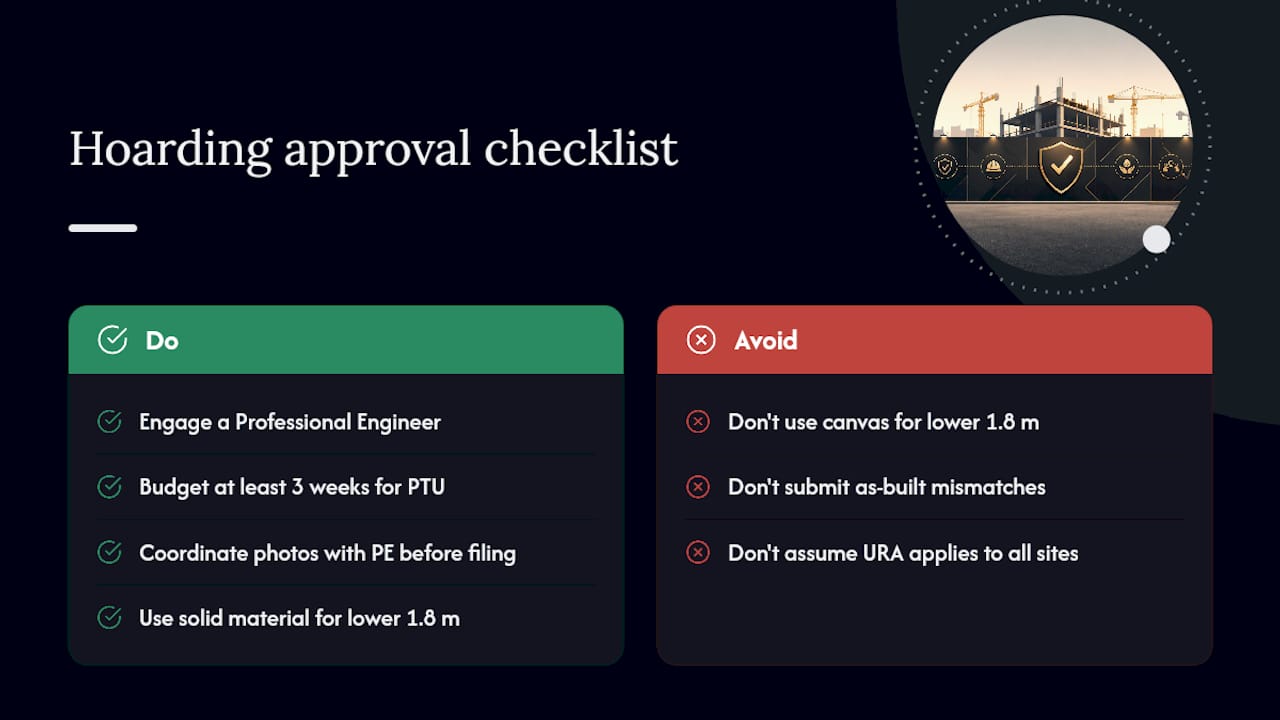
- Engage a Professional Engineer (PE) to design the hoarding and prepare drawings for preliminary review.
- Erect the hoarding to the approved design, keeping height, materials, and framing within BCA’s minimum specifications.
- Have the PE inspect the completed structure and issue supervision certificates.
- Submit the PE certificates for the Permit to Use via CORENET, allowing at least three weeks before scheduled construction activity depends on it.
- Confirm whether URA creative-hoarding rules apply to the site before finalizing panel designs.
The practical first move on any project: loop in your PE or engineering consultant during the planning stage, not after the hoarding is already standing.
Key Takeaways
Construction hoarding approval in Singapore requires PE-certified design and supervision, a completed two-stage BCA process ending in a CORENET-filed Permit to Use, and, on select sites, a separate URA creative-hoarding proposal.
| Point | Details |
|---|---|
| Two-stage approval | Preliminary design review comes first, followed by PTU issued only after the hoarding is erected and inspected. |
| PE certification is mandatory | A Professional Engineer must design, supervise, and certify the hoarding before PTU filing. |
| Minimum specs matter | Height minimums of 1.8 m (3.6 m where abutting neighbors) and solid lower sections are checked closely. |
| Plan for review time | Allow at least three weeks for PTU processing via CORENET before construction depends on it. |
| Get expert support early | Com provides PE design, CORENET submission, and creative-hoarding proposal support for Singapore projects. |
Table of Contents
- Which Laws And Agencies Control Hoarding Approval In Singapore?
- Who Is Responsible For Designing And Certifying Hoarding?
- What Is The Step-By-Step Hoarding Approval Process?
- What Are The Minimum Hoarding Specs And Safety Requirements?
- When Does URA Creative Hoarding Apply?
- What Causes PTU Delays And How Do You Avoid Them?
- Why Early PE Engagement Changes the Whole Approval Timeline
- How Aman Engineering Can Support Your Hoarding Approval
- Frequently Asked Questions
- Sources
Which Laws And Agencies Control Hoarding Approval In Singapore?
Two statutory instruments govern hoarding on Singapore construction sites. The Building Control Regulations 2003 set the foundational requirement that builders erect and maintain protective hoardings separating a work site from public streets, footways, and adjacent properties. The Building Control (Temporary Buildings) Regulations 2018 treat hoarding as a category of temporary building, which is why the PTU process and PE certification requirements apply to it in the same way they apply to site offices or scaffolding towers.
The Building and Construction Authority, through the Commissioner of Building Control, is the primary regulator for hoarding design, erection, and use. The Commissioner has the authority to order additional precautions on any site judged inadequately protected:
Builders must erect protective hoardings of solid, robust construction, keep them in good repair throughout the works, and the Commissioner of Building Control may require additional safety measures where the existing hoarding is judged insufficient.
For projects in designated high-visibility areas, the Urban Redevelopment Authority (URA) layers on a separate creative-hoarding requirement. Depending on the site, you may also need to coordinate with the Singapore Police Force for road-related permits, NEA for environmental controls, or LTA where hoarding encroaches near a public roadway. The Ministry of National Development has reiterated that hoardings exist to minimize public health and environmental hazards to residents near active sites, which is the policy logic behind the enforcement powers above.
Who Is Responsible For Designing And Certifying Hoarding?
Responsibility splits cleanly between three parties, and confusion about who owns which step is one of the most common causes of delay. The owner or developer holds ultimate accountability for the site and typically appoints the Professional Engineer. The PE, in turn, carries the statutory obligation to design, supervise, inspect, and certify that the completed structure matches the approved plans.
- The owner/developer commissions the PE and ensures CORENET submissions are filed under proper authorization.
- The contractor builds strictly to the PE-approved drawings and flags any site conditions that force a design change.
- The PE inspects the hoarding during erection and again before it can be certified for use, then files supervision certificates through CORENET.
Because hoardings fall under the Building Control (Temporary Buildings) Regulations, the PE requirement applies even to what looks like a simple perimeter fence job. Skipping it, or bringing a PE in only after erection is complete, is one of the more expensive mistakes a project can make.
Pro Tip: Engage your PE before you finalize the hoarding layout, not after. A PE who reviews the site boundary and gate locations early can flag conflicts with the risk-based height review before steel or timber goes up, saving a full round of rework.
What Is The Step-By-Step Hoarding Approval Process?
Construction hoarding approval in Singapore runs on a two-stage structure: preliminary approval of the design, then a Permit to Use once the hoarding is physically built. Both stages route through CORENET e-Submission, and BCA’s own guidance is to allow at least three weeks for PTU processing before construction activity depends on the hoarding being certified.
The sequence typically runs as follows:
- Owner/developer appoints a PE and confirms the site scope, including whether URA creative-hoarding rules apply.
- PE prepares the hoarding design and structural details, then submits for preliminary review.
- Contractor erects the hoarding to the approved drawings, coordinating gate placement and signage zones.
- PE conducts a site inspection of the completed structure and issues the supervision certificate.
- Owner/developer or PE’s office files the PTU application via CORENET, attaching the certification package.
- BCA reviews the submission and issues the PTU, or returns queries (RFIs) if documentation is incomplete.
A complete submission package generally includes:
- Approved hoarding plans and elevations
- Structural calculations where required
- The PE’s certificate of supervision
- Photographs of the erected hoarding matching the approved design
- Any relevant forms, such as the BCA-CSC-CTSTBW certificate of supervision, where applicable
Timeline callout: the three-week PTU window BCA advises is a minimum, not a guarantee. Projects that submit incomplete PE documentation or that show mismatches between as-built photos and approved drawings routinely see that window stretch, sometimes doubling if a resubmission is required.
For teams unfamiliar with how the PTU differs from other permit types, it helps to think of it as a post-installation audit rather than a pre-construction approval. Nothing gets signed off until the physical structure exists and matches the paper.
What Are The Minimum Hoarding Specs And Safety Requirements?
BCA’s technical guidance sets concrete dimensional and material thresholds that inspectors check against, and most rejected submissions fail on one of these points. For landed development projects, the guideline calls for a minimum hoarding height of 1.8 meters generally, rising to 3.6 meters on sides that directly abut adjacent properties. Height adequacy should ultimately be reviewed against the risk profile of the works themselves, not just the minimum number.
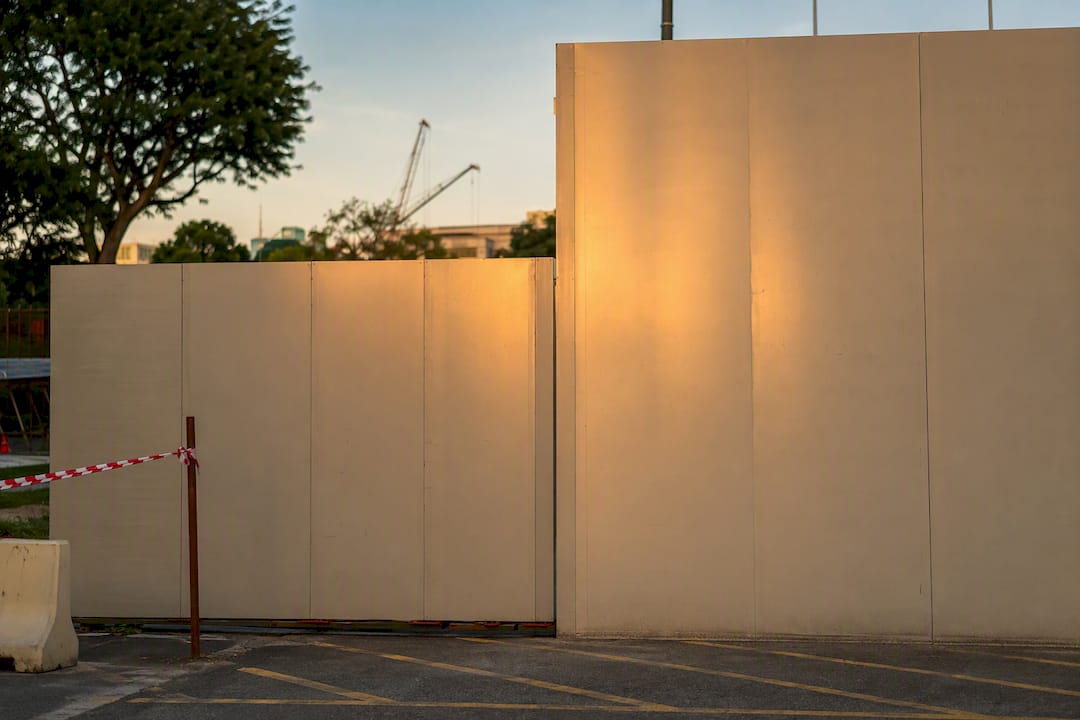
Statistic callout: the lower 1.8 meters of any hoarding must be solid, and canvas is explicitly prohibited for that portion. Above that height, non-solid materials are permitted provided the supporting frame remains solid and properly braced.
Beyond height and material, BCA guidance and the Temporary Buildings Regulations layer on several operational requirements:
- Catch platforms where falling debris is a realistic risk to pedestrians or neighboring properties.
- Safety netting using close mesh no larger than 2mm square, tightly secured to the frame.
- Continuous hoarding along the entire site boundary, with no unprotected gaps.
- Gates or openable sections that must be closed and locked outside working hours.
Maintenance is not a one-time obligation. Hoardings must stay in good repair for the duration of the works, and the Commissioner of Building Control can order additional measures at any point if a structure is judged inadequate, including mid-project.
When Does URA Creative Hoarding Apply?
Not every site needs a creative-hoarding submission, but where it applies, skipping it creates real compliance exposure. URA mandates creative hoarding for selected high-visibility developments, including Government Land Sales sites in central areas, major public agency projects, and locations within designated growth corridors.
A Creative Hoarding Proposal submitted to URA typically needs to include:
- A site plan showing both creative and project panel lengths
- Elevations with full dimensions
- A written design concept explaining the visual treatment
- Details of materials and finishes for the panels
The proposal goes to URA after the project has received Provisional Permission (PP), not before. If your hoarding panels double as advertising or marketing surfaces, that signage typically needs separate confirmation with BCA, since creative hoarding and approved construction signage are reviewed under different tracks even when they sit on the same physical structure.
What Causes PTU Delays And How Do You Avoid Them?
Most PTU rejections trace back to a small handful of recurring issues, and nearly all of them are avoidable with better sequencing rather than more paperwork. Missing PE supervision certificates top the list, followed closely by as-built hoarding that no longer matches the drawings submitted for preliminary approval.
Common pitfalls worth checking before you file:
- Missing or incomplete PE certificates of supervision
- As-built discrepancies between the erected hoarding and the approved plans
- Canvas or non-solid material used below the 1.8-meter solid threshold
- Undersized or under-braced framing that doesn’t match structural calculations
- Safety netting that doesn’t meet the 2mm mesh specification
- PE inspections booked too late to align with the intended PTU filing date
Before submitting, run through a compact checklist: approved plans, PE certificates, current photographs of the completed hoarding, netting and material specs, and confirmation that gates lock properly after hours. Booking your PE inspection to land right as erection finishes, rather than days or weeks later, is the single biggest lever for keeping the PTU clock moving.
Why Early PE Engagement Changes the Whole Approval Timeline
Projects that bring a Professional Engineer in during layout planning, rather than after the hoarding is already up, tend to move through PTU review with far fewer queries. When the PE has shaped the design from the start, the as-built structure almost always matches what was submitted, which removes the single most common reason BCA sends a submission back.
The time savings compound when creative hoarding is also required. Preparing the URA proposal alongside the CORENET plan submission, instead of sequentially, keeps both approvals moving in parallel rather than stacking one delay on top of another. Pre-booking the PE’s final inspection for the exact day erection wraps up is a small scheduling detail that consistently shaves days off the PTU timeline.
Pro Tip: Keep a running photo log of the hoarding as it goes up, not just at completion. When BCA compares as-built conditions to approved drawings, having progress photos ready to explain any field adjustment resolves queries faster than a single after-the-fact certificate.
How Aman Engineering Can Support Your Hoarding Approval
Getting hoarding approved in Singapore hinges on getting the PE work right the first time, and that’s precisely where a specialist consultancy earns its keep. Com works directly with developers and contractors on the full statutory path: PE design and supervision, CORENET e-Submission, and, where a site calls for it, URA creative-hoarding proposal preparation.

Services relevant to your hoarding submission include:
- PE design and supervision for hoarding structures, from layout through as-built certification
- CORENET e-submission support to keep preliminary approval and PTU filings on schedule
- Creative Hoarding proposal preparation for URA-mandated high-visibility sites
- Site inspections and PTU filing, including documentation packages built to avoid common RFIs
Com’s team has handled BCA and URA submissions across Singapore projects of varying scale, from landed redevelopment to larger commercial sites requiring temporary works design. If your hoarding erection is coming up and you need a PE who can move from design through PTU certification without gaps, get in touch with Aman Engineering Consultancy to scope your submission.
Frequently Asked Questions
Do I need a Professional Engineer for a simple hoarding fence?
Yes. Hoarding is classified as a temporary building under the Building Control (Temporary Buildings) Regulations 2018, so PE design and supervision applies regardless of how simple the structure looks.
How long does construction hoarding approval take from start to finish?
Preliminary design review and erection timing vary by project, but BCA advises budgeting at least three weeks for the PTU stage alone once the hoarding is built and PE certificates are ready.
What happens if my hoarding doesn’t match the approved design?
As-built mismatches are one of the most common reasons BCA queries a PTU submission, which is why coordinating photo documentation with your PE before filing matters.
Does every construction site in Singapore need URA creative hoarding?
No. URA requires it only for selected high-visibility developments, including certain GLS sites and major public agency projects, not standard private developments.
Can hoarding materials be canvas throughout?
No. The lower 1.8 meters must be solid material; canvas is prohibited for that portion, though non-solid materials are allowed above that height with proper framing.
Sources
- Temporary Building Application | Building and Construction Authority
- Building Control Regulations 2003 – Singapore Statutes Online
- Creative Hoarding requirements and guidance (URA)