
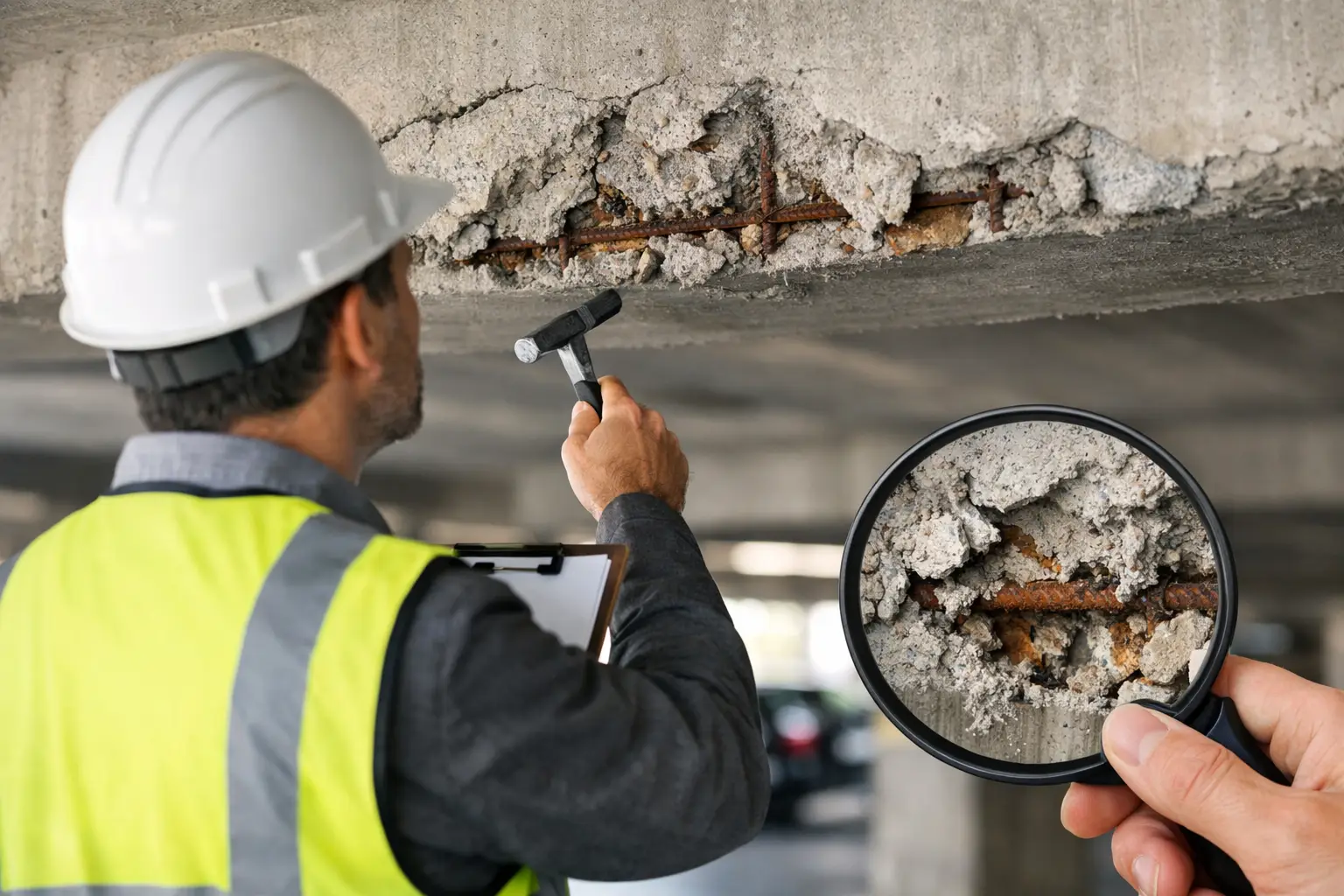
A small patch of missing concrete can be a localized finish failure, or the visible edge of active reinforcement corrosion. The difference affects occupant safety, repair scope, budget, and whether an immediate structural inspection is necessary. Knowing how to assess concrete spalling begins with treating exposed or delaminated concrete as evidence to investigate, not simply a surface defect to patch.
Start With Safety and Immediate Risk Control
Before measuring damage, determine whether loose material could fall or whether the affected member may be carrying compromised load. Spalling at overhead slabs, balconies, parking-garage soffits, facades, stair landings, beams, columns, and canopy edges deserves particular caution. Establish an exclusion zone below overhead damage and prevent access where falling concrete could injure people or damage vehicles.
Do not strike, chip, or remove damaged concrete from a ladder or beneath an unsupported area. If reinforcement is visibly exposed, heavily rusted, bent, or separated from the concrete, the condition should be reviewed promptly by a qualified structural professional. The same applies where spalling occurs on a beam, column, foundation wall, retaining wall, or a member showing cracking, deflection, or movement.
Four conditions call for urgent escalation:
- Concrete is actively falling, hollow-sounding areas are widespread, or reinforcement is exposed overhead.
- A load-bearing beam, column, slab edge, or connection has lost a significant portion of its concrete cover.
- Cracks are widening, water is entering the member, or rust staining continues to spread.
- The damage follows a fire, vehicle impact, chemical spill, seismic event, or suspected structural movement.
Temporary protection may be needed, but it is not a substitute for a documented condition assessment and an engineered repair plan.
How to Assess Concrete Spalling Systematically
A useful assessment moves from visual observation to measured documentation, then to targeted testing. The goal is to establish the extent of unsound concrete, identify the likely deterioration mechanism, and determine whether the condition is cosmetic, durability-related, or structural.
Map the Damage Before Touching It
Begin with clear photographs taken from a safe position. Include wide shots showing the member location and close-ups with a ruler, tape measure, or known scale. Record the date, elevation or floor, gridline or room reference, and whether the damage is on a soffit, vertical face, slab edge, or horizontal surface.
Create a simple damage map for each affected area. Mark visible spalls, cracks, rust staining, efflorescence, damp patches, previous repairs, and exposed steel. Measure the length, width, and approximate depth of each spall. For larger areas, record the total affected square footage and the distance between separate patches.
This mapping matters because individual spalls often understate the true extent of deterioration. A repair contractor may remove more concrete than is initially visible once loose material and delaminated zones are identified. Good records also allow the owner or building manager to track whether conditions are progressing over time.
Look for Corrosion Clues and Water Paths
Most concrete spalling results from reinforcing steel corrosion. Steel rust occupies more volume than intact steel, creating pressure that cracks and pushes off the surrounding concrete cover. Rust-colored streaks, longitudinal cracks parallel to reinforcing bars, and exposed steel are common signs.
The next question is why corrosion began. Review where water can enter: failed sealant joints, leaking roofs, ponding decks, unprotected slab edges, leaking plumbing, blocked drains, cracks, and inadequate waterproofing. In coastal or deicing-salt environments, chlorides can reach the reinforcement even when obvious leakage is absent. Freeze-thaw cycling can also damage saturated concrete in colder climates.
Other causes are possible. Poor consolidation during original placement can leave honeycombing. Incompatible patch repairs can trap moisture or create cracking at repair edges. Chemical exposure may attack the cement paste. Fire or impact can fracture and weaken concrete. The repair approach depends on the cause, so a visual patch alone is rarely a complete diagnosis.
Check for Delamination, Carefully
Delamination is concrete that has separated internally but has not yet fallen away. It may appear intact from a distance. A trained inspector can use sounding methods, such as tapping with a hammer or chain drag on appropriate surfaces, to identify hollow or drum-like responses compared with sound concrete.
Sounding should be controlled and limited to areas that can be accessed safely. It can dislodge loose concrete, especially on ceilings and facades. For this reason, overhead sounding, high-level facade assessment, and investigations near public areas should be handled with proper access equipment, protection measures, and a qualified inspection team.
A hollow sound indicates a suspect area, not the full diagnosis. It should be marked on the damage map and correlated with cracking, moisture, reinforcement location, and any non-destructive test results.
Measure Depth and Reinforcement Condition
Where concrete has already detached, measure the remaining cover to the reinforcing steel and the depth of the cavity. Note whether the steel is merely visible, lightly corroded, deeply pitted, or has lost section. Do not assume a bar is acceptable because it remains continuous. Section loss can reduce load capacity, while corrosion may extend beyond the exposed patch.
A structural assessment may require reinforcement scanning to locate bars and determine cover, along with selective breakout to inspect concealed corrosion. Depending on the structure and exposure, the engineer may also specify concrete cover meter surveys, half-cell potential testing, resistivity testing, chloride testing, carbonation depth testing, moisture assessment, or concrete core sampling. These tools help distinguish isolated damage from a broader corrosion problem.
Separate Appearance From Structural Significance
Not every spall is a structural emergency. A small, shallow spall in a non-load-bearing architectural element may primarily require a durable repair and correction of the water source. However, the same size defect in a thin slab edge or near critical reinforcement can be more consequential.
Structural significance depends on the member type, location, depth of loss, reinforcement condition, extent of delamination, loading, and observed movement. Spalling on a heavily loaded parking deck, industrial floor, retaining structure, or elevated facade should not be evaluated by appearance alone. A condition assessment should also consider whether the deterioration is isolated or repeated across similar exposures, floors, or elevations.
Owners should avoid authorizing broad cosmetic repairs before this distinction is made. Covering rust-stained concrete with mortar without removing unsound material, treating corrosion, and stopping water ingress can lead to early repair failure. It may also conceal conditions that later expand beyond the repair perimeter.
Define the Repair Scope From the Findings
Once the damage is mapped and the cause is understood, the repair scope can be developed. A durable scope generally identifies the concrete removal limits, reinforcement treatment or replacement requirements, repair mortar or concrete system, bonding method, curing requirements, crack and joint repairs, waterproofing or coating work, and quality-control inspections.
The removal boundary should extend to sound concrete, not just the visibly missing area. Corroded reinforcing steel may need cleaning, supplemental steel, or replacement, subject to engineering review. Where corrosion is widespread, localized patching can create a trade-off: it has a lower immediate cost, but it may not address ongoing deterioration in adjacent areas. Broader protective systems, cathodic protection, waterproofing renewal, or planned phased rehabilitation may be more appropriate depending on the exposure and asset life target.
For occupied buildings, the repair plan should also address access, dust control, falling-object protection, noise, traffic or pedestrian management, and inspection hold points. These execution details are part of risk control, not an afterthought.
When to Bring in a Structural Engineer
A licensed structural engineer should assess spalling that affects structural members, exposes reinforcing steel, recurs after prior repair, or occurs across multiple areas. Professional involvement is also prudent before property acquisition, major renovation, facade work, or capital budgeting for an aging building.
The engineer can determine the investigation scope, evaluate structural implications, prepare repair details and specifications, and provide documentation suitable for contractors, insurers, lenders, owners, and relevant authorities. Where repairs alter structural behavior or involve regulated building work, required permits, professional certifications, and inspections should be coordinated before construction starts.
The most useful next step is to document the condition while it is visible, make the area safe, and obtain an assessment that connects the observed spall to its cause and repair requirements. That approach gives owners a defensible basis for action rather than a temporary patch with an unknown service life.