

Environmental consultant companies are specialized firms that assess, manage, and mitigate environmental risk across property transactions, development projects, regulatory compliance programs, and sustainability strategy. Their core functions span Phase I and Phase II Environmental Site Assessments (ESAs), Environmental Impact Assessments (EIAs), NEPA documentation, permitting, remediation oversight, and ESG advisory. Before engaging any firm, procurement teams should take these immediate steps:
- Identify the primary need: transactional due diligence, permitting support, active remediation, or sustainability reporting.
- Request a Records Search and Risk Assessment (RSRA) or Phase I ESA as the opening deliverable for any property-related engagement.
- Confirm credentials and insurance: look for licensed professionals holding PE, LSP, CIH, or CHMM designations, plus adequate professional liability and general liability coverage.
- Request sample deliverables and references from comparable projects before signing a scope of work.
- Verify laboratory accreditation and chain-of-custody procedures for any sampling-intensive scope.
Standards from ASTM International (particularly ASTM E1527 for Phase I ESAs), the U.S. Environmental Protection Agency (EPA), and the National Environmental Policy Act (NEPA) framework define the minimum technical thresholds that credible firms must meet.
Table of Contents
- What services do environmental consulting companies provide?
- What types of environmental consulting firms should you consider?
- When should an organization hire an environmental consultant?
- How do you choose the right environmental consultant?
- What is an RSRA, and how does it relate to a Phase I ESA?
- What deliverables should you require in a proposal or SOW?
- Key Takeaways
- The case for integrated technical capability in environmental consulting
- How Aman Engineering Consultancy supports your compliance and risk assessment needs
- Authoritative standards and resources for further reference
What services do environmental consulting companies provide?
Environmental consulting services span a broad range of technical disciplines, each producing distinct deliverables that procurement teams should recognize before reviewing proposals.
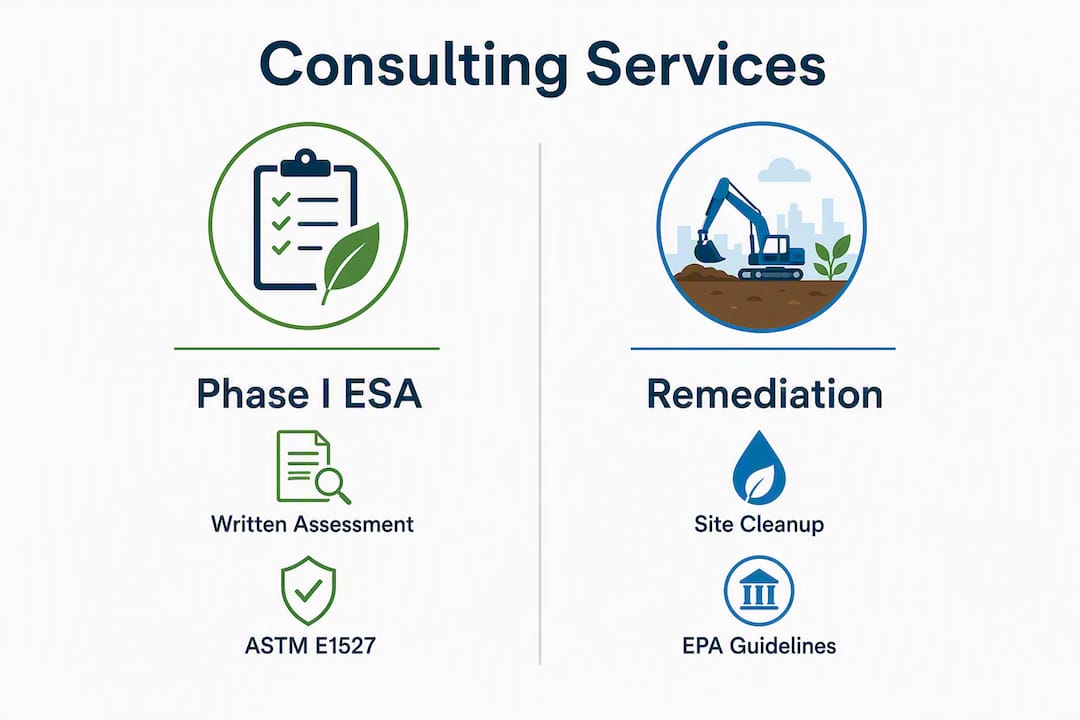
- Transactional due diligence: Phase I ESAs (ASTM E1527-21 standard), Phase II ESAs with soil/groundwater sampling, and RSRAs. Deliverables include written assessment reports, recognized environmental condition (REC) findings, and sampling data packages.
- EIA and NEPA documentation: Environmental Impact Statements (EIS), Environmental Assessments (EA), Categorical Exclusion determinations, and public comment response matrices. These are required for federally funded or federally permitted projects.
- Permitting and regulatory compliance: air quality permits (Title V, NSR), stormwater permits (NPDES), wetland Section 404 permits, and state-level environmental approvals. Deliverables include permit applications, compliance schedules, and agency correspondence files.
- Remediation and construction-phase monitoring: remedial investigation and feasibility study (RI/FS) reports, remedial action plans, construction quality assurance (CQA) plans, and post-remediation monitoring reports.
- Air, water, and soil sampling: field sampling plans, laboratory analytical reports (EPA-method referenced), chain-of-custody records, and data validation summaries.
- Ecological and threatened species surveys: biological assessments, Section 7 or Section 10 consultation packages under the Endangered Species Act, wetland delineation reports, and habitat management plans.
- Sustainability and ESG strategy: sustainability consulting has shifted from compliance-only work into core business strategy, with firms now integrating sustainability into operations and supply chains to reduce risk and create measurable competitive advantages. Deliverables include GHG inventories, Science Based Targets (SBTi) roadmaps, ESG disclosure reports (GRI, SASB, TCFD), and supply chain risk assessments.
| Service Category | Typical Deliverable | Key Standard or Authority |
|---|---|---|
| Phase I ESA | Written assessment report with REC findings | ASTM E1527-21 |
| Phase II ESA | Sampling plan, lab reports, data validation | EPA analytical methods |
| EIA / NEPA | EIS or EA document, public comment response | NEPA (40 CFR 1500–1508) |
| Permitting | Permit application, compliance schedule | EPA, state agencies |
| Remediation oversight | RI/FS report, CQA plan, monitoring logs | EPA CERCLA guidance |
| Ecological survey | Biological assessment, wetland delineation | ESA Sections 7 and 10 |
| ESG / Sustainability | GHG inventory, SBTi roadmap, ESG report | GRI, SASB, TCFD |
What types of environmental consulting firms should you consider?
Not all environmental consulting firms are structured the same way, and selecting the wrong firm category for a project’s scope is one of the most common procurement errors.

National multidisciplinary firms combine geology, geotechnical engineering, air and water quality science, and ecological expertise under one roof. Large, full-service firms provide integrated delivery that can reduce coordination risk on complex infrastructure projects where multiple regulatory disciplines intersect simultaneously. These firms suit large-scale infrastructure development, federal permitting, and multi-site corporate compliance programs.
Regional and boutique transactional firms focus on high-volume, time-sensitive property due diligence. Boutique transactional specialists often structure services around ASTM and SBA standards, holding repeatable processes tailored to lenders and real estate buyers. For routine Phase I ESAs and RSRAs on commercial properties, a regional specialist frequently delivers faster turnaround and lower cost than a national firm.
Specialist remediation firms design, remediate, build, and operate environmental and energy projects with direct field capability. Full-service remediation providers that integrate construction-phase monitoring can reduce the need to hire a separate contractor after liabilities are discovered, which matters significantly when a Phase II ESA uncovers contamination requiring immediate action.
Sustainability boutiques concentrate on ESG strategy, responsible finance, and energy transition advisory. These firms are appropriate when the primary objective is stakeholder reporting, net-zero roadmapping, or supply chain decarbonization rather than regulatory compliance or site remediation.
| Firm Type | Best Fit | Key Tradeoff |
|---|---|---|
| National multidisciplinary | Complex infrastructure, federal permitting | Higher cost; broader bench |
| Regional / boutique transactional | Routine Phase I/II, lender-driven due diligence | Deep local knowledge; narrower scope |
| Specialist remediation | Contaminated sites, construction-phase monitoring | Strong field capability; less ESG depth |
| Sustainability boutique | ESG strategy, net-zero roadmaps, ESG disclosure | Strategic depth; limited field sampling |
Pro Tip: When a project carries meaningful contamination risk, select a firm that can both assess and deliver remediation or construction-phase monitoring. Avoiding a re-contracting event after liabilities surface reduces schedule uncertainty and total project cost.
When should an organization hire an environmental consultant?
The timing of engagement directly affects both cost and regulatory outcome. Hiring too late in a project cycle can trigger permit delays, transaction failures, or cost overruns that a timely assessment would have prevented.
- Sustainability strategy and ESG reporting: — engage during annual planning cycles, at least six months before a reporting deadline, to allow time for data collection, GHG inventory verification, and stakeholder review.
Urgent engagements (active contamination discovery, regulatory enforcement notices, imminent transaction closings) require firms with immediate field availability. Planned engagements (annual compliance audits, ESG reporting cycles) allow time for a competitive RFP process.
How do you choose the right environmental consultant?
Selecting a qualified firm requires evaluating technical credentials, operational capacity, and documentation quality, not just price. The following framework applies across RFP, interview, and contracting stages.
Selection checklist
- Licensed professionals on the project team: PE (Professional Engineer), LSP (Licensed Site Professional), CIH (Certified Industrial Hygienist), or CHMM (Certified Hazardous Materials Manager), as applicable to scope.
- Professional liability (errors and omissions) insurance and general liability insurance, with coverage limits appropriate to project scale.
- Demonstrated local permitting experience with the relevant state environmental agency and federal authorities (EPA Region, Army Corps of Engineers, U.S. Fish and Wildlife Service).
- Laboratory accreditations: confirm that partner labs hold state certification and, where applicable, DoD ELAP or TNI accreditation for the analytical methods specified.
- Documented QA/QC procedures: written field sampling protocols, chain-of-custody forms, data validation procedures, and peer review requirements.
- Sample deliverables from comparable projects, reviewed for technical rigor, regulatory defensibility, and clarity of findings.
Interview questions to ask during shortlisting
- Which licensed professionals will sign and seal the deliverables, and what is their direct project experience with this site type?
- What is your firm’s chain-of-custody procedure from field collection through laboratory receipt and data validation?
- Which laboratories do you use, and what accreditations do they hold for the analytical methods this scope requires?
- How do you handle scope changes when field conditions differ from desktop assumptions?
- What QA/QC review steps occur before a draft report leaves your office?
- Can you provide two references from projects of comparable scope completed within the past three years?
Pricing drivers and typical timelines
Pricing in environmental consulting is scope-driven. Key cost factors include site size and complexity, sampling density (number of borings, monitoring wells, or air samples), laboratory analytical fees, specialty analyses (PFAS, vapor intrusion, radiological), travel and mobilization costs, and the number of regulatory agencies involved. Defensible, site-specific documentation remains the foundation for permitting and fund release, so cutting costs by reducing sampling density or skipping peer review typically creates larger downstream expenses.
| Deliverable | Typical Timeline |
|---|---|
| RSRA / transaction screen | ~2 business days |
| Phase I ESA (ASTM E1527-21) | 1–2 weeks |
| Phase II ESA (sampling and reporting) | 4 weeks |
| Compliance gap analysis | 2–4 weeks |
| EIA / NEPA Environmental Assessment | 3–6 months |
| EIA / NEPA Environmental Impact Statement | months |
| Remedial investigation and feasibility study | months |
Red flags to reject in proposals
- Vague scope language with no defined sampling locations, analytical methods, or deliverable formats.
- No written QA/QC plan or peer review step described in the proposal.
- Missing or inadequate professional liability insurance certificates.
- No references or case studies from comparable project types.
- Unclear chain-of-custody procedures or unnamed laboratory partners.
- Credentials listed at the firm level only, with no named licensed professional assigned to the project.
What is an RSRA, and how does it relate to a Phase I ESA?
A Records Search and Risk Assessment (RSRA), also called a transaction screen, is a rapid desktop review of publicly available environmental databases, regulatory records, and historical land use information for a subject property. Its purpose is to provide a preliminary risk determination for time-sensitive commercial transactions without the full field reconnaissance and regulatory file review required by a Phase I ESA.
RSRAs typically return results within approximately two business days and cost significantly less than a full Phase I ESA. Critically, fees paid for an RSRA are frequently credited toward a subsequent Phase I ESA if the preliminary findings indicate that a full assessment is warranted. This credit structure makes the RSRA a cost-effective first filter rather than a redundant expenditure.
The relationship between the two deliverables is sequential and additive:
- RSRA deliverables: database search results, regulatory file summary, preliminary risk determination (low/medium/high), and a recommendation on whether a Phase I ESA is necessary.
- Phase I ESA deliverables (ASTM E1527-21): site reconnaissance, regulatory file review, interviews with owners and occupants, historical records review (Sanborn maps, aerial photographs, city directories), and a written report identifying Recognized Environmental Conditions (RECs), Controlled RECs (CRECs), and Historical RECs (HRECs).
- Phase II ESA deliverables: site-specific sampling plan, field collection of soil, groundwater, or soil vapor samples, laboratory analytical reports, data validation summary, and a risk characterization narrative.
For lender-driven transactions, SBA Standard Operating Procedures specify when an RSRA is acceptable versus when a full Phase I ESA is required, making familiarity with those thresholds a practical selection criterion for boutique transactional firms.
What deliverables should you require in a proposal or SOW?
Procurement teams that specify deliverable requirements in the RFP stage receive comparable, defensible proposals. Vague SOWs produce vague proposals.
| Deliverable | Purpose | Minimum Quality Requirements |
|---|---|---|
| Phase I ESA report | Identify RECs prior to transaction or permitting | ASTM E1527-21 compliance; PE or EP signature; peer review |
| Phase II sampling plan | Define sampling locations, methods, and analytical suite | Named lab with state certification; chain-of-custody forms |
| EIA / NEPA chapter drafts | Document project impacts for agency review | Agency-specific format; public comment response matrix |
| Remediation action plan | Guide site cleanup to regulatory closure | Regulatory agency pre-approval; CQA plan included |
| Monitoring report | Document ongoing compliance post-remediation | Certified lab data; data validation summary attached |
| ESG / GHG inventory report | Disclose emissions for stakeholder reporting | Third-party verification; GRI or SASB alignment stated |
Scope checklist items to include in every RFP
- Specify minimum sampling density (borings per acre, number of monitoring wells, or air sampling locations).
- Require deliverable format: electronic PDF with GIS-referenced figures, plus raw data files.
- Mandate a written QA/QC plan describing field protocols, chain-of-custody procedures, and internal peer review steps.
- Require laboratory accreditation certificates for all analytical methods specified.
- Specify turnaround time for draft and final deliverables separately.
Pro Tip: When reviewing a sample deliverable from a shortlisted firm, check three things first: whether RECs are clearly defined with supporting evidence, whether chain-of-custody records are included as an appendix, and whether the conclusions are directly traceable to the data presented. A report that states conclusions without traceable data will not survive regulatory scrutiny.
Technically rigorous, defensible site-specific assessments are the foundation for releasing construction financing and obtaining authority approvals. A well-structured SOW is the procurement team’s primary tool for ensuring that standard is met.
Key Takeaways
Selecting the right environmental consulting firm requires matching firm type to project scope, verifying credentials and insurance, and specifying deliverable requirements in the RFP before proposals are received.
| Point | Details |
|---|---|
| Match firm type to scope | Use boutique transactional firms for routine Phase I/II ESAs; use multidisciplinary firms for complex, multi-agency infrastructure projects. |
| Start with an RSRA | For property transactions, an RSRA returns results in approximately two business days and fees often credit toward a full Phase I ESA. |
| Verify credentials and insurance | Require named PE, LSP, CIH, or CHMM professionals on the project team, plus professional liability and general liability insurance certificates. |
| Specify deliverables in the RFP | Define sampling density, deliverable format, QA/QC plan, lab accreditations, and turnaround times before requesting proposals. |
| Com’s integrated approach | Com’s integrated risk assessment and compliance workflows align with the selection criteria above, combining statutory compliance expertise with defensible technical delivery. |
The case for integrated technical capability in environmental consulting
The most consequential mistake procurement teams make when engaging environmental consultants is treating the assessment phase and the delivery phase as separate procurement events. A firm that identifies contamination but cannot manage remediation or construction-phase monitoring forces the owner into a re-contracting process at the worst possible moment: after liabilities are confirmed, under schedule pressure, and with a regulatory clock running.
Firms that combine advisory and field remediation capabilities tend to reduce total project risk and timeline uncertainty for owners and lenders. The reasoning is straightforward: the team that wrote the remedial investigation report understands the site conditions, the regulatory agency relationships, and the data gaps better than any incoming contractor could after a handoff. That continuity translates directly into fewer change orders, fewer agency comment cycles, and more predictable closure timelines.
There is a parallel argument on the sustainability side. Effective environmental consultants evaluate projects through technical, economic, and social lenses to deliver risk-aware recommendations. A sustainability boutique that produces a GHG inventory without understanding the permitting implications of the underlying operations is delivering an incomplete product. The firms worth retaining are those whose proposals articulate not just technical steps but also project impacts, mitigation benefits, and operational implications across all three dimensions.
The practical implication for procurement: require proposals to address what happens after the assessment. If a firm’s scope ends at report delivery with no discussion of what a positive finding triggers, that is a structural gap in the engagement, not a cost-saving feature.
How Aman Engineering Consultancy supports your compliance and risk assessment needs
Aman Engineering Consultancy brings statutory compliance expertise, risk assessment workflows, and integrated project delivery to organizations that need technically defensible documentation for authority approvals and project financing. Where environmental assessment intersects with structural, facade, fire safety, or M&E compliance, Aman’s multidisciplinary capability means a single engagement covers the regulatory scope that would otherwise require multiple consultants.
For project teams at the RFP stage, Aman’s risk assessment and compliance services provide the structured, QA/QC-backed documentation that regulators and lenders require. For developers and asset managers who need a scoping conversation before committing to a full assessment, contact Aman Engineering Consultancy to discuss your project requirements and determine the appropriate first-step deliverable.
Authoritative standards and resources for further reference
The following primary sources and regulatory guidance documents underpin the standards referenced throughout this article. Procurement teams should consult these directly when drafting RFP requirements or evaluating firm proposals.
- ASTM International — ASTM E1527-21: the current standard practice for Phase I Environmental Site Assessments. Verify that any Phase I ESA proposal explicitly references this version, not the superseded E1527-13.
- U.S. Environmental Protection Agency — CERCLA and Brownfields guidance: the primary federal authority for contaminated site assessment and remediation standards, including All Appropriate Inquiries (AAI) requirements that Phase I ESAs must satisfy.
- Council on Environmental Quality — NEPA regulations (40 CFR 1500–1508): the governing framework for EIA and NEPA documentation requirements on federally funded or federally permitted projects.
- Los Angeles City Planning — Environmental Consultant List: an example of a municipal pre-qualified consultant registry; check the equivalent list maintained by the relevant state or local planning authority for your project jurisdiction.
“Project approvals depend on rigorous field work combined with defensible reporting. Technical documentation that cannot withstand regulatory scrutiny delays fund release and authority approvals regardless of the underlying project merit.” — Environmental assessment practitioner guidance
When reviewing any firm’s methodology, confirm that their sampling protocols reference the applicable EPA analytical methods, that chain-of-custody procedures are documented in writing, and that laboratory partners hold the state certifications required for the analytical suite your project demands. These three checks, applied consistently, will eliminate the majority of underqualified proposals before the interview stage.