
Introduction
End-of-life demolition of industrial structures in Singapore is a highly regulated process requiring coordination across four key regulatory agencies, mandatory structural surveys by a qualified Professional Engineer, and environmental impact studies before a single wall is touched. This guide provides the definitive compliance blueprint for plant managers, JTC lessees, and facility owners navigating the demolition of factories, warehouses, logistics centers, and manufacturing buildings on industrial land.
This article covers demolition protocols specific to JTC industrial estates, B1/B2 zoned manufacturing facilities, warehouses, and logistics centers. Residential and commercial structures fall outside its scope. The target audience includes plant managers overseeing aging facilities, logistics companies facing lease expiry decisions, and JTC lessees responsible for site return obligations-professionals who require heavy-duty engineering solutions and strict regulatory compliance across the entire lifecycle of their demolition projects. In Singapore, limited land space and redevelopment pressure also make demolition and reconstruction decisions a practical consideration for industrial sites.
Direct answer: End of life demolition protocols for industrial structures in Singapore require multi-agency approval from JTC Corporation, the Building and Construction Authority (BCA), the National Environment Agency (NEA), and the Ministry of Manpower (MOM). Demolition permits must be obtained from the Building and Construction Authority, environmental site assessments must be completed, and a demolition plan must include a stability report and method statement-all before demolition works can commence.
By the end of this guide, you will understand:
-
The complete regulatory compliance roadmap across JTC, BCA, NEA, and MOM
-
How to determine whether your existing building has reached end-of-life status
-
Cost optimization strategies including material recovery and recycling
-
Timeline planning with realistic milestones for a process that spans six months or more
-
Authority submission requirements including forms, reports, and professional certifications
Understanding Industrial Structure End-of-Life Assessment
Determining when an industrial structure has reached end-of-life in Singapore involves more than checking a calendar. It requires evaluating structural integrity benchmarks, economic obsolescence factors, and regulatory compliance triggers. The average building lifespan in Singapore is only 33 years-significantly shorter than in many developed nations-meaning that much of Singapore’s industrial building stock cycles through demolition and reconstruction within just a few decades.
For JTC lessees facing lease renewal decisions, the assessment phase is critical: it sets the foundation for every permit, every budget estimate, and every timeline that follows.
Structural Condition Evaluation Standards
BCA’s Periodic Structural Inspection (PSI) regime mandates that non-residential and industrial buildings aged 13 years or older undergo structural inspections every five years. A qualified Professional Engineer must conduct a structural survey before demolition, evaluating load-bearing capacity, concrete deterioration, overhead crane tracks, floor slab deflection, and roof structure integrity.
For existing structures where PSI reports reveal defects of structural significance-extensive concrete spalling, corroded reinforcement, or compromised load paths-the cost of remedial works often exceeds the economic value of continued operation. This is the practical decision gate: when repair costs surpass replacement costs, demolition becomes the rational path. PSI fees for large industrial complexes typically range from S$6,000 to S$12,000 or more depending on gross floor area and complexity.
Economic Obsolescence Indicators
JTC land lease optimization drives many demolition decisions. When existing buildings cannot achieve the allowable plot ratio under current URA/JTC zoning, lessees leave significant economic value unrealized. The URA’s CBD Incentive Scheme, for instance, offers a GPR bonus of 25% to 30%, incentivizing redevelopment of underperforming sites. Singapore has 10 of the world’s 100 tallest voluntarily demolished skyscrapers-a testament to how aggressively the city pursues economic optimization of its built environment.
Operational efficiency degradation compounds the case for demolition: escalating maintenance costs, energy inefficiency in older systems, workflow constraints from outdated layouts, and the inability to accommodate modern manufacturing technologies. Plant managers should weigh these factors alongside structural assessment outcomes when developing their demolition business case. Renovating buildings could cut embodied emissions by nearly 70%, so the decision between adaptive reuse and full demolition also carries significant sustainability implications.
Regulatory Compliance Triggers
Several regulatory triggers can force demolition regardless of economic preference. Environmental contamination above NEA thresholds requires mandatory remediation or demolition. Fire safety code non-compliance-inadequate escape routes, outdated sprinkler systems, or non-conforming fire safety configurations-may result in closure orders. Failure to pass PSI with critical structural defects can lead to enforcement action under the Building Control Act.
JTC’s Environmental Site Assessment (ESA) requirements are triggered at lease expiry, change of use, or exit from industrial sites. Asbestos surveys are mandatory for buildings built before 1991. These regulatory triggers often compress decision timelines, making careful planning in the assessment phase essential before moving into the multi-agency approval framework.
Singapore’s Multi-Agency Industrial Demolition Framework
Once assessment outcomes confirm that demolition is the appropriate course, facility owners enter a regulatory landscape that demands coordination across multiple authorities simultaneously. The process is governed by the Building and Construction Authority and the National Environment Agency, with parallel requirements from JTC and MOM. Demolition requires compliance with four key regulatory agencies, each with distinct submission requirements and approval timelines.
JTC Land Authority Requirements
For industrial properties under JTC leases, the JTC Site Return Guidelines (updated July 2020) define the land return conditions and reinstatement obligations. Lessees must provide topographic survey and layout plans showing substructures, underground storage tanks, pile foundations, and all site improvements. Demolished materials and demolition debris removal must follow method statements approved by JTC.
Site clearance must ensure that all debris is removed and the site is leveled. Final site clearance includes removing foundations and contaminant remediation. The ESA process-mandatory for B1/B2 zoned industrial land-establishes baseline contamination levels and determines whether remediation is required before the site can be returned. Understanding the distinction between JTC plan consent and BCA approval is essential for navigating this process efficiently.
Environmental remediation standards are rigorous. ESA must be carried out by NEA-listed consultants, and the process takes approximately four months for baseline assessment alone, with additional time required if contamination is detected.
BCA Structural Safety Protocols
Singapore Standard SS 557 establishes a Code of Practice for Demolition, and the newly adopted SS 557:2026 (effective 2 June 2026) represents a major update in which the Demolition Protocol is incorporated into the formal compliance framework. This revision introduces stricter requirements for structural appraisal and stability assessments. For buildings older than 40 years or where concrete quality is questionable, intrusive tests are now mandatory. Soft stripping to expose the structural framework prior to detailed PE appraisal is required before the demolition plan can be finalized.
A demolition plan must include a stability report and method statement, both certified by a Professional Engineer. SS 557:2026 also expands demolition standards for newer structure types such as PPVC (Prefabricated Prevolumentric Construction) and MET (Mass Engineered Timber), reflecting the evolving composition of Singapore’s building stock. BIM is mandated for large-scale demolition projects in Singapore, as BIM enhances project management across the demolition lifecycle and integrates all project stakeholders from conception to demolition.
The Building and Construction Authority issues permits for demolition through a structured submission process that requires compliance with the Building Control Act.
Environmental and Safety Agency Coordination
NEA’s pollution control measures under SS 593 regulate trade effluent, soil and groundwater quality thresholds, air pollution control, and contaminated site remediation during demolition works. Environmental measures include dust suppression, noise control, and vibration monitoring. Noise limits for demolition vary by time and building type, requiring contractors to schedule high-impact activities within permitted windows.
MOM’s Workplace Safety and Health Regulations impose operational controls during demolition, including permit-to-work systems, risk assessments, safe work procedures, and protection of adjacent structures. Asbestos management involves notifying the Ministry of Manpower at least 28 days before work commences and following proper disposal methods. Workers handling hazardous materials must be competent and trained, with resident technical officers among the key on-site personnel overseeing demolition safety, environmental management, and legal compliance, while senior company officials remain personally accountable under SAFE measures.
The integrated compliance approach requires a project manager who can coordinate parallel submissions across all agencies, ensuring that documentation is consistent and approvals proceed without bottlenecks. This coordination is one of the key aspects that determines whether a demolition project stays on schedule.
Industrial Demolition Protocol Implementation
With regulatory approvals mapped and the multi-agency framework understood, implementation follows a systematic sequence. Demolition works in Singapore follow a strict sequence designed to mitigate risks, protect workers and adjacent facilities, and ensure environmental protection throughout the process.
Pre-Demolition Assessment and Planning
Comprehensive pre-demolition assessment is required for all industrial facilities before any physical works begin. The demolition protocol begins with several concurrent workstreams:
-
Environmental site assessment: Soil sampling, groundwater testing, identification of underground tanks, chemical storage areas, and hazardous materials including asbestos, PCBs, and industrial chemicals. NEA-listed consultants must be engaged.
-
Structural stability analysis: A qualified Professional Engineer must conduct a structural assessment evaluating the existing building’s load paths, foundation condition, and adjacency to operational structures. Non-destructive testing and, where required under SS 557:2026, intrusive testing must be completed.
-
Utility disconnection: Utilities must be securely isolated and certified safe before heavy machinery arrives. This includes gas, water, electricity, process steam, and any specialized industrial supply systems.
-
Hazardous equipment removal: Chemical decommissioning, removal of flammable material storage, and safe disposal of industrial process equipment with chemical residues.
-
Demolition must include a thorough risk assessment and a method statement, certified by a PE, covering demolition sequencing, protection measures, barriers, traffic management for haulage routes, and noise and vibration control plans.
Hoardings and covered walkways are mandatory for site protection during demolition, particularly in dense industrial clusters where adjacent facilities remain operational.
Demolition Works Method Selection for Industrial Structures
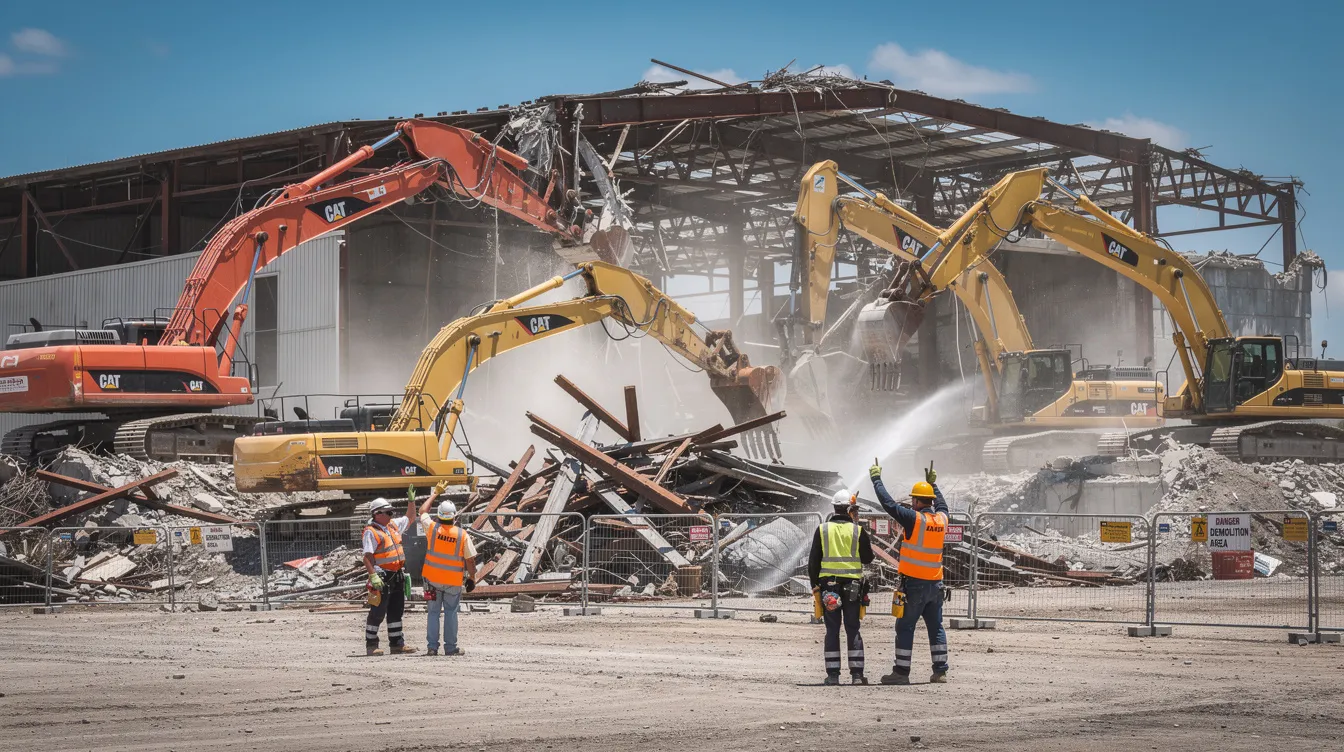
Controlled demolition methods favor top-down mechanical demolition over explosive implosion in Singapore’s dense industrial environment. Top-down mechanical demolition is the standard method in Singapore, but the choice of approach depends on facility type, contamination status, and operational constraints.
|
Method |
Industrial Applications |
Regulatory Requirements |
|---|---|---|
|
Controlled Mechanical Demolition |
Standard warehouses, manufacturing buildings, logistics centers |
BCA permit, noise control measures, dust suppression |
|
Selective Dismantling |
Contaminated facilities, chemical processing plants, structures with asbestos |
NEA environmental clearance, specialized waste handling, MOM notification |
|
Phased Demolition |
Operational facilities requiring business continuity |
JTC operational approvals, staged permit applications, temporary works design |
Hydraulic excavators are essential for breaking and clearing debris in mechanical demolition. Robotic demolition reduces risks from falling debris and structural collapse, making it increasingly practical for complex industrial teardowns. BIM improves safety and efficiency in demolition processes by enabling precise sequencing and clash detection before physical works begin.
Plant managers should select demolition methods based on the potential risks present at their specific facility-contamination levels, structural condition, proximity to operating neighbors, and the health risks posed by hazardous materials. Past incidents in Singapore highlight the need for strict adherence to approved demolition sequences.
Material Recovery, Waste Management, and Waste Classification
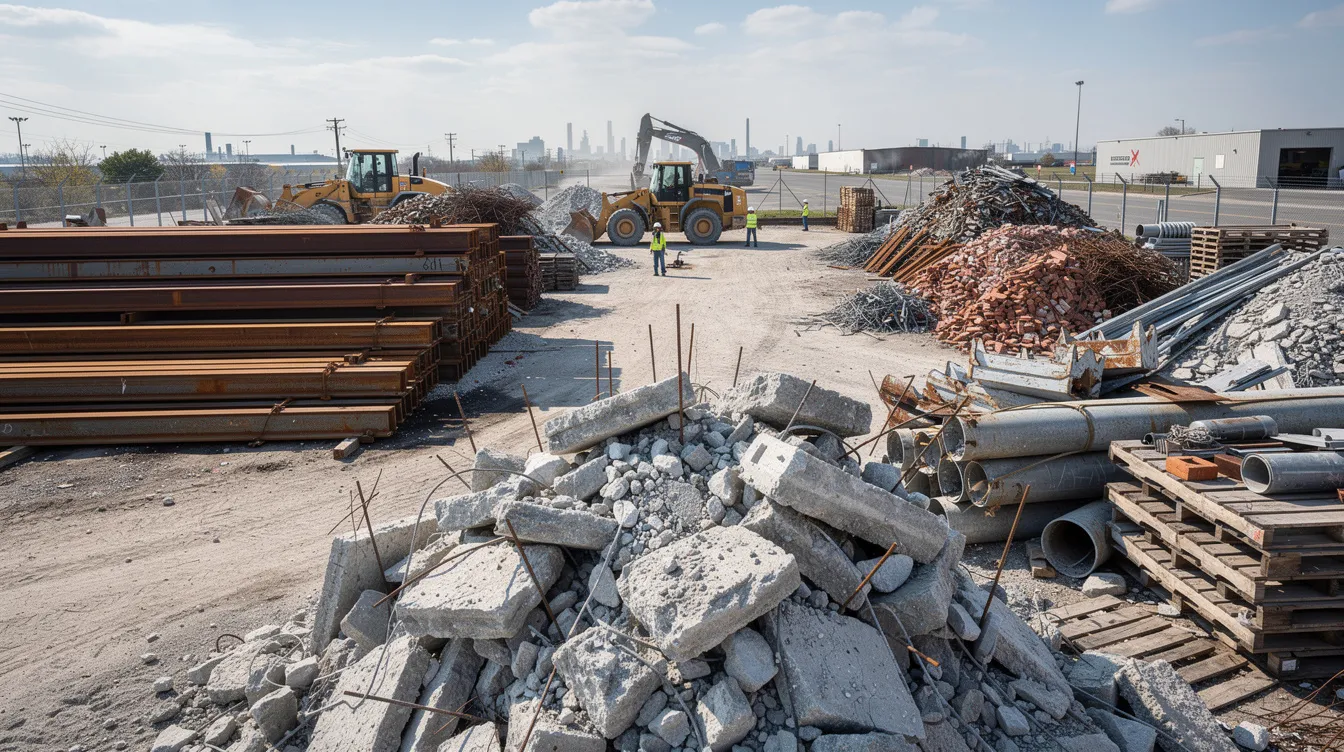
The BCA’s Demolition Protocol maximizes material recovery during demolition, aligning with Singapore’s push toward a circular economy. Singapore recycles over 99% of construction and demolition waste since 2013-in that year alone, the city recovered 1.69 million tonnes of C&D waste. This world class recycling rate is driven partly by economics: Singapore’s gate fee for waste disposal at Semakau is $97 per ton, making recycling significantly more cost-effective than disposal.
Concrete is primarily recycled into Recycled Concrete Aggregates (RCA) for use in new construction or road base. Steel and metals are recovered, processed, and sold. Contaminated materials-concrete with chemical residues, surfaces exposed to industrial processes-require specialized treatment before they can be recycled or must be sent to approved waste disposal facilities.
Singapore has only one operational landfill, Semakau Landfill, which gives the waste management imperative real urgency. Sustainable demolition practices align with Singapore’s push toward a circular economy, where materials are recovered and reused rather than disposed of. Embodied carbon emissions are poorly regulated in Singapore, but the industry is developing toward greater accountability for whole life carbon considerations across the entire lifecycle of buildings-from construction through demolition. The Demolition Protocol maximizes recovery of materials for recycling, reducing both disposal costs and environmental impact.
Common Challenges and Solutions
Industrial demolition projects in Singapore routinely encounter obstacles that can derail timelines, inflate costs, and create regulatory complications. Here are the most common challenges faced by plant managers and logistics companies, with practical solutions.
Contamination and Hazardous Material Management
Delayed detection of contamination-legacy chemicals, oil-soaked soils, undocumented asbestos-is the single most expensive surprise in industrial demolition. The solution: engage certified environmental consultants for comprehensive site assessment early, ideally six months before planned demolition. Develop a contamination remediation plan before seeking demolition approval. For facilities built before 1991, asbestos surveys are mandatory and should be completed as the first environmental assessment step.
Operational Continuity During Phased Demolition
When parts of an industrial facility must remain operational during demolition-common in logistics centers and multi-tenant JTC buildings-the risks multiply. Implement a detailed staging plan with temporary facilities, logistics rerouting, and structural monitoring of adjacent operational areas. Temporary works design for shoring and support systems must be PE-certified, and workplace safety protocols must account for the coexistence of demolition and operational activities.
Multi-Agency Approval Coordination
The sequential nature of multi-agency approvals-JTC, BCA, NEA, MOM, and sometimes URA-can add months to project timelines if documentation is incomplete or inconsistent across submissions. Engage an experienced engineering consultancy familiar with all four agencies to prepare parallel submissions where regulations allow. Ensure that the demolition plan, ESA reports, waste management plans, and structural condition reports are cross-referenced and consistent.
Cost Escalation and Timeline Overruns
Industrial demolition budgets frequently blow out due to shallow initial assessments, unexpected structural conditions, or contamination requiring remediation. Fuji Xerox Towers was demolished in 2023 for the Newport Plaza redevelopment, and the demolition of Pearl Bank Apartments occurred in 2019 for profit maximization-both large-scale projects that demonstrated how comprehensive upfront planning prevents costly surprises. Establish a project budget with 20–25% contingency for industrial-specific challenges. Implement weekly progress monitoring with regulatory milestone tracking, and ensure your project manager maintains direct communication channels with all responsible authorities.
Conclusion, Sustainable Construction, and Next Steps
Successful end-of-life demolition of industrial structures in Singapore demands systematic demolition protocol implementation, multi-agency coordination, and early investment in thorough assessment. From PSI and structural evaluation through environmental site assessment, permit submissions, demolition method selection, waste management, and site reinstatement-each phase builds on the last, and shortcuts in early stages invariably create expensive problems later.
The adoption of SS 557:2026, tightening requirements for structural appraisal and expanding standards for newer construction technologies, signals that regulations will only become more demanding. Plant managers and JTC lessees who prioritize retention of professional engineering expertise and begin assessments early will navigate this process more efficiently.
Immediate next steps:
-
Commission a periodic structural inspection if your industrial building is 13 years or older and hasn’t been assessed within the last five years
-
Engage a qualified engineering consultancy with multi-agency submission experience to conduct a feasibility study evaluating repair versus demolition economics
-
Initiate early discussions with JTC regarding land return requirements and ESA timelines-allow a minimum of four months for the environmental baseline alone
-
Develop a preliminary waste management plan to estimate material recovery value and waste disposal costs
Related topics worth exploring include industrial site remediation strategies, JTC lease renewal alternatives to demolition, and sustainable construction practices that reduce whole life carbon impact in future developments. As climate change pressures intensify and Singapore’s built environment continues its rapid evolution, demolition practices that incorporate circular economy principles and reduce embodied carbon will become the industry standard.
Additional Resources
-
JTC Site Return Guidelines: Detailed requirements for demolition, earthworks, turfing, and as-built survey during industrial land return
-
SS 557:2026 Code of Practice for Demolition: The current standard governing demolition practice, including enhanced requirements for structural appraisal and newer building types
-
JTC Environmental Site Assessment Guidelines: Technical requirements for ESA at entry, exit, lease renewal, or change of use on B1/B2 zoned industrial land
-
WSH (Construction) Regulations: MOM’s regulatory framework covering permit-to-work, risk assessments, asbestos management, and workplace safety during demolition
-
BCA Sustainable Construction Guidelines: Pre-demolition audit requirements, site waste management plans, and material recovery standards
-
Demolition safety training course: Useful for teams coordinating site shutdowns and hazardous-work controls; participants receive an e-certificate upon successful completion.