

The JTC submission process is the formal procedure to obtain plan consent from JTC Corporation for proposed development, renovation, or change of use works on industrial and commercial land in Singapore. Developers, contractors, and project managers must navigate this process before commencing any works on JTC-managed properties. The procedure involves submitting plans and statutory forms through CORENET portals, coordinating with regulatory bodies such as BCA and SLA, and addressing Land Betterment Charges (LBC) where applicable. Failure to secure plan consent before works begin constitutes a breach of lease conditions and can result in enforcement action.
What are the key documents required in the JTC submission process?
The JTC application process requires a defined set of documents, and missing even one form can trigger an immediate rejection. The specific documents vary depending on whether the submission is made by a Qualified Person (QP) or a Non-Qualified Person (non-QP), but both tracks share a core set of requirements.
For QP submissions, Qualified Persons are registered architects or engineers who must endorse all plans and take professional responsibility for the works. Their submissions must comply with JTC’s regulatory guidelines and include all relevant statutory forms alongside the endorsed plans.

For non-QP submissions, applicants must submit a self-declaration form (JTC_LPD_SD_NonQP) and a letter of consent authorizing JTC to act on the applicant’s behalf. This track applies to minor works that do not require professional endorsement.
The following documents are required across most submission types:
- Application for Assumption of Liability form: Required when works trigger Land Betterment Charges due to GFA increases or change of use.
- Letter of Consent: Authorizes JTC to act on the applicant’s behalf for LBC matters and other regulatory dealings.
- Self-declaration form (non-QP track): Confirms the applicant’s understanding of JTC guidelines and their responsibility for the works.
- Authorization letter from lessee or tenant: Must be on official company letterhead, signed by an authorized signatory, and state the full project title. This letter grants no-objection for the submission to proceed.
- Plans package: Includes key plans, site plans, unit plans, sections, and elevations.
All plans must include a GFA table showing Site Area, GFA quantum breakdown, and Gross Plot Ratio (GPR). Plans must be submitted in CAD, BIM, or PDF formats and signed or stamped by the lessee or tenant. Refer to the guide on JTC layout plan submissions for a detailed breakdown of document requirements specific to renovation and A&A works.
Pro Tip: Prepare the authorization letter on company letterhead before any other document. Delays in obtaining the lessee’s signature are the single most common cause of submission backlogs.
How to navigate submission workflows on CORENET portals for JTC approvals
The JTC submission guidelines require all plan consent applications to be submitted electronically through either CORENET 2.0 or CORENET X, depending on the project type and timeline. Both portals follow a structured workflow that developers and QPs must understand before uploading any files.
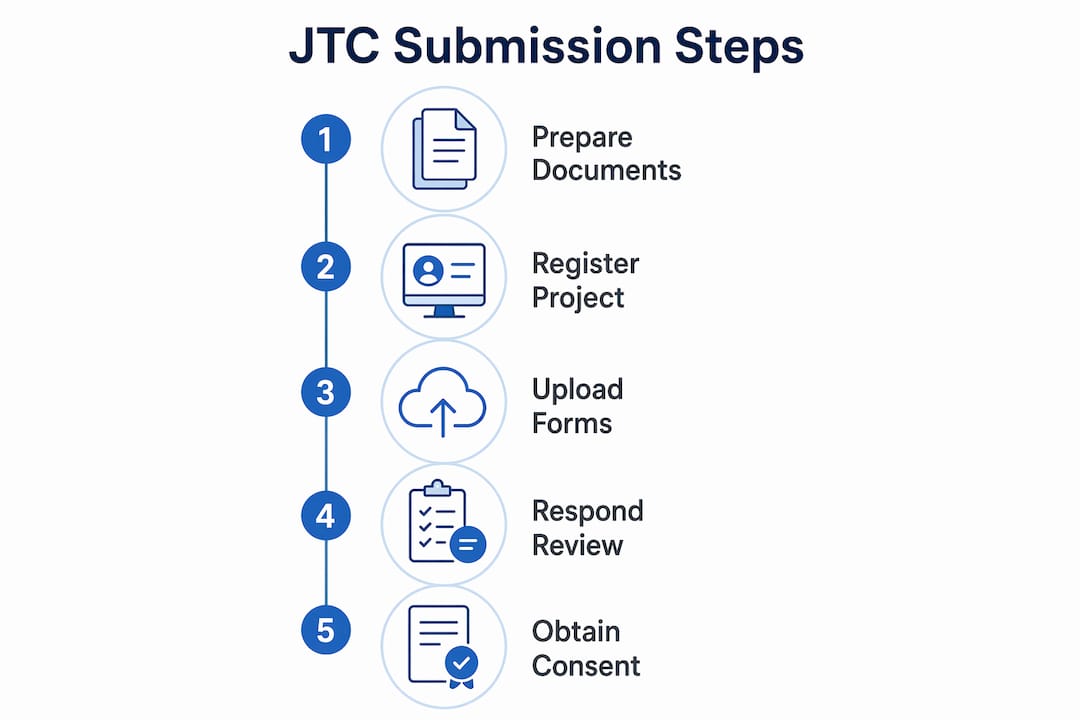
The procedural steps for submitting through CORENET are as follows:
- Register the project on the CORENET portal. Create a new project record with the correct JTC property address, lease number, and proposed works description. Accuracy at this stage prevents mismatches during review.
- Schedule a pre-submission consultation with JTC. For complex proposals involving GFA changes, change of use, or structural works, JTC offers pre-consultation sessions. These sessions identify potential issues before formal submission and reduce the risk of rejection.
- Prepare and upload all required documents. Upload plans in the correct format (CAD, BIM, or PDF) alongside all statutory forms. Ensure file naming conventions match JTC’s requirements, as incorrect file names can cause processing delays.
- Submit the application and await JTC’s acknowledgment. JTC will issue a formal acknowledgment upon receipt. This acknowledgment does not constitute approval.
- Respond to JTC’s comments and requests for information. JTC reviewers may issue queries or request revised plans. Responses must be submitted within the timeframe specified in the query notice.
- Receive plan consent. Upon satisfactory review, JTC issues written plan consent. Works may only commence after this consent is received.
Submission workflows on CORENET include registering projects, preparing and uploading forms, and responding to JTC’s requests throughout the review cycle. The distinction between CORENET 2.0 and CORENET X matters: CORENET X is the newer platform and handles a broader range of submission types, while CORENET 2.0 remains active for legacy projects. Developers should confirm which portal applies to their specific project type before beginning registration.
Pro Tip: Use JTC’s pre-consultation service for any project involving a change of use or GFA increase. The session takes less than an hour and can save weeks of back-and-forth during formal review.
When are Land Betterment Charges applicable in the JTC submission process?
Land Betterment Charges (LBC) apply when a proposed development increases the Gross Floor Area (GFA) or changes the use of a property beyond its established development baseline. This is one of the most financially significant aspects of the JTC submission process, and developers must account for LBC liability before finalizing project budgets.
The table below summarizes the key triggers, forms, and implications for LBC in JTC submissions:
| Trigger | Required Form | Implication |
|---|---|---|
| GFA increase beyond development baseline | Application for Assumption of Liability | Developer assumes financial liability for LBC payable to SLA |
| Change of use exceeding approved baseline | Letter of Consent | JTC authorized to act on applicant’s behalf in LBC dealings |
| Both GFA increase and change of use | Both forms required | Dual liability; LBC calculated on combined uplift value |
| No change to GFA or use | Neither form required | Standard plan consent process applies without LBC assessment |
Applicants must submit the Application for Assumption of Liability form and Letter of Consent when increasing GFA or changing usage beyond the development baseline. These forms allow JTC to act on behalf of the applicant for LBC matters with the Singapore Land Authority (SLA). LBC is distinct from development charge and premium payments, though all three relate to land value uplift. LBC applies specifically to State land transactions and is calculated based on the enhancement in land value resulting from the proposed change. Developers should engage a qualified valuer or engineering consultant early to estimate LBC exposure before committing to a project scope.
For projects involving change of use, the JTC change of use approval guide provides detailed procedural guidance on canteens, ancillary offices, and other permitted uses within industrial developments.
What are common challenges and best practices in managing JTC submissions?
Submission rejections are preventable in the majority of cases. Common submission errors include unsigned documents, incomplete forms, missing authorizations, and failure to comply with JTC’s land use and GFA guidelines. Each of these errors adds weeks to the approval timeline and may require a full resubmission.
The following practices reduce rejection risk and keep submissions on track:
- Verify all signatures before uploading. Plans must be signed and stamped by the lessee or tenant. Unsigned plans are rejected outright, with no opportunity for amendment without resubmission.
- Confirm the project title matches across all documents. The project title on the authorization letter, the CORENET registration, and all submitted forms must be identical. Discrepancies trigger queries that delay processing.
- Check compliance with JTC’s 60:40 industrial use rule. JTC’s 60:40 rule mandates that industrial use quantum in developments on JTC land must maintain a specified ratio. Any change of use application that pushes the non-industrial component above the permitted threshold will be rejected.
- Coordinate between the developer, QP, and contractor before submission. Misalignment between the QP’s endorsed plans and the contractor’s proposed scope is a frequent source of post-submission queries. All parties should review the final submission package together.
- Use the correct submission track. Submitting a QP-required project through the non-QP track, or vice versa, results in immediate rejection. Confirm the applicable track with JTC before beginning document preparation.
- Schedule pre-consultations for complex proposals. JTC’s pre-consultation service is available for proposals involving structural changes, GFA increases, or change of use. Using this service before formal submission reduces the likelihood of major comments during review.
Developers managing A&A works should also review the detailed guide on JTC plan consent for A&A works to understand the specific document requirements for that submission category. For industrial unit submissions specifically, the guide on industrial unit plan consent addresses the most common pitfalls in that context.
Key Takeaways
The JTC submission process requires complete documentation, correct portal registration, and early coordination between developers, QPs, and lessees to secure plan consent without delays.
| Point | Details |
|---|---|
| Document completeness is non-negotiable | Unsigned plans, missing forms, or absent authorization letters result in immediate rejection. |
| Portal selection determines workflow | CORENET X handles most current submissions; confirm the correct portal before registering your project. |
| LBC triggers require additional forms | GFA increases or change of use beyond the development baseline require the Assumption of Liability form and Letter of Consent. |
| The 60:40 rule affects change of use approvals | Industrial use quantum must meet JTC’s specified ratio; non-compliance blocks change of use applications. |
| Pre-consultation reduces rejection risk | Scheduling a JTC pre-consultation before formal submission identifies issues early and shortens the review cycle. |
What I’ve learned from managing JTC submissions across complex projects
The most consistent pattern I see across failed submissions is not technical error. It is a failure of coordination. Developers assume the QP has the authorization letter. The QP assumes the developer has confirmed the project title with the lessee. The contractor assumes the plans are already signed. By the time the submission reaches CORENET, three documents are missing and the review clock has not even started.
The fix is not complicated. A single pre-submission checklist, reviewed by all parties before upload, eliminates most of these problems. The checklist should confirm signatures, verify the project title across every document, and confirm the GFA table reflects the actual proposed works. This takes thirty minutes. A rejection and resubmission takes four to six weeks.
The second thing I consistently observe is that developers underestimate the LBC exposure on change of use projects. The Application for Assumption of Liability form feels like a formality until the SLA issues a charge notice. Engage a consultant to estimate LBC liability before finalizing the project scope. The cost of that estimate is negligible compared to an unexpected charge that disrupts project financing.
Finally, the JTC plan consent vs. BCA approval distinction matters more than most developers realize. JTC plan consent and BCA approval are separate processes with separate requirements. Obtaining one does not substitute for the other. Projects that require both must run these processes in the correct sequence to avoid delays at the construction stage.
— Aman
How Aman Engineering Consultancy supports your JTC submissions
Aman Engineering Consultancy provides end-to-end support for developers, contractors, and project managers navigating JTC plan consent applications in Singapore. The firm’s team handles document preparation, plan drafting in CAD and BIM formats, QP coordination, and CORENET portal submissions across industrial and commercial project types.
For projects involving GFA changes, change of use, or A&A works on JTC land, Aman Engineering’s integrated engineering services cover the full submission lifecycle, from pre-consultation scheduling through to plan consent receipt. The team’s familiarity with JTC’s review criteria and common rejection triggers reduces turnaround time and minimizes the risk of resubmission. Contact Aman Engineering to discuss your project’s specific submission requirements and timelines.
FAQ
What is JTC submission, and when is it required?
JTC submission, formally known as JTC plan consent, is the mandatory approval process for any development, renovation, or change of use works on JTC-managed industrial or commercial land in Singapore. Plan consent must be obtained before works commence.
What documents are needed for a non-QP JTC submission?
Non-QP submissions require a self-declaration form (JTC_LPD_SD_NonQP), a letter of consent, an authorization letter from the lessee or tenant, and plans in CAD, BIM, or PDF format including a GFA table.
How long does the JTC submission process take?
Processing time varies by project complexity. Simple layout plan submissions may be resolved within a few weeks, while proposals involving GFA changes, change of use, or structural works typically take longer due to additional review requirements and potential LBC assessment.
What triggers Land Betterment Charges in a JTC submission?
LBC is triggered when a proposed project increases GFA or changes the use of a property beyond its established development baseline. Applicants must submit the Application for Assumption of Liability form and Letter of Consent to proceed.
What is the 60:40 rule in JTC submissions?
The 60:40 rule requires that industrial use occupies the specified majority quantum in JTC developments. Change of use applications that breach this ratio will not receive plan consent.