
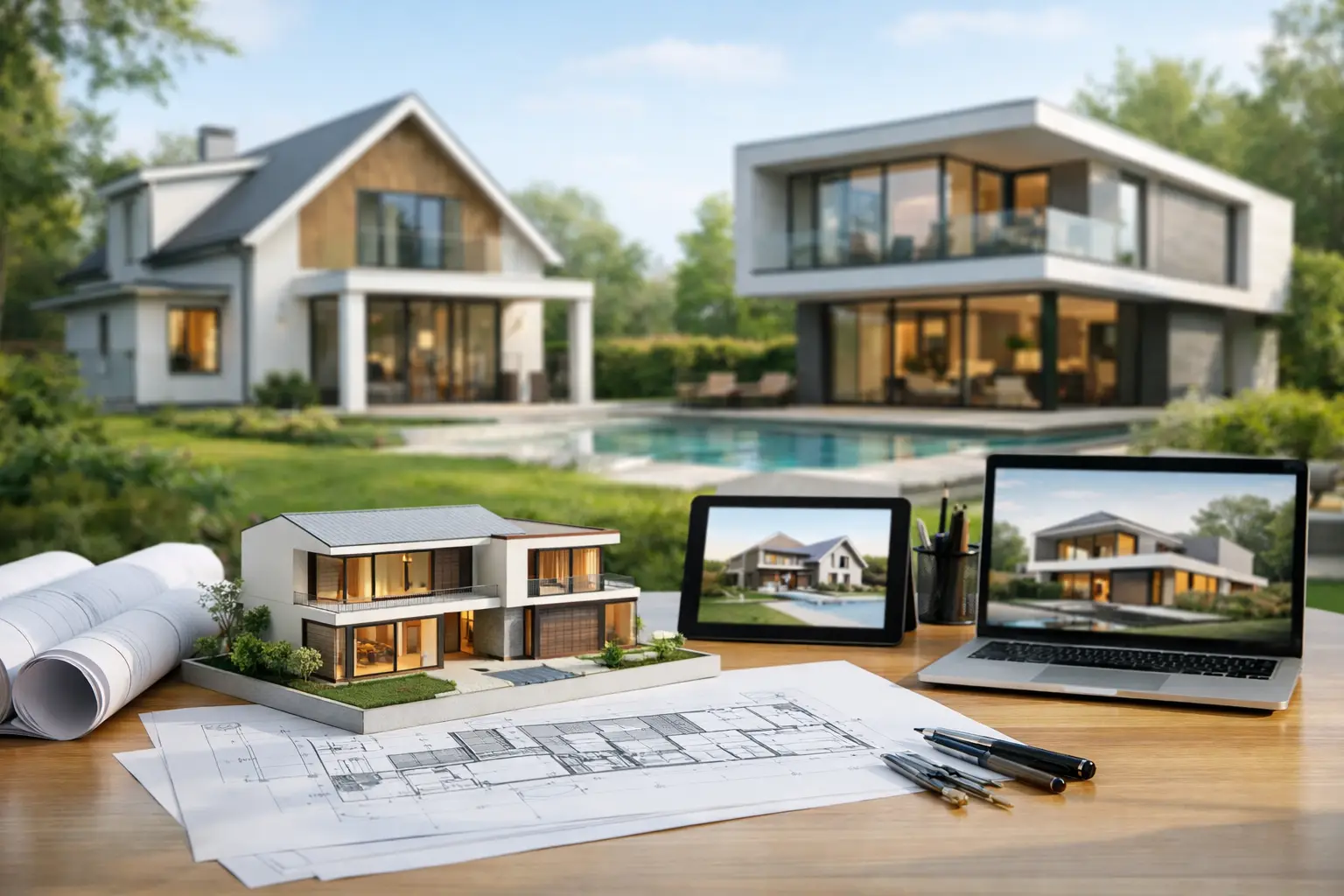
A landed house project usually looks simple at the start – more space, better layout, a cleaner façade, maybe an extension or a rebuild. The complexity appears the moment architectural design for landed houses has to satisfy real site constraints, owner expectations, buildability, and approval requirements at the same time. Good design is not just about how the home looks on paper. It is about whether the scheme can be approved, built safely, maintained properly, and adapted to how the household actually lives.
For homeowners, that often means making decisions long before construction begins that will affect cost, timeline, and compliance. For developers and project teams, it means coordinating architecture with structural design, M&E requirements, drainage, fire safety considerations, and authority submissions from the outset. When these issues are addressed late, redesigns become expensive.
What architectural design for landed houses really involves
Architectural design for landed houses is the process of translating a site, a set of user needs, and a regulatory framework into a buildable residential scheme. That includes spatial planning, massing, façade treatment, circulation, daylight strategy, natural ventilation, access, and the relationship between interior spaces and external areas.
In practice, landed housing design is rarely a pure architecture exercise. The shape of the staircase can affect structural spans. The roof form can affect drainage and façade expression. Window placement can influence privacy, solar heat gain, and code compliance. A proposed attic, basement, rear extension, or side setback adjustment may trigger detailed review against planning controls and technical submission requirements.
This is why early-stage design should be grounded in more than aesthetics. A well-composed house that cannot clear statutory review or creates construction conflicts is not a successful design.
Start with the site, not the floor plan
Many owners begin with a reference image or a preferred room schedule. That is understandable, but the site should lead the design logic. Plot dimensions, orientation, topography, neighboring structures, access conditions, drainage levels, and existing utilities all shape what is practical.
A corner lot, for example, offers different façade opportunities and privacy challenges than an intermediate plot. A narrow frontage may require more disciplined planning to bring daylight into the center of the house. A sloping site can create opportunities for split-level organization, but it can also complicate retaining works, structural design, and water management.
Setbacks, site coverage limits, height controls, and boundary conditions should be assessed early. If the design team starts from an oversized program without checking these parameters, the project can lose time in repeated revisions.
Layout planning should follow actual living patterns
The best landed house layouts are not always the largest or most visually dramatic. They work because they fit the household. A multigenerational family may need a ground-floor bedroom with accessible bathroom access. A family with domestic staff may need clearer service circulation. Owners who entertain often may prioritize kitchen-dining-living connectivity, while others prefer stronger separation between formal and private zones.
This is where practical briefing matters. How many people will live in the house over the next five to ten years? Is there a need for a home office that can remain acoustically private during the day? Will aging parents need fewer level changes? Is parking just a requirement, or does the frontage need to accommodate maneuvering for larger vehicles?
Open-plan layouts are popular, but they are not always ideal. They improve visual spaciousness, yet they can reduce acoustic control and privacy. Double-volume spaces create impact, but they also affect cooling loads, structure, and usable floor area. Every design move has a trade-off.
Compliance affects design quality more than owners expect
Landed house design is often judged by appearance, but project risk is usually driven by compliance. Planning controls, building regulations, structural requirements, drainage provisions, and fire safety considerations can all shape the design before any finishes are selected.
That is especially relevant when the scope includes additions and alterations, reconstruction, attic works, or significant façade changes. Existing buildings may carry structural constraints that are not obvious at concept stage. What seems like a simple wall removal may require strengthening. A new opening may affect load paths. Roof modifications may require more extensive intervention than originally assumed.
An execution-focused consultant will test design intent against submission pathways early. That reduces the chance of developing a scheme that looks attractive but stalls during review. In practice, timely coordination with architectural, structural, civil, and M&E inputs is one of the most effective ways to protect both schedule and budget.
Design decisions that affect long-term performance
A landed house is a long-life asset. Architectural design should therefore account for operation and maintenance, not only handover appearance. This point is often underestimated in custom homes.
Façade materials need to suit the exposure conditions and maintenance expectations of the owner. Large glazed areas may create a premium look, but they can increase heat gain and cleaning needs. Flat roofs can support a certain visual language, yet detailing and waterproofing quality become more critical. Deep overhangs can improve shading and weather protection, though they may also affect the exterior expression and structural approach.
Natural ventilation, daylight penetration, and rain protection should be resolved as part of the architecture, not left for later correction. A house that relies entirely on mechanical cooling despite having strong passive design potential usually reflects a missed opportunity in planning.
Storage is another recurring issue. Elegant layouts can fail in daily use if they do not provide enough concealed storage, service yard functionality, or utility planning. Good residential architecture is measured in ordinary routines as much as formal presentation.
Architectural design for landed houses must coordinate with engineering
The strongest residential projects are coordinated early across disciplines. Architectural design for landed houses should not proceed in isolation from structural feasibility, utility routing, drainage strategy, and construction sequencing.
For example, owners may want wide column-free interiors, slim roof edges, large cantilevers, or floating stair elements. These can be achieved in many cases, but they require disciplined engineering integration. Without that integration, the architectural concept may later be compromised by beam depths, service conflicts, or excessive cost.
The same applies to basement design, retaining structures, car porch loading, and roof drainage. A visually clean scheme still depends on technical systems working properly behind the scenes. Where coordination is weak, defects and rectification issues tend to surface after completion, when corrective work is harder and more expensive.
This is one reason many clients prefer a consultancy that can align design development with submissions, engineering inputs, inspections, and authority coordination under one team. For projects with regulatory sensitivity or technical complexity, that structure reduces fragmentation.
New build, reconstruction, or A&A – the design approach changes
Not all landed house projects should be treated the same way. A new build offers more freedom, but it also requires a full response to site planning, structure, utilities, and authority requirements. Reconstruction may preserve some aspects of the original asset while still triggering substantial compliance and technical review. Additions and alterations can seem less demanding, yet they often involve the trickiest coordination because new works must integrate with existing conditions.
The right approach depends on the age of the property, owner objectives, structural condition, and approval implications. If an owner wants significantly larger spaces, a new façade, revised circulation, and major service upgrades, limited renovation may not be the most efficient route. Conversely, if the structure is fundamentally sound and the target is selective modernization, a controlled A&A scope can protect budget and timeline.
A serious assessment at the start can prevent the common mistake of underestimating how much intervention is actually required.
What clients should expect during the design process
A disciplined design process should begin with site review, briefing, planning checks, and feasibility alignment. Concept development follows, then design refinement coordinated with structure and building systems, then submission documentation and technical detailing for construction.
Clients should expect questions that go beyond finishes and style. A competent consultant will ask about occupancy, phasing, maintenance priorities, approval risk, and whether future adaptability matters. They should also explain where the design has flexibility and where constraints are fixed.
At this stage, speed matters, but rushed design usually creates downstream problems. The objective is not simply to issue drawings quickly. It is to issue drawings that can move through approvals, support procurement, and reduce site changes.
For homeowners who are less familiar with the process, this is where professional guidance becomes especially valuable. For more technical stakeholders, the priority is often coordination discipline, submission readiness, and reduced ambiguity across consultants and contractors. Aman Engineering Consultancy operates in that space where design quality and regulatory execution need to work together, not compete.
A landed house should feel personal, but it should also be technically resolved. When the design is grounded in site realities, coordinated with engineering, and tested against approval requirements early, the result is not just a better-looking home. It is a project with fewer surprises and a clearer path from concept to completion.