
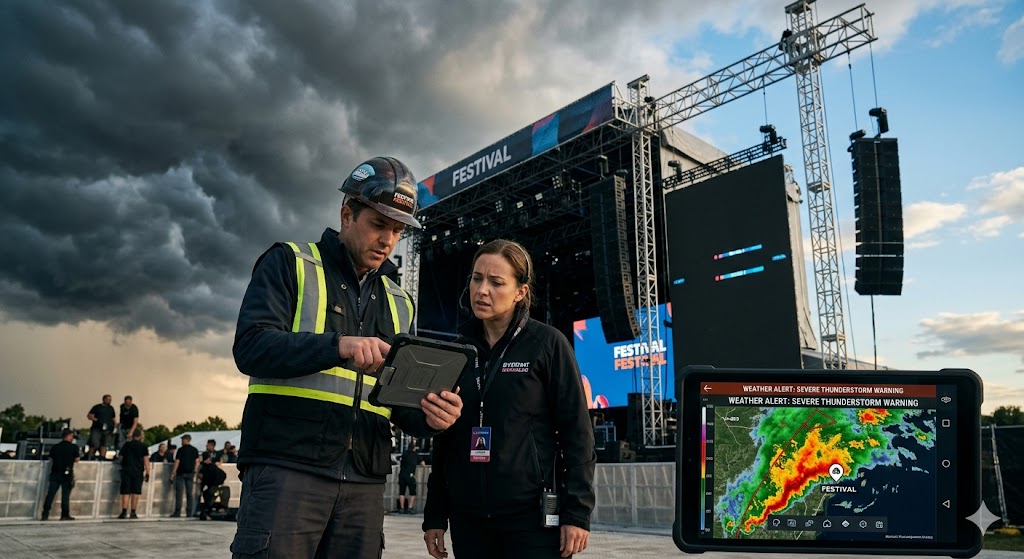
Safety First: The PE’s Role in Certifying Temporary Structures
Introduction to Temporary Structure Engineering
Certifying temporary structures for public use requires immense technical expertise. Consequently, a Professional Engineer must guarantee uncompromised structural integrity. The mantra of safety first dictates every project phase. Public use scenarios introduce highly unpredictable environmental variables. Therefore, structural certification requires extremely rigorous engineering oversight. It is never a mere administrative or legal formality. Rather, it is a binding technical evaluation protecting human lives.
Engineers face complex tasks designing temporary demountable structures today. These assemblies encompass concert stages, grandstands, and hospitality tents.1 They also include scaffolding, fabric structures, and barricades.1 Approximately 32 million people attend music festivals annually.2 This massive attendance highlights the critical importance of safety first. Often, these assemblies are erected rapidly under suboptimal site conditions. Furthermore, they are repeatedly assembled and disassembled across various locations.
This repetitive cycle causes dynamic wear and severe material degradation.3 Consequently, loss of structural capacity becomes a critical design factor.3 Professional Engineers must mathematically account for this inevitable degradation.3 Temporary structures must withstand severe, unpredictable environmental forces constantly. Wind loads pose the most significant threat to outdoor stages.3 High-velocity gusts can induce catastrophic lateral instability almost instantaneously. Snow, ice, and seismic loads also threaten structural equilibrium significantly.4
Consequently, temporary structure design requires specialized codes and distinct standards. Standard permanent building codes often prove too rigid structurally. Sometimes, these standard codes are wholly inapplicable to temporary deployments. Thus, specialized frameworks guide the Professional Engineer expertly. These frameworks balance structural safety with rapid practical deployments. Ultimately, certifying temporary structures for public use prevents deadly disasters.
Statutory Professional Responsibility
Defining the Professional Engineer
The statutory definition of a Professional Engineer anchors the process. A Professional Engineer renders services requiring extensive specialized education.5 They expertly apply mathematical, physical, and engineering sciences daily.5 In California, the law strictly defines various engineering branches.5 A civil engineer practices civil engineering in any phase.5 An electrical engineer handles complex electrical systems and power distributions.5 A mechanical engineer oversees mechanical systems and machinery integration.5 Together, these disciplines ensure comprehensive safety first for public use.
Oklahoma law further defines the Professional Structural Engineer designation.6 These engineers perform analysis for highly significant structures.6 They obtain this authorization through additional experience and specialized examinations.6 Furthermore, Oklahoma defines an Engineer Intern legally.6 This person has passed fundamental engineering subject examinations.6 Missouri laws also clarify statutory engineering definitions carefully.7 They define accredited schools of engineering and architecture explicitly.7 Missouri also dictates rules for vital design coordination tasks.7
Responsible Charge and Ethical Duty
The concept of responsible charge is fundamental to structural certification. Responsible charge means exercising independent control over engineering work.5 It requires initiative, technical skill, and uncompromised professional judgment.5 The Professional Engineer maintains direct supervision over the structural design.8 This legal responsibility cannot be delegated to unlicensed subordinates.8 In Alabama, this means direct control and personal supervision.8
In Missouri, Professional Engineers must maintain responsible charge constantly.9 They oversee all designs affecting public health and welfare.9 Interestingly, Missouri offers temporary courtesy licenses for military spouses.9 This license permits active practice for one hundred eighty days.9 Ethical rules reinforce this statutory obligation to protect public safety. A Professional Engineer must never seal inherently unsafe plans.10 If a client insists on dangerous designs, actions are required.10 The engineer must report the situation to building authorities immediately.10 Furthermore, they must withdraw from the consulting service immediately.10 Consequently, safety first supersedes any commercial or scheduling pressures.
| State | Statutory Requirement Focus | Applicable Reference |
| California | Strict branch definitions for Civil, Mechanical, Electrical. | 5 |
| Alabama | Direct control and personal supervision mandated. | 8 |
| Missouri | Responsible charge required for public welfare designs. | 9 |
| Oklahoma | Specific authorization for Professional Structural Engineers. | 6 |
Standard of Care and Professional Negligence
The standard of care dictates the benchmark for engineering performance. It requires using adequate knowledge and expertise during project execution.11 The design must prevent harm resulting from foreseeable injurious events.11 When certifying temporary structures for public use, engineers calculate loads.11 They must properly account for additional heavy equipment loads.11 Every aspect of the construction must be inspected and documented.11
Failing to exercise due care constitutes actionable professional negligence.11 If physical harm results, courts hold the Professional Engineer liable.11 State liability laws profoundly impact the daily practice of engineering.12 Statutes of repose bar legal actions after a specified period.12 However, these statutes do not totally absolve engineers of liability.12 They merely limit the timeframe for defending against historical claims.12
Other crucial liability laws affect engineers nationwide.12 These include sole source workers’ compensation and certificate of merit.12 Joint-and-several liability laws can expose engineers to massive financial damages.12 Therefore, executing the standard of care perfectly remains absolutely indispensable. Contractual agreements also limit specific operational responsibilities carefully.12 According to EJCDC documents, engineers do not supervise actual constructors.12 They are not responsible for construction means, methods, or sequences.12 Furthermore, engineers are not liable for a constructor’s safety precautions.12
Navigating Codes and Standards
Certifying temporary structures for public use requires mastering specialized codes. Professional Engineers navigate a complex web of overlapping national regulations.
International Building Code Updates
The 2024 International Building Code introduces highly anticipated structural revisions.4 Chapter 31 governs special building construction, including temporary structures.13 It also covers pedestrian walkways, automatic vehicular gates, and awnings.13 Seattle specifically includes fixed guideway transit and passenger rail systems.14 Seattle also includes public use restrooms in flood hazard areas.14
Previously, temporary structures faced a strict 180-day operational time limit.4 The International Fire Code originally mandated this rigid six-month restriction.4 However, pandemic-era regulations necessitated longer durations for outdoor testing facilities.4 Consequently, the 2024 IBC extended this limit to one year.4 This extension specifically applies to public-occupancy temporary structures today.4
Additionally, the IBC requires permits for specific temporary structure sizes. Temporary structures covering areas greater than 120 square feet require permits.13 This applies if they accommodate gatherings of ten or more persons.13 Building officials must issue these permits before any public erection.13
ANSI E1.21-2024 Specifications
ANSI E1.21-2024 represents a cornerstone standard for outdoor entertainment events.2 This standard regulates temporary structures used for technical production purposes.2 The primary purpose is ensuring structural reliability and overall safety.2 Notably, it does not address fire safety or safe egress.2 Furthermore, it excludes general public access structures like food tents.2 Portable toilets and independent modular floor staging are also excluded.2
The 2024 version harmonizes perfectly with the 2024 IBC.2 This unprecedented collaboration aligns building officials and structural engineers effectively.2 ANSI E1.21-2024 removes previous restrictions on load combination factors.2 It acknowledges that performance-based criteria achieve safety for limited durations.2 Moreover, it includes a crucial load reduction factor of 0.85.15
This specific factor applies to frequently reused structural systems.15 It successfully accounts for minor damage occurring in aluminum structures.15 Inspections are rigorously required before every single show.15 Inspections are also mandatory immediately after extreme weather events.15 This ensures the structure remains safe before guests can enter.15
Additional Entertainment Safety Standards
Other ANSI standards strictly regulate entertainment technology safety further.16 ANSI E1.42 covers safety standards for entertainment stage lifts.16 This includes orchestra pit lifts and similar mechanical equipment.16 ANSI E1.47-2020 establishes guidelines for entertainment rigging system inspections.16 It mandates annual inspections for manually operated and motorized rigging.16
OSHA regulations also deeply impact theatrical and event professionals.16 In 2024, OSHA aligned the Hazard Communication Standard closely.16 It now aligns with the UN Globally Harmonized System.16 The traditional Material Safety Data Sheet was officially replaced recently.16 The new Safety Data Sheet features a standardized 16-section format.16 Chemical manufacturers must fully comply by January 19, 2026.16
ASCE 37 Design Loads
The American Society of Civil Engineers publishes ASCE 37.17 This standard dictates design loads on structures during construction phases.17 ASCE 37 prescribes loads based on rigorous probabilistic analysis methodologies.18 It embraces expert opinions and observations of real construction practices.18 The loads apply equally to allowable stress design and strength design.19
This standard addresses dead loads, live loads, and construction loads.19 It also manages lateral earth pressures and complex environmental loads.19 Most importantly, it governs loads affecting partially completed structural assemblies.19 It serves structural engineers, construction engineers, and municipal code officials.18
NFPA and IStructE Standards
The National Fire Protection Association provides the vital NFPA 102.20 NFPA 102 regulates grandstands, tents, and folding assembly seating structures.21 It extracts critical requirements from NFPA 101 and NFPA 5000.22 This standard mitigates dangers related to fire, storms, and collapse.22 It uniquely addresses the unpredictable variables of panic and crowd behavior.22 Provisions cover open flame devices, pyrotechnics, and HVAC services.22
Internationally, the Institution of Structural Engineers provides comprehensive structural guidance.1 The Advisory Group on Temporary Structures authored these specific guidelines.23 They publish guidance on procuring and designing temporary demountable structures.24 The guidance explicitly reminds stakeholders of their strict legal responsibilities.24
A competent person must carry out all design and checking.25 Ad hoc employment of alternate-use materials must be actively resisted.25 The British Standard BS EN 13782 strictly regulates tent safety.26 It dictates that anchorage is critical to fabric structure stability.26 Pull-out forces depend heavily on soil type and water penetration.26 Furthermore, CDM Regulations strictly mandate safety in construction management internationally.27
Engineering Load Reductions
Certifying temporary structures for public use involves complex load reductions. Temporary structures typically exist for extremely short, specified time periods.28 Consequently, exposing them to maximum permanent design loads is improbable.28 Engineers equate this probability with permanent structure exposure limits directly.28 Therefore, applying full permanent wind loads creates unnecessarily massive structures.
Wind Load Reductions
ASCE 37 incorporates specific provisions for adjusting temporary wind loads.28 It lowers wind thresholds for short-term exposures during construction phases.28 For structures erected for less than six weeks, reductions apply.28 The standard permits a wind load factor of exactly 0.75.29 This reduces the applied wind load to roughly 56 percent.30 The calculation relies on a reduced probability of catastrophic winds.30
| Construction Period | ASCE 37 Wind Load Factor | Equivalent Load |
| Less than six weeks | 0.75 | 56% |
| Six weeks to one year | 0.80 | 64% |
| One to two years | 0.85 | 72% |
| Two to five years | 0.90 | 81% |
Tom Markel previously advocated heavily for these vital wind reductions.4 He served as the Tent Rental Division representative to ICC.4 His work set the stage for ASCE drafting new regulations.4 However, utilizing these reductions requires stringent, non-negotiable safety conditions always.4 The IBC 2024 allows a 65 percent reduction in wind loads.4 This specific reduction is entirely contingent upon occupancy control measures.4
Seismic, Snow, and Flood Reductions
The 2024 IBC dramatically reduces other structural code criteria globally.4 Live loads can be reduced based on approved rational analyses.4 Snow load reductions depend heavily on the structure’s service life.4 The code permits a standard snow reduction factor up to 70 percent.4 Implementing occupancy control measures drops this factor to 65 percent.4
Seismic loading requirements also feature massive reductions under IBC 2024.4 For moderate shaking zones, a 75 percent reduction is permitted.4 For minor shaking potential zones, seismic loading is entirely ignored.4 Ice thickness design requirements are strictly capped at half an inch.4 Furthermore, flood and tsunami loads require absolutely zero consideration structurally.4 However, this exemption demands active, rigorous occupancy control measures continuously.4
Operations Management Plans
Load reductions are never granted without corresponding operational safety protocols.4 A Professional Engineer mandates an operations management plan for certification.4 This plan must explicitly comply with stringent ANSI ES1.7 standards.4 It details environmental thresholds dictating mandatory, immediate public crowd evacuations.4 Organizers must actively monitor wind, snow, and ice conditions locally.4
If wind speeds approach reduced thresholds, evacuation is triggered immediately.31 Dismantling approaches must be realistic, highly documented, and fully achievable.31 Staggered thresholds are often utilized to maintain overall site safety.31 For example, video walls are quickly lowered at 40 mph.31 At 60 mph, the entire truss structure requires complete dismantling.31 Consequently, decisions on wind loads are never ad hoc decisions.31 Conclusive standards establish these vital thresholds to achieve optimum safety.31
Forensic Engineering Case Studies
Structural failures highlight the catastrophic consequences of severe professional negligence. Forensic engineering meticulously analyzes these collapses to improve code requirements. Reviewing these tragedies underscores why safety first is completely paramount.
The Indiana State Fair Stage Collapse
In August 2011, a devastating structural collapse occurred in Indiana.32 A severe storm caused a massive concert stage roof to plummet.32 This catastrophic incident resulted in seven deaths and numerous injuries.33 The State Fair Commission retained Thornton Tomasetti for forensic investigation.33 This prestigious firm executed a highly detailed cause and origin analysis.33 They carefully cataloged thousands of aluminum truss components and suspension equipment.33
The forensic findings revealed multiple critical engineering failures immediately.34 The temporary stage structure possessed an entirely inadequate lateral system.34 Calculations determined the Jersey barrier ballast system possessed insufficient capacity.34 High winds violently shifted these concrete barriers holding guy cables.32 This shifting rapidly redistributed the load, triggering the catastrophic collapse.32 Furthermore, the synthetic webbing ratchet straps failed under extreme tension.34
Wind speeds reached exactly 59 miles per hour during the event.32 However, the structure failed at wind speeds significantly below code.34 The metal rigging did not meet requirements to withstand 68 mph.32 Mid-America Sound, the staging company, shockingly refused to provide interviews.32 Thornton Tomasetti issued strict recommendations to prevent future temporary disasters.35
Licensed design professionals must evaluate complex loading configurations very meticulously.35 Environmental and site-specific loads must be mathematically analyzed before erection.35 Moreover, guy line systems should utilize fixed mechanical anchors whenever possible.35
The Ottawa Bluesfest Stage Collapse
Just weeks prior, another massive collapse occurred in July 2011.36 A fierce storm struck the Ottawa Bluesfest festival in Canada.36 Winds reaching 96 kilometers per hour devastated the main stage.36 The MBNA stage collapsed completely, sending three individuals to hospitals.36
Meteorological analysis revealed a severe bow echo weather pattern approaching.37 A bow echo is a primary indicator of very high winds.37 Despite available weather radar, event organizers failed to halt shows.37 Severe weather geeks noted the storm rolled in very fast.37 However, properly utilizing weather monitoring technologies prevents such catastrophic surprises.37 This mirrored the tragically fatal Big Valley Jamboree collapse in 2009.37
Engineering investigations revealed significant operational and structural deficiencies very quickly.38 Thornton Tomasetti compared actual wind forces with standard building codes.38 Finite element models determined the structural response to the storm.38 The staging company failed to provide an Operations Management Plan.38 The stage utilized wind walls designed to increase structural integrity.38 These walls required immediate removal during strong, unpredictable wind events.38
However, crews failed to release the walls, severely compromising strength.38 The lack of a clear, rehearsed plan directly caused failure.38 Following the collapse, Cheap Trick’s equipment was crushed and trapped.39 The entire mangled stage structure was eventually sent for recycling.39
The Radiohead Toronto Stage Collapse
The most legally profound stage collapse occurred in June 2012.40 Radiohead was scheduled to perform at Downsview Park in Toronto.40 The tour utilized eleven massive trucks of heavy production equipment.40 Stage construction was already running significantly behind the planned schedule.40 At 2:00 PM, business manager Ade Bullock noticed the roof drooping.40 He photographed it but lacked the engineering knowledge to challenge it.40
An hour before gates opened, the massive stage roof collapsed.40 Drummer Philip Selway heard a sound like falling glass cabinets.40 The impact instantly killed drum technician Scott Johnson on site.40 A video monitor weighing 5,000 pounds fell directly upon him.40 Three other road crew members sustained various serious bodily injuries.40 This disaster completely destroyed the band’s elaborate light show equipment.40
The forensic investigation uncovered shocking layers of professional engineering negligence.40 Professional Engineer Domenic Cugliari designed the temporary stage roof structure.40 The Ontario Ministry of Labour subsequently filed thirteen severe legal charges.40 Prosecutors proved Cugliari severely miscalculated the roof’s applied load weight.40 He underestimated the suspended equipment by roughly 16,010 total pounds.40 Consequently, the roof grid lacked adequate capacity to support 76,000 pounds.40
Furthermore, the design called for parts that did not exist.40 Optex Staging lacked a specific, highly critical truss component entirely.40 Dale Martin, head of Optex, testified regarding this massive flaw.40 Staff alerted Cugliari to this deficiency multiple times over years.40 Nevertheless, Cugliari claimed he believed the proper truss was utilized.40 This demonstrated a total failure to inspect the final erected structure.40
The original roof design was approved by engineer George Snowden.40 Snowden was previously disciplined for the fatal 2000 Ambassador Bridge collapse.40 No building permits were obtained because the site sat on federal land.40 Consequently, third-party engineering oversight was not legally required or enforced.40
The legal proceedings spanned several deeply frustrating and painful years.40 In 2017, the legal case was dropped under the Jordan ruling.40 This ruling puts strict time limits on ongoing legal cases.40 A Canadian inquest later issued twenty-eight non-binding structural safety recommendations.40 A British inquest concluded inadequate technical advice directly caused the death.40
In 2020, Professional Engineers Ontario found Cugliari guilty of misconduct.40 He officially admitted to a catalogue of errors and negligence.40 He resigned his license, and the PEO revoked it completely.41 This case exemplifies why certifying temporary structures demands absolute engineering vigilance. When Professional Engineers fail their standard of care, innocent people die.
| Collapse Incident | Year | Primary Forensic Findings | Legal / Professional Repercussions |
| Indiana State Fair | 2011 | Inadequate lateral system, ballast failure. | Enhanced industry scrutiny, structural lawsuits. |
| Ottawa Bluesfest | 2011 | Unreleased wind walls, severe bow echo. | Changes in weather monitoring protocols. |
| Radiohead Toronto | 2012 | Roof weight miscalculation, missing parts. | PE license revoked, professional misconduct. |
Scaffold and Formwork Collapses
Temporary formwork systems present another major area of engineering liability. Hadipiono and Wang studied 85 cases of formwork system collapses.42 Almost half occurred directly during the active pouring of concrete.42 The second critical failure stage occurs during premature formwork removal.42 Untimely removal of formwork causes catastrophic structural instability very instantly.42
During construction, temporary lateral bracing must be continuously provided safely.43 Concrete punching shear redundancies are absolutely vital for overall stability.43 Engineers must mandate cribbing to support slabs until completely attached.43 Sway bracing cables keep stacked floors from shifting sideways dangerously.43 Failing to utilize these components causes tragedies like L’Ambiance Plaza.43
Another case involved a massive 15-foot tall scaffold sign collapsing.3 Robson Forensic investigated this temporary tubular structure wrapped in vinyl.3 Soil anchors failed during reasonably foreseeable, standard wind condition events.3 The structural analysis proved that temporary material degradation was ignored completely.3
Risk Management and Liability Trends
The legal landscape for Professional Engineers is worsening significantly today.44 Industry surveys highlight rising professional liability insurance premiums globally.44 Several tangible macroeconomic factors drive these demonstrable premium increases continuously.44
Social Inflation and Nuclear Decisions
Social inflation heavily impacts the perceived liability of engineering firms.44 This term describes the societal perception that corporations must pay.44 Juries increasingly assume that standard of care implies absolute flawlessness.44 Consequently, any structural failure leads to massive financial judgments instantly.44
These trends produce what the insurance industry terms nuclear decisions.44 Nuclear decisions are jury verdicts exceeding typical claim amounts astronomically.44 Horizontal infrastructure projects see many of these inflated legal claims.44 California, Florida, Illinois, New York, and Pennsylvania report massive payouts.44 Bodily injury claims associated with construction projects are rising rapidly.44
Mitigating Professional Liability
Professional Engineers must employ strict risk management to mitigate liability. Certifying temporary structures for public use requires extremely detailed documentation. Liability risks soar when contractors seek advice on construction means.12 The standard EJCDC agreement explicitly limits the engineer’s site responsibilities.12 Engineers must never supervise, direct, or control the constructor’s work.12
However, certifying temporary structures requires verifying the final constructed condition.11 The engineer must formally sign off to verify completion specifications.11 To mitigate liability, rigorous third-party independent checks are highly recommended.23 A chartered engineer should independently review calculations, drawings, and specifications.23 This is crucial for non-standardized temporary demountable grandstands and stages.23
Product vs. Design Certification
Understanding certification layers is essential for modern temporary works engineering.45 Product certification represents the most basic level of quality assurance.45 It guarantees that all equipment safely meets necessary manufacturing standards.45 OEM certifications verify that parts are fit for intended uses.45 Coates utilizes third-party consulting engineers for independent product verification consistently.45
Design certification represents the subsequent, highly critical engineering review process.45 Project teams produce detailed drawings outlining the temporary structural solution.45 Certifying temporary structures verifies the design is safe for site conditions.45 It guarantees compliance with all building codes and safety regulations.45 Caltrans strictly monitors submittals through Contract Specifications Section 48.46 They remind contractors of legal relations regarding total public safety.46
Construction SEO and Digital Visibility
In the modern digital era, engineering firms must embrace SEO. Construction SEO directly connects engineering expertise with potential industry clients.47 Finding a qualified Professional Engineer requires high online search visibility.47 Certifying temporary structures for public use is a highly searched niche.
The Unique Nature of Construction SEO
Construction SEO operates differently than standard retail consumer search strategies.48 Engineering firms sell technical services to a multifaceted buyer committee.48 General contractors, architects, and municipal officials conduct these complex searches.48 Consequently, website content must match how these professionals actually procure.48
Traditional advice suggests waiting six months for measurable SEO results.48 However, highly optimized sites see ranking movement within a few days.48 This requires a Domain Authority of at least twenty.48 Building topical authority requires forecasting rankings based on competitive metrics.48 Digital PR and AI Overviews heavily influence modern search behaviors.48
Optimizing Keyword Strategies
Strategic keyword research anchors successful construction SEO campaigns highly effectively.49 Engineers should connect search intent directly to specific service pages.49 For example, design-build searches must map to design-build pages.49 Generic searches like “structural engineer near me” generate substantial traffic.50 The basic keyword “engineering” generates over one million monthly searches.50
Firms must optimize for specialized, high-intent phrases demonstrating niche expertise.47 Examples include “commercial building construction” or “sustainable green building materials”.47 Turning past project notes into target keywords yields highly relevant terms.49 Regularly updating website content signals business activity to search engines.49 Neglecting local SEO practices severely limits visibility to nearby clients.49
Digital success requires treating SEO as a highly measurable system.48 When content targets the correct buyer committee, leads behave predictably.48 High rankings transform a website into a powerful, continuous traffic magnet.47 Missing digital leads equals building an engineering firm on quicksand.47
| Keyword Target | Search Volume | Relevance to Engineering Firm |
| engineering | 1,220,000 | Broad top-of-funnel brand visibility. |
| structural engineer | 110,000 | Core service offering discovery. |
| structural engineer near me | 33,100 | High-intent local service procurement. |
| construction contractors | Variable | Partner networking and B2B leads. |
Safety First: The Ultimate Mandate
Certifying temporary structures for public use remains profoundly challenging work. The Professional Engineer balances rapid deployment schedules with uncompromising safety. Temporary structures lack the intrinsic redundancies of permanent concrete buildings. Therefore, every single connection, ballast, and truss carries magnified importance. Safety first must always remain the ultimate, non-negotiable engineering mandate.
Harmonizing Safety and Functionality
The industry continually evolves to harmonize rapid functionality with safety. The collaboration between the IBC and ANSI exemplifies this positive evolution.2 Acknowledging performance-based criteria allows for innovative, spectacular outdoor entertainment events.2 However, this innovation strictly relies upon flawless operational management execution.4
Occupancy control measures are not mere suggestions; they are lifesavers.4 When weather radar indicates bow echoes, evacuation protocols must activate.37 The Ottawa Bluesfest collapse demonstrated the terrifying velocity of summer storms.36 Event managers must subordinate financial considerations to engineering safety thresholds entirely.
The Weight of Certification
The Radiohead stage collapse serves as a dark, permanent warning.40 Professional misconduct in temporary structure design destroys lives and careers.40 Domenic Cugliari’s failure to verify part existence constitutes gross negligence.40 Miscalculating roof weights by 16,000 pounds reveals catastrophic technical sloppiness.40 Therefore, structural certification demands relentless, almost paranoid attention to detail.
A Professional Engineer must independently verify every assumed structural value.23 Relying blindly on contractor assurances violates the fundamental standard of care.11 The engineer’s seal guarantees that the structure protects the public completely.10 Certifying temporary structures for public use prevents unnecessary, tragic fatalities.
Conclusion
The Professional Engineer’s role in certifying temporary structures is indispensable. As temporary structures grow larger and complex, risks multiply exponentially. A Professional Engineer acts as the final bulwark against catastrophic failure. They navigate a complex matrix of building codes and environmental unpredictability. Certifying temporary structures for public use demands exceptional technical competence always.
Safety first is not a marketing slogan; it is statutory law. Load reductions permitted by ASCE 37 and IBC 2024 offer flexibility. However, this flexibility requires unwavering commitment to operations management plans continuously. Forensic case studies demonstrate that wind, poor construction, and negligence kill.
The Indiana State Fair and Radiohead collapses reshaped safety perceptions forever. Consequently, risk management and strict liability mitigation must guide practices today. Digital visibility through construction SEO ensures qualified engineers find critical projects. By upholding rigorous standards, Professional Engineers ensure public events remain spectacular. Ultimately, safety first guarantees that audiences return home unharmed every time.
Works cited
- Temporary demountable structures: Guidance on procurement, design and use (Fourth edition) – IStructE, accessed May 25, 2026, https://www.istructe.org/resources/guidance/temporary-demountable-structures-design-use/
- ANSI E1.21-2024: Temporary Structures for Outdoor Events, accessed May 25, 2026, https://blog.ansi.org/ansi/ansi-e1-21-2024-temporary-structures-outdoor-events/
- Structural Engineer Expert Investigation of Sign Collapse at an Event – Robson Forensic, accessed May 25, 2026, https://www.robsonforensic.com/articles/event-sign-collapse-expert
- 2024 IBC code changes affect temporary structures – Fabric …, accessed May 25, 2026, https://fabricarchitecturemag.com/2024/04/01/2024-ibc-code-changes-affect-temporary-structures/
- 2026 Professional Engineers Act, accessed May 25, 2026, https://www.bpelsg.ca.gov/laws/pe_act.pdf
- Section 475.2. Definitions – Oklahoma.gov, accessed May 25, 2026, https://oklahoma.gov/pes/resources/regulatory-documents/statutes/section-475-2.html
- Revised Statutes of Missouri, RSMo Section 327.011 – MO.gov, accessed May 25, 2026, https://revisor.mo.gov/main/OneSection.aspx?section=327.011
- 50-State Survey of Licensed Design Professional’s Stamping and Sealing Obligations – Baker Donelson, accessed May 25, 2026, https://www.bakerdonelson.com/webfiles/Bios/50StateSurveyofLicensedDesignProfessionalStampingandSealingObligations.pdf
- Missouri–Rules, Statutes and Ethics for Professional Engineers – EZ-pdh.com, accessed May 25, 2026, https://ez-pdh.ez-pdh.com/course-material/MO101-Missouri-Rules-Statutes-and-Ethics-for-Professional-Engineers1.pdf
- Responsibility for Public Safety | National Society of Professional Engineers, accessed May 25, 2026, https://www.nspe.org/career-growth/ethics/board-ethical-review-cases/responsibility-public-safety
- Standard of Care Engineering: What You Should Know – MDCSystems®, accessed May 25, 2026, https://mdcsystems.com/standard-of-care-engineering-what-you-should-know/
- Focusing on the Fundamentals | National Society of Professional Engineers, accessed May 25, 2026, https://www.nspe.org/career-growth/pe-magazine/may-2018/focusing-the-fundamentals
- CHAPTER 31 SPECIAL CONSTRUCTION – 2021 INTERNATIONAL BUILDING CODE (IBC), accessed May 25, 2026, https://codes.iccsafe.org/content/IBC2021P1/chapter-31-special-construction
- Seattle Building Code, Chapter 31, Special Construction, accessed May 25, 2026, https://www.seattle.gov/documents/departments/sdci/codes/seattlebuildingcode/2021sbcchapter31.pdf
- Temporary structure design – Schaefer, accessed May 25, 2026, https://schaefer-inc.com/temporary-structure-design/
- Environmental Health and Safety Laws for the Theater Professional, accessed May 25, 2026, https://entertainingsafety.com/knowledge-base/environmental-health-and-safety-laws-for-the-theater-professional/
- ASCE 37, accessed May 25, 2026, https://ascelibrary.org/doi/book/10.1061/asce37
- Design Loads on Structures during Construction | Books – ASCE Library, accessed May 25, 2026, https://ascelibrary.org/doi/book/10.1061/9780784413098
- Design Loads on Structures during Construction (37-02) – ASCE, accessed May 25, 2026, https://pubs.asce.org/Product?isbn=9780784406182
- NFPA 102, Standard for Grandstands, Folding and Telescopic Seating, Tents, and MembraneStructures – ANSI Webstore, accessed May 25, 2026, https://webstore.ansi.org/standards/nfpa/nfpa1022021
- NFPA 102 Standard Development, accessed May 25, 2026, https://www.nfpa.org/codes-and-standards/nfpa-102-standard-development/102
- NFPA 102: Standard for Grandstands, Folding and Telescopic Seating, Tents, and Membrane Structures (2026), accessed May 25, 2026, https://www.fire-police-ems.com/NFPA102-2026.shtml
- Temporary demountable structures, accessed May 25, 2026, http://for-sale.used-secondhand.co.uk/media/documents/tempstructuresguidance1.pdf
- Procurement and use of demountable structures – IStructE, accessed May 25, 2026, https://www.istructe.org/resources/guidance/procurement-and-use-of-demountable-structures/
- Temporary demountable structures – Winter 2020/21 considerations – IStructE, accessed May 25, 2026, https://www.istructe.org/resources/guidance/temporary-demountable-structures-winter-2020-21/
- Best Practice Guide | MUTA, accessed May 25, 2026, https://www.muta.org.uk/wp-content/uploads/2022/07/MUTAs-Best-Practice-Guide.pdf
- Temporary demountable structures – Designing Buildings Wiki, accessed May 25, 2026, https://www.designingbuildings.co.uk/wiki/Temporary_demountable_structures
- Wind Loads for Temporary Structures: Making the Case for Industrywide Standards – ASCE Library, accessed May 25, 2026, https://ascelibrary.org/doi/pdf/10.1061/%28ASCE%291076-0431%282009%2915%3A2%2835%29
- Wind Loads on Temporary Structures – SK Ghosh Associates, accessed May 25, 2026, https://www.skghoshassociates.com/blog/wind-loads-on-temporary-structures/
- accessed May 25, 2026, https://www.skghoshassociates.com/blog/wind-loads-on-temporary-structures/#:~:text=So%2C%20based%20on%20ASCE%2037,event%20as%20a%20permanent%20structure.
- Wind Loads for Temporary Structures: Making the Case for Industrywide Standards | Journal of Architectural Engineering | Vol 15, No 2 – ASCE Library, accessed May 25, 2026, https://ascelibrary.org/doi/10.1061/%28ASCE%291076-0431%282009%2915%3A2%2835%29
- Investigation Results in from August Indiana State Fair Stage Collapse | DENENA | POINTS, accessed May 25, 2026, https://www.denenapoints.com/investigation-results-august-indiana-state-fair-stage-collapse/
- The Indiana State Fair Collapse Incident: Anatomy of a Failure | Thornton Tomasetti, accessed May 25, 2026, https://www.thorntontomasetti.com/news/indiana-state-fair-collapse-incident-anatomy-failure
- TT Indiana State Fair Commission Investigation Report | PDF | Image Scanner – Scribd, accessed May 25, 2026, https://www.scribd.com/document/332331009/TT-Indiana-State-Fair-Commission-Investigation-Report
- Failures – Indiana State Fair Stage Collapse, accessed May 25, 2026, https://www.engr.psu.edu/ae/thesis/failures/MKP/failures/failures.wikispaces.com/Indiana_State_Fair_Stage_Collapse.html
- Investigators look at weather and construction as possible causes of Ottawa stage collapse | Globalnews.ca, accessed May 25, 2026, https://globalnews.ca/news/127010/investigators-look-at-weather-and-construction-as-possible-causes-of-ottawa-stage-collapse-2/
- Ottawa BluesFest Stage Roof Collapses – John Huntington, accessed May 25, 2026, https://www.controlgeek.net/blog/2011/7/18/ottawa-bluesfest-stage-roof-collapses.html
- Temporary Structure Failure – Case Studies – Penn State College of Engineering, accessed May 25, 2026, https://www.engr.psu.edu/ae/thesis/failures/MKP/failures/failures.wikispaces.com/Temporary%20Structure%20Failure%20-%20Case%20Studies.html
- Bluesfest Collapse Explained – Pollstar News, accessed May 25, 2026, https://news.pollstar.com/2011/07/21/bluesfest-collapse-explained/
- Radiohead stage collapse – Wikipedia, accessed May 25, 2026, https://en.wikipedia.org/wiki/Radiohead_stage_collapse
- Stage design in fatal Radiohead concert collapse called for parts that didn’t exist, witness says – CBC, accessed May 25, 2026, https://www.cbc.ca/news/world/stage-design-in-fatal-radiohead-concert-collapse-called-for-parts-that-didn-t-exist-witness-says-1.5082347
- Overview of Temporary Structures Failures in Construction, accessed May 25, 2026, https://www.engr.psu.edu/ae/thesis/failures/MKP/failures/failures.wikispaces.com/Overview_of_Temporary_Structures_Failures_in_Construction.html
- Building Failure Cases – William States Lee College of Engineering, accessed May 25, 2026, https://engr.charlotte.edu/asce-failure-case-studies/building-failure-cases/
- Legal Brief: Expanding liability for design professionals: The hits just keep coming | ASCE, accessed May 25, 2026, https://www.asce.org/publications-and-news/civil-engineering-source/civil-engineering-magazine/article/2023/08/expanding-liability-for-design-professionals-the-hits-just-keep-coming
- Temporary works certification explained – Coates, accessed May 25, 2026, https://www.coates.com.au/news/expert-tips/engineering-solutions/temporary-works-certification-explained
- Temporary Structures Manual, Compiled PDF – Caltrans, accessed May 25, 2026, https://dot.ca.gov/-/media/dot-media/programs/engineering/documents/structureconstruction/temp-str/sc-temp-str-manual.pdf
- Construction SEO: Your Ultimate Guide to Boosting Keyword Rankings and Sales, accessed May 25, 2026, https://www.digitalsuccess.us/blog/construction-seo-your-ultimate-guide-to-boosting-keyword-rankings-and-sales.html
- SEO for Construction Companies: 2026 Pipeline Growth System – Percepture, accessed May 25, 2026, https://percepture.com/construction-insights/seo-for-construction-companies/
- Quick & Dirty Guide To Construction Website Keyword Research – RSM Marketing, accessed May 25, 2026, https://rsmconnect.com/blog/keyword-research-for-construction-websites/
Top Engineering Keywords | Free SEO Keyword List | KeySearch, accessed May 25, 2026, https://www.keysearch.co/top-keywords/engineering-keywords