

Building Information Modeling has moved from optional to operationally critical in Singapore’s construction sector, yet many project teams still treat it as a software exercise rather than a managed information process. This guide to digital engineering BIM addresses that gap directly, covering the full lifecycle from pre-appointment planning through asset handover. Whether you are a developer selecting consultants, a project manager structuring a delivery framework, or a construction professional navigating BIM standards for Singapore, this article gives you the process clarity that generic introductions rarely provide.
Table of Contents
- Key Takeaways
- Guide to digital engineering BIM: core concepts
- Preparation phase: what you must establish before BIM starts
- Execution phase: managing BIM through design and construction
- Verification and handover: closing out BIM correctly
- My perspective on BIM governance in Singapore projects
- How Aman Engineering Consultancy supports your BIM delivery
- FAQ
Key Takeaways
| Point | Details |
|---|---|
| BIM extends beyond 3D modeling | Digital engineering integrates requirements, simulation, and lifecycle data across the entire project continuum. |
| ISO 19650 structures information delivery | Define EIR, BEP, and CDE requirements before tender to prevent data quality degradation later. |
| BEPs must evolve throughout the project | Treating BIM Execution Plans as static documents leads to delivery failures at key project stage gates. |
| Governance determines BIM success | Naming conventions, metadata audits, and CDE workflow enforcement matter more than software selection. |
| BIM is the foundation for digital twins | Establishing accurate, well-managed BIM models is the prerequisite before introducing real-time operational data systems. |
Guide to digital engineering BIM: core concepts
Digital engineering represents a systemic shift away from document-intensive construction workflows toward model-based, continuously updated, and integrated data governance environments. It embeds what practitioners call a “digital thread” that connects project requirements, design geometry, simulation outputs, regulatory verification, and operational data across the full asset lifecycle. BIM sits within this broader framework as the primary vehicle for managing building information, but it is not the whole picture.
At its foundation, Building Information Modeling is a structured process for creating and managing digital representations of a built asset, where geometry, spatial relationships, geographic information, quantities, and properties of building components are encoded within a shared model. The operational benefits are significant:
- Clash detection identifies design conflicts between structural, architectural, M&E, and facade elements before they become costly on-site problems
- Design visualization allows clients and regulators to evaluate spatial performance and code compliance before construction commences
- Lifecycle data management retains as-built information in formats accessible to facility managers years after project completion
- Improved collaboration across disciplines through a single shared model reduces design iteration cycles and rework
“Digital engineering extends beyond modeling to embed a digital thread that connects requirements, design, simulation, verification, and operational data across the full lifecycle.” — SEBoK Digital Engineering
Understanding the distinction between BIM and digital twins is also essential. BIM typically produces a static or periodically updated 3D model; a digital twin integrates real-time sensor data for continuous asset monitoring, predictive maintenance, and operational simulation. The practical takeaway for construction teams is clear: build robust, well-managed BIM first before investing in digital twin infrastructure.
Preparation phase: what you must establish before BIM starts
The most consequential decisions in any BIM project are made before a single model element is created. Poor definition of information needs and lax governance are the primary causes of ISO 19650 failures, not software incompatibilities or skills gaps.

Key information requirement documents
The ISO 19650 series provides the internationally accepted framework for BIM information management. Before procurement, project owners must define four interdependent requirement sets:
| Document | Owner | Purpose |
|---|---|---|
| OIR (Organizational Information Requirements) | Asset owner | Long-term strategic data needs of the organization |
| AIR (Asset Information Requirements) | Asset owner/FM | Data needed to manage the asset post-completion |
| PIR (Project Information Requirements) | Project client | Information needed to make project-stage decisions |
| EIR (Employer’s Information Requirements) | Client team | Contractual BIM requirements imposed on delivery teams |
The EIR is the document that contractually integrates BIM standards into the procurement process. It must specify software format requirements, model content standards, naming conventions, CDE platform rules, and handover deliverables. If the EIR is vague, every downstream deliverable will be inconsistent.
Setting up the Common Data Environment
A Common Data Environment (CDE) is a concept and workflow, not merely a software product. CDE workflow states define the four stages that all information containers must pass through: Work in Progress (WIP), Shared, Published, and Archived. Each transition requires defined checks and approvals. The CDE governs the single source of truth for project information and prevents parallel, uncontrolled file exchanges between parties.
- Select or configure a platform that supports these four workflow states with access controls and audit trails
- Define CDE governance rules in the BEP before appointment
- Assign information manager roles with defined responsibilities for approvals at each state
- Train all project parties on CDE usage before design commences
- Document the CDE structure in the pre-appointment BEP submitted during tender
Pro Tip: Require prospective design teams to submit their pre-appointment BEP as part of the tender response. Review it for specificity: vague commitments to “follow ISO 19650” without defined information delivery milestones are a reliable indicator of weak BIM capability.
Execution phase: managing BIM through design and construction
Once appointed, the delivery team must convert the pre-appointment BEP into a post-appointment BEP that reflects the actual project scope, team structure, and software platforms. The BEP is a live document that must be updated at every stage gate to reflect changes in teams, scope, and tools. Treating it as static documentation is one of the most common causes of information delivery failure.
BEP structure and information delivery planning
The post-appointment BEP must incorporate two subsidiary documents:
- MIDP (Master Information Delivery Plan): The overarching schedule of all information deliverables, cross-referencing every container with its responsible party, format, and delivery milestone
- TIDPs (Task Information Delivery Plans): Discipline-specific delivery schedules that feed into the MIDP, authored and maintained by each design team lead
BIM management roles encompass operational oversight of these documents throughout the project, not just initial modeling setup. The BIM manager is responsible for model review, conflict resolution, data governance enforcement, and workflow synchronization across all disciplines.
Coordinating models and managing quality
Clash detection and model federation are at the center of multi-discipline coordination. The recommended workflow proceeds through the following steps:
- Each discipline publishes updated models to the CDE on the agreed schedule in the MIDP
- The BIM coordinator federates discipline models into a combined coordination model
- Clash detection is run, and a clash matrix is issued to responsible parties with resolution deadlines
- Resolved clashes are verified in the updated models before the next coordination cycle
- Coordination meeting records and clash logs are archived in the CDE as project records
Naming conventions and metadata governance are non-negotiable throughout this process. Monitoring CDE usage metrics and conducting regular metadata audits are the specific governance tasks that prevent the rapid decline in information quality that occurs without strict controls. A project team that ignores these tasks during the construction phase will face significant problems reconciling the as-built model with physical reality at handover.
Pro Tip: Run a metadata compliance audit at every major project milestone, not just at handover. Retrospective corrections to naming conventions and attribute data across hundreds of model containers can consume weeks of effort that structured governance would have prevented.
Integrated BIM platforms that combine authoring, CDE management, model coordination, and project tracking significantly reduce manual data transfers and automate monitoring across diverse project teams.
Verification and handover: closing out BIM correctly
The final phase of BIM delivery determines whether the asset owner receives genuine value from the digital investment. Validation of all BIM deliverables against the AIR and PIR must occur before handover is accepted.
Pre-handover validation checklist
- Confirm all model elements meet the Level of Information Need specified in the EIR
- Verify naming convention compliance across all information containers
- Check that geometric accuracy reflects constructed conditions, not design intent
- Validate that all specified asset data attributes are populated correctly
- Confirm the CDE is in the Published or Archived state with no active WIP items outstanding
- Review completeness of the integrated asset information model against FM requirements
A common pitfall at this stage is accepting a “design BIM” as the handover model without requiring the contractor to update it with as-constructed geometry and confirmed specification data. The resulting model is accurate as-built documentation only when it reflects what was physically built, not what was designed.
BIM vs. digital twins at handover
| Feature | BIM at handover | Digital twin in operation |
|---|---|---|
| Data update frequency | Periodic, project-driven | Continuous, sensor-driven |
| Primary use | Design, construction, compliance | Operations, maintenance, prediction |
| Data source | Human-authored model updates | Automated sensor and IoT integration |
| Decision support | Project stage decisions | Real-time operational decisions |
| Infrastructure requirement | CDE platform | IoT infrastructure plus BIM integration layer |
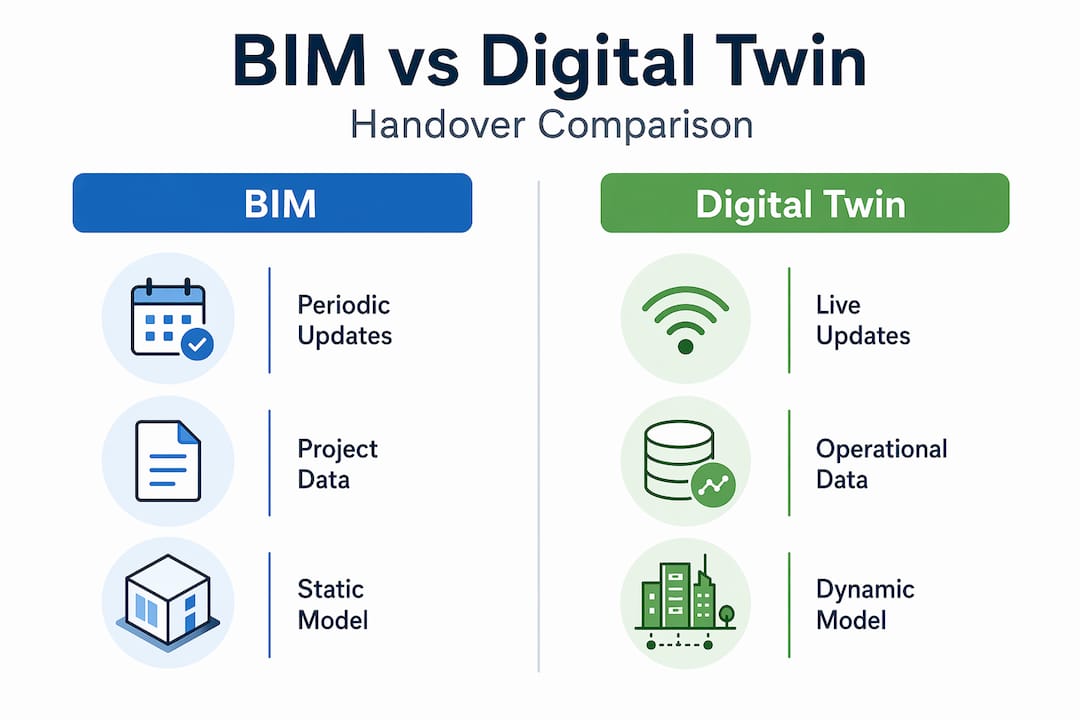
Starting with well-managed BIM before progressing to digital twins avoids unnecessary technical complexity and produces better long-term asset management outcomes. Organizations that attempt to implement digital twins over poorly governed BIM data inherit the data quality problems along with the additional operational infrastructure.
My perspective on BIM governance in Singapore projects
I have worked across enough Singapore construction projects to recognize a consistent pattern: the teams that struggle with BIM delivery are almost never struggling because of software. They struggle because the EIR was underspecified at tender, the BEP was authored once and filed away, and nobody assigned clear ownership over CDE governance during production.
ISO 19650 is not bureaucratic overhead. It is a structured communication protocol for complex multi-party projects where information quality directly affects safety, regulatory approval outcomes, and the long-term value of the asset. The framework provides exactly what large project teams need: defined roles, defined states for information containers, defined checkpoints, and a contractual backbone that holds parties accountable. In my experience, the organizations that treat BIM implementation as primarily a technology deployment consistently underperform compared to those that treat it as an information governance discipline.
The most practically valuable lesson I carry is this: update your BEP at every stage gate. Treat it as a live operational document, not a tender submission artifact. Live BEPs that evolve with project realities prevent delivery failures and enable the kind of adaptive information management that complex projects genuinely require.
— Aman
How Aman Engineering Consultancy supports your BIM delivery
Aman Engineering Consultancy provides structured BIM and digital engineering services designed specifically for Singapore’s construction regulatory environment. From developing project-specific EIRs and BIM Execution Plans to managing ISO 19650 compliance throughout design and construction, Aman brings operational oversight to projects where information governance determines delivery success.
The firm’s BIM modeling and management services cover the full project lifecycle, including CDE configuration, clash coordination, metadata governance, and handover model validation. For developers and project managers seeking a structured entry point, Aman’s Singapore-specific BIM advisory addresses local regulatory requirements across BCA, URA, HDB, and other authorities. Contact Aman Engineering Consultancy to discuss a BIM strategy assessment for your project.
FAQ
What is a BIM Execution Plan and when is it required?
A BIM Execution Plan (BEP) is a project document that defines how BIM will be implemented, by whom, with what tools, and to what standards. ISO 19650 requires both a pre-appointment BEP submitted during tender and a post-appointment BEP developed after contract award.
What does ISO 19650 require for BIM projects in Singapore?
ISO 19650 requires project owners to define Employer’s Information Requirements (EIR), establish a Common Data Environment, and mandate BIM Execution Plans from delivery teams. These requirements must be embedded in contracts to be enforceable.
What is the difference between BIM and a digital twin?
BIM produces a structured 3D information model updated periodically during design and construction; a digital twin integrates live sensor data to support continuous operational monitoring and predictive maintenance after the asset is in use.
What are the four CDE workflow states under ISO 19650?
The four states are Work in Progress, Shared, Published, and Archived. All information containers must pass through these states with defined checks and approvals before reaching the client.
What are the most common causes of BIM project failures?
Poor definition of information requirements at the outset, failure to embed BIM standards contractually, and absence of ongoing CDE governance and metadata auditing are the primary causes of BIM delivery failures, not software limitations.