
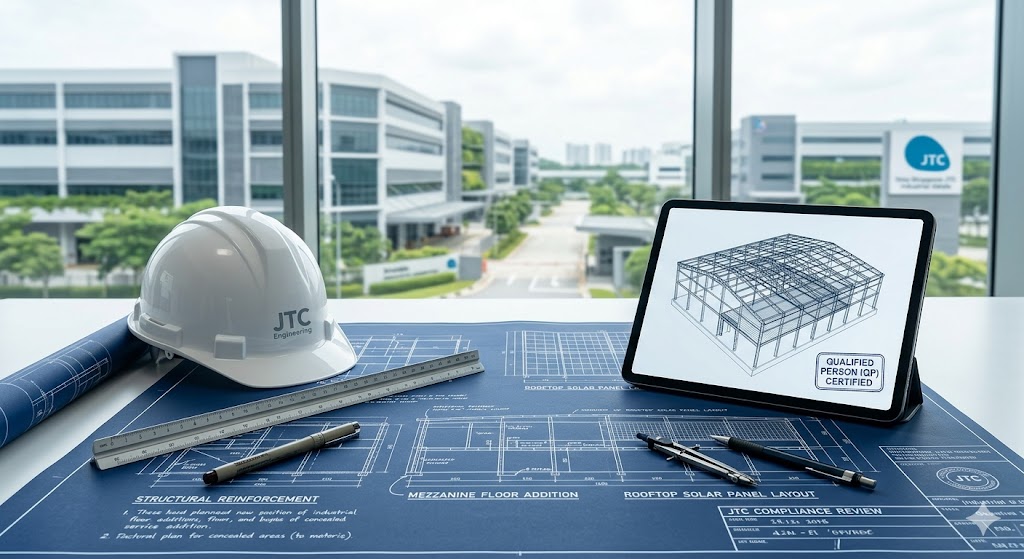
JTC Lease Renewal: Why Building Plans Must Be Up-To-Date Before Renewing
Introduction to JTC Lease Extension Dynamics
JTC lease renewal processes demand strict regulatory compliance today.1 Furthermore, accurate building plans remain absolutely essential for success.1 Consequently, industrialists must prioritize these precise architectural updates early.2 The Jurong Town Corporation oversees these complex industrial estates.3 Therefore, their strict guidelines dictate long-term business survival directly.3 A JTC lease renewal grants a new lease term.1 This new term commences after the current lease expires.1 However, this renewal remains a highly conditional privilege always.4 Consequently, approvals demand robust business cases and economic commitments.1
Industrialists must submit their JTC lease renewal applications proactively.2 The updated 2026 guidelines introduce a ten-year engagement window.2 Therefore, tenants can engage JTC officers a decade ahead.2 Furthermore, minimum application deadlines require submission three years prior.2 Early engagement guarantees sufficient time for future business planning.1 Additionally, the Flexible Lease Extension Initiative supports eligible industrialists.2
| JTC Lease Renewal Timeline | Operational Requirement Specification |
| Early Engagement Window | 10 years before existing lease expiration 1 |
| Minimum Application Deadline | 3 years before existing lease expiration 1 |
| Maximum Standard Term | 20 years based on site intensification 1 |
| FLEXI Scheme Extension | Two tranches of 5 years (10 total) 2 |
| FLEXI Eligibility (>30 years) | Application permitted after 10 years elapse 2 |
| FLEXI Eligibility (<30 years) | Application permitted after 5 years elapse 5 |
The FLEXI scheme grants short-term, incremental lease extensions effectively.2 Eligible lessees receive two five-year lease extension tranches sequentially.2 Consequently, this totals a potential ten-year tenure addition overall.2 However, this scheme demands powerful economic outcomes from tenants.6 Additionally, new plant and machinery investments remain strictly mandatory.6 Auditable investments in digital transformation significantly improve renewal chances.7 Furthermore, fixed asset investment benchmarks dictate ultimate application success.8 Therefore, updating building plans reflects these massive corporate investments.9
The Critical Importance of Accurate Building Plans
Accurate building plans remain indispensable for JTC lease renewal.1 Applications demand exact spatial representations of the industrial site.10 Consequently, building plans must reflect all physical architectural structures.1 Discrepancies between physical sites and as-built plans cause rejections.9 Furthermore, unapproved structures violate existing JTC tenancy agreements fundamentally.9 Breaches in lease terms mandate immediate rectification before application.9 Therefore, updating building plans rectifies historical compliance failures effectively.11
Qualified Person certification validates these critical architectural modifications legally.1 Subsequently, structural approvals guarantee industrial safety and regulatory standards.12 Additionally, updated building plans facilitate smooth physical site inspections.9 JTC conducts rigorous investment audits upon lease expiry consistently.9 Consequently, accurate as-built plans prevent punitive pro-rated lease terms.1 Furthermore, companies must submit updated ACRA business profiles promptly.1 Audited financial statements support these physical architectural investment declarations.1 Therefore, precise physical documentation secures long-term industrial real estate stability.3
Severe Penalties for Unauthorized Alterations
Unauthorized alterations invite severe legal repercussions across Singapore today.11 Industrialists face strict building control regulations for physical modifications.11 Consequently, unauthorized extensions trigger punitive statutory actions immediately.13 Building works lacking proper BCA approvals constitute serious offenses.13 Specifically, these actions violate Section 20 of the Building Control Act.13 Therefore, regulatory bodies pursue aggressive and uncompromising enforcement measures.11
| Regulatory Authority | Violation Category Description | Maximum Penalty Imposed |
| Building Construction Authority | Unauthorized Building Works | $200,000 fine and/or 2 years jail 13 |
| Building Construction Authority | Professional Engineer Inspection Failure | $20,000 fine for professional non-compliance 14 |
| Urban Redevelopment Authority | Standard Unauthorized Retention | Civil penalty up to 12x processing fee 13 |
| Urban Redevelopment Authority | Deceptive Retention Practices | Civil penalty up to 25x fee or $150,000 15 |
| Jurong Town Corporation | Breach of Lease Terms | Rejection of JTC lease renewal application 9 |
Furthermore, the Urban Redevelopment Authority imposes escalating civil penalties.13 Civil penalty rates depend entirely on the unauthorized footprint.15 Consequently, massive unapproved structures attract crippling corporate financial burdens.15 If blatant deception occurs, monetary penalties escalate dramatically.15 For example, concealing works during inspections constitutes illegal deception.15 Therefore, authorities impose maximum fines reaching $150,000 swiftly.15 Alternatively, fines reach 25 times the standard processing fee.15
Furthermore, unapproved works stall statutory completion certifications completely.13 Unauthorized alterations can pose massive public safety risks locally.13 A prominent corporate example highlights this severe systemic danger.13 Samwoh Corporation faced district court charges for illegal works.13 They allegedly altered a public drain without proper approval.13 Furthermore, they erected massive scaffolds without seeking prior authorization.13 Consequently, this obstructed the critical stormwater drainage system completely.13 Therefore, a major knee-high flood occurred in Pasir Ris.13 This devastating flood submerged thirteen vehicles in the area.13 Additionally, authorities had to rescue trapped motorists immediately.13 Consequently, severe traffic gridlock paralyzed the entire surrounding region.13 Ultimately, unauthorized alterations destroy JTC lease renewal eligibility permanently.9
URA 60:40 Space Utilization Rule Guidelines
JTC lease renewal guidelines mandate optimal industrial land usage.9 Consequently, the URA enforces a strict 60:40 utilization rule.9 Industrialists must configure building plans to reflect this ratio.9 Specifically, industrial activities must occupy sixty percent minimum space.9 These primary activities include manufacturing, warehousing, and production operations.16 Conversely, ancillary uses maximize at forty percent strictly.9
| Space Utilization Category | Maximum / Minimum Allowance | Permitted Structural Usages |
| Core Industrial Activities | Minimum 60% of Total Gross Area | Manufacturing, Processing, Core Warehousing 9 |
| Ancillary Commercial Uses | Maximum 40% of Total Gross Area | Offices, Showrooms, Communal Facilities, Meetings 9 |
| Plot Ratio Exemptions | No Minimum Gross Plot Ratio | Subject to minimum land area coverage 9 |
Furthermore, ancillary offices and showrooms fall under this limit.9 Consequently, building plans must explicitly highlight this quantum breakdown.10 Qualified Person certification validates this specific spatial configuration mathematically.10 Therefore, gross floor area calculations require extreme architectural precision.10 Furthermore, JTC demands high gross plot ratio maximization generally.9 Land intensification supports Singapore’s broader economic development objectives directly.1 Nevertheless, plot ratio exempt industries face vastly different criteria.10 Instead, they must meet minimum land area coverage requirements.1 Therefore, meticulous spatial planning ensures JTC lease renewal success.1 Building plans must demonstrate this continuous regulatory compliance visually.10
Mezzanine Floor Approvals and Structural Compliance
Mezzanine floors optimize scarce industrial land resources brilliantly.17 They expand usable area without requiring expensive physical relocation.17 However, mezzanine installations demand rigorous and exhaustive structural approvals.16 Consequently, businesses must update building plans before commencing construction.12 Unauthorized mezzanines threaten structural integrity and broader public safety.17 Therefore, JTC enforces strict mezzanine sizing guidelines for properties.16 Specifically, mezzanines cannot exceed fifty percent of the floorplate.16 Furthermore, JTC ensures core industrial functions remain entirely uncompromised.16
| Regulatory Authority | Mezzanine Structural Requirement | Specific Metric / Guideline |
| JTC Corporation | Maximum Permissible Size | 50% of the unit’s total floorplate 16 |
| JTC Corporation | Minimum Spatial Heights | 4.5 meters floor-to-floor height clearance 16 |
| Building Construction Authority | Structural Independence | Complete independence from primary building 16 |
| Building Construction Authority | Floor Slab Integrity | No tampering with existing concrete slabs 16 |
| Urban Redevelopment Authority | Submission Threshold | Submissions required for mezzanines >5 sqm 17 |
Additionally, mezzanine structures must remain completely structurally independent.16 Tampering with existing floor slabs is strictly prohibited legally.16 Consequently, heavy machinery installation requires specialized engineering foresight always.16 Furthermore, minimum floor-to-floor heights must reach 4.5 meters.16 Professional engineers must endorse all complex structural calculations comprehensively.10 Subsequently, QP certification verifies these exact structural engineering standards.1 Therefore, obtaining structural approvals legitimizes the newly expanded space.12 Minor mezzanines under five square meters skip formal submissions.17 However, they still require professional engineer endorsement design checks.17 Consequently, building plans must capture every single structural addition.10
SCDF Fire Code Mezzanine Requirements
Fire safety regulations dictate modern industrial space designs heavily.18 Consequently, the SCDF Fire Code 2023 imposes strict constraints.18 Mezzanine floor approvals require immediate fire safety compliance.19 Furthermore, non-compliant structures face mandatory and costly demolition orders.11 Updating building plans ensures fire safety systems align correctly.17
| SCDF Fire Code 2023 Parameter | Regulatory Specification Limit | Applicable Safety Clause |
| Maximum Aggregate Floor Area | 60 square meters per factory unit 19 | Clause 9.6.1a(2)(a) 19 |
| Permitted Industrial Usage | Restricted to store and/or office 19 | Clause 9.6.1a(2)(f) 19 |
| Minimum Staircase Width | 1 meter minimum for safe escape 18 | Clause 9.6.1a(2)(b) 18 |
| Construction Material Rules | Strictly non-combustible materials used 18 | Clause 9.6.1a(2)(b) 18 |
| Structural Fire Resistance | 1-hour fire resistance rating minimum 18 | Clause 9.6.1a(2)(d) 19 |
| Maximum Habitable Height | Cannot exceed 24 meters vertically 20 | Clause 9.6.1a(2)(e) 20 |
| Fire Sprinkler Systems | Mandatory extension underneath the mezzanine 17 | Clause 6.4 (General) 18 |
Specifically, the maximum Aggregate Floor Area is sixty square meters.19 Moreover, mezzanine usage is restricted to very specific functions.19 Ancillary offices and storage remain the only permitted uses.19 Furthermore, safe escape routes require robust open staircases.19 Staircases must measure at least one meter in width.18 Consequently, non-combustible materials must form these primary escape routes.18 Additionally, structural elements demand one-hour fire resistance ratings.19
Furthermore, habitable heights cannot exceed twenty-four meters vertically.20 Sprinkler systems must extend entirely underneath mezzanine structures mandatory.18 However, the code offers specific exemptions for certain equipment.18 Manual call points are exempt under specific travel conditions.18 Specifically, travel distances under thirty meters grant this exemption.18 Furthermore, hose reels face exemptions for limited coverage areas.18 Coverage under thirty-six meters removes the hose reel requirement.18 Additionally, landing valves share similar strict spatial distance exemptions.18 Therefore, these structural approvals safeguard industrial operations and lives.21 Building plans must detail these fire safety provisions explicitly.17
Urban Design and Architectural Requirements
JTC lease renewal demands strict compliance with urban guidelines.1 Consequently, new building plans must respect physical setback limits.1 Furthermore, platform levels face rigid architectural elevation constraints.1 Therefore, unauthorized alterations modifying these parameters require immediate demolition.1
| Architectural Feature Category | Urban Design Constraint Description |
| Building Setback Limits | Must comply with NParks green buffer requirements 1 |
| Platform Elevation Levels | Internal platform maximum +1.2m relative to roads 1 |
| Service Areas & Storage | Must be concealed entirely within building envelope 1 |
| Open Storage Rules | Strictly prohibited on any side of development 1 |
| Retaining Wall Rules | Maximum height 1.0m, designed as landscape features 1 |
| Surface Carpark Limits | Maximum 5 lots along local access roads only 1 |
| Boundary Fencing Rules | Maximum height 1.5m, visually porous, no solid walls 1 |
Service areas must remain completely hidden from public view.1 Consequently, cooling towers and refuse centers demand internal integration.1 Furthermore, open storage remains prohibited on all development sides.1 Retaining walls cannot exceed one meter in total height.1 Additionally, these walls must function as landscape features visually.1 Therefore, structural approvals depend heavily on these aesthetic parameters.1 Surface car parking faces severe restrictions along arterial roads.1 Consequently, multi-storey carparks must conceal vehicular ramps entirely.1 Furthermore, fencing must remain visually porous along public frontages.1 Therefore, updating building plans ensures these specific constraints are met.1
The Qualified Person (QP) Certification Process
Qualified Person certification legitimizes all modern industrial building works.1 Consequently, QPs manage the entire complex authority submission framework.17 JTC lease renewal requires final QP endorsed as-built plans.1 Therefore, businesses must hire registered professional architects or engineers.10 Furthermore, QPs navigate complex multi-agency clearances for the client.17 These regulatory agencies include BCA, URA, SCDF, and JTC.17
| Certification Phase Event | Documentary Requirement / Action | Submitting Professional |
| Initial Design Proposal | CAD/BIM drawings, GFA tables, structural calculations 10 | Qualified Person (QP) 10 |
| JTC Pre-Consultation | Early engagement clearance from JTC officers 10 | Lessee / Tenant / QP 10 |
| Authority Plan Lodgment | E-submission via CORENET system with self-declarations 10 | Qualified Person (QP) 10 |
| Active Construction Phase | Electronic Permit-To-Work (EPTW) application via portal 10 | Appointed Contractor 10 |
| Project Completion Phase | Temporary Occupation Permit (TOP) application submission 10 | Qualified Person (QP) 10 |
| Final Project Approval | Certificate of Statutory Completion (CSC) submission 1 | Qualified Person (QP) 1 |
Submissions occur exclusively via the CORENET 2.0 electronic system.10 Consequently, QPs upload self-declaration forms and precise architectural drawings.10 The Electronic Submission for Professionals system handles this workflow.10 Furthermore, QPs submit the essential SD-LD declaration forms electronically.10 QP certification ensures structural approvals match physical realities perfectly.1
Before construction begins, contractors must secure an Electronic Permit-To-Work.10 They access the Facility Management Company portal for this.10 Consequently, they submit detailed risk assessments and method statements.10 The safety team reviews these submissions within twenty days.10 Therefore, updating building plans accelerates this mandatory safety review.10 After completing physical construction, QPs secure vital occupation permits.1 Specifically, the Temporary Occupation Permit precedes any physical occupancy.1 Subsequently, the Certificate of Statutory Completion finalizes the project.1 Ultimately, JTC lease renewal depends heavily on these critical documents.1
Navigating the Land Betterment Charge Framework
Updating building plans often increases underlying property value significantly.10 Consequently, the Singapore Land Authority administers the Land Betterment Charge.10 This tax targets land value increases from chargeable consents.10 Therefore, planning permission directly triggers LBC financial assessments always.10 This system replaced older development charges in August 2022.10
| Land Betterment Charge Factor | Process Specification Details |
| Tax Assessment Trigger | Approval of planning permission or plan lodgment 10 |
| Standard Computation Method | Table of Rates Method based on use groups 10 |
| Alternative Computation Method | Spot Valuation Method (irrevocable election) 10 |
| Official Payment Deadline | Strictly within 1 month from Liability Order 10 |
| Liability Transfer Mechanism | Submission of Notice of Assumption of Liability 10 |
SLA computes the LBC using the standard Table of Rates.10 Alternatively, taxable persons can elect the Spot Valuation method.10 Subsequently, SLA issues a Liability Order to the landowner.10 Payments must reach SLA within one single calendar month.10 However, tenants driving the development can assume this liability.10 Consequently, tenants submit an Assumption of Liability Notice promptly.10 This S16(2) form goes to the SLA Chief Executive.10 Furthermore, unpaid liability orders stall URA written permissions entirely.10 Therefore, updating building plans requires careful financial corporate forecasting.10 Additionally, updating the baseline database costs an administrative fee.10 This specialized fee currently stands at one thousand dollars.10 Structural approvals remain contingent on resolving these LBC obligations.10
Mandatory Solar Deployment Guidelines
Sustainability dictates modern JTC lease renewal criteria heavily today.2 Consequently, mandatory solar deployment features prominently in 2026 guidelines.2 Businesses must integrate solar layouts into their building plans.10 Furthermore, JTC assesses site eligibility using specific mathematical thresholds.22
| JTC Solar Deployment Criterion | Mandatory Threshold Specification Requirement |
| Contiguous Rooftop Area | Minimum 800 square meters of available space 23 |
| Remaining Lease Duration | 15 years or more remaining on lease 23 |
| Deployment Exclusions | Areas blocked by technical or regulatory constraints 24 |
| Permitted Business Models | Direct Ownership, Solar Leasing, Rooftop Licensing 22 |
| Documentation Requirement | As-built plans confirming installed solar footprint 24 |
Specifically, sites require 800 square meters of contiguous rooftop.23 This calculation excludes areas hindered by technical or regulatory constraints.24 Additionally, the remaining lease term must exceed fifteen years.23 Therefore, eligible industrialists must deploy active solar photovoltaic panels.2 QPs must submit proposed plans during the initial endorsement phase.22 Consequently, structural approvals require detailed roof load mathematical calculations.22 Dead loads and wind uplift forces demand careful engineering.22
Furthermore, solar as-built plans must reflect final installed capacities.24 The plans must show the Singapore Height Datum elevations.10 Additionally, building plans require a detailed PV Attributes table.10 This table indicates precise solar panel depths and dimensions.10 Non-qualifying sites can still pursue beneficial voluntary solar deployment.24 Nevertheless, voluntary installations still require JTC additions and alterations consent.24 Direct ownership models require energy consumption on the premises.25 Ultimately, solar deployment supports Singapore’s ambitious green energy targets.26
Environmental Audits and Site Inspections
JTC enforces strict financial accountability during lease renewals constantly.9 Consequently, JTC officers conduct rigorous post-investment physical audits.9 Lessees must execute all declared Fixed Asset Investments accurately.27 Furthermore, actual plant and machinery expenditures require audited verification.1 If shortfalls occur, JTC pro-rates the renewed lease term.1 Therefore, truthful financial declarations in building plans remain paramount.27
| JTC Post-Approval Audit Item | Verification Requirement Details |
| Gross Plot Ratio (GPR) | Site inspection matching final as-built building plans 9 |
| Plant & Machinery (P&M) | Audited statement showing actual incurred capital costs 1 |
| Building & Civil (B&C) | Certificate of Statutory Completion issued by BCA 1 |
| Job Creation Targets | Audited statements confirming remuneration and worker count 9 |
| Environmental Site Assessment | Baseline contamination levels in soil and groundwater 1 |
Additionally, Environmental Site Assessments form a crucial mandatory requirement.1 These environmental assessments establish baseline contamination levels in soil.1 Consequently, groundwater conditions undergo deep technical environmental investigations globally.1 Furthermore, lessees must conduct extensive decontamination works if required.1 Therefore, updating building plans helps identify potential environmental hazard zones.1 Subsequently, JTC site inspections verify as-built plans against physical reality.9 Any structural discrepancies trigger demands for immediate site regularization.17 Ultimately, maintaining total compliance guarantees uninterrupted industrial business operations.12
JTC Space Submission Guidelines and Exemptions
JTC categorizes architectural submissions into specific operational types systematically.10 Consequently, the Space Submission Handbook guides interior structural modifications.10 Meanwhile, Land Submissions cover major exterior and foundational structural changes.10 Therefore, building plans must align with these distinct categories.10
| Space Submission Handbook List | Endorsement & Submission Requirement |
| List A: Exemption List | Exempt from JTC consent; requires other approvals 10 |
| List B: Endorsement Required | Mandatory QP, PE, LEW, or LP endorsements 10 |
| List C: Performance Based | Fire Safety Engineer (FSE) declarations are mandatory 10 |
| List D: Green Obligations | M&E equipment must comply with green standards 10 |
List A covers minor works exempt from JTC plan consent.10 For example, internal partitioning without quantum changes avoids JTC.10 Conversely, List B demands strict QP and PE endorsements.10 Furthermore, List C identifies Performance-Based fire safety design locations.10 In these zones, Fire Safety Engineers must declare absolute compliance.10 Fourteen specific JTC locations fall under this strict category.10 The JTC Summit levels one through three require this.10 Furthermore, the JTC Food Hub at Senoko demands compliance.10 All units within the JTC Poultry Processing Hub qualify.10 Additionally, ramp-up factory units at JTC Space Tuas comply.10
Additionally, List D outlines Green Building Obligations for specific clusters.10 Consequently, mechanical and electrical equipment must meet green standards.10 Thirty-three distinct JTC buildings mandate these strict environmental obligations.10 CleanTech One, Two, and Three enforce these green rules.10 Furthermore, LaunchPad at one-north follows these exact same guidelines.10 Fusionopolis One and Two also require green building compliance.10 Therefore, building plans must strictly integrate these localized requirements.10
Land Submissions and Specific Exemption Constraints
Not all exterior building works require explicit JTC plan consent.10 Consequently, Annex A details specific land submission exemptions clearly.10 For instance, machinery installation inside factories proceeds without JTC.10 Furthermore, installing single high-level signages bypasses JTC consent temporarily.10
| Annex A Exempted Work Category | Specific Condition for JTC Consent Exemption |
| Machinery Installation | Must occur strictly inside the factory building 10 |
| Internal Partitioning | Cannot alter factory quantum or trigger changes 10 |
| Air-Conditioning Systems | Must be installed within interior of factories 10 |
| High-Level Signage | Limited to one sign under strict dimensions 10 |
| Construction Hoarding | Permitted only during active authorized construction periods 10 |
However, signage dimensions face strict mathematical caps and constraints.10 They cannot exceed 1/15th of overall architectural building height.10 Alternatively, they must remain under three by three meters.10 Furthermore, installing sanitary and plumbing systems enjoys regulatory exemption.10 Erection of temporary site offices enjoys this exact exemption.10 Nevertheless, these exemptions still demand other authority approvals strictly.10 Consequently, BCA and URA submissions remain fully mandatory always.10 Therefore, updating building plans secures these secondary agency clearances.10 Ultimately, unauthorized alterations void these specific regulatory exemptions completely.10
Plot Ratio Exemptions and Site Coverage Breakdowns
Certain industries benefit from plot ratio exemption status legally.10 Consequently, their JTC lease renewal requirements differ slightly functionally.9 They avoid minimum gross plot ratio intensification demands entirely.9 However, they must fulfill minimum land area coverage requirements.9 Therefore, their building plans must detail site coverage breakdowns.10
| Plot Ratio Exempt Industry Category | Relevant SSIC Code Classification |
| Petroleum Refineries & Lubricating Oil | SSIC19201, SSIC19202 10 |
| Industrial Gases & Basic Chemicals | SSIC20111, SSIC20131, SSIC20132, SSIC20133 10 |
| Electricity & Utility Mains | SSIC35101, SSIC35102, SSIC35201 10 |
| Cargo & Chemical Storage | SSIC52103, SSIC52109 10 |
| Heavy Marine & Drilling Equipment | SSIC28241, SSIC30111, SSIC30112, SSIC30120 10 |
Eligible sectors include petroleum refineries and basic chemical manufacturers.10 Furthermore, heavy marine equipment and shipbuilding fall into this category.10 Jurong Island companies requiring petroleum feedstock receive these unique exemptions.10 Container services also qualify under very specific reduction conditions.10 Consequently, building plans must display precise footprint measurements visually.10 Additionally, floor loading values must be explicitly stated architecturally.10 Therefore, hardstanding open production spaces require exact kN/sqm declarations.10 Ultimately, QP certification confirms these complex spatial computations perfectly.10
Enterprise District Lodgment Procedures
JTC operates specialized Enterprise Districts across Singapore for innovation.10 These include the Jurong Innovation and Punggol Digital Districts.10 Consequently, development submissions follow unique plan lodgment schemes.10 Therefore, building plans must satisfy distinct Enterprise District conditions.10
| Enterprise District Condition Criteria | Mandatory Lodgment Requirement Details |
| Encroachment Limitations | Operations must not encroach onto any abutting land 10 |
| Earthfill Works Constraint | Cannot exceed 1.5 meters above existing platform 10 |
| Existing Structure Legality | No part of existing buildings can be unauthorized 10 |
| Vehicular Access | Must possess direct vehicular access to public road 10 |
| Professional Declaration | Architect or engineer must declare compliance prior 10 |
Operations must avoid encroaching onto abutting land completely.10 Furthermore, earthfill works cannot exceed 1.5 meters high.10 Consequently, QPs must lodge precise architectural declarations beforehand strictly.10 Additionally, existing structures must be completely authorized by BCA.10 Therefore, unauthorized alterations instantly disqualify sites from lodgment benefits.10 Pre-consultation with customer engagement officers ensures procedural accuracy beforehand.10 Ultimately, updating building plans ensures smooth administrative processing flows.10
Specialized Submissions: Dormitories and Fuel Storage
Specific industrial features require specialized clearance procedures before submission.10 Consequently, installing worker dormitories demands unique authority approvals immediately.10 Building plans must demonstrate strict compliance with amenity guidelines.10 Therefore, updating building plans correctly speeds up these applications.10
| Specialized Submission Type | Pre-Submission Clearance Requirement Needed |
| Worker Dormitory Facilities | Clearances from NEA, SCDF, PUB, and LTA 10 |
| Worker Dormitory Facilities | Minimum living space standard of 4.2 sqm 10 |
| Diesel and P&FM Storage | Endorsement of Diesel Declaration Form by JTC 10 |
| Diesel and P&FM Storage | Clearance letter from Major Hazards Department (MHD) 10 |
Workers require a minimum of 4.2 square meters each.10 Furthermore, building plans must indicate total room capacities clearly.10 Consequently, QPs upload these specific capacity declarations via CORENET.10 Additionally, diesel storage submissions require Major Hazards Department clearances.10 Therefore, quantitative risk assessments determine spatial safety parameters strictly.10 Furthermore, site plans must annotate all proposed pump points visually.10 Building plans must explicitly state diesel is not for third-party sale.10 Ultimately, updating building plans guarantees specialized industrial operations remain compliant.10
Financial Readiness and Strategic Preparation
JTC lease renewal demands extraordinary proactive strategic planning today.2 The ten-year engagement window requires immense corporate foresight logically.2 Consequently, businesses must project decade-long spatial requirements accurately.2 Furthermore, financial readiness determines lease extension success profoundly.1
| Strategic Planning Phase | Actionable Objective for Lessees |
| Decade-Long Projection | Estimate future spatial footprint and technology requirements 2 |
| Structural Auditing | Identify and rectify any legacy unauthorized alterations 9 |
| Financial Planning | Secure funding for LBC payments and solar deployment 10 |
| Consultant Engagement | Hire QPs early to finalize as-built certifications 10 |
The Land Intensification Allowance supports substantial capital expenditures financially.9 This powerful allowance is administered directly by the EDB.9 Furthermore, upfront land premiums require massive immediate capital liquidity.1 Building premiums apply if the existing building is JTC-owned.1 Updating building plans forms the foundation of these financial projections.9 Additionally, QP certification proves architectural proposals are functionally viable.1 Consequently, structural approvals de-risk massive industrial financial investments entirely.12 Furthermore, accurate as-built plans protect companies from audit penalties.1 Therefore, meticulous documentation safeguards future industrial operations securely.1
Conclusion
JTC lease renewal remains an incredibly complex regulatory mechanism.3 Successful extensions require perfect alignment with physical structural realities.9 Consequently, updating building plans stands as the primary requirement.1 Furthermore, unauthorized alterations guarantee application rejections and massive fines.13 Therefore, securing structural approvals protects business continuity effectively.12 Obtaining QP certification validates structural integrity and operational safety.1 Additionally, compliance with the SCDF fire code prevents catastrophic disasters.18 Preparing accurate as-built plans satisfies stringent JTC investment audits.9 Furthermore, accommodating mandatory solar deployment meets national green energy mandates.24 Ultimately, early engagement guarantees a seamless lease extension process.2 Thus, diligent architectural compliance secures Singapore’s long-term industrial future.1
Works cited
- Renewing Your Industrial Lease – JTC, accessed May 23, 2026, https://www.jtc.gov.sg/-/media/project/jtc-cx/corpweb/assets/get-help/lease-renewal-handbook_jul-2025update.pdf
- JTC Lease Renewal: Navigating the Process in Singapore (2026 Update) – JFStrategic, accessed May 23, 2026, https://jfstrategic.com/navigating-the-jtc-lease-renewal-process-in-singapore/
- JTC Industrial Property: Lease Renewal & Assignment Guide – JF Strategic, accessed May 23, 2026, https://jfstrategic.com/jtc-industrial-property-lease-renewal-assignment-guide/
- JTC Assignment of Lease – Frequently Asked Questions (FAQs), accessed May 23, 2026, https://www.afm.com.sg/our-services/jtc-assignment-of-lease-frequently-asked-questions-faqs
- Renewing your tenancy or lease – Singapore – JTC, accessed May 23, 2026, https://www.jtc.gov.sg/get-help/managing-your-tenancy-or-lease/renewing-your-tenancy-or-lease
- JTC extends land leases for new industrial sites, offers more flexible renewals for businesses – Singapore Economic Development Board (EDB), accessed May 23, 2026, https://www.edb.gov.sg/en/business-insights/insights/jtc-extends-land-leases-for-new-industrial-sites-offers-more-flexible-renewals-for-businesses.html
- Industrial land lease – Enterprise Singapore, accessed May 23, 2026, https://www.enterprisesg.gov.sg/smepeo/industrial-land-lease
- Key Criteria for JTC Lease Renewal – ALLIANCE FACILITIES MANAGEMENT PTE LTD, accessed May 23, 2026, https://www.afm.com.sg/our-services/jtc-renewal-of-lease/key-criteria-for-jtc-lease-renewal
- Renewing Your Industrial Lease – JTC, accessed May 23, 2026, https://www.jtc.gov.sg/-/media/project/jtc-cx/corpweb/assets/get-help/lease_renewal_handbook.pdf
- Plan consent for qualified person submission | JTC, accessed May 23, 2026, https://www.jtc.gov.sg/get-help/development-and-renovation-works/qp-submission
- Legal Analysis: Unapproved Mezzanine Floor And It’s Legal Implications, accessed May 23, 2026, https://www.smtplaw.com/legal-analysis-unapproved-mezzanine-floor-and-its-legal-implications/
- Mezzanine Authority Submission: Obtaining JTC, URA, BCA, and SCDF Approvals – Stellar Structures, accessed May 23, 2026, https://structures.com.sg/mezzanine_authority_submission_scdf_bca_ura_jtc/
- Revised Civil Penalty Rates for Unauthorised Works in Singapore …, accessed May 23, 2026, https://www.adxarchitects.com/blog/revised-civil-penalty-rates-for-unauthorised-works-in-singapore-what-you-need-to-know/
- Oral Answer by Ministry of National Development on unauthorised works in buildings, accessed May 23, 2026, https://www.mnd.gov.sg/newsroom/speeches/view/oral-answer-by-ministry-of-national-development-on-unauthorised-works-in-buildings
- Revised Civil Penalty Rates For Unauthorised Works / Use For Non-Conservation Developments – URA, accessed May 23, 2026, https://www.ura.gov.sg/Corporate/Guidelines/Development-Control/Planning-Permission/Folder/DC-Charge-Rates/penalty-rates
- Mezzanine Floor Approval Guide Singapore 2026 – Stellar Structures, accessed May 23, 2026, https://structures.com.sg/mezzanine-floor-approval-guide-singapore-2026/
- Mezzanine Retention Authority Submissions – Stellar Structures, accessed May 23, 2026, https://structures.com.sg/mezzanine-retention-authority-submissions/
- SCDF Mezzanine Requirements: Fire Code 2023 & BCA Guide, accessed May 23, 2026, https://structures.com.sg/scdf-mezzanine-requirements/
- Clause 9.6 Purpose Group VI Occupancy – SCDF, accessed May 23, 2026, https://www.scdf.gov.sg/fire-safety-services-listing/fire-code-2023/table-of-content/chapter-9-additional-requirements-for-each-purpose-group/clause-9.6-purpose-group-vi-occupancy
- Clause 9.8 Purpose Group VIII Occupancy – Singapore – SCDF, accessed May 23, 2026, https://www.scdf.gov.sg/fire-safety-services-listing/fire-code-2023/table-of-content/chapter-9-additional-requirements-for-each-purpose-group/clause-9.8-purpose-group-viii-occupancy
- Tag Archives: Fire resistance rating – Stellar Structures, accessed May 23, 2026, https://structures.com.sg/tag/fire-resistance-rating/
- What to do when solar Is mandatory for JTC lease renewal in Singapore – Eigen Energy, accessed May 23, 2026, https://www.eigen.energy/articles/jtc-solar-mandatory-lease-renewal-guide
- Renewing Your Industrial Lease – JTC, accessed May 23, 2026, https://www.jtc.gov.sg/-/media/project/jtc-cx/corpweb/assets/get-help/lease-renewal-handbook_jul-2025_.pdf
- JTC solar requirements explained (without the legal jargon) – Eigen Energy, accessed May 23, 2026, https://www.eigen.energy/articles/jtc-solar-requirements-explained
- Solar deployment – Singapore – JTC, accessed May 23, 2026, https://www.jtc.gov.sg/get-help/managing-your-tenancy-or-lease/solar-deployment
- Solar Panels Now Required in JTC Solar Policy – GetSolar, accessed May 23, 2026, https://www.getsolar.ai/en-sg/blog/jtc-solar-deployment-policy