

Securing planning approval in Singapore is one of the most consequential steps in any development project, yet it remains one of the most frequently mismanaged. Delays caused by incomplete submissions, missed pre-application consultations, or misunderstood conditions can stall projects by months and significantly erode project budgets. This planning approval process guide breaks down each stage, from initial preparation through post-approval compliance, to give property developers, construction managers, and real estate investors a precise, practical framework for moving through Singapore’s regulatory system with confidence and minimal disruption.
Table of Contents
- Key takeaways
- The planning approval process guide: prerequisites and preparation
- Submission and validation: avoiding delays
- Public consultation and officer assessment
- Final decision, conditions, and post-approval steps
- My perspective on navigating Singapore’s planning approvals
- How Aman Engineering Consultancy can support your approval journey
- FAQ
Key takeaways
| Point | Details |
|---|---|
| Pre-application advice is critical | Engaging authorities before formal submission identifies documentation gaps and reduces the risk of refusal. |
| Validation starts the planning clock | Incomplete applications are returned without starting the statutory determination timeline, causing avoidable delays. |
| Public consultation shapes outcomes | Objections from neighbors and statutory consultees directly influence officer assessments and approval conditions. |
| Conditions must be discharged first | Starting construction before discharging pre-commencement conditions invalidates planning permission entirely. |
| Permissions expire after three years | Development must commence within three years of grant, or a new application is required. |
The planning approval process guide: prerequisites and preparation
Before a formal application is submitted to any regulatory authority in Singapore, developers must complete a structured preparation phase. Skipping this phase is the single most common reason applications fail at validation or receive conditional approvals loaded with costly requirements.
Understanding zoning regulations and land use parameters
Singapore’s land use is governed by the Urban Redevelopment Authority (URA) Master Plan, which designates permitted uses, plot ratios, building height limits, and setback requirements for every parcel of land. Developers must verify their site’s zoning category and confirm that the proposed use aligns with the Master Plan before committing to design work. Projects that deviate from permitted uses require a change of use application, which adds complexity and time. For developments on JTC, HDB, or other state land, additional landowner approvals apply on top of URA planning consent.

Pre-application consultation with authorities
Pre-application advice is the most critical stage, allowing developers to identify potential issues before formal submission, which saves time and costs. In Singapore, developers can request pre-application guidance from URA and other agencies, including the Building and Construction Authority (BCA), Singapore Civil Defence Force (SCDF), and Public Utilities Board (PUB), depending on the project type. These consultations surface technical requirements, infrastructure constraints, and agency-specific conditions that must be addressed in the application.
Pro Tip: Schedule pre-application meetings with all relevant agencies simultaneously rather than sequentially. Conflicting requirements surfaced early allow your design team to reconcile them in a single revision cycle rather than multiple costly redesign rounds.
Required documentation and technical studies
The documentation required for a planning submission in Singapore is extensive, and its completeness determines whether the application passes validation. A standard planning application checklist typically includes the following categories:
- Site survey plans prepared by a licensed surveyor, showing plot boundaries, existing structures, and surrounding context
- Architectural drawings including site plans, floor plans, elevations, and sections at required scales (typically 1:200 for detailed drawings and 1:1250 for location plans)
- Impact assessments such as traffic impact assessments, environmental baseline studies, or shadow studies where applicable
- Supporting statements including a planning statement, design rationale, or development brief explaining how the proposal aligns with planning policy
- Ownership declarations confirming the applicant’s legal standing to submit the application
- Structural and M&E schematics for projects requiring BCA building plan approval alongside URA planning permission
Missing any of these items returns the application to the developer without starting the determination clock, a point addressed further in the next section.
Submission and validation: avoiding delays
The formal submission process in Singapore operates through designated digital portals including the Government e-Business Portal (GeBIZ) and the BCA’s CORENET eSUBMIT system, which handles building plan applications. Understanding the distinction between these portals and the requirements of each is a prerequisite for error-free submission.
Step-by-step submission process
- Confirm the correct application type. Determine whether the project requires a Provisional Permission (PP) from URA, Written Permission (WP), or a Change of Use application. Each has different documentation requirements and fees.
- Prepare and verify all drawings. Correct scale plans and elevations are mandatory. Plans submitted at incorrect scales or missing required views are grounds for immediate invalidation.
- Complete the application form accurately. All ownership details, land particulars, and proposed use descriptions must match the supporting documents precisely.
- Calculate and submit the correct application fee. Fee structures are tiered by development type and gross floor area. Submitting an incorrect fee amount delays processing.
- Upload all supporting documents in the required formats. Agencies in Singapore specify file formats, file naming conventions, and resolution requirements. Non-compliant files are rejected at upload.
- Receive the acknowledgment reference number. This confirms receipt. However, receipt does not equal validation. The validation check is a separate stage.
- Respond promptly to any validation queries. If the validation officer identifies missing or non-compliant items, the developer has a defined window to resubmit. The planning clock does not start until the application passes full validation.
Statutory timelines and fee structures
| Application Type | Statutory Determination Period | Common Cause of Extension |
|---|---|---|
| Minor or householder works | 8 weeks from validation | Missing supporting documents |
| Major developments | 13 weeks from validation | Requests for additional technical studies |
| Complex or strategic projects | Variable, by negotiation | Multi-agency coordination requirements |
Statutory determination periods are 8 weeks for minor applications and 13 weeks for major developments, but these timelines extend when agencies request additional information. Developers should factor these potential extensions into their project programs from the outset rather than treating statutory timelines as guaranteed completion dates.
Pro Tip: Review the building plan submission requirements specific to Singapore before finalizing your drawing package. Submission requirements evolve with regulatory updates, and drawings prepared to outdated standards trigger validation failures.
Public consultation and officer assessment
Once an application passes validation, the authority enters the consultation and assessment phase. In Singapore, unlike some jurisdictions, formal neighbor notification is not universally mandated for all application types. However, for development applications that affect adjacent properties, statutory consultees, or public amenity, consultation is triggered automatically.
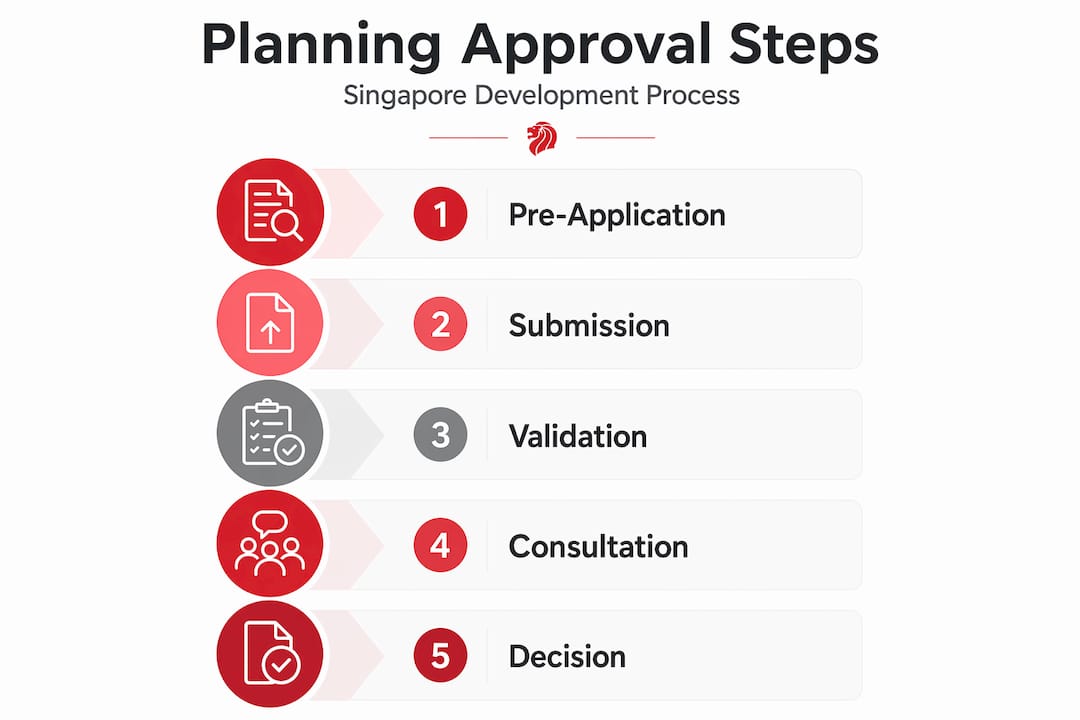
The standard consultation period is 21 days, during which neighboring landowners, statutory agencies, and designated consultees can submit representations. These agencies include PUB (drainage and water), LTA (transport and road access), SCDF (fire safety and emergency access), and NEA (environmental considerations), among others.
How feedback influences assessment
Planning officers synthesize all received feedback against the relevant planning policies, including the URA Master Plan, design guidelines, and development control parameters. Objections from neighbors regarding overlooking, overshadowing, or traffic impact are weighed against policy provisions. Where objections are material and supported by policy, officers typically impose conditions or request design modifications rather than refusing the application outright.
Developers who engage consultancy support during this phase are better positioned to respond to officer queries quickly and prepare pre-emptive responses to anticipated objections. Response speed matters. Delays in addressing officer queries extend the determination timeline and, in complex cases, can trigger escalation to higher-level review.
Developers should treat the public consultation phase as an active management task, not a passive waiting period. Proactive engagement with objecting parties and early submission of clarifications can prevent minor concerns from escalating into formal refusal grounds.
Criteria used in officer evaluations
Officers assess applications against multiple criteria simultaneously, including land use compatibility, built form and urban design, infrastructure capacity, environmental performance, and compliance with development control rules. A well-prepared planning statement that directly addresses each of these criteria reduces the volume of officer queries and shortens the assessment cycle.
Final decision, conditions, and post-approval steps
The planning authority issues one of three outcomes: approval with conditions, refusal, or a request for further information before a determination is made. Understanding these outcomes and the obligations attached to each is where many developers encounter unexpected complications.
Delegated decisions versus committee review
Most planning applications (90 to 95 percent) are decided by officers under delegated powers, with only significant or contested applications referred to higher-level review panels. In Singapore’s regulatory context, major infrastructure projects, developments on sensitive land, or applications attracting substantial public interest may require additional layers of approval beyond the standard officer decision. Developers should confirm at the pre-application stage whether their project is likely to follow the delegated or elevated review pathway, as this affects timeline planning.
Understanding and discharging approval conditions
Conditions attached to planning approvals fall into two categories. The first category covers pre-commencement conditions, which must be fully discharged before any physical works begin on site. The second covers ongoing or post-occupancy conditions, which govern how the completed development operates. Starting construction before discharging pre-commencement conditions invalidates planning permission entirely, a risk that carries severe financial and legal consequences.
Common pre-commencement conditions in Singapore include:
- Submission and approval of detailed structural and geotechnical reports
- Approval of a construction traffic management plan by LTA
- Discharge of drainage reserve requirements by PUB
- Submission of a fire safety plan approved by SCDF
- Confirmation of building hoarding and site boundary demarcation
Each condition discharge is a separate application to the relevant authority, and each carries its own processing timeline. Developers must program condition discharges as concurrent workstreams rather than sequential tasks to avoid unnecessary delays between receiving planning approval and commencing construction.
Permission validity and appeal rights
Planning permissions typically expire three years after grant if development does not commence. Developers managing multiple sites or long-horizon projects must track permission expiry dates actively and submit renewal or extension applications before lapse. Additionally, building regulations approval is separate from planning permission. Receiving planning consent does not authorize commencement of construction. Building plan approval from BCA is required independently, confirming that the proposed construction meets structural, fire safety, and technical standards under the Building Control Act.
For applications that receive a refusal, developers have the right to appeal. Under updated guidance, appellants must respond to draft planning conditions within 7 days when engaging the appeals process. Missing this window can prejudice the appeal outcome. Reviewing the BCA Building Control Act updates is advisable before filing any appeal relating to building plan decisions.
My perspective on navigating Singapore’s planning approvals
I have worked with developers at every scale, from landed residential projects to large commercial developments, and the pattern I see most consistently is this: the projects that move fastest are never the ones with the simplest proposals. They are the ones where the developer invested serious time in preparation before submission.
The instinct to submit quickly to “get the clock started” is understandable but counterproductive. If your application fails validation, the clock never starts. Worse, you have signaled to the reviewing officers that your documentation is weak, which affects the tone of subsequent officer engagements. What I have found works is treating the pre-application phase as a full project stage with its own deliverables, timeline, and budget.
I have also seen developers underestimate the complexity of post-approval compliance. Approval is not the finish line. The condition discharge phase demands the same rigor as the original submission. Developers who understaff this phase routinely find themselves holding a valid planning permission they legally cannot act on because pre-commencement conditions remain open.
The other misconception worth addressing directly: planning permission and building plan approval are not the same thing. Securing one does not substitute for the other. Both are mandatory, and both require independent preparation. Understanding authority approvals for construction as a multi-track process rather than a single sequential path is one of the more practical shifts in mindset a developer can make.
— Aman
How Aman Engineering Consultancy can support your approval journey
Navigating Singapore’s planning and regulatory requirements demands technical precision, agency-specific knowledge, and disciplined documentation management at every stage.
Com provides end-to-end consultancy support across all phases of the planning approval process, from pre-application strategy and documentation preparation through submission, validation management, and condition discharge. The team’s expertise spans URA, BCA, SCDF, PUB, LTA, and JTC approvals, covering structural, facade, M&E, fire safety, and BIM-supported design workflows that align with Singapore’s current regulatory standards. For developers seeking to optimize design outcomes within regulatory parameters, Com’s value engineering services identify cost and compliance efficiencies without compromising approval prospects. Contact Aman Engineering Consultancy to discuss your project’s specific requirements and secure the technical support needed to move from planning to construction without delay.
FAQ
What are the main stages of the planning approval process?
The planning permission process involves six key stages: pre-application advice, formal submission, validation, public consultation, officer assessment, and final decision. Each stage carries distinct documentation requirements and timelines.
How long does planning approval take in Singapore?
Statutory determination periods are 8 weeks for minor applications and 13 weeks for major developments, measured from the date of successful validation, not submission. Complex projects involving multiple agencies or requests for additional information may take longer.
What happens if I start construction before discharging conditions?
Starting construction before all pre-commencement conditions are discharged invalidates the planning permission entirely. Each condition must receive formal approval from the relevant authority before any physical works commence on site.
Is planning permission the same as building plan approval?
No. Planning permission and building plan approval are two separate regulatory requirements. Planning permission governs land use and built form, while building plan approval from BCA confirms compliance with structural, fire safety, and technical construction standards.
Can a planning permission expire before I start construction?
Yes. Planning permissions typically expire three years after the grant date if development has not commenced. Developers must track expiry dates and apply for renewals or extensions before lapse to avoid restarting the full application process.