
The 60:40 Rule: How to Ensure Your JTC Unit Complies with Industrial Use Quantum
Meta Title: The 60:40 Rule: Ensure Your JTC Unit Complies with Industrial Use Quantum
Meta Description: Discover how to ensure your JTC unit complies with industrial use quantum. Learn about the 60:40 rule, JTC compliance, and URA guidelines.
Focus Keyphrase: JTC Unit Complies with Industrial Use Quantum
Tags: The 60:40 Rule, JTC Compliance, Industrial Use Quantum, Singapore Real Estate, URA Guidelines, Gross Floor Area, Land Betterment Charge
Introduction to Industrial Space Regulations
Singapore faces severe physical land constraints. Consequently, the government meticulously regulates all land utilization. The Urban Redevelopment Authority establishes strict zoning laws.
These laws govern industrial space utilization across the nation. Furthermore, the Jurong Town Corporation enforces these regulations across its properties. JTC ensures industrial land supports core economic activities. Therefore, businesses cannot convert factories into cheap commercial offices.
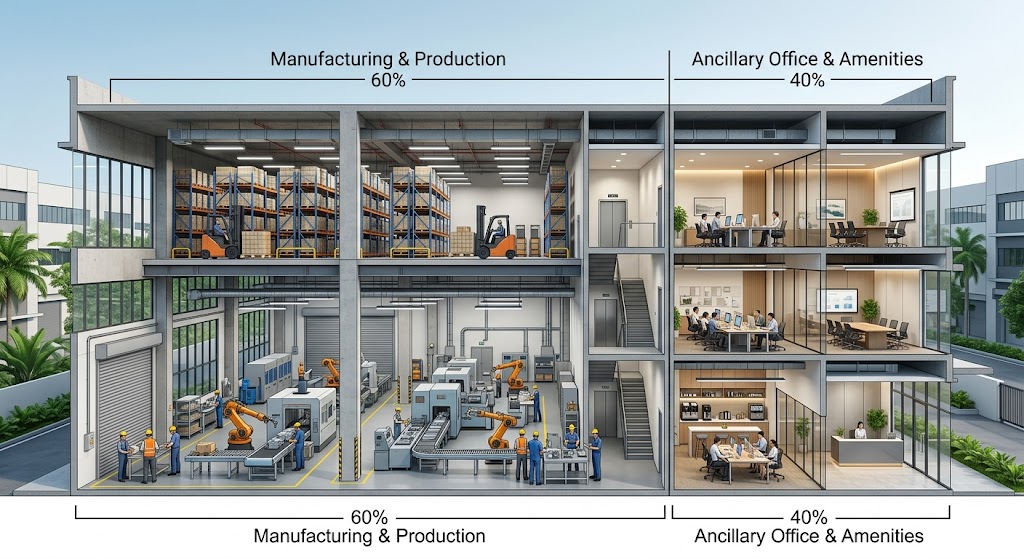
The 60:40 rule represents the most critical compliance framework. This regulation dictates the specific industrial use quantum for properties. It prevents the misuse of subsidized industrial spaces.
Accordingly, property owners must understand these intricate regulations. Non-compliance triggers severe financial and operational penalties. This report provides an exhaustive analysis of JTC compliance protocols. Furthermore, it details the nuances of the 60:40 rule. It also explores recent legislative shifts impacting industrial real estate.
Fundamental Principles of the Space Utilization Rule
The 60:40 rule governs space allocation within industrial buildings. Specifically, it applies to industrial developments and business parks.1
The policy mandates a strict division of Gross Floor Area. This ensures that your JTC unit complies with industrial use quantum.
The Predominant Industrial Component
At least 60 percent of the total space must serve core activities. This predominant component safeguards industrial productivity.2 Acceptable core activities vary based on the specific zoning designation.
However, they generally include manufacturing, assembly, and production.1 Furthermore, warehousing and logistics operations qualify as core activities. Research and development facilities also meet the criteria.1
Additionally, specific modern trades qualify under the 60 percent quantum. Clean and light industries easily meet this requirement.1
Heavier manufacturing operations fulfill the requirement in appropriate zones.1 Core media activities represent a specialized acceptable use. These include pre-production, broadcasting, and audio engineering facilities.3
Furthermore, approved e-business operations satisfy the predominant use quantum. Examples include data centers, software development, and telecommunications infrastructure.3
Businesses can utilize their entire space for core activities. A 100 percent core utilization rate is entirely permissible.1 This occurs when ancillary support functions remain unnecessary.
The Ancillary Support Component
The remaining area constitutes the ancillary component. This secondary space cannot exceed 40 percent of the total area.4 Furthermore, ancillary spaces must directly support the core industrial operations.5 Standalone commercial operations remain strictly prohibited within this quantum.6
Allowable ancillary uses include essential administrative offices. Human resource, finance, and sales departments operate here.1 Staff amenities also fall under this restrictive 40 percent cap.
This includes pantries, meeting rooms, and internal training facilities.7 Additionally, companies may establish specialized ancillary display areas. These spaces display products directly linked to the company.1
However, these display areas face specific operational restrictions. They cannot function as traditional retail storefronts.3
Communal facilities and neutral areas also consume the ancillary quantum.4 Therefore, meticulous space planning remains essential during property development.
Zoning Classifications: Business 1 Versus Business 2
The Urban Redevelopment Authority divides industrial land into distinct zones. The two primary categories are Business 1 and Business 2.
Each zone dictates permissible trades and environmental impact limits. Importantly, the 60:40 rule applies equally to both zones.5
Characteristics of Business 1 Zones
Business 1 zones cater to clean and light industries. These operations generate minimal environmental disturbances.5
Consequently, B1 developments often sit closer to residential areas. Examples include Tai Seng, Ubi, and Ang Mo Kio.5 The National Environment Agency mandates a 50-meter nuisance buffer.5 This buffer protects surrounding neighborhoods from industrial noise.
Permissible B1 trades include software development and electronics assembly.5 Printing, publishing, and non-hazardous warehousing also thrive here.5 Furthermore, light food packing operations qualify for B1 zoning.5
High-tech production and robotics represent emerging B1 sectors.5 Notably, B1 zones permit the establishment of childcare centers.5 These centers require specific approvals from relevant early childhood agencies.5
Characteristics of Business 2 Zones
Business 2 zones accommodate general and heavy industrial operations. These activities inherently produce higher environmental impacts.5
Therefore, B2 zones require a larger 100-meter nuisance buffer.5 These developments sit in peripheral industrial estates. Prominent B2 locations include Tuas, Pioneer, and Senoko.5
Permissible B2 trades involve significant machinery and fabrication.5 Automotive repair workshops and metal fabrication facilities operate here.5 Additionally, B2 zones house chemical processing and biotech plants.5
Heavy warehousing and logistics infrastructure also require B2 zoning.5 Marine and oil utility infrastructure fall under this classification.5 Crucially, authorities strictly prohibit childcare centers within B2 zones.5 This prohibition prioritizes public safety in hazardous environments.
| Feature | Business 1 Zone | Business 2 Zone |
| Environmental Impact | Minimal impact; clean industries | Higher impact; heavy industries |
| NEA Nuisance Buffer | Up to 50 meters | Minimum 100 meters |
| Typical Locations | Tai Seng, Ubi, Ang Mo Kio | Tuas, Pioneer, Senoko |
| Allowable Trades | Software, electronics, light packaging | Metal fabrication, chemical processing |
| Childcare Centers | Permitted (with agency approval) | Strictly Prohibited |
| Usage Quantum | 60:40 Rule Applies | 60:40 Rule Applies |
Gross Floor Area Harmonization and Space Planning
Regulatory frameworks governing floor space continuously evolve. A monumental shift occurred in September 2022.
Multiple government agencies harmonized their floor area definitions.8 Previously, different agencies utilized conflicting measurement methodologies. This created significant confusion during compliance audits.
The Mechanics of Harmonization
The new harmonization framework standardizes Gross Floor Area calculations. Currently, floor areas are measured to the midpoint of walls.8
This specific metric replaces previous full-thickness external wall measurements.8 Furthermore, all strata areas now count toward the total GFA.8 This inclusion encompasses private balconies and roof terraces.8
Crucially, private air-conditioning ledges now consume GFA allocations.8 Conversely, the new rules completely exclude internal void spaces.
Double-height ceilings no longer inflate the sellable floor area.8 Buyers no longer pay for essentially empty vertical space.8
Mathematical Impact on the 60:40 Quantum
This harmonization profoundly impacts industrial space planning. The fundamental compliance equation remains structurally unchanged. However, the variables within the equation have shifted. The inclusion of air-conditioning ledges inflates the total GFA denominator. Consequently, developers must allocate slightly more core industrial space.
This ensures the overall fraction remains above 60 percent. Furthermore, this policy forces developers to prioritize architectural efficiency.8
Non-functional architectural features now actively penalize compliance margins. Therefore, future industrial units will feature highly utilitarian designs. Planners must scrutinize every square meter of proposed developments.
Navigating Subletting Regulations Within Industrial Premises
Industrial tenants often experience fluctuating space requirements. Consequently, JTC permits subletting under strictly controlled conditions.
However, unauthorized subletting remains a severe compliance violation.9 The regulations differentiate between related and non-related business entities.10
Subletting to Non-Related Businesses
Lessees may sublet excess space to non-related external entities. However, this action faces a strict 30 percent GFA cap.11 This provision assists businesses during temporary economic downturns.
Because it serves temporary needs, the maximum lease term is limited. Non-related sublease agreements cannot exceed three years.10 Alternatively, they end upon the master lease expiry, whichever occurs earlier.10
Crucially, subletting open land remains strictly prohibited.10 Subletting spaces purely for standalone commercial office use is forbidden.10
The subtenant’s office functions must support manufacturing operations onsite.10 Furthermore, subtenants must strictly adhere to the overarching 60:40 rule.10
Subletting to Related Businesses
Regulations provide greater flexibility for related corporate entities. A business is related if ownership exceeds a 50 percent threshold.10
Specifically, the lessee must own over half of the subtenant’s shares.10 Alternatively, the subtenant must own over half of the lessee’s shares.10
Subletting to related businesses bypasses the 30 percent GFA limitation.10 Furthermore, the lease duration can match the remaining master lease term.10 However, lessees must still obtain formal JTC approval before proceeding.10
Application Procedures and Penalties
Applicants must submit detailed floor plans during the approval process.10 These plans must clearly demarcate the intended sublet zones.10
Failure to secure prior approval triggers immediate punitive measures. JTC reserves the right to terminate the master tenancy entirely.10
Alternatively, JTC may impose severe financial penalties. Unauthorized sublet fees can reach 100 percent of the assessed rent.10 Therefore, proactive compliance tracking remains an operational necessity.
Mezzanine Floor Regularization and Compliance
Industrial tenants frequently require additional operational space. Expanding vertically via mezzanine floors presents a viable solution.12 However, mezzanine installations face rigorous regulatory scrutiny. Unauthorized structural additions pose extreme safety and compliance risks.13
JTC Specific Controls and Limitations
JTC restricts the maximum coverage of mezzanine structures. Generally, mezzanines cannot exceed 50 percent of the floor plate.14
Furthermore, these structures must meet strict height requirements. A minimum floor-to-floor height of 4.5 meters is generally mandated.14
Crucially, mezzanine spaces generally do not consume Gross Plot Ratio.14 This exemption provides significant value to property owners.
However, this allowance varies based on the specific development type.14 Project-by-project verification remains an absolute necessity.14
Structural Independence and Core Compliance
Mezzanine installations must maintain absolute structural independence.14 They cannot rely on the building’s primary structural framework for support.14
Industrial mezzanines handle heavy loads from manufacturing or warehousing.14 Therefore, engineering standards mandate heavy-duty construction techniques.14
Industrial zones are designed for heavy live loads. These loads typically reach 7.5 kilonewtons per square meter.15 Furthermore, mezzanine usage must align with the 60:40 rule.
Tenants often attempt to convert mezzanines into pure office spaces. This practice rapidly violates the maximum 40 percent ancillary allowance.9 Continuous usage monitoring prevents inadvertent zoning violations.
The Regularization Approval Process
Mezzanine regularization is a complex, multi-stage administrative procedure.16 Property owners must engage a certified Qualified Person (QP).16
The QP ensures absolute compliance with prevailing building codes.16
The submission process requires extensive documentation. Applicants must provide detailed structural calculations and financial statements.16
Submissions traverse through the Building and Construction Authority (BCA). The Singapore Civil Defence Force (SCDF) also evaluates fire safety protocols.13 Regularization prevents costly demolition orders and ensures workplace safety.
The Space Submission Handbook Requirements
JTC governs facility fit-out works through the Space Submission Handbook. Version 6.0 introduced comprehensive restructuring for improved readability.17 This handbook dictates the exact documentation required for various installations.
Air Conditioning and Mechanical Ventilation
Installing Air Conditioning and Mechanical Ventilation (ACMV) requires rigorous documentation. Tenants must submit detailed site and location plans.18
Layout plans must indicate specific equipment locations.18 These plans must show chilled water lines and refrigerant pipes.18 Furthermore, condensate drainpipes must be clearly marked.18
Applicants must provide sizes and weights of the equipment.18 Fixing details to structural elements are absolutely mandatory.18
A Professional Engineer (Civil) must provide structural calculations.18 The PE must officially endorse the submitted plans.18
Additionally, tenants must submit the specific air conditioning catalogue.18 Schedules must indicate efficiency and chilled water consumption rates.18
Exemptions from QP Endorsements
List C of the handbook details specific submission exemptions. Certain minor works do not require a QP endorsement.19
For example, installing small signages requires no endorsement.19 The signage must simply be smaller than 10 square meters.19 It must not be installed on a partition wall.19
Erecting partition walls is also exempt under specific conditions.19 The walls must not infringe upon established fire codes.19 They must not exceed the maximum allowable floor loading.19 Laying telecom or fiber cables enjoys similar exemptions.19 However, the cables must remain within common corridors or lift lobbies.19 They must not tamper with existing structural floor slabs.19
Specialized Building Obligations
List D outlines buildings featuring Performance-Based Design (PBD).19 Submissions for these buildings require special declarations.
The QP must declare that proposals will not affect the PBD.19 Affected buildings include the JTC Summit and JTC Food Hub.19 The JTC Chemicals Hub also falls under this strict category.19
List E details buildings with Green Building Obligations.19 Any installed mechanical equipment must comply with these green standards.19
CleanTech One and CleanTech Two enforce these stringent environmental rules.19 Fusionopolis One and JTC nanoSpace also maintain these obligations.19
Change of Use Procedures and Protocols
Industrial businesses occasionally shift their operational focus. This shift may necessitate changing the property’s designated use. However, unauthorized conversions trigger immediate enforcement actions.6 A formalized Change of Use application mitigates these severe regulatory risks.3
Initial Assessment and Agency Clearances
Applicants must first determine if planning permission is required. Changes between different Use Classes inherently demand formal approval.3
Prior to submitting a URA application, businesses need preliminary agency clearances. These are termed In-Principle No Objections (IPNOs).3
The National Environment Agency assesses potential pollution and environmental impacts.3 The Land Transport Authority evaluates projected traffic generation increases.3
The SCDF reviews fire safety escape routes and hazard mitigation.3 Obtaining these IPNOs concurrently accelerates the overall approval timeline.3
The Urban Redevelopment Authority Evaluation
Following IPNO acquisition, the formal URA evaluation begins. Applications are submitted electronically via the GoBusiness Singapore portal.3 The URA exacts a non-refundable processing fee of $500.3
During evaluation, the URA scrutinizes the 60:40 rule compliance.3 The proposed usage must maintain the requisite industrial predominance.
Furthermore, the new use must integrate seamlessly with surrounding industries.3 The URA typically issues a decision within ten working days.3 However, complex cases may require several months for complete resolution.3
Strategic Prohibitions During Evaluation
Applicants face strict operational prohibitions during the evaluation period. JTC strongly advises against executing new tenancy agreements prematurely.3
Furthermore, commencing renovation works before approval remains strictly forbidden.3 Premature actions risk severe capital losses if authorities reject the application.
Additionally, JTC may mandate an Environmental Site Assessment.3 This assessment verifies that past operations did not contaminate the soil.
Consequently, the entire change of use process requires meticulous strategic planning.
Land Transport Authority Traffic Assessments
Certain changes of use require specific Land Transport Authority forms. The LTA evaluates how new developments impact surrounding traffic grids.
This evaluation prevents industrial estates from suffering severe traffic gridlock.
The General Land Use Proposal Form
The LTA requires a General Planning Information Form for major proposals.3 This form demands a detailed breakdown of planning parameters.3 Applicants must compare existing conditions directly against proposed conditions.3
Metrics include site area, land use zoning, and total GFA.3 Furthermore, applicants must detail the number of vehicle parking lots.3 Loading and unloading bays must also be explicitly quantified.3
The form requests specific worker and visitor population estimates.3 Applicants must define the number of work shifts and hours.3 This data allows the LTA to model human traffic accurately.
Traffic Projections and Vehicle Classifications
The most critical section involves hourly traffic projections.3 Applicants must quantify traffic flow in vehicles per hour.3
The LTA mandates evaluation during specific daily peak periods.3 The morning peak evaluates the busiest hour between 0630 and 0930.3 The evening peak evaluates the busiest hour between 1700 and 1930.3
Projections must categorize vehicles by specific functional types.3 These include motorcycles, cars, and private hire vehicles.3 Light Goods Vehicles (LGV) represent 2-axle goods vehicles like vans.3 Heavy Goods Vehicles (HGV) represent vehicles with more than 2 axles.3
Examples include heavy lorries and large commercial trailers.3 Private buses and coaches must also be accurately tracked.3 If LGVs transport workers, specific drop-off locations must be identified.3
SCDF Petroleum and Flammable Materials Licensing
Many industrial operations require hazardous chemical storage. The Singapore Civil Defence Force tightly regulates these dangerous materials. Securing a Petroleum and Flammable Materials (P&FM) storage license is mandatory.3
Classification of Petroleum Products
The SCDF classifies petroleum based strictly on specific flashpoints.3 Class 0 encompasses extremely volatile Liquefied Petroleum Gas.3 Class I includes hydrocarbons with a flashpoint below 23 degrees Celsius.3 Class II includes hydrocarbons with a flashpoint between 23 and 60 degrees.3 Class III involves hydrocarbons with a flashpoint above 60 degrees.3 Diesel represents the primary licensable Class III product.3
Flammable Materials and Exemptions
Beyond petroleum, the SCDF regulates 378 groups of flammable chemicals.3 These chemicals are listed in the Fourth Schedule of the regulations.3 The SCDF reviews this comprehensive list periodically to address emerging threats.3
However, specific common products enjoy complete licensing exemptions.3 These exemptions apply if they lack scheduled Fourth Schedule chemicals.3
Exempted products include common adhesives and portable gas lighters.3 Cosmetic products and beverages also avoid these strict regulations.3 Furthermore, everyday paints, lubricants, and medicines remain exempt from licensing.3
| P&FM Classification | Technical Description | Regulating Authority |
| Class 0 | Liquefied Petroleum Gas (LPG) | SCDF |
| Class I | Flashpoint below 23°C | SCDF |
| Class II | Flashpoint between 23°C and 60°C | SCDF |
| Class III | Flashpoint above 60°C (e.g., Diesel) | SCDF |
| Exemptions | Adhesives, cosmetics, beverages, paints | None (if unscheduled) |
Environmental Site Assessments
JTC mandates Environmental Site Assessments (ESA) during critical transitions. These transitions include lease renewals or significant changes of use.3 The ESA ensures industrial activities have not poisoned the underlying soil.
Baseline and Exit Assessments
Tenants must establish baseline ESA values when assuming a lease. When departing, an exit ESA determines the extent of contamination. If contamination exists, the new ESA values supersede previous baseline values.20
Remediation is mandatory if contamination exceeds acceptable established standards. During remediation testing, consultants cannot merely retest exceeded contaminants.20 They must comprehensively retest all potential contaminants across affected boreholes.20 This strict protocol prevents any hazardous materials from escaping detection.
Certification and Reporting
Remediated sites require official certification by an ESA specialist.20 The specialist must declare the site meets all required standards.20 Furthermore, they must state the certification represents an unbiased assessment.20
The final ESA report contains numerous mandatory analytical components.20 It must detail the exact objectives and work scope executed.20
It must outline the client’s historical business operations comprehensively.20 Furthermore, the report must include detailed site background information.20 This includes topography, geology, hydrology, and surrounding land uses.20
The Land Betterment Charge: Financial Implications
Changing a property’s use often enhances its fundamental economic value. The Singaporean government captures a portion of this enhanced value. This value capture occurs via the Land Betterment Charge (LBC).21 The LBC represents a critical financial consideration for property developers.
Evolution of Value Capture Mechanisms
The Land Betterment Charge Act commenced in August 2022.21 This legislation consolidated previous disparate land charge systems.5 It effectively replaced the legacy Development Charge regime.22
It also superseded the Temporary Development Levy and Differential Premium systems.5 The Singapore Land Authority now centralizes the administration of these charges.21 This consolidation streamlines the bureaucratic process for developers and owners.
Valuation Methodology and Calculation
The LBC operates as a direct tax on land value increases.22 These increases stem from favorable planning permissions or authorized developments.22 The SLA calculates the LBC using a specific Table of Rates.22
The calculation examines the post-chargeable versus pre-chargeable land valuation.22 The pre-chargeable valuation derives from the historically authorized development.22
The post-chargeable valuation reflects the newly approved intensive use.22 If the mathematical difference is positive, the SLA issues a Liability Order.22
Published Table of Rates Examples
The SLA updates the Table of Rates every six months.5 These rates vary wildly based on geographical sectors and use groups.
For example, Sectors 7 through 10 face specific financial levies.23 High-value commercial uses attract massive charges compared to standard industrial uses.
| Geographical Sector | High-Value Use Group Rate | Lower-Value Use Group Rate |
| Sector 7 | $13,650 | $875 |
| Sector 8 | $12,880 | $875 |
| Sector 9 | $13,650 | $875 |
| Sector 10 | $12,880 | $875 |
Payment Timelines and Strategic Impact
Taxable persons must settle the Liability Order rapidly. Payment is strictly due within one month of issuance.22 The LBC drastically impacts the financial feasibility of property conversions.
Converting a cheap factory into a lucrative commercial showroom triggers massive charges.3 Consequently, businesses must utilize LBC estimators during their preliminary financial modeling.21 Ignoring the LBC results in catastrophic budget overruns and project failures.
Specialized Industrial Space Configurations
The 60:40 rule accommodates various specialized operational spaces. However, these spaces face granular regulations beyond the basic percentage quantum. Understanding these nuances prevents inadvertent compliance breaches during facility fit-outs.
Industrial Showrooms and Retail Restrictions
Showrooms technically fall under the 40 percent ancillary allowance.3 However, they cannot operate as standard retail consumer storefronts.1
URA guidelines strictly define permissible showroom display items. Showrooms may only display bulky products requiring off-site delivery.3 Acceptable examples include large furniture, heavy machinery, or motor vehicles.3
Incidental sales of smaller items remain conditionally permissible. However, the primary focus must remain on bulky item display.3 Furthermore, showrooms are strictly confined to the first storey.3
Basements may also house showrooms under specific architectural conditions.24 Converting standard industrial space to a showroom attracts high LBC rates.3 The SLA assesses these spaces using Group A Commercial rates.3
Ancillary Display Areas
Ancillary display areas differ legally from formal showrooms. These areas display products directly manufactured during predominant operations.3 They serve corporate demonstration purposes rather than consumer retail.3 Consequently, direct on-premises sales to the general public remain forbidden.3 The SLA assesses these areas under cheaper Group D Industrial rates.3
The White Component Allowances
Certain industrial developments feature a flexible “White component”.3 This space may undergo strata-subdivision under specific conditions.3 In B1 developments, White uses can occupy separate buildings entirely.3 This is permitted provided there is absolutely no land subdivision.3
Allowable White component uses include shops, restaurants, and associations.3 Commercial schools and banking offices also operate within these zones.3
Furthermore, childcare centers and sports facilities find homes here.3 These flexible spaces enhance the overall vibrancy of industrial estates.
Worker Amenities and Dormitory Regulations
Industrial estates require infrastructure to support large worker populations. Food services and housing facilities face extremely detailed operational guidelines.
Industrial Canteens and Size Limitations
Industrial canteens provide essential food services to estate workers. These facilities face stringent size limitations. Canteen space cannot exceed 700 square meters.3 Alternatively, they cannot exceed 5 percent of the total GFA.3 The lower of these two metrics dictates the maximum allowable size.3 Authorities generally approve canteens on temporary five-year permissions.3
Temporary Workers’ Dormitories
Housing migrant workers within industrial premises requires meticulous compliance. Factory Converted Dormitories (FCDs) face intense regulatory scrutiny.
Dormitories are strictly prohibited in specific zones, including Business Parks.3 Furthermore, they are banned entirely in the Central Area.3
Approved dormitories must meet exact living space standards. The mandate requires a minimum of 4.2 square meters per resident.3
This metric encompasses both sleeping and associated living areas.3 Developers must provide en-suite toilets, dining areas, and recreational facilities.3 Additionally, dormitories must clear strict health and safety buffer zones.3
Dormitories accommodating 500 to 5,000 residents face commercial GFA limits.3 They receive a minimum of 0.10 square meters per resident.3
The maximum is 0.30 square meters per resident for commercial amenities.3 However, the total commercial GFA is strictly capped at 1,000 square meters.3
Mandatory Solar Deployment Requirements
Sustainability initiatives now directly impact JTC lease renewals. JTC enforces mandatory solar deployment under specific site conditions.25 Lessees cannot view this as an optional green initiative. It is a strict condition for lease renewal approval.25
Eligibility Thresholds
Before panicking, tenants must verify two critical operational thresholds.25 The site must possess at least 800 square meters of roof.25 Crucially, this roof space must be completely contiguous and usable.25 Fragmented sections separated by skylights or HVAC units do not count.25 Furthermore, the site must have 15 years remaining on its lease.25 If the site misses these thresholds, solar deployment becomes purely voluntary.25
Deployment Models and Timelines
JTC recognizes three practical models for solar deployment execution.25 Tenants can choose zero-CAPEX solar leasing via third parties.25 Alternatively, they can utilize rooftop licensing or direct ownership models.25
Tenants must commence this process 12 months before the renewal deadline.25 This avoids severe delays that could jeopardize the entire lease approval.25 The process necessitates exhaustive structural and electrical audits.25 Ultimately, proposed plans must be submitted during the endorsement phase.25
Regulatory Audits, Inspections, and Penalties
JTC and the URA continuously monitor industrial estates. They deploy robust enforcement mechanisms to ensure strict compliance. Ignorance of the 60:40 rule does not constitute a valid legal defense.
Proactive Inspection Regimes
Authorities do not rely solely on third-party whistleblowers. JTC conducts systematic, unannounced spot checks across its properties.26
Inspectors physically verify that spatial allocations match approved floor plans. They scrutinize the operations occurring within the 40 percent ancillary spaces.
Furthermore, building owners face the Periodic Structural Inspection (PSI) regime.15 Qualified structural engineers inspect aging industrial buildings.
These inspections uncover unauthorized heavy machinery on unauthorized mezzanine levels.15 Consequently, structural audits frequently expose underlying spatial usage violations.
Financial Penalties and Criminal Liability
Non-compliance transcends simple administrative lapses; it constitutes a criminal offense.15 Failure to rectify usage violations invites severe statutory penalties. Upon conviction, owners face fines reaching up to $20,000.15 Furthermore, offenders risk imprisonment for up to 12 months.15
The financial pain compounds if the violation continues post-conviction. Authorities levy continuing offense fines of up to $500 daily.15 JTC also wields absolute contractual power over lease agreements.
Severe breaches allow JTC to unilaterally terminate the master lease.27 They can recover the land without offering financial compensation.10 Therefore, maintaining continuous compliance protects the fundamental business asset.
Case Study Analysis: The Cost of Non-Compliance
Theoretical regulations manifest harshly in real-world enforcement scenarios. A recent enforcement action highlights the danger of ignoring URA guidelines. The case of My Digital Lock demonstrates the severe consequences of unauthorized usage.24
The Unauthorized Showroom Expansion
My Digital Lock operated within A’ Posh Biz Hub in Yishun.24 The building sits on land zoned explicitly for industrial factory use.24
In 2022, the business operated an unauthorized showroom on the second floor.24 Following an initial enforcement notice, they relocated to the first floor.24
In March 2023, the owner submitted a formal land use application.24 They sought to officially convert the industrial space into a commercial showroom.24 The URA conditionally approved the change, pending LBC payment.24
The Land Betterment Charge Dispute
The Singapore Land Authority calculated the required Land Betterment Charge. The invoice demanded over $260,000 per unit to authorize the commercial use.24 The total financial demand approached $500,000.28 This staggering figure reflected the vast difference between industrial and commercial land values.
The business owner found the charges exorbitant and refused payment.24 Consequently, the URA officially rejected the change of use application in April 2023.24
Enforcement Action and Business Closure
Despite the official rejection, the owner continued operating the showrooms.24 In September 2023, URA enforcement officers conducted a physical site inspection.24 They documented the illegal commercial operations occurring within the industrial zone.24
The URA issued a final, unyielding enforcement notice. The business faced a stark ultimatum: close the showrooms or face prosecution.24
Defiance carried risks of massive fines and potential jail time.28 Consequently, the owner shuttered the showrooms entirely in November 2023.24 This forced closure resulted in the resignation of multiple employees.24
This case study proves that authorities actively enforce the 60:40 rule. Furthermore, it demonstrates that LBC avoidance guarantees devastating enforcement actions. Ensure your JTC unit complies with industrial use quantum immediately.
Strategic Lease Renewal Considerations
Industrial leases in Singapore feature relatively short tenures. Master leases typically span 30 to 60 years.29 Therefore, lease renewal applications represent critical junctures for industrial businesses. JTC utilizes the renewal process to audit long-term compliance and economic value.4
Assessing Economic Contribution and Productivity
JTC does not automatically grant lease extensions. They rigorously evaluate the tenant’s overarching economic contribution to Singapore.4
The analysis examines the productivity of the specific industrial project.4 Furthermore, JTC assesses the creation of high-value technical jobs.4
Synergistic linkages to other critical economic sectors heavily influence the decision.4 JTC prioritizes businesses that optimize limited land resources.4
Consequently, inefficient operations occupying massive plots face severe renewal challenges.4 JTC may force inefficient users to consolidate their operations into smaller footprints.4
Plant and Machinery Investment Criteria
Capital expenditure heavily influences lease renewal outcomes. Specifically, JTC scrutinizes investments in qualifying Plant and Machinery (P&M).9 However, not all equipment purchases satisfy the stringent JTC criteria.9
Qualifying investments must directly support the core production process.9 Acceptable items include heavy manufacturing equipment, factory cranes, and warehouse racking.9 Furthermore, industrial-grade air-conditioning and production-linked computing systems qualify.9
Conversely, administrative assets fail the P&M qualification test. Standard office furniture and administrative computers do not count.9
Regular commercial vehicles also fail to meet the industrial investment threshold.9 Tenants frequently inflate their investment figures using these non-qualifying administrative assets.9 This inflation triggers immediate red flags during the JTC evaluation process.9
Usage Compliance Verification
During renewal, JTC comprehensively audits the historical 60:40 rule compliance.9 Many businesses inadvertently breach this rule over long periods.9
Gradual, undocumented office expansions slowly consume the core industrial footprint.9 Eventually, the ancillary space exceeds the absolute 40 percent limitation.
Unauthorized subletting remains a primary cause for lease renewal rejection.9 Therefore, proactive tenants conduct rigorous internal compliance audits years before renewal.9
They rectify zoning violations and remove unauthorized partitions beforehand. Pristine compliance records drastically accelerate the complex JTC lease extension process.30
Mastering Industrial Real Estate Compliance
Mastering JTC’s land policies transforms compliance from a burden into a strategic advantage. The 60:40 rule remains the absolute foundation of Singapore industrial real estate. Consequently, developers and tenants must internalize its mechanical nuances.
The 60 percent predominant quantum fiercely protects the nation’s industrial productivity capacity.
Simultaneously, the 40 percent ancillary allowance provides necessary administrative flexibility. Strict adherence to these distinct spatial boundaries prevents catastrophic regulatory interventions.
Furthermore, businesses must navigate the complexities of GFA harmonization and accurate measurement.
Utilizing mezzanines and subletting mechanisms requires meticulous coordination with regulatory bodies. Change of use applications demand intense financial modeling regarding Land Betterment Charges.
As demonstrated by recent enforcement actions, attempting to bypass these fees proves disastrous. Ultimately, continuous internal auditing ensures unassailable alignment with JTC and URA expectations.
Proactive compliance guarantees smooth lease renewals and uninterrupted industrial operations. By respecting these spatial boundaries, businesses secure their long-term footprint in Singapore.
Works cited
- What is URA 60:40 Rule? Do You Need to be Aware? – SpaceLookUp Singapore, accessed May 19, 2026, https://spacelookup.com.sg/what-is-ura-6040-rule/
- Usage Guidelines For JTC Premises – ALLIANCE FACILITIES MANAGEMENT PTE LTD, accessed May 19, 2026, https://www.afm.com.sg/jtc-policy-Site-Usage-update/usage-guidelines-for-jtc-premises
- Changing the use of your industrial property | JTC, accessed May 19, 2026, https://www.jtc.gov.sg/get-help/managing-your-tenancy-or-lease/changing-the-use-of-your-industrial-property
- Renewing Your Industrial Lease – JTC, accessed May 19, 2026, https://www.jtc.gov.sg/-/media/project/jtc-cx/corpweb/assets/get-help/lease_renewal_handbook.pdf
- B1 vs B2 Industrial Zones Difference per URA Guidelines, accessed May 19, 2026, https://spacelookup.com.sg/ura-b1-vs-b2-zones-difference/
- CEA Practice Circular 3/12 URA/PB/2012/08-DCG Tel, accessed May 19, 2026, https://isomer-user-content.by.gov.sg/71/391df595-dad7-4448-a03f-d62cb0e5504d/PC%2003-12%20-%20Misleading%20Marketing%20of%20Industrial%20Properties.pdf
- Industrial Property Investment: The Difference between B1 and B2 Industrial Properties – Proptiply, accessed May 19, 2026, https://www.proptiply.com.sg/industrial-property-investment-the-difference-between-b1-and-b2-industrial-properties/
- Singapore’s GFA Harmonization: A Game-Changer for Property …, accessed May 19, 2026, https://msingaporeproperty.medium.com/singapores-gfa-harmonization-a-game-changer-for-property-buyers-4e9e79cee86e
- Top 5 Reasons JTC Lease Renewal Applications Are Rejected (And How to Avoid Them), accessed May 19, 2026, https://jfstrategic.com/top-5-reasons-jtc-lease-renewal-applications-are-rejected-and-how-to-avoid-them/
- Subletting your premises – Singapore – JTC, accessed May 19, 2026, https://www.jtc.gov.sg/get-help/managing-your-tenancy-or-lease/subletting-your-premises
- SUBLETTING YOUR PREMISES – JTC, accessed May 19, 2026, https://www.jtc.gov.sg/-/media/project/jtc-cx/corpweb/assets/get-help/sublet_handbk_march2024.pdf
- Mezzanine Retention Authority Submissions – Stellar Structures, accessed May 19, 2026, https://structures.com.sg/mezzanine-retention-authority-submissions/
- Your complete guide to industrial building compliance in Singapore, accessed May 19, 2026, https://www.amanengineering.com.sg/industrial-building-compliance-guide-singapore/
- Mezzanine Submission and Retention – Aman Engineering …, accessed May 19, 2026, https://www.amanengineering.com.sg/mezzanine-authority-approval/
- Periodic Structural Inspection (PSI) for Industrial Buildings in Singapore: Regulations, Costs, and Smart Inspection Trends (2026 Edition), accessed May 19, 2026, https://structures.com.sg/periodic-structural-inspection-psi-for-industrial-buildings-in-singapore-regulations-costs-and-smart-inspection-trends-2026-edition/
- Mezzanine regularization for JTC properties – Stellar Structures, accessed May 19, 2026, https://structures.com.sg/mezzanine-regularization-for-jtc-properties/
- Space Submission Handbook PCP-WI-09 Version 6.0, Updated 25.04.2025 – JTC, accessed May 19, 2026, https://www.jtc.gov.sg/-/media/project/jtc-cx/corpweb/space-submission-handbook-v6.pdf
- Space Submission Handbook PCP-WI-09 Version 5.0, Updated 03.01.2022 1 – JTC, accessed May 19, 2026, https://www.jtc.gov.sg/-/media/project/jtc-cx/corpweb/space-submission-handbook.pdf
- space-submission-handbook.pdf – JTC, accessed May 19, 2026, https://www.jtc.gov.sg/-/media/project/jtc-cx/corpweb/assets/get-help/space-submission-handbook.pdf
- JTC Environmental Site Assessment (ESA) Requirements and Technical Guideline (2024 EDITION), accessed May 19, 2026, https://www.jtc.gov.sg/-/media/project/jtc-cx/corpweb/assets/get-help/jtc-environmental-site-assessment-requirements-and-technical-guideline-2024-edition-version-1.pdf
- #SLAExplains: Demystifying the Land Betterment Charge (LBC) | Singapore Land Authority, accessed May 19, 2026, https://www.sla.gov.sg/articles/demystifying-the-lbc/
- Land Betterment Charge | Singapore Land Authority, accessed May 19, 2026, https://www.sla.gov.sg/properties/land-betterment-charge/
- Revision of Land Betterment Charge Rates from 1 September 2025 | Singapore Land Authority, accessed May 19, 2026, https://www.sla.gov.sg/news/press-release/revision-of-land-betterment-charge-rates-from-1-september-2025/
- Digital lock business closes as owner can’t afford showroom’s S …, accessed May 19, 2026, https://mothership.sg/2023/12/digital-lock-store-closes-showroom-fee-exorbitant/
- What to do when solar Is mandatory for JTC lease renewal in Singapore – Eigen Energy, accessed May 19, 2026, https://www.eigen.energy/articles/jtc-solar-mandatory-lease-renewal-guide
- EX-10.1 – SEC.gov, accessed May 19, 2026, https://www.sec.gov/Archives/edgar/data/1500412/000119312526219341/ambq-ex10_1.htm
- JTC – APPENDIX 6 TO CONDITIONS OF TENDER DRAFT TENANCY/LICENCE OFFER Annex-6A, accessed May 19, 2026, https://www.jtc.gov.sg/-/media/project/jtc-cx/corpweb/assets/find-space/price-quality-tender/8-conditions-of-tender–appendix-6-draft-tenancy-offer.pdf
- My Digital Lock Fails To Fulfil S$500K Land Betterment Charges For Yishun Showroom – MustShareNews, accessed May 19, 2026, https://mustsharenews.com/my-digital-lock-land-charges/
- Industrial Property Classes and What They Mean For Investors – DBS, accessed May 19, 2026, https://www.dbs.com.sg/personal/articles/nav/my-home/industrial-property-classes
Strategic Mastery of JTC’s Land & Building Policy – JFStrategic, accessed May 19, 2026, https://jfstrategic.com/strategic-mastery-of-jtcs-land-building-policy/